Responding to climate change in southern Africa: the role of research
Projections show that the effects of climate change in Africa will not be uniform over the region. The region is extremely vulnerable to climate change because of poverty, a high pre-existing disease burden, fragmented health services and water and food insecurity. Despite the consensus that locally relevant information is necessary to inform policy and practice related to climate change, very few studies assessing the association between climate change and health in southern Africa have been conducted. More comprehensive information is therefore urgently needed for the southern African region to estimate the health risks from projected future changes in climate.
Responding to climate change in southern Africa : the role of research
J MyersI; T YoungII; M GallowayIII; P ManyikeIV; T TuckerV
IBSc, MB ChB, DTM&H, MD. Centre for Occupational and Environmental Health Research, School of Public Health and Family Medicine, University of Cape Town
IIMB ChB, PhD, FCPath (SA) Virol . Strategic Evaluation, Advisory & Development Consulting, Cape Town, and Division of Clinical Virology, Department of Clinical Laboratory Sciences, University of Cape Town
IIIMB ChB, MMed (PHM). Strategic Evaluation, Advisory & Development Consulting, Cape Town
IVMPhil (Journalism). Strategic Evaluation, Advisory & Development Consulting, Cape Town
VBPharm, MSc (Med). PhD Strategic Evaluation, Advisory & Development Consulting, Cape Town
Projections show that the effects of climate change in Africa will not be uniform over the region. The region is extremely vulnerable to climate change because of poverty, a high pre-existing disease burden, fragmented health services and water and food insecurity. Despite the consensus that locally relevant information is necessary to inform policy and practice related to climate change, very few studies assessing the association between climate change and health in southern Africa have been conducted. More comprehensive information is therefore urgently needed for the southern African region to estimate the health risks from projected future changes in climate.
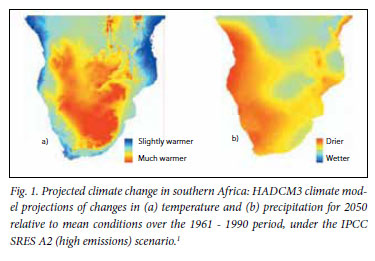
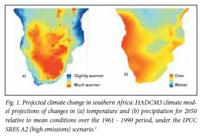
Evidence is that the southern African region (Fig. 1)1
The region is vulnerable to climate change because of poverty, a high pre-existing disease burden, fragmented health services, and water and food insecurity. Despite the consensus that locally relevant information is necessary to inform policy and practice related to climate change, very few studies assessing the association between climate change and health in southern Africa have been conducted.2-4 Existing research focuses on infectious diseases - particularly malaria. Little work has been done on attributing disease burden to climate change in the region. Furthermore, an overview of health considerations in the National Adaptation Programmes of Action for climate change in least-developed countries and small-island states found that health was not seen as a priority, as most activities focused on biodiversity and agricultural activities.5
The health effects of climate change are not uniform and will be influenced by local environmental conditions, socio-economic circumstances, the extent of adaptations implemented to minimise the full range of threats to health, and other modulating factors.67
Framework for responding to climate change
Corrective activities may be grouped into mitigation, adaptation, education and training, and raising awareness. Research is central to all these, as it will inform identification and assessment of effects, comparison of interventions, and determination of best practices.
Regarding mitigation, 5 African countries are responsible for most of Africa's greenhouse gas (GHG) emissions, with South Africa by far the greatest emitter, responsible for 39% of the continental total - making GHG emissions in the SADC region relatively higher than in other regions of Africa.8
Adaptation needs to be underpinned by surveillance for climaterelated health risks9
Mitigation and adaptation interventions should be monitored and evaluated for effectiveness and efficiency.
Climate change and health should be incorporated as part of undergraduate and postgraduate public health education curricula, and appropriate training packages developed. Special efforts should be made to recruit trainees from areas at greatest risk from the health effects of climate change.
Awareness should be raised through informing, educating and empowering the public at large, along with policymakers and all relevant stakeholders about the health risks of climate change as well as primary and secondary prevention strategies which can reduce the impact.
Research in support of adapting to climate change
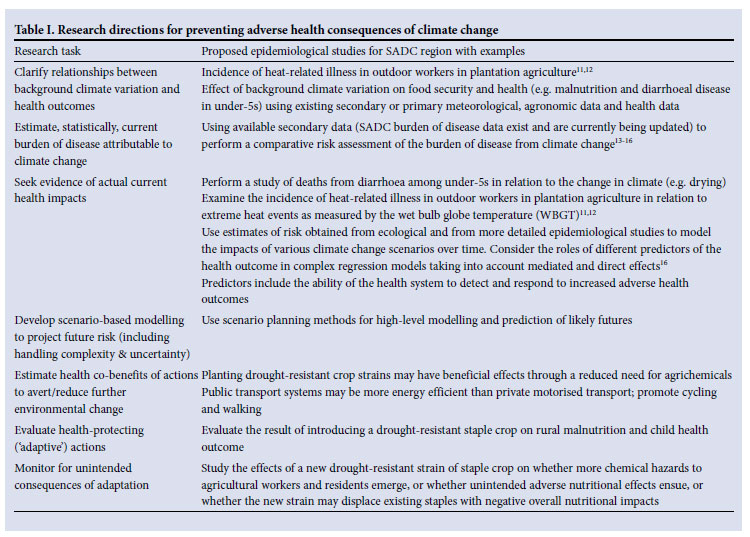
Research should aim to facilitate the reduction of both global and local climate change health risks via aetiological studies, risk assessments, scenario planning of likely future health risks, and evaluation of adaptive interventions. More comprehensive information is needed for the southern African region to estimate the health risks from projected future changes in climate. Epidemiological studies are needed to identify climate-health relationships, to quantify them, and to identify high-risk groups or communities. Table I provides a framework for research provided by McMichael.10
To gain a more complex understanding from epidemiological modelling, it is important to incorporate confounding or interacting, non-climate variables. Scenario planning should incorporate information about trends in other determinants of health outcomes for which future extrapolations are considered feasible (e.g. demographic trends in age structures); likely future contextual conditions (e.g. uptake of domestic air-conditioning by 2050); the advent of relevant vaccines and likely consequent population immunity levels; and deliberate 'adaptive' changes (e.g. mosquito control programmes, heat-wave warning systems, flood protection measures).
The health sector itself requires research attention as a result of the environmental effect of resource use and waste generation, and the need for sustainable health sector practices. Health economic analysis of climate-related health impacts, along with research into communication strategies for climate-related health issues, is an important research focus.
Pressing action and research priorities include the assessment of the climate-related burden of disease in southern Africa, and the identification of appropriate adaptations for which there is existing evidence of effectiveness and cost-efficiency elsewhere, particularly parts of the globe with similar climate-change scenarios.
References
- 1. Scholes RJ, Biggs R. Ecosystem Services in Southern Africa: A Regional Assessment. 2004. Pretoria: Council for Scientific and Industrial Research, 2004.
- 2. Byass P. Climate change and population health in Africa: where are the scientists? Global Health Action 2009. DOI: 10.3402/gha.v2i0.2065.
-
3. Dube OP, Chimbari MJ, on behalf of DBL - Centre for Health Research and Development Faculty of Life Sciences, University of Copenhagen, Denmark. Documentation of Research on Climate Change and Human Health in Southern Africa. July 2009. http://www.ddrn.dk/filer/forum/File/Climate_change_and_human_health_in_SADC_region_July09.pdf (accessed 5 October 2010).
» http://www.ddrn.dk/filer/forum/File/Climate_change_and_human_health_in_SADC_region_July09.pdf - 4. Ramin BM, McMichael AJ. Climate change and health in sub-Saharan Africa: a case-based perspective. EcoHealth 2009. DOI: 10.1007/s10393-009-0222-4.
- 5. Manga L, Bagayoko M, Meredith T, Neira M. Overview of Health Considerations within National Adaptation Programmes of Action for Climate Change in Least Developed Countries and Small Island States. Geneva: WHO, 2010.
- 6. Frumkin H, McMichael AJ. Climate change and public health: thinking, communicating, acting. Am J Prev Med 2008;35(5):403-410. DOI:10.1016/j.amepre.2008.08.019
- 7. Parry M, Canziani O, Palutokof J, et al., eds. Impacts, Adaptation and Vulnerability. Contribution of Working Group 2 to Fourth Assessment Report of IPCC. Cambridge: Cambridge University Press, 2007.
-
8. http://www.eia.gov/countries/ (accessed 1 September 2010).
» http://www.eia.gov/countries/ - 9. Myers J, Young T, Galloway M, Manyike P, Tucker T. A public health approach to the impact of climate change on health in southern Africa: identifying priority modifiable risks. S Afr Med J 2011;101:xxx-xxx. NB complete at page proof stage
- 10. McMichael AJ. Climate Change, Global Environmental Change, and Health: Context, Concepts and Research Tasks for Epidemiologists. Canberra: European Educational Programme in Epidemiology, 2010.
- 11. Kjellstrom T, Holmer I, Lemke B. Workplace heat stress, health and productivity an increasing challenge for low and middle-income countries during climate change. Global Health Action 2009. DOI: 10.3402/gha.v2i0.2047
- 12. Schulte PA, Chun H. Climate change and occupational safety and health: establishing a preliminary framework. J Occup Environ Hygiene 2009;6(9):542-554.
- 13. Campbell-Lendrum D, Woodruff R. Comparative risk assessment of the burden of disease from climate change. Environ Health Perspect 2006;114(12):1935-1941.
- 14. Lewin S, Norman R, Nannan N, Thomas E, Bradshaw D and the South African Comparative Risk Assessment Collaborating Group. Estimating the burden of disease attributable to unsafe water and lack of sanitation and hygiene in South Africa in 2000. S Afr Med J 2007;97:755-762.
- 15. Norman R, Bradshaw D, Schneider M, et al. A comparative risk assessment for South Africa in 2000: towards promoting health and preventing disease. S Afr Med J 2007;97(8):637-641.
- 16. Victora CG, Huttly SR, Fuchs SC, Olinto MT. The role of conceptual frameworks in epidemiological analysis: a hierarchical approach. Int J Epidemiol 1997;26(1):224-227.