Childhood behavioural and developmental disorders
Current maternal alcohol consumption, especially binge drinking, is strongly associated with childhood behavioural and/or developmental disorders (BDDs) in a population attending tertiary hospital ambulatory services. BDDs were also associated with maternal alcohol use 6 months before pregnancy. An association with BDDs could not be conclusively demonstrated for drinking during pregnancy, but this may have been influenced by underreporting and reduced study power due to misclassification of exposure. We cannot rule out the a priori suspicion that some mild BDDs in children in the Western Cape could be undiagnosed fetal alcohol spectrum disorder. Nonetheless, the study highlighted the important impact of current maternal alcohol use on behaviour and development of children. Future research on the impact of maternal alcohol use on childhood development should include examination of environmental and social factors contributing to this increased risk. Upstream interventions aimed at reducing alcohol-related harms may also contribute to reducing the burden of BDDs.
Childhood behavioural and developmental disorders - association with maternal alcohol consumption in Cape Town, South Africa
Elizabeth Katwan; Colleen AdnamsIII; Leslie LondonII
IMPH. Centre for Occupational and Environmental Health Research, School of Public Health and Family Medicine, University of Cape Town
IIMD, MB ChB, BSc Hons (Epidemiol), DOH, MMed (Public Health). Centre for Occupational and Environmental Health Research, School of Public Health and Family Medicine, University of Cape Town
IIIBSc, BScMed (Hons), MB ChB, FCPaed (SA). Department of Psychiatry and Mental Health, University of Cape Town
Current maternal alcohol consumption, especially binge drinking, is strongly associated with childhood behavioural and/or developmental disorders (BDDs) in a population attending tertiary hospital ambulatory services. BDDs were also associated with maternal alcohol use 6 months before pregnancy. An association with BDDs could not be conclusively demonstrated for drinking during pregnancy, but this may have been influenced by underreporting and reduced study power due to misclassification of exposure. We cannot rule out the a priori suspicion that some mild BDDs in children in the Western Cape could be undiagnosed fetal alcohol spectrum disorder. Nonetheless, the study highlighted the important impact of current maternal alcohol use on behaviour and development of children. Future research on the impact of maternal alcohol use on childhood development should include examination of environmental and social factors contributing to this increased risk. Upstream interventions aimed at reducing alcohol-related harms may also contribute to reducing the burden of BDDs.
To the Editor: Prenatal alcohol exposure can result in a range of permanent birth defects known as fetal alcohol spectrum disorders (FASD). Fetal alcohol syndrome (FAS), which adversely affects the neurodevelopmental, physical and social capabilities of children, is the most severe diagnosis in the FAS spectrum. Rates of FAS in the Western Cape have been reported as among the highest in the world.1 2,3
Research suggests that FASD may be misdiagnosed as attention deficit hyperactivity disorder (ADHD).4
Research on the prevalence of BDDs in South Africa is scarce. Retrospective studies on prenatal alcohol exposure have been conducted among mothers of children with FAS in South Africa,5,6 but there has been little research on the association between drinking during the gestational period and less severe forms of FASD presenting as BDDs.
Given the high prevalence of FASD7
Methods
Opportunistic sampling was employed to select parents or caretakers of 110 children aged 4 - 12 years for interviews at a tertiary children's public hospital in Cape Town, including 55 case children with BDDs drawn from selected developmental and behavioural disorder clinics and 55 controls, children without BDDs from the general outpatient population. To increase the likelihood of excluding confirmed cases of FASD, the age range chosen was one during which FAS is most accurately diagnosed.8
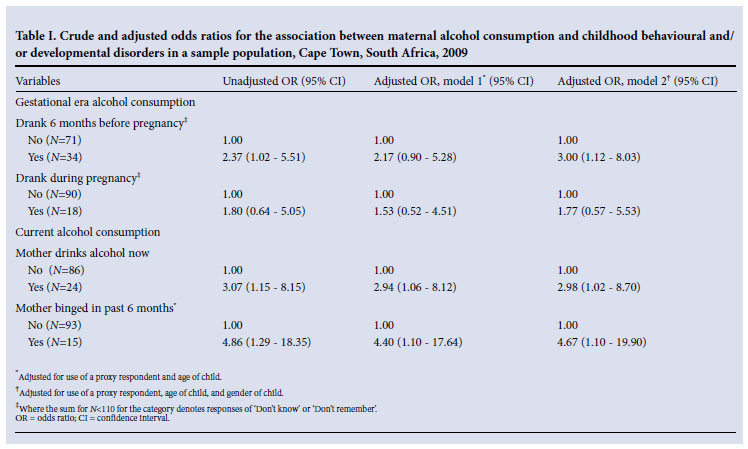
Clinic records were reviewed to identify eligible cases and controls to approach for interview while waiting to see a doctor. Consenting parents or caregivers of the children were interviewed in their first language. Additionally, adult respondents of control children answered screening questions regarding the child's behaviour and social aptitude to exclude undiagnosed BDDs. The questionnaire comprised closed and open-ended questions on demographic information and maternal alcohol consumption habits. Logistic regression analyses explored the relationship between alcohol consumption variables and an outcome of BDDs (Table I), controlling for potential confounders such as the use of a proxy respondent (versus the biological mother) and the age of the child (model 1), and also including the gender of the child (model 2). The study was approved by the University of Cape Town Health Science Faculty Human Research Ethics Committee.
Results
The response rate among eligible cases was 100%. Ten (13.9%) of the 72 control children approached were excluded based on screening questions related to the child's behaviour. Seven potential controls declined to participate, resulting in a response rate of 88.7% (55/62) among eligible controls. The median ages of case and control children (8 and 7 years, respectively) and of the ages of their mothers during pregnancy (27 and 26 years, respectively) were not significantly different. Case children were more likely to be male than control children (74.5% v. 45.5%; p=0.002) and less likely to be accompanied by a biological mother (72.7% v. 92.7%; p=0.006).
BDDs were positively associated with current maternal alcohol consumption (adjusted odds ratio (AOR) 2.98; 95% confidence interval (CI) 1.02 - 8.70), maternal binge drinking in the last 6 months (AOR 4.67; 95% CI 1.10 - 19.90), maternal alcohol use 6 months before pregnancy (AOR 3.00; 95% CI 1.12 - 8.03), and reported maternal gestational drinking (AOR 1.77; 95% CI 0.57 - 5.53), although the last association was not statistically significant. All associations were adjusted for use of a proxy respondent, age of the child, and gender of the child.
Discussion
Children with BDDs were 3 times more likely to have mothers who currently drink and over 4.5 times more likely to have mothers who had binged in the past 6 months compared with control children, while gestational drinking by the mother was non-significantly associated with BDDs. There are two possible reasons why current maternal drinking status was associated with BDDs. First, mothers could turn to alcohol to help cope with the stresses of taking care of a child with a BDD. It is more likely, however, that drinking status, especially binge drinking, may be a proxy for an unstable home environment and other social factors that could lead to, or exacerbate, behavioural issues in the children. This is supported by the consistency of the direction and strength of association for current drinking and for drinking before pregnancy.
The non-significant association between BDDs and gestational maternal alcohol use can be interpreted as follows. While the effect measure was non-significant (Table I), the ORs in the multivariate analyses were modestly elevated (1.5 and 1.8 for both models). Failure to show a significant difference may result from misclassification related to under-reporting alcohol consumption in pregnancy. Although previous research found that South African women admit to drinking alcohol more readily than women in First-World settings,8 2
Proxy respondents were more likely than biological mothers to report drinking during gestation. Biological mother respondents of cases reported rates for alcohol use 6 months before pregnancy and during pregnancy of 38% and 15%, respectively, compared with 47% and 33%, respectively, reported by proxy respondents, which would be consistent with under-reporting by biological mothers.
Reports on alcohol consumption 6 months before pregnancy may be more indicative of drinking patterns during early stages of pregnancy, when much of the damage to the infant occurs,9
The difference between gender distributions among the cases and controls is consistent with other research suggesting that behavioural disorders such as attention deficit hyperactivity disorder are more frequent among male children.410
References
- 1. May PA, Gossage JP. Estimating the prevalence of fetal alcohol syndrome: A summary. Alcohol Res Health 2001;25:159-176.
- 2. Bertrand J, Floyd RL, Weber MK, et al. Fetal Alcohol Syndrome: Guidelines for Referral and Diagnosis. Atlanta, GA: Centers for Disease Control and Prevention, 2004.
- 3. Astley SJ. Diagnostic Guide for Fetal Alcohol Spectrum Disorders: The 4-Digit Diagnostic Code. 3rd ed. FAS Diagnostic and Prevention Network. Seattle: University of Washington, 2004.
- 4. Greenbaum RL, Stevens SA, Nash K, Koren G, Rovet J. Social cognitive and emotion processing abilities of children with fetal alcohol spectrum disorders: A comparison with attention deficit hyperactivity disorder. Alcohol Clin Exp Res 2009;33(10):1656-1670.
- 5. Viljoen D, Croxford J, Gossage JP, Kodituwakku PW, May PA. Characteristics of mothers of children with fetal alcohol syndrome in the Western Cape province of South Africa: a case control study. J Stud Alcohol 2002;63(1):6-12.
- 6. May PA, Gossage P, Brooke LE, et al. Maternal risk factors for fetal alcohol syndrome in the Western Cape province of South Africa: A population-based study. Am J Public Health 2005;95(7):1190-1199.
- 7. May PA, Gossage JP, Marais AS, et al. The epidemiology of fetal alcohol syndrome and partial FAS in a South African community. Drug Alcohol Depend 2007;8(2-3):259-271.
- 8. Croxford J, Viljoen D. Alcohol consumption by pregnant women in the Western Cape. S Afr Med J 1999;89(9):962-965.
- 9. Thompson W. Alcohol intake by pregnant women and its dangers. IPPF Med Bull 1990;24(4):1-2.
- 10. Kelly YJ, Nazroo JY, McMunn A, Boreham R, Marmot M. Birthweight and behavioural problems in children: a modifiable effect? Int J Epidemiol 2001;30:88-94.