Immunosuppression, viral infections and early kidney allograft function: Findings from a South African cohort
BACKGROUND: Kidney transplantation remains the optimal treatment for end-stage renal disease, offering superior survival and quality of life compared with dialysis. However, data from low- and middle-income countries (LMICs), particularly in Africa, remain scarce. OBJECTIVE: To assess early post-transplant renal function and its associations with demographic, viral and immunosuppressive factors in a South African cohort using linear mixed-effects models. METHODS: This retrospective cohort study included 299 adult kidney transplant recipients treated at a private hospital in Pretoria between 1999 and 2019. Recipients with complete demographic, treatment and laboratory data, and at least 1 year of follow-up, were included. The primary outcome was estimated glomerular filtration rate (eGFR) over the first year post transplant, modelled using linear mixed-effects regression. RESULTS: Most recipients (73.9%) were of European ancestry and 64.2% were male. Tacrolimus use was associated with significantly higher eGFR. Older donor age and post-transplant cytomegalovirus, Epstein-Barr virus and BK virus infections were associated with reduced eGFR. Recipient ancestry was not independently associated with eGFR in adjusted models. Interaction effects revealed complex relationships between ancestry, immunosuppression and viral status. CONCLUSION: This study provides real-world data on early post-transplant kidney function in an LMIC setting. While eGFR at 1 year is a surrogate marker for long-term function, it remains a relevant endpoint in under-resourced settings. Our findings highlight the importance of viral monitoring, judicious immunosuppressive selection and the need for inclusive, longitudinal transplant data in African populations.
kidney transplantation; eGFR; South Africa; immunosuppression; viral infections; linear mixed-effects models
Immunosuppression, viral infections and early kidney allograft function: Findings from a South African cohort
W van Hougenhouck-TullekenI; O C OrluwosuII; P RheederIII; K OuthoffIV
ICN (SA), MSc; Dr George Mukhari Academic Hospital, Sefako Makgatho Health Sciences University, Pretoria, South Africa
IIMB BCh; Department of Pharmacology, Faculty of Health Sciences, University of Pretoria, South Africa
IIIPhD, FCP (SA); Department of Internal Medicine, Faculty of Health Sciences, University of Pretoria, South Africa
IVMB BCh, PhD; Department of Pharmacology, Faculty of Health Sciences, University of Pretoria, South Africa
BACKGROUND: Kidney transplantation remains the optimal treatment for end-stage renal disease, offering superior survival and quality of life compared with dialysis. However, data from low- and middle-income countries (LMICs), particularly in Africa, remain scarce.
OBJECTIVE: To assess early post-transplant renal function and its associations with demographic, viral and immunosuppressive factors in a South African cohort using linear mixed-effects models.
METHODS: This retrospective cohort study included 299 adult kidney transplant recipients treated at a private hospital in Pretoria between 1999 and 2019. Recipients with complete demographic, treatment and laboratory data, and at least 1 year of follow-up, were included. The primary outcome was estimated glomerular filtration rate (eGFR) over the first year post transplant, modelled using linear mixed-effects regression.
RESULTS: Most recipients (73.9%) were of European ancestry and 64.2% were male. Tacrolimus use was associated with significantly higher eGFR. Older donor age and post-transplant cytomegalovirus, Epstein-Barr virus and BK virus infections were associated with reduced eGFR. Recipient ancestry was not independently associated with eGFR in adjusted models. Interaction effects revealed complex relationships between ancestry, immunosuppression and viral status.
CONCLUSION: This study provides real-world data on early post-transplant kidney function in an LMIC setting. While eGFR at 1 year is a surrogate marker for long-term function, it remains a relevant endpoint in under-resourced settings. Our findings highlight the importance of viral monitoring, judicious immunosuppressive selection and the need for inclusive, longitudinal transplant data in African populations.
Keywords: kidney transplantation, eGFR, South Africa, immunosuppression, viral infections, linear mixed-effects models
Chronic kidney disease (CKD) is a global health priority, affecting >850 million individuals, and kidney disease ranks as the seventh leading cause of death worldwide.[1] By 2040, CKD is projected to become the fifth leading cause of years of life lost globally.[2] Its increasing prevalence is driven by demographic changes, urbanisation and the growing burden of non-communicable diseases such as diabetes and hypertension.[3,4] This impact is particularly severe in low- and middle-income countries (LMICs), where constrained healthcare resources exacerbate poor outcomes.[5] In sub-Saharan Africa, additional challenges include a high prevalence of CKD in individuals with HIV, often due to HIV-associated nephropathies, delayed initiation of antiretroviral therapy (ART) and nephrotoxic ART regimens.[5,6] Furthermore, CKD of unknown aetiology, driven by environmental and genetic factors, disproportionately affects rural populations in the region, adding complexity to disease management.[3,5,7]
Kidney transplantation (KT) remains the gold standard for managing end-stage renal disease, providing significant survival and quality-of-life advantages over dialysis.[1] South Africa (SA) has been an African pioneer in renal transplantation, and the first kidney transplant in Africa was performed in Johannesburg in 1966.[5] Despite this legacy, access to transplantation remains highly inequitable in both SA and Africa as a whole. The SA Renal Registry reports that of patients receiving renal replacement therapy (dialysis or KT), only 20.7% have transplants, with approximately three-quarters of these patients in the private sector. This discrepancy highlights the systemic inequities faced by the majority of South Africans, predominantly of African ancestry, who rely on the underfunded public healthcare system.[5] These disparities illustrate significant socioeconomic and infrastructural barriers to transplantation.[7,8]
Beyond systemic inequities, genetic factors further contribute to disparities in transplantation outcomes. In sub-Saharan Africa, APOL1 risk variants, which are almost exclusively found among individuals of African descent, are strongly associated with an increased risk of kidney disease progression and post-transplant graft failure.[7,9] Additionally, the interplay of immunosuppressive regimens, post-transplant infections and donor-recipient compatibility further complicates outcomes. Addressing these challenges demands not only equitable access to transplantation but also personalised medical strategies tailored to the genetic and socioeconomic landscape of SA.[1,5,10]
Despite SA's long-established transplant programme, longitudinal data describing kidney transplant outcomes in African populations remain scarce across most African countries.[11] Most available studies originate from high-income countries, with limited relevance to the demographic, clinical and resource profiles of LMICs.[8,12] This gap hinders the development of evidence-based strategies tailored to regional needs. Accordingly, this study aims to evaluate post-transplant kidney function over the first year in a diverse SA cohort. We specifically assess how recipient and donor characteristics, viral infections and immunosuppressive regimens are associated with estimated glomerular filtration rate (eGFR). Our findings aim to inform future efforts to improve transplant outcomes in underrepresented populations and settings.
Methods
Study design and setting
This was a 20-year retrospective cohort study of kidney transplant recipients and their donors at a tertiary private hospital in Pretoria, SA. All transplant procedures were performed at this centre between January 1999 and December 2019. Post-transplant care followed a shared-care model, with early follow-up (<1 month) at the transplant centre and subsequent routine follow-up transferred to referring nephrologists. Follow-up data were analysed to 12 months post transplant, with all laboratory results obtained directly from laboratory information systems, accessed with institutional agreement. Ethical approval was obtained from the University of Pretoria Health Sciences Research Ethics Committee (ref. no. 633/2021) and the hospital's Research Ethics Committee (ref. no. UNIV-2022-0018).
Study population
Eligible patients were adult renal transplant recipients who underwent kidney-only transplantation and had complete records of demographic, clinical and laboratory data. Patients with multiple organ transplants or incomplete follow-up data were excluded. Donor data, including demographic characteristics and donor type (living related, living unrelated, or deceased) were also analysed.
Immunosuppression protocol
The immunosuppressive protocol followed a standardised institutional regimen that remained broadly consistent throughout the study period. Induction therapy was determined by immunological risk. Low-risk recipients received perioperative intravenous corticosteroids with rapid taper, basiliximab and mycophenolate mofetil. Tacrolimus was typically initiated on post-transplant day 4 once early graft function and haemodynamic stability were established. Higher-risk recipients, including those with prior transplantation or sensitisation, received anti-thymocyte globulin instead of basiliximab. Maintenance immunosuppression consisted of tacrolimus, mycophenolate mofetil and prednisone. In a small number of patients, alternative agents were used due to intolerance or clinical considerations, including cyclosporin A, azathioprine, or mTOR inhibitors (sirolimus or everolimus). These substitutions were uncommon and implemented on an individual patient basis. After the early post-transplant period (~2 - 4 weeks), routine care was transferred to the referring nephrologist, and subsequent adjustments to immunosuppression were made at their discretion.
Data collection
Data were extracted from paper-based patient records and entered into a secure REDCap database.[13,14] Collected variables included recipient and donor demographics (age, sex, ancestry (self-identified) and blood group), cause of kidney disease, prior transplantation history, viral status (cytomegalovirus (CMV), Epstein-Barr virus (EBV) and BK virus (BKV), immunosuppressive regimens (e.g. tacrolimus, cyclosporin, sirolimus and everolimus), and donor status. Viral infections were identified through documented polymerase chain reaction (PCR) or serological testing performed during the early post-transplant period, or subsequently when clinically indicated. CMV and BK virus PCR testing were most commonly used in routine clinical practice, while EBV testing was performed in selected cases at the discretion of the treating nephrologist, as no formal surveillance protocol was in place during the study period.
ABO-compatible allocation was used for all kidney transplants, although strict ABO-identical matching was not required. Group O donor kidneys could be allocated to non-O recipients when no compatible O recipient was available within an appropriate clinical timeframe. Allocation decisions considered immunological risk, medical urgency and logistical factors, in line with prevailing clinical practice.
The primary outcome measure was eGFR, calculated using the CKD-EPI (Chronic Kidney Disease Epidemiology Collaboration) formula, recorded longitudinally over 1 year post transplant. All included recipients had eGFR values available at 1 year. No deaths or graft losses were reported to the transplant centre during this period, although care was typically transferred to referring nephrologists 1 month post transplant, limiting long-term event, but not eGFR, capture.
Statistical analyses
Descriptive statistics summarised continuous variables as means with standard deviations (SDs) and categorical variables as counts with percentages. Group comparisons used χ2t-tests or analysis of variance (ANOVA) for continuous variables, as appropriate.
Post-transplant eGFR trajectories were analysed using linear mixed-effects models to account for repeated measurements within patients. Models included a random intercept and slope for post-transplant day at the patient level. A core model was first specified, including post-transplant day, recipient age, recipient sex, recipient ancestry and history of previous transplantation. This model was used as the reference framework for subsequent analyses.
Donor characteristics were then evaluated in separate models by adding donor age, donor sex, donor ancestry, donor blood group, or donor type individually to the core model. Similarly, viral infections (CMV, EBV, BKV) and immunosuppressive therapies (tacrolimus, cyclosporin, sirolimus and everolimus) were each assessed in separate models while retaining the core covariates.
All models were estimated using maximum likelihood. Regression coefficients with 95% confidence intervals (CIs) were reported for each predictor. For categorical variables, overall group significance was assessed using likelihood ratio tests comparing models with and without the variable of interest, and the resulting ANOVA p-values were reported alongside individual coefficient estimates. Random effects were specified as patient-level intercepts and slopes for post-transplant day to account for within-patient correlation of repeated eGFR measurements over time.
Statistical analyses were performed using the statistical programming language R (version 2024.04.1 Build 748; R Foundation for Statistical Computing, Austria). Statistical significance was defined as p<0.05. Full results details are available in Appendix 1.
Ethical considerations
The study was approved by the University of Pretoria Health Sciences Research Ethics Committee (ref. no. 633/2021) and the research ethics committees of the private SA hospital (ref. no. UNIV-2022-0018). Informed consent was waived by both ethics committees for this retrospective study of patient records. All medical data were collected and analysed in accordance with the ethics committees' requirements and the 1964 Helsinki Declaration. All data were captured in an anonymous manner and patient anonymity was maintained throughout the study.
Results
Demographic and characteristics
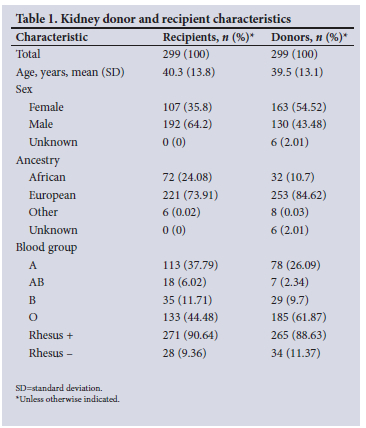
A total of 373 donor-recipient pairs were screened, of whom 299 met inclusion criteria and were included in the analysis. All recipients underwent single-organ kidney transplantation between 1999 and 2019, with eGFR recorded over 12 months post transplant. Recipient and donor demographic and clinical characteristics are summarised in Table 1. Recipients had a mean age of 40.3 years (SD 13.8) and were predominantly male (64.2%), while donors had a mean age of 39.5 years (SD 13.1) and were mostly female (54.5%). Donors were significantly younger than recipients (p<0.001), and there were significant differences in sex distribution (p<0.001), ancestry (p<0.001) and blood group (p<0.001) between donors and recipients. Most individuals were Rhesus positive.
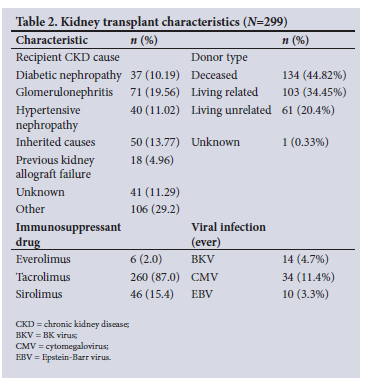
The most common causes of CKD among recipients were glomerulonephritis (19.6%), inherited conditions (13.8%), hypertensive nephropathy (11.0%) and diabetic nephropathy (10.2%). A total of 44.8% of donors were deceased, 34.5% living and related and 20.4% living and unrelated. Most recipients received tacrolimus (87.0%); fewer received sirolimus (15.4%), cyclosporin (4.7%), or everolimus (2.0%). Documented viral infections included CMV (11.4%), BKV (4.7%) and EBV (3.3%) (Table 2).
Figs 1 - 4 show the 1-year eGFR trajectories by recipient and donor sex (1A and B), ancestry (2A and B), blood group (3A and B), viral status (4A) and immunosuppressive regimen (4B).
Recipients with BKV, CMV, or EBV infection had lower average eGFRs than the cohort average (p=0.048, 0.012 and 0.081, respectively). Tacrolimus was associated with the highest average eGFR (45.28), followed by everolimus (39.55) and sirolimus (32.11), but this did not reach significance (p>0.05) at the group level.
Linear mixed-effects model regression analysis
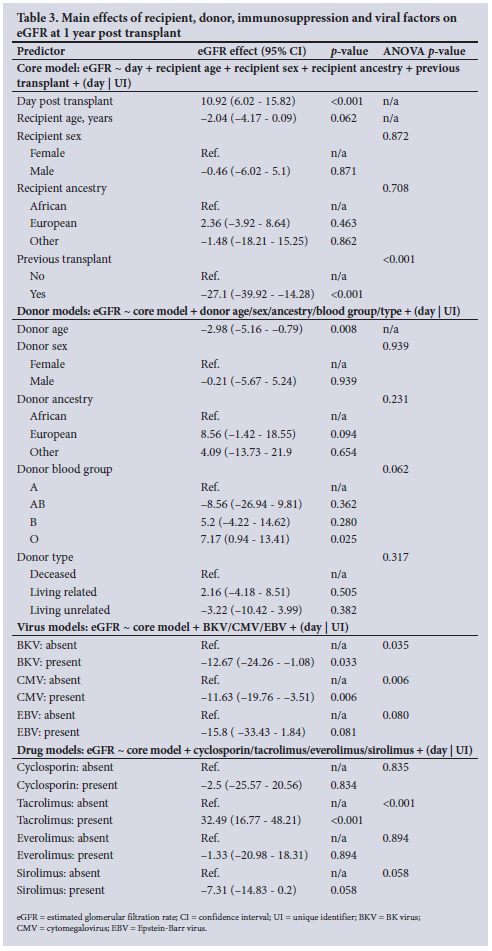
Linear mixed-effects models were used to assess associations with post-transplant eGFR. Table 3 shows the estimates from the models evaluated (core, donor, viral and medication models). Higher eGFR was significantly associated with donor blood group O (β=7.17, p=0.025) and tacrolimus use (β=32.49, p<0.001). Lower eGFR was associated with previous transplantation (β=-27.1, p<0.001) and any viral infection. Donor age was also inversely associated with eGFR (β=-2.98 per standard deviation, p=0.008). Sex, ancestry and blood group showed no statistically significant associations.
To evaluate broader effect modification, we constructed additional interaction models (Appendix 1). There was no significant interaction between donor and recipient ancestry or age. However, donor blood group B had a significantly lower eGFR when paired with recipient blood group B or AB (p<0.002), while matched blood group O to O had the best eGFR outcome (β=32.28, p=0.022). There was no significant interaction between recipient ancestry and medication use or viral infection.
Discussion
This 20-year retrospective study examined factors affecting early post-transplant kidney function in a SA private-sector transplant centre. Key findings include the predominance of male recipients and female donors, and the significant negative impact of viral infections on graft function.[3,8,10,15] Tacrolimus use was significantly associated with better graft function at 1 year, while other immunosuppressants were linked to a poorer eGFR. In our cohort, there was no significant difference in eGFR at 1 year among recipients or donors of any ancestry.
Tacrolimus, used in 87% of recipients, was associated with superior eGFR outcomes at 1 year, consistent with international practices.[3,8,10] In contrast, sirolimus, everolimus and cyclosporin were non-significantly associated with poorer eGFR. However, these associations must be interpreted with caution due to confounding by indication. At our centre, mTORi (mammalian target of rapamycin inhibitors - second line drugs for immunosupression) were not used routinely but rather reserved for patients with calcineurin inhibitor (CNI) intolerance, vascular complications or a history of malignancy.[3] These patients may have had more complex clinical profiles or impaired graft quality at baseline, which could independently influence outcomes. Importantly, the observed effect within most subgroups should be interpreted with caution, as small subgroup sizes likely introduce statistical instability and increase the risk of type I error. Larger studies are needed to determine whether this reflects a true biological effect or a spurious association.
Viral infections, though uncommon in our cohort, were significantly associated with reduced eGFR, particularly BKV and CMV. These findings are consistent with prior studies linking these viruses to direct nephrotoxicity, immune activation and endothelial injury.[15-19] When considering changes over time, BKV emerged as the most important viral determinant of eGFR trajectory, with a significant and sustained negative slope. In contrast, the temporal effects of CMV and EBV were non-contributary. These findings suggest that while CMV and EBV may exert early or static effects on graft function, BKV may play an increasingly important role over time, contributing to progressive allograft injury. However, the possibility cannot be ruled out that the presence of these viral infections, rather than direct toxicity, may indicate over-immunosuppression, potentially contributing to complications such as recurrent subclinical urinary tract infections, CNI toxicity or other factors, ultimately leading to a lower eGFR.
Our cohort predominantly comprised recipients and donors of European ancestry, reflecting the skewed demographic profile of the private healthcare sector in SA.[8,10] Patients of African ancestry, who represent the majority of the SA population, were relatively under-represented, likely underscoring longstanding structural barriers to accessing renal transplantation in SA.[8] Although recipients of African ancestry had slightly higher eGFR trajectories over time in our data, kidneys from African ancestry donors were associated with a non-significant reduction in eGFR compared with those from European donors.
Study strengths and limitations
This study provides rare, real-world data on kidney transplantation outcomes from a LMIC, using a well-characterised cohort over a 20-year period. The use of linear mixed-effects models allowed for nuanced analysis of repeated measures and interaction terms across recipient, donor, viral and treatment variables. By focusing on a private-sector transplant population in SA, the study captures a specific but under-reported segment of transplant recipients in the region.
However, several limitations must be acknowledged. First, this was a retrospective, single-centre study conducted in the private sector, limiting generalisability to broader populations, particularly those served in the public sector. Postoperative care was transferred to referring nephrologists after the first month, which restricted our ability to capture longer-term outcomes such as rejection, graft loss and mortality. Additionally, data were unavailable for several key variables: human leukocyte antigen mismatch, cold ischaemia time, baseline donor serum creatinine and protocol biopsy findings, which were not routinely measured. Lastly, the use of multiple prespecified models increases the risk of type I error, and the small number of certain subgroups will probably contribute to statistical instability in some interaction terms. These limitations highlight the need for standardised, prospective data collection in LMIC transplant programmes.
Conclusion
Our findings underscore the importance of context-specific transplant research in LMICs. Although many of the observed associations, such as the impact of donor age, immunosuppression and viral infections, are well established in high-income settings, this study provides important validation and nuance within a SA private-sector cohort, and is likely to echo the public sector as well.[3,8] The demographic skew towards recipients of European ancestry reflects persistent inequities in access, and the trend towards poorer outcomes among African ancestry recipients raises important questions about the roles of genetics, pharmacology and health-system factors.
Future research should prioritise the development of inclusive, nationally representative transplant data sets that incorporate both public and private sector donors and recipients. These efforts should include the integration of genetic data (e.g. APOL1 genotyping and pharmacogenomic profiles), socioeconomic variables, medication adherence and longer-term clinical outcomes. Strengthening post-transplant monitoring, particularly virological and histopathological surveillance, is essential for identifying modifiable risk factors and tailoring interventions.
Ultimately, improving kidney transplant outcomes in resource-limited settings will require a combined approach that addresses both biological and structural determinants of health. Our findings offer a foundation for this work, and highlight the urgent need for equity-focused transplant policy and research across Africa.[8]
Data availability. The data used for this study are freely available upon reasonable request to the corresponding author.
Declaration. This study was carried out in fulfilment of OCO's MPharmMed at the University of Pretoria.
Acknowledgements. The authors are indebted to the transplant teams and renal patients.
Author contributions. OCO: contributed to the conception and design, acquisition of data and interpretation, drafting of the article and final approval of the version to be published. KO: made contributions to conception and design, data interpretation and revision for important conceptual content, along with final approval of the version. WT: contributed to conception and design, acquisition of data, data analysis and revision of the manuscript for clinical and technical content, culminating in final approval of the version to be published. PR: statistical analysis and interpretation of data, and critical review of the manuscript for statistical and methodological accuracy.
Funding. None.
Conflicts of interest. None.
References
-
1. Francis A, Harhay MN, Ong ACM, et al. Chronic kidney disease and the global public health agenda: An international consensus. Nat Rev Nephrol 2024;20(7):473-485. https://doi.org/10.1038/s41581-024-00820-6
» https://doi.org/10.1038/s41581-024-00820-6 -
2. Kovesdy CP. Epidemiology of chronic kidney disease: An update 2022. Kidney Int Suppl 2022;12(1):7-11. https://doi.org/10.1016/j.kisu.2021.11.003
» https://doi.org/10.1016/j.kisu.2021.11.003 -
3. Davidson B, du Toit T, Jones ESW, et al. Outcomes and challenges of a kidney transplant programme at Groote Schuur Hospital, Cape Town: A South African perspective. PLoS ONE 2019;14(1): e0211189. https://doi.org/10.1371/journal.pone.0211189
» https://doi.org/10.1371/journal.pone.0211189 -
4. Jagannathan R, Patzer RE. Urbanisation and kidney function decline in low- and middle-income countries. BMC Nephrol 2017;18(1):276. https://doi.org/10.1186/s12882-017-0685-4
» https://doi.org/10.1186/s12882-017-0685-4 -
5. Hariparshad S, Bhimma R, Nandlal L, Jembere E, Naicker S, Assounga A. The prevalence of chronic kidney disease in South Africa - limitations of studies comparing prevalence with sub-Saharan Africa, Africa, and globally. BMC Nephrol 2023;24(1):62. https://doi.org/10.1186/s12882-023-03109-1
» https://doi.org/10.1186/s12882-023-03109-1 -
6. George JA, Brandenburg J-T, Fabian J, et al. Kidney damage and associated risk factors in rural and urban sub-Saharan Africa (AWI-Gen): A cross-sectional population study. Lancet Glob Health 2019;7(12):e1632-1643. https://doi.org/10.1016/s2214-109x(19)30443-7
» https://doi.org/10.1016/s2214-109x(19)30443-7 -
7. Fiseha T, Ekong NE, Osborne NJ. Chronic kidney disease of unknown aetiology in Africa: A review of the literature. Nephrology 2024;29(4):177-187. https://doi.org/10.1111/nep.14264
» https://doi.org/10.1111/nep.14264 -
8. Razeen Davids M, Marais N, Sebastian S, Jardine T, Jacobs JC. South African Renal Registry annual report 2021. Afr J Nephrol 2023;26(1):83-94. https://doi.org/10.21804/26-1-5982
» https://doi.org/10.21804/26-1-5982 -
9. Freercks R, Rodrigues M, Manning K, et al. APOL1 genotype and patient outcomes in US and South African transplant recipients with HIV who received kidneys from donors with HIV. medRxiv 2025.04.15.25325856. https://www.medrxiv.org/content/10.1101/2025.04.15.25325856v1.abstract (accessed 1 August 2025).
» https://www.medrxiv.org/content/10.1101/2025.04.15.25325856v1.abstract -
10. Muller WK, Dandara C, Manning K, et al. CYP3A5 polymorphisms and their effects on tacrolimus exposure in an ethnically diverse South African renal transplant population. S Afr Med J 2020;110(2):159-166. https://doi.org/10.7196/samj.2020.v110i2.13969
» https://doi.org/10.7196/samj.2020.v110i2.13969 -
11. Davies M, Chiba S, van Hougenhouck-Tulleken W; Transplantation Committee of the African Association of Nephrology (AFRAN). Kidney transplantation in Africa - workforce, capabilities and perceived barriers. Nephrol Dial Transplant 2026;41(9):1654-1664. https://doi.org/10.1093/ndt/gfag030
» https://doi.org/10.1093/ndt/gfag030 -
12. Naicker S. End-stage renal disease in sub-Saharan Africa. Ethn Dis 2009;19(1 Suppl 1):S1-13-5. https://pubmed.ncbi.nlm.nih.gov/19484867/ (accessed 20 October 2026).
» https://pubmed.ncbi.nlm.nih.gov/19484867/ -
13. Harris PA, Taylor R, Thielke R, Payne J, Gonzalez N, Conde JG. Research electronic data capture (REDCap) - a metadata-driven methodology and workflow process for providing translational research informatics support. J Biomed Inform 2009;42(2):377-381. https://doi.org/10.1016/j.jbi.2008.08.010
» https://doi.org/10.1016/j.jbi.2008.08.010 -
14. Harris PA, Taylor R, Minor BL, et al. The REDCap consortium: Building an international community of software platform partners. J Biomed Inform 2019;95(103208):103208. https://doi.org/10.1016/j.jbi.2019.103208
» https://doi.org/10.1016/j.jbi.2019.103208 -
15. Nautiyal A, Bagchi S, Bansal SB. Gender and kidney transplantation. Front Nephrol 2024;4:1360856. https://doi.org/10.3389/fneph.2024.1360856
» https://doi.org/10.3389/fneph.2024.1360856 -
16. Van der Schyff F, Barnard M, Ströbele B, et al. Renal transplant recipient and deceased-donor risk profiles at Wits Donald Gordon Medical Centre, Johannesburg, South Africa: A 9-year review. S Afr Med J 2024;114(3b):e1321. https://doi.org/10.7196/samj.2024.v114i3b.1321
» https://doi.org/10.7196/samj.2024.v114i3b.1321 -
17. Kant S, Dasgupta A, Bagnasco S, Brennan DC. BK virus nephropathy in kidney transplantation: A state-of-the-art review. Viruses 2022;14(8):1616. https://doi.org/10.3390/v14081616
» https://doi.org/10.3390/v14081616 -
18. Diena D, Allesina A, Fop F, et al. Relationship between cytomegalovirus viremia and long-term outcomes in kidney transplant recipients with different donor ages. Microorganisms 2023;11(2):458. https://doi.org/10.3390/microorganisms11020458
» https://doi.org/10.3390/microorganisms11020458 -
19. Le J, Durand CM, Agha I, Brennan DC. Epstein-Barr virus and renal transplantation. Transplant Rev 2017;31(1):55-60. https://doi.org/10.1016/j.trre.2016.12.001
» https://doi.org/10.1016/j.trre.2016.12.001

Accepted 31 March 2026