The National Health Insurance Act: Possible private health funding reform scenarios
Abstract
The passing of the National Health Insurance (NHI) Act was an important milestone in the reform of the South African healthcare system and will have a profound impact on the funding and provision of healthcare in the country. While the impacts will be felt across the entire system, the focus of this article is on the potential impact on the private health funding sector, which currently enables financial risk protection for those with private health insurance. This article highlights some key trends and challenges in this sector from 2007 to 2022 and then examines two possible extreme scenarios for the sector during the NHI transition phases. In the first scenario, a passive' process is assumed. This is characterised as a continuation of the current policy environment, where the sector is allowed to continue a downward trajectory without any specific actions to maintain its viability during the transition. A key risk in this scenario is that the sector becomes unsustainable before the NHI can provide an alternative financial risk protection mechanism to those currently protected through private health insurance. In the second scenario, an active' process is followed, where steps are taken to keep the sector sustainable during the NHI transition. While part of this would include the purposive shifting of government-related funding from the private funding sector to the NHI, other actions would include regulatory and other reforms necessary to keep the private funding sector viable, which would also provide a stronger foundation for the NHI.
health financing reform; National Health Insurance; private health funding sector; South Africa
Overview and challenges
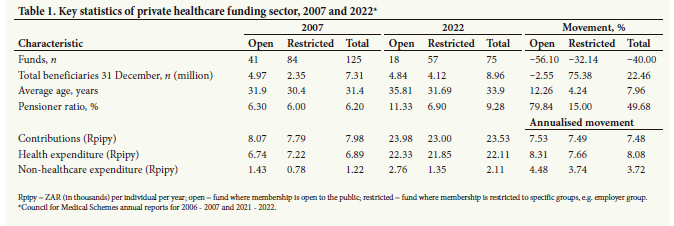
Reports of the Council for Medical Schemes (CMS) for 2006 - 2007[12] and 2021 - 2022[13] were analysed to examine sector trends over a 15-year period (Table 1). During the period, the sector experienced substantial consolidation, with the total number of funds reducing by 40% (Table 1). This was more marked in open funds, which reduced in number by 56.1%, compared with a reduction of 32.1% in restricted funds. This consolidation was driven by the CMS adoption of the medical schemes consolidation framework, which put pressure on smaller funds to consolidate.[14] This was in line with the NHI plans for consolidation of medical schemes and benefit options in the period leading to full implementation of the NHI.[15] The goal of the consolidation framework was to reduce excessive fragmentation of risk pools, address risk rating and strengthen cross-subsidies, while enhancing social solidarity, and to standardise and simplify benefit options.[14-16]
Overall scheme membership increased by 22.5% over the period, driven primarily by the growth in restricted funds (especially the Government Employees Medical Scheme (GEMS), established in 2005[17]), which saw a 75.4% increase in membership. Open fund membership over the period declined by 2.5%. The average age of covered individuals increased from 31.4 years (pensioner ratio 6.2%) to 33.9 years (pensioner ratio 9.3%). Given that age is a major determinant of morbidity and mortality, the increase in average age likely contributed to an increase in health expenditures.[18] Average annual increases in health expenditure, and consequently in contributions, were well above consumer price index (CPI) over the period. While CPI averaged 5.5% per annum,[19] healthcare expenditure increased by 8.1% on average, with higher increases in Open versus Restricted funds; and contributions increased by 7.5% across the board (Table 1). The average annual increase of 3.7% for non-healthcare expenditures over the period was lower than CPI, contained largely by regulatory pressure from the CMS.
The relatively stagnant and ageing membership (outside of the growth driven by GEMS), together with the consistently above-inflation increases in claims and contributions, highlight the systemic challenges facing the sector. Concerns about affordability and long-term sustainability led the Competitions Commission (CC) to initiate the second Health Market Inquiry (HMI) in 2013 to investigate and provide explanations for these increases in price and expenditure.[20] The HMI considered recommendations 'that serve to promote competition in the interest of a more affordable, accessible, innovative and good quality private healthcare'. The HMI final report, published in September 2019, documents its findings and recommendations in >250 pages.[21]
The HMI concluded that regulatory failures, starting with deregulation in the 1980s, followed by partial and incomplete re-regulation, and failure to monitor, had led to a situation where 'funders compete in an environment which is characterised by an incomplete regulatory framework, distorting the parameters of competition.'[21,22] The HMI concluded that rather than competing on issues such as affordability and value for money, funders competed on risk factors such as attracting younger, healthier members. The sector had failed to manage supplier-induced demand or moral hazard and - given the complexity of the offerings of medical schemes (and their combined 270 products) - this made it difficult for consumers to compare and make informed choices. Consumer information was incomplete, and the role of brokers and other agents in directing consumer choice was questionable. The HMI further concluded that the interests of medical schemes and their members were misaligned, with a limited pool of incentives to ensure that scheme employees and trustees acted in the best interest of members, and held administrators to account.[21,22]
The slow progress in carrying out the NHI reforms overall has been well documented.[23' Little progress has also been made by policy-makers and the CMS in addressing any of the substantive regulatory shortcomings of the private funding sector since the passing of the Medical Schemes Act 131 in 1998.[24] Sector reforms have been limited to amendments to the legislation in 2001[25] to regulate the definition of reinsurance and marketing expenses, and to allow the registrar to inspect schemes, and in 2003 to introduce the Chronic Disease List (CDL).[26] Amendments to the Act were proposed in 2008[27] and 2018,[28] but were not passed by the National Assembly. Since the publication of the HMI report in 2019, there has been little debate on its key findings and recommendations, and no indication from the NDoH that it is investigating the implementation of any of the recommendations.[23]
The slow and limited progress in carrying out the NHI and private health funding and provider reforms has been attributed to weak governance and management capacity,[29] inability to build compromise and consensus across interest groups, the complexity of navigating provincial v. national powers and political interests and weak economic growth since 2010.[23,30] Regulatory and legislative hurdles, together with legal challenges,[31] have impeded progress, and this is likely to continue. This relative inertia does not bode well, given that it is widely understood and accepted among stakeholders that NHI implementation will be done in phases and over a period lasting from 'years to decades'.[11] Failure to address the need for reforms outlined in the HMI report will in all likelihood result in further inflationary increases in health expenditure, with potentially negative impacts on the financial risk protection afforded to medical scheme members - and employers -during this potentially very long period.
Private health funding reform scenarios
In this section, we examine the types of scenarios that could emerge from a continuation of the current passive approach or from a shift towards a more active approach to the reform process.[23]
A passive' policy reform process which allows the sector to continue without any specific action to keep the sector viable during the NHI transition phase would represent a continuation of the 10-year policy vacuum that has seen nearly all strategic health reforms progress very slowly, or not at all.[23] Without active reform, the most likely outcome is a continued downward trajectory for the sector, with further exacerbation of the challenges and threats to its viability. These include above-inflation contribution increases, loss of membership, movement of members to cheaper options, higher out-of-pocket spending and potential catastrophic spending, and increased reliance on the public sector.[21] The major risk for the health system and the country is that the sector becomes non-viable before NHI is put into place. For example, if the existing medical scheme population were to become dependent on the public health sector prior to any improvements in government-mediated funding for the NHI, this would cause substantial strain on the public sector and might lead to a reduction in the capacity of private providers. Given that the NHI intends to purchase services from both public and private providers, protecting this capacity is essential.
On the other hand, an active reform process could mitigate these risks. Implicit in such an approach would be a recognition that (i) the implementation timelines for NHI are uncertain and will extend over a lengthy period, given the legal,[2,32] financial,[33] governance and political issues (especially in the era of a Government of National Unity);[34] and (ii) the sector plays an important role in filling the current gaps in public health service provision and universal health coverage, and consequently needs to be affordable and sustainable while NHI is being implemented. Strategically important within such an approach would be putting into place the building blocks for the NHI by shifting government-related funding from the private funding sector to the NHI, and carrying out the necessary regulatory and other reforms to keep the remaining private sector viable until the NHI is implemented.
The first prong of the strategy of shifting government-related funding from the private funding sector has long been mooted by the NDoH, and was called for again by the Minister of Health, Dr Aaron Motsoaledi, at the National Council of Provinces policy debate on the health budget vote.[35] According to the minister, ZAR30 billion could be shifted by redirecting the tax rebates on medical scheme contributions. It should be noted that while the NDoH has long argued for these tax rebates to be removed, they have not been able to convince Treasury to do so. Claimants of medical scheme and medical expense deductions represent ~27%[36] of taxpayers, and these tax credits provide important relief for low- and middle-income members, the elderly and those with relatively high healthcare costs.
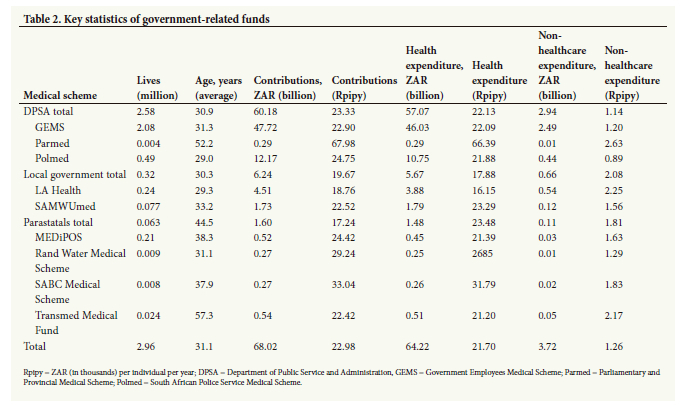
The minister also mooted redirection of government funding of medical scheme membership for 1.3 million public servants and members of Parliament and legislatures. The total combined employer and employee contributions towards medical schemes in 2022 amounted to ZAR60.18 billion for employees on the Department of Public Service and Administration (DPSA) payroll , ZAR6.24 billion for those in local government and ZAR1.60 billion for those on parastatal funds (Table 2).
Despite the major public sector unions such as NEHAWU,[37] and union federations such as COSATU,[38] having been vocal in their support for the NHI, the re-direction of this pot of funding would need to be very carefully managed, as it would require a change in the conditions of employment of a substantial number of employees, and would have to be in compliance with the Labour Relations Act 66 of 1995,[39] and negotiated at various bargaining councils. The process of redirecting the funds could begin with fast-tracking the amalgamation of the DPSA schemes (GEMS, the SA Police Service Medical Scheme (Polmed) and the Parliamentary and Provincial Medical Scheme (Parmed)), as the government has direct influence on the flow of funds to and the governance structures of these schemes. Parmed, the parliamentary scheme, is a notable outlier in terms of contributions and expenditure, with average expenditure per individual more than three times the average of the DPSA schemes. This redirection of funds could be initiated as soon as is practically possible, with later consideration for moving the local government and parastatal funds. Members of these DPSA schemes could be directed to use the public health sector as the preferred service provider in the transition phase. This would ensure that the funding is directed towards public health services rather than the private provider sector, and hopefully the requirement that public servants utilise public health services would lead to quality improvement in those services. Overall, however, it needs to be recognised that the feasibility of government-led consolidation remains speculative, and a strategy of influencing market forces and regulatory guidance, rather than outright enforcement, may be more appropriate.
The second prong of the strategy would be to take steps to ensure that the remaining portions of the private health funding sector remain sustainable while NHI is being implemented. Key here would be addressing the broader health system governance challenges and recommendations that have been made to address them in the Academy of Science of SA report on achieving good governance and management in the SA health system.[29] The failures of the private sector regulatory framework highlighted in the HMI report also need to be addressed. Policymakers need to acknowledge that regulation is a function of government, and regulatory failure is a failure of government. The first step would be to systematically review the performance of the important regulators including, but not limited to, the CMS, the Health Professions Council of SA (HPCSA) and the SA Nursing Council, and to address the underlying reasons for under- or non-performance. Only once the regulators are competent and fully functioning can the regulatory shortcomings of the sector, and the health system, be addressed. In terms of regulatory reforms, the creation of a risk-sharing mechanism and the establishment of a supply-side regulator should be prioritised, as these measures will contribute to keeping the sector viable while also building towards the NHI.[21-23]
Pilot projects for contracting of district health services as well as for specialised and highly specialised services could be implemented and phased in. A defined monitoring and evaluation system could be implemented, with a focus on clinical governance, good quality and affordable care and alternative re-imbursement methods. Pilot projects that are well planned and managed provide the opportunity to encourage the evolution of innovative and integrated models of care, including consideration of multidisciplinary group practices with a range of re-imbursement models. This will also provide the impetus for bodies such as the HPCSA, the CMS and others to carry out the required regulatory reforms.
Conclusion
The passing of the NHI Act could signal the start of fundamental reform of the SA healthcare system. It is important that policy-makers consider seriously these potential private health funding reform scenarios during the transition phase. The most likely outcome of the current, largely passive-leaning approach, is a continued downward trajectory for the sector, with further exacerbation of the challenges and threats to its viability. A more pragmatic and deliberate approach for the next 10 - 15-year period would be to proactively lead and manage private sector reforms, to ensure that the sector remains viable until such time as the NHI offers an integrated and acceptable alternative. One strategically important move would be to prioritise reforms to shift government-related funds that currently enter the private funding sector toward NHI implementation. There are also several existing regulatory steps and other reforms that can be implemented to ensure that the private health funding sector remains viable and more accountable through the transition phase. These reforms will also provide important foundation blocks for building the NHI.
Data availability. N/a.
Declaration. None.
Acknowledgements. The authors would like to acknowledge the institutional support to the study authors provided by the South African Medical Research Council, the University of Cape Town and the Clinton Health Access Initiative.
Author contributions. Conceived and designed the study: GS, VB. Developed the article: GS, VB, RM, NM, JC, SC. Reviewed the article:
RM, NM, JC, SC.
Funding. GS was employed on a contractual basis by the South African Medical Research Council and NMG Consultants and Actuaries; support in the form of salaries was provided by the South African Medical Research Council. VB is employed by the Clinton Health Access Initiative. SC is employed by the University of Cape Town. None of these institutions had any additional role in the study design, data collection and analysis, decision to publish, or preparation of the manuscript.
Conflicts of interest. None.
References
-
1. South Africa. National Health Insurance Act No. 20 of 2003. https://www.gov.za/sites/default/files/gcis_document/202405/50664nathealthinsuranceact202023.pdf1 (accessed 1 April 2025).
» https://www.gov.za/sites/default/files/gcis_document/202405/50664nathealthinsuranceact202023.pdf1 -
2. Solanki GC, Myburgh NG, Wild S, Cornell JE, Brijlal V. Thematic analysis of the challenges and options for the Portfolio Committee on Health in reviewing the National Health Insurance Bill. S Afr Med J 2022;112(7):456-464. https://doi.org/10.7196/SAMJ.2022.v112i7.16644
» https://doi.org/10.7196/SAMJ.2022.v112i7.16644 -
3. Constitution of the Republic of South Africa, 1996. https://www.justice.gov.za/legislation/constitution/saconstitution-web-eng.pdf (accessed 1 August 2022).
» https://www.justice.gov.za/legislation/constitution/saconstitution-web-eng.pdf -
4. Board of Healthcare Funders presentation to Portfolio Committee on Health. NHI Bill: public hearings. Day 1, 18 May 2021. https://pmg.org.za/committee-meeting/32925/ (accessed 1 April 2025).
» https://pmg.org.za/committee-meeting/32925/ -
5. Bonitas presentation to Portfolio Committee on Health. NHI Bill: public hearings. Day 22, 25 January 2022. https://pmg.org.za/committee-meeting/34114/ (accessed 1 April 2025).
» https://pmg.org.za/committee-meeting/34114/ -
6. South African Medical Association presentation to Portfolio Committee on Health. NHI Bill: public hearings. Day 5, 1 June 2021. https://pmg.org.za/committee-meeting/33119/ (accessed 1 April 2025).
» https://pmg.org.za/committee-meeting/33119/ -
7. South African Medical Research Council presentation to Portfolio Committee on Health. NHI Bill: public hearings. Day 3, 20 May 2021. https://pmg.org.za/committee-meeting/32994 (accessed 1 April 2025).
» https://pmg.org.za/committee-meeting/32994 -
8. Public Health Association of South Africa presentation to Portfolio Committee on Health. NHI Bill: public hearings. Day 2, 19 May 2021. https://pmg.org.za/committee-meeting/32952/ (accessed 1 April 2025).
» https://pmg.org.za/committee-meeting/32952/ -
9. Actuarial Society of South Africa presentation to Portfolio Committee on Health. NHI Bill: public hearings. Day 8. 22 June 2021. https://pmg.org.za/committee-meeting/33238/ (accessed 1 April 2025).
» https://pmg.org.za/committee-meeting/33238/ -
10. National Department of Health. National Health Insurance. Frequently asked questions. https://www.health.gov.za/nhi-faq/ (accessed 1 April 2025).
» https://www.health.gov.za/nhi-faq/ -
11. Bhekisisa Health Beat #9. Nicholas Crisp, deputy director general, National Health Insurance. Bhekisisa, June 2023. https://www.youtube.com/watch?v=DhVpcns8sE4 (accessed 1 April 2025).
» https://www.youtube.com/watch?v=DhVpcns8sE4 -
12. Council for Medical Schemes. Annual Report 2006/07. CMS, 2007. https://www.medicalschemes.co.za/wpfd_file/cms-annual-report-2006-2007-revised/ (accessed 1 April 2025).
» https://www.medicalschemes.co.za/wpfd_file/cms-annual-report-2006-2007-revised/ -
13. Council for Medical Schemes. Annual Report 2021/22. CMS, 2022. https://www.medicalschemes.co.za/cms-annual-report-2021-22/ (accessed 1 April 2025).
» https://www.medicalschemes.co.za/cms-annual-report-2021-22/ -
14. Council for Medical Schemes. Circular 42 of 2018: Draft Medical Schemes Consolidation Framework 19 September 2019. https://www.medicalschemes.co.za/publications/#2009-2560-wpfd-2018-circulars-archive-p2 (accessed 1 April 2025).
» https://www.medicalschemes.co.za/publications/#2009-2560-wpfd-2018-circulars-archive-p2 -
15. Government Gazette 30 June 2017. No. 40995. National Health Act, 2003 National Health Insurance Policy. Towards universal health coverage. https://static.pmg.org.za/1/170630healthinsurancepolicydoc.pdf (accessed 1 April 2025).
» https://static.pmg.org.za/1/170630healthinsurancepolicydoc.pdf -
16. Council for Medical Schemes. Medical scheme consolidation. A high level analysis on consolidation of medical schemes with less than 6,000 members. CMS, 29 March 2019. https://www.moonstone.co.za/wp-content/uploads/library/Moonstone%20Library/MS%20Industry%20News/MedicalSchemeConsolidation_final2.pdf (accessed 1 April 2025).
» https://www.moonstone.co.za/wp-content/uploads/library/Moonstone%20Library/MS%20Industry%20News/MedicalSchemeConsolidation_final2.pdf -
17. Government Employees Medical Scheme. Fact sheet. GEMS, 2025. https://www.gems.gov.za/en/Information/Fact-Sheet (accessed 1 April 2025).
» https://www.gems.gov.za/en/Information/Fact-Sheet - 18. Solanki G KG, Cornell J, Daviaud E, Geffen L. Population ageing in South Africa: Trends, impact, and challenges for the health sector. In: Moeti T, Padarath A, eds. South African Health Review 2019. Durban: Health Systems Trust, 2019.
-
19. Statistics South Africa. CPI History. Stats SA, 25 July 2024. https://www.statssa.gov.za/publications/P0141/CPIHistory.pdf (accessed 1 April 2025).
» https://www.statssa.gov.za/publications/P0141/CPIHistory.pdf -
20. Government Gazette 29 November 2013. No. 37062. Competition Commission of South Africa terms of reference for market inquiry into the South African private healthcare sector. www.gpwonline..co.za http://www.compcom.co.za/wp-content/uploads/2015/04/Health-ToR.pdf (accessed 1 April 2025).
» www.gpwonline..co.za http://www.compcom.co.za/wp-content/uploads/2015/04/Health-ToR.pdf - 21. Competition Commisssion of South Africa. Health Market Inquiry final findings and recommendations report. CCSA, 2019.
-
22. http://www.compcom.co.za/wp-content/uploads/2014/09/Health-Market-Inquiry-Report.pdf (accessed 1 April 2025).
» http://www.compcom.co.za/wp-content/uploads/2014/09/Health-Market-Inquiry-Report.pdf -
23. Solanki GC, Cornell JE, Besada D, Morar RL, Wilkinson T. The Competition Commission Health Market Inquiry Report: An overview and key imperatives. S Afr Med J 2020;110(2):88-91. https://doi.org/10.7196/SAMJ.2020.v110i2.14455
» https://doi.org/10.7196/SAMJ.2020.v110i2.14455 - 24. Matsoso MP, Chikte U, Makubalo L, Pillay Y, Fryatt R, eds. The South African Health Reforms 2015 - 2020: The Road Ahead. Johannesburg: Trackstar Trading, 2022.
-
25. South Africa. Medical Schemes Act No. 131 of 1998. https://www.gov.za/sites/default/files/gcis_document/201409/a131-98.pdf (accessed 1 April 2025).
» https://www.gov.za/sites/default/files/gcis_document/201409/a131-98.pdf -
26. South Africa. Medical Schemes Amendment Bill B80-2001. https://www.gov.za/sites/default/files/gcis_document/201806/41726gon636s.pdf (accessed 1 April 2025).
» https://www.gov.za/sites/default/files/gcis_document/201806/41726gon636s.pdf -
27. South Africa. Amendment to the general regulations made in terms of the Medical Schemes Act, 1998 (Act No. 131 of 1998). No. R540, April 2022. https://www.gov.za/sites/default/files/gcis_document/201409/233790.pdf (accessed 1 April 2025).
» https://www.gov.za/sites/default/files/gcis_document/201409/233790.pdf -
28. South Africa. Medical Schemes Amendment Bill B58-2008. https://www.gov.za/sites/default/files/gcis_document/201409/b58-2008-080623.pdf (accessed 1 April 2025).
» https://www.gov.za/sites/default/files/gcis_document/201409/b58-2008-080623.pdf -
29. South Africa. Medical Schemes Amendment Bill B-2018. https://www.gov.za/sites/default/files/gcis_document/201409/b80-010.pdf (1 April 2025).
» https://www.gov.za/sites/default/files/gcis_document/201409/b80-010.pdf -
30. Academy of Science of South Africa. Achieving good governance and management in the South African health system. ASSAf, 2024. http://doi.org/10.17159/assaf.2024/95
» http://doi.org/10.17159/assaf.2024/95 -
31. Blecher MS, Daven J, Harrison S, et al. National Health Insurance: Vision, challenges and solutions. In: Moeti T, Paradath A, eds. South African Health Review 2019. Durban: Health Systems Trust, 2019. http://www.hst.org.za/publications/Pages/SAHR2019 (accessed 1 April 2025).
» http://www.hst.org.za/publications/Pages/SAHR2019 - 32. Dhai A. The NHI Act: Will it survive? S Afr Med J 2024;114(6):e2279.
-
33. Business Tech Staff Writer. NHI heading to court - with many more legal challenges to come. Business Tech, 14 June 2023. https://businesstech.co.za/news/government/696225/nhi-heading-to-court-with-many-more-legal-challenges-to-come/ (accessed 1 April 2025).
» https://businesstech.co.za/news/government/696225/nhi-heading-to-court-with-many-more-legal-challenges-to-come/ -
34. Kahn T. Extra money for health workers, but sector's budget shrinks in real terms. Business Day, 21 February 2024. https://www.businesslive.co.za/bd/national/health/2024-02-21-extra-money-for-health-workers-but-sectors-budget-shrinks-in-real-terms/#google_vignette (accessed 1 April 2025).
» https://www.businesslive.co.za/bd/national/health/2024-02-21-extra-money-for-health-workers-but-sectors-budget-shrinks-in-real-terms/#google_vignette -
35. Van Niekerk A, Pretorius L. The GNU has 5 parties. Only 2 support the NHI. What will happen to the Act? News24, 19 June 2024. https://www.news24.com/news24/southafrica/news/the-gnu-has-5-parties-only-2-support-the-nhi-what-will-happen-to-the-act-20240619 (accessed 1 April 2025).
» https://www.news24.com/news24/southafrica/news/the-gnu-has-5-parties-only-2-support-the-nhi-what-will-happen-to-the-act-20240619 -
36. Motsoaledi A. Address by Aaron Motsoaledi, Minster of Health at policy debate budget vote, National Council of Provinces, 17 July 2024. www.health.gov.za/wp-content/uploads/2024/07/NCOP-Health-Budget-Speech-17-July-2024.pdf (accessed 1 April 2025).
» www.health.gov.za/wp-content/uploads/2024/07/NCOP-Health-Budget-Speech-17-July-2024.pdf -
37. Donaldson AR. The South African personal income tax base, 2011 - 2018. Income and taxable income, adjusted for retirement fund and medical expense reporting changes. WIDER Working Article 2023/43. United Nations University World Institute for Development Economics Research, March 2023. www.wider.unu.edu/sites/default/files/Publications/Working-article/PDF/wp2023-43-South-African-personal-income-tax-base-2011-2018.pdf (accessed 1 April 2025).
» www.wider.unu.edu/sites/default/files/Publications/Working-article/PDF/wp2023-43-South-African-personal-income-tax-base-2011-2018.pdf -
38. National Education and Health Workers Union presentation to Portfolio Committee on Health. NHI Bill: public hearings. Day 28, 16 February 2022. https://pmg.org.za/committee-meeting/34333/ (accessed 1 April 2025).
» https://pmg.org.za/committee-meeting/34333/ -
39. Congress of South African Trade Unions presentation to Portfolio Committee on Health. National Health Insurance (NHI) Bill: public hearings. Day 27, 15 February 2022. https://pmg.org.za/committee-meeting/34311/ (accessed 1 April 2025).
» https://pmg.org.za/committee-meeting/34311/ -
40. South Africa. Labour Relations Act 66 of 1995. https://www.gov.za/sites/default/files/gcis_document/201409/act66-1995labourrelations.pdf (accessed 1 April 2025).
» https://www.gov.za/sites/default/files/gcis_document/201409/act66-1995labourrelations.pdf

Accepted 24 February 2025