Access to oncology care in western KwaZulu-Natal Province before, during and after the COVID-19 pandemic
Abstract
BACKGROUND. Timely access to oncological care is essential. International experience suggests that the COVID-19 pandemic negatively impacted this. Knowledge of the experience in South Africa is limited. OBJECTIVE. To assess the effect of COVID-19-associated lockdowns on access to cancer care for public sector patients in western KwaZulu-Natal Province (KZN). METHODS. A retrospective chart review was conducted in the Oncology Department of Grey's Hospital (GHOD), a tertiary hospital in KZN, to determine times between onset of symptoms, diagnosis, first consultation at GHOD and treatment. Patient demographics were included. Patients were stratified by both date of first GHOD appointment and of biopsy with respect to the various lockdown stages. RESULTS. A total of 360 patient files over four time periods (pre COVID-19, hard and soft lockdown and post-COVID-19) were reviewed. When stratified by first GHOD appointment, only waiting time from GHOD review to treatment decreased, with all other waiting times remaining stable. The average number of new patients seen per day decreased during soft lockdown, with the proportion of patients referred from primary care facilities most affected. CONCLUSION. Despite the challenges of a global pandemic, access to GHOD care was not compromised in terms of patient waiting times. The absolute number of patients seen decreased, however, particularly those referred from primary care facilities. This study reviewed the entire COVID-19 period and shows that the impact of COVID-19 on patients who accessed care was not necessarily negative. The need for research regarding diagnosis and referral at primary and secondary care levels during the pandemic is highlighted.
cancer care; access to care; treatment delays; waiting times; COVID-19 pandemic
Overview of demographic data
Various demographic data were examined for patients included in the study: these included age, sex, level of referring hospital, facility where biopsy was done and presence or absence of comorbidities, including HIV status (Table 2). There was no statistically significant relationship between the demographic variables across the five strata.
Waiting times stratified by date of first GHOD appointment
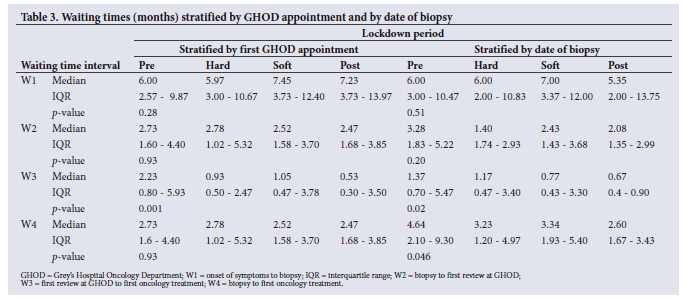
Waiting times in months (Table 3) were analysed by strata defined by date of first GHOD appointment. The self-reported mean period between a patient noticing their symptoms and cancer diagnosis (W1) did not vary significantly between COVID-19 periods (Table 4) (p=0.28). Viewing the four periods together, the median W1 was 6.20 months, and the IQR was 3 - 12 months, implying that approximately half of the patients waited just over half a year, a quarter waited <3 months, and a quarter waited >1 year before presenting to the healthcare system. Once the cancer was diagnosed, less than half of the patients waited 2.62 months until being seen at GHOD (W2), while one quarter waited >4.37 months. This wait did not vary significantly before, during or after the COVID-19 pandemic.
Analysis of the time period from first appointment at GHOD to first treatment (W3) showed that patients received treatment significantly sooner after the COVID-19 pandemic when compared with all other time periods (p=0.001). Median (IQR) W1s were 2.23 (0.80 - 5.93) months and 0.53 (0.30 - 1.13) months pre and post pandemic, respectively (Table 3).
The time period between diagnosis (biopsy) and receipt of first oncological therapy (W4) was, however, not significantly different between the time periods (p=0.93) (Table 3). Considering all four time periods together, approximately half the patients waited >2.62 months and one-quarter waited >4.37 months. Any instances where cancer treatment was initiated prior to biopsy (n=4) were excluded from this calculation, as this was considered unusual practice.
Waiting times stratified by date of biopsy
The data were grouped into strata defined by when the biopsy was done in relation to the COVID-19 pandemic (n=337). As seen in Table 3, W1 did not vary significantly between the different time periods, with an overall median (IQR) of 6.09 (3 - 12) months (p=0.51). Median (IQR) W2 overall was 6.00 (3.00 - 10.47) months, and was stable between the various COVID-19 periods (p=0.197).
The time period of W3 was significantly shorter during soft and post lockdown (p=0.02). Prior to the pandemic, patients waited a median (IQR) of 1.47 (0.70 - 5.47) months from first oncological appointment to treatment, while during soft lockdown this delay was 0.77 (0.43 - 3.03, p=0.003) months and post lockdown was 0.67 (0.47 - 0.90, p=0.02) months.
Similarly, comparing the time period from biopsy to first treatment (W4) among these strata demonstrated that W4 pre-COVID-19 was significantly longer than in all other periods (p=0.046). Pre COVID-19, half the patients waited >4.64 months, with one-quarter of patients waiting >9.30 months. This was significantly longer than all three other periods, with median waiting times of 3.23 (1.02 - 5.32; p=0.02) months, 3.34 (1.58 - 3.70; p=0.02) months and 2.60 (1.68 - 3.85; p=0.04) months for hard, soft and post-lockdown periods, respectively.
Average number of new patients seen per day
The study findings were extrapolated to the target population to estimate the mean number of new patients per day for each time period (Table 4).
Table 4 shows that fewer biopsies were done per day for patients in the study cohort during the COVID-19 pandemic than before the pandemic. While a similar average number of new patients per day (5.1) were seen in hard lockdown compared with pre (5.0) and post lockdown (5.3), soft lockdown saw an average of only 3.5 new patients per day. This is 69% of baseline levels.
Furthermore, it is evident that the proportion of new patients referred from primary levels of care was lower during both lockdown periods (42% and 33% of baseline, respectively). While the proportion of referrals from secondary and tertiary/quaternary levels of care increased during hard lockdown (111% and 121%, respectively), this also decreased relative to baseline during soft lockdown (84% and 74%, respectively) which correlates with the lower total number of new patients seen. Post-lockdown referrals from secondary level facilities remained relatively high at 132% compared with baseline, whereas tertiary and quaternary referrals returned to approximately baseline (95%).
To review the cancer diagnoses being referred, the study cohort was further subdivided by organ system to facilitate useful comparisons when absolute numbers of a single cancer diagnosis were low. This showed that a lower proportion of patients with cancers of the gastrointestinal (GIT) tract were referred during soft lockdown (50% of baseline), and this value did not return to pre-pandemic levels during the study period (63% of baseline in the post-lockdown period). Referrals of patients with gynaecological cancers decreased to 74% of baseline in hard lockdown, and 47% during soft lockdown, increasing to 79% of baseline post lockdown. There are corresponding proportionate increases in rates of patients seen with other cancer diagnoses during these periods.
Discussion
Impact of COVID-19 on waiting times
Assessing the impact of the COVID-19 pandemic on access to GHOD care is complex. Regarding waiting times to biopsy, GHOD appointment, or treatment stratified by date of presentation to GHOD, the findings suggest that, if care was accessed, oncological care was largely unaffected by the pandemic. Conversely, patients received treatment significantly sooner after first GHOD review post pandemic than before. However, in terms of the average number of new patients seen per day, fewer patients were seen during soft lockdown than during any other period. GHOD did not limit referrals of new patients during any period of lockdown;[25] therefore other explanations for this decreased number need to be sought. Potential explanations include an absolute decrease in the number of patients presenting to primary and secondary healthcare facilities with symptoms of cancer, or fewer biopsies being done and a decrease in screening programmes.[9] Fear of attending hospitals (including GHOD) during the pandemic could well have contributed.[29] This decrease could also contribute to the shorter waiting time experienced by patients from the first GHOD appointment to treatment in the post-lockdown period, as fewer patients filtered through the system.
Waiting time data are complicated by the delay between biopsy and first review at GHOD, which is of variable length and attributed to multiple factors at all levels of care.[30] The strata in this study were originally defined by date of first GHOD appointment. Data were then re-analysed based on timing of biopsy in relation to the lockdown periods. The disparity is highlighted by the significant difference in W3 and W4 when the data are stratified by biopsy date, compared with the finding of no difference in W2 or W4, but a difference in W3 when data are stratified based on GHOD appointment. Shorter waiting times in the late and post-lockdown periods could well be explained by a decrease in the absolute number of patients seeking cancer care during and immediately post pandemic - the lower average number of new patients seen per day in soft lockdown correlates with this interpretation. There may have also been departmental factors that contributed to W3 that were not explored in this study, but require acknowledgement. A second linear accelerator was commissioned at GHOD in late 2020.[31] However, the original linear accelerator experienced significant maintenance challenges, so two machines were not consistently in operation. Furthermore, COVID-19 infection of patients, staff and those patients accommodated in the lodger facility presented delays to completion of radiotherapy treatments. The use of chemotherapy was rationalised but, when indicated, there was no marked change from baseline practice regarding chemotherapy access. The effect of the lockdowns on surgical care varied with level of lockdown, type of surgery and treating hospital. The impact is not well documented in the literature. Endocrine therapy was used extensively during the lockdown periods owing to its relative safety, with no impact on timing.
Of those patients who presented to GHOD, there was no patient demographic group whose access to care was particularly affected by the lockdowns. Neither age, HIV status nor presence of comorbidities was seen to affect access to care, indicating that patients deemed to be at higher risk of adverse COVID-19 outcomes[29,32,33] persisted in accessing cancer care despite this. Similarly, pre-existing engagement with the healthcare system through treatment for comorbid disease did not affect access to cancer diagnosis and care. Importantly, this study was conducted from the perspective of patients who persisted in seeking care for their cancer despite the pandemic, so results must be interpreted with caution. Despite this, no specific patient characteristic varied significantly from baseline, which suggests no specific patient group or groups experienced poorer access to cancer care owing to the COVID-19 pandemic. Prior to biopsy (T2), seeking care is largely within the control of the patient, while after initial contact with the healthcare system, access to care is a combination of patient compliance with healthcare appointments and the healthcare system itself.
COVID-19 and referrals from various levels of care
It can be postulated from the average patient numbers per day that cancer detection services were decreased at primary care institutions during both hard and soft lockdowns. While institutions at higher levels of care initially compensated somewhat for this decrease during hard lockdown, soft lockdown showed fewer referrals from facilities of these levels as well. The study was not, however, designed to evaluate cancer diagnosis rates from a non-GHOD perspective, and further investigation to analyse the decrease in referrals is warranted.
Differences in patient numbers during soft lockdown
Possible explanations for lower average new patient numbers in GHOD during soft lockdown need to be sought. GHOD did not change the booking policy for new patients during COVID-19 lockdowns, so the decreased number of new patients was likely a result of factors external to the department. Fewer biopsies performed and referrals from district level facilities are supported by the data, with secondary and tertiary level facilities also referring fewer patients, but not by the same proportion. Therefore, while the absolute wait experienced by patients who accessed oncological care remained stable, it seems that the number of patients referred decreased during the COVID-19 pandemic. Some possible reasons include patient reluctance to access care, limitations imposed by healthcare facilities, socioeconomic factors, such as lack of public transport or financial constraints, and or a combination of factors.[4,7,34,35]
The proportions of patients seen by cancer site also varied during lockdown. Some sites, such as breast and genito-urinary cancers, remained relatively stable, while others, notably GIT and gynaecological cancers, decreased, especially in soft lockdown. Published experience from a pathology laboratory in the Western Cape Province during the first 3 months of lockdown[6] showed a decrease in the rates of diagnosis of common cancers, but with different cancers affected to different degrees. A study reviewing only breast cancer shows similar decreased rates of access to care.[19] Rates of breast and genito-urinary (primarily prostate) cancers were stable in this study period, but seen to decrease in other studies,[6,8] while gynaecological cancers, represented in the pathology study by cervical cancers, remained stable in the Western Cape Province but decreased in KZN. GIT cancers decreased in both studies. The decrease in GIT and breast cancers particularly may have been partly due to limitations on non-urgent surgical procedures imposed during the entire lockdown period.[22] In the case of gynaecological cancers, this is probably related to the decreased rate of referrals from primary healthcare level - a common setting for both screening and diagnostic investigations. A corresponding increase in the proportion of head and neck cancers was also seen in KZN -probably due to the specialist nature of the diagnostic processes for these cancers, which are predominantly done in a tertiary centre. The dissimilar experience between the present KZN study and the Western Cape studies may be due to the longer surveillance period of our study, differences between provincial healthcare systems or the fact that the lag between biopsy and review at GHOD means that the time when a patient was diagnosed was not necessarily during the same COVID-19 time period as when seen at GHOD.
Limitations and recommendations
All findings of this study need to be interpreted in the context of a patient population that did in fact seek oncological care, despite the COVID-19 pandemic and its aftermath. A study evaluating rates and patterns of care from the perspective of the clinics to which patients initially present with symptoms suspicious of cancer is needed to confirm these findings. Furthermore, analysis of radiotherapy practices, including machine downtime at GHOD during this period, is needed to establish the significance of these factors.
The relatively short duration of the post-lockdown period studied is a limitation in that it is possible that not enough time had elapsed since the pandemic to allow services to stabilise. Furthermore, the delay between biopsy and referral to GHOD exacerbates this. It is thought that the low number of biopsies in the study post lockdown reflects a lag in referrals of patients to GHOD (and therefore study entry), rather than a decrease in number of biopsies done. As such, no conclusions can be drawn from this study regarding post-lockdown service delivery. It does, however, reflect the experience of many patients who sought care and were diagnosed during the pandemic, especially soft lockdown, but were only referred to GHOD post lockdown.
A key finding was the lower average number of patients seen per day during soft lockdown. As the 'average number of patients per day' variable was an aggregate, with no measurement of variance about the mean, it could not be analysed for statistical significance, and thus no formal comparisons between periods could be made.
As this was a retrospective chart review, it was reliant on medical records. The study and data collection tool were purposely designed with this is mind to keep data as objective and uniform as possible, other than in W1 (onset of suspicious symptoms to diagnosis). This was a patient-reported variable, therefore prone to recollection and social desirability bias.[36]
Each stratum in the original study design was predetermined to consist of 90 patients, regardless of the duration of the time period. This was to ensure that each period had adequate data points to enable analysis, but it may misrepresent relative periods. The analysis based on average number of new patients per day attempts to provide more perspective.
Conclusion
For patients who did access oncological care in western KZN during the COVID-19 pandemic, waiting times to GHOD appointment and treatment were not affected. There were, however, on average, fewer new patients seen at GHOD during soft lockdown, and this may have resulted in the decreased waiting time from GHOD appointment to treatment experienced in the immediate post-lockdown period. There were also lower numbers of patients referred from primary healthcare facilities during lockdown. Research over a similar period into rates of cancer diagnoses and referrals at all levels of care is warranted to correlate these findings.
Data availability. Anonymised raw data may be requested by correspondence with the authors and within appropriate ethical constraints.
Declaration. This study was a component of LW's MMed (Radiotherapy and Oncology) at the University of KwaZulu-Natal, Durban, SA. Acknowledgements. Catherine Connolly, MPH Biostatistics, biostatistician, School of Nursing and Public Health, College of Health Sciences, University of KwaZulu-Natal, for her invaluable input regarding the statistical analysis.
Author contributions. LW conceived of and designed the study protocol as well as conducted the data collection, management and analysis. She drafted, edited and completed the manuscript. SF contributed to data analysis and reviewed the manuscript. LS and LN were involved in supervision and advised on the design of the study and the interpretation of data, as well as contributed to and reviewed drafts of the manuscript and approved its completed form for publication.
Funding. This study was self-funded by LW.
Conflicts of interest. LW is a doctor (registrar) in the GHOD; LS is head clinical unit of GHOD; LN was senior manager: Medical Services at Grey's Hospital during the study period. There are no financial relationships that may have influenced the writing of this article. The views expressed in this article are those of the authors and not the official position of GHOD, Grey's Hospital or the KZN Department of Health.
References
-
1. Nyasulu J, Pandya H. The effects of coronavirus disease 2019 pandemic on the South African health system: A call to maintain essential health services. Afr J Primary Health Care Family Med 2020;12(1):1-5. https://doi.org/10.4102/phcfm.v12i1.2480
» https://doi.org/10.4102/phcfm.v12i1.2480 -
2. Pillay Y, Pienaar S, Barron P, et al. Impact of COVID-19 on routine primary healthcare services in South Africa. S Afr Med J 2021;111(8):714-719. https://doi.org/10.7196/SAMJ.2021.v111i8.15786
» https://doi.org/10.7196/SAMJ.2021.v111i8.15786 -
3. Abdool Karim Q, Baxter C. COVID-19: Impact on the HIV and tuberculosis response, service delivery, and research in South Africa. Curr HIV/AIDS Rep 2022;19(1):46-53. https://doi.org/10.1007/s11904-021-00588-5
» https://doi.org/10.1007/s11904-021-00588-5 -
4. Riera R, Bagattini AM, Pacheco RL, et al. Delays and disruptions in cancer health care due to COVID-19 pandemic: Systematic review. JCO Global Oncol 2021;7(1):311-323. https://doi.org/10.1200/GO.20.00639
» https://doi.org/10.1200/GO.20.00639 -
5. Bakouny Z, Hawley JE, Choueiri TK, et al. COVID-19 and cancer: Current challenges and perspectives. Cancer Cell 2020;38(5):629-646. https://doi.org/10.1016/j.ccell.2020.09.018
» https://doi.org/10.1016/j.ccell.2020.09.018 -
6. Wyk ACV, de Jager LJ, Razack R, et al. The initial impact of the COVID-19 pandemic on the diagnosis of new cancers at a large pathology laboratory in the public health sector, Western Cape Province, South Africa. S Afr Med J 2021;111(6):570-574. https://doi.org/10.7196/SAMJ.2021.v111i6.15580
» https://doi.org/10.7196/SAMJ.2021.v111i6.15580 -
7. Addai BW, Ngwa W. COVID-19 and cancer in Africa. Science 2021;371(6524):25-27. https://doi.org/10.1126/science.abd1016
» https://doi.org/10.1126/science.abd1016 -
8. Twahir M, Oyesegun R, Yarney J, et al. Real-world challenges for patients with breast cancer in sub-Saharan Africa: A retrospective observational study of access to care in Ghana, Kenya and Nigeria. BMJ Open 2021;11(3):e041900. https://doi.org/10.1136/bmjopen-2020-041900
» https://doi.org/10.1136/bmjopen-2020-041900 -
9. Ezenwankwo EF, Nnaji CA, Moodley J. Cancer service delivery and the impact of the COVID-19 pandemic in sub-Saharan Africa: A scoping review. Ecancermedicalscience 2022;16:1485. https://doi.org/10.3332/ecancer.2022.1485
» https://doi.org/10.3332/ecancer.2022.1485 -
10. Hanna TP, King WD, Thibodeau S, et al. Mortality due to cancer treatment delay: Systematic review and meta-analysis. BMJ 2020;371:4087. https://doi.org/10.1136/bmj.m4087
» https://doi.org/10.1136/bmj.m4087 - 11. Grey's Hospital. 2023 Public health establishment report. Pietermaritzburg: Greys Hospital, 2023.
-
12. KwaZulu Natal Department of Health. Title. Durban: KZN DoH, 2024. www.kznhealth.gov.za/greyshospital.htm (accessed 21 March 2024).
» www.kznhealth.gov.za/greyshospital.htm -
13. South African Human Rights Commission. Ngwelezana Hospital oncology clinic brings relief. SAHRC, 2017. https://www.sahrc.org.za/index.php/sahrc-media/news/item/825-ngwelezana-hospital-oncology-clinic-brings-relief (accessed 13 September 2024).
» https://www.sahrc.org.za/index.php/sahrc-media/news/item/825-ngwelezana-hospital-oncology-clinic-brings-relief -
14. Govender ML, Ferndale L, Damian C. Oesophageal cancer in South Africa: The long timeline from onset of symptoms to definitive management. S Afr J Oncol 2017;1(1):1-3. https://doi.org/10.4102/sajo.v1i0.6
» https://doi.org/10.4102/sajo.v1i0.6 - 15. Statistics South Africa. Census South Africa 2022. Pretoria: Stats SA, 2024. census.statssa.gov.za (accessed 21 March 2024).
- 16. Harry Gwala District Municipality. Harry Gwala District Municipality, KwaZulu-Natal, 2023. harrygwaladm.gov.za (accessed 19 March 2024).
-
17. Dawood BA, Tomita A, Ramlall S. 'Unheard"uncared for' and 'unsupported': The mental health impact of Covid-19 on healthcare workers in KwaZulu-Natal Province, South Africa. PLoS One 2022;17(5):e0266008. https://doi.org/10.1371/journal.pone.0266008
» https://doi.org/10.1371/journal.pone.0266008 -
18. Behrens KG. Clinical ethical challenges in the Covid-19 crisis in South Africa. Wits J Clin Med 2020;2(Si1):29-32. https://doi.org/10.18772/26180197.2020.v2nSIa5
» ):29-32. https://doi.org/10.18772/26180197.2020.v2nSIa5 -
19. Van Wyngaard T, Cairncross L, Maswime S, et al. Impact of COVID-19 on breast cancer diagnostic and surgical services at a South African academic hospital. S Afr J Surg 2022;60(2):119-123. https://doi.org/10.17159/2078-5151/SAJS3750
» https://doi.org/10.17159/2078-5151/SAJS3750 - 20. National Department of Health, South Africa. COVID-19 online resources and news portal. Pretoria: NDoH, 2020. sacoronavirus.co.za (accessed 21 March 2024).
-
21. Merriam-Webster. Lockdown. Merriam-Webster, 2024. https://www.merriam-webster.com/dictionary/lockdown (accessed 21 March 2024).
» https://www.merriam-webster.com/dictionary/lockdown - 22. Joint Organising Committee COVID-19 Response, Grey's Hospital. Grey's Hospital COVID-19 JOC Internal Communication 13. Pietermaritzburg: 2020.
- 23. Joint Organizing Committee COVID-19 Response, Grey's Hospital. Grey's Hospital COVID-19 JOC Internal Communication 12. Pietermaritzburg: 2020.
- 24. Joint Organizing Committee COVID-19 Response, Grey's Hospital. Grey's Hospital COVID-19 JOC Internal Communication 14. Pietermaritzburg: 2020.
- 25. Stopforth L. Continued oncology services for new patients at Grey's Hospital. Pietermaritzburg, South Africa: 2020.
-
26. School of Medicine, University of Missouri. Centre for Health Ethics: Access to care. Columbia: University of Missouri, 2023. https://medicine.missouri.edu/centers-institutes-labs/health-ethics/faq/health-care-access#:~:text=Health%20care%20access%20is%20the,have%20access%20to%20adequate%20healthcare (accessed 2 February 2024).
» https://medicine.missouri.edu/centers-institutes-labs/health-ethics/faq/health-care-access#:~:text=Health%20care%20access%20is%20the,have%20access%20to%20adequate%20healthcare -
27. South African Human Rights Commission. Access to healthcare information sheet. Pretoria: SAHRC. www.sahrc.org.za (accessed 2 February 2024)
» www.sahrc.org.za -
28. Faul F, Erdfelder E, Lang A-G, Buchner A. G*Power 3: A flexible statistical power analysis program for the social, behavioral, and biomedical sciences. Behav Res Methods 2007;39(2):175-191. https://doi.org/10.3758/bf03193146
» https://doi.org/10.3758/bf03193146 -
29. Quinn-Scoggins HD, Cannings-John R, Moriarty Y, et al. Cancer symptom experience and help-seeking behaviour during the COVID-19 pandemic in the UK: A cross-sectional population survey. BMJ Open 2021;11(9):e053095. https://doi.org/10.1136/bmjopen-2021-053095
» https://doi.org/10.1136/bmjopen-2021-053095 -
30. CaCala SR, Gilart J. Factors relating to late presentation of patients with breast cancer in area 2 KwaZulu-Natal, South Africa. J Glob Oncol 2017;3(5):497-501. https://doi.org/10.1200/jgo.2016.008060
» https://doi.org/10.1200/jgo.2016.008060 - 31. Stopforth L. Commissioning of new linear accelerator at Grey's Hospital. Pietermaritzburg: Oncology staff, 2020.
-
32. Xu PP, Tian RH, Luo S, et al. Risk factors for adverse clinical outcomes with COVID-19 in China: A multicenter, retrospective, observational study. Theranostics 2020;10(14):6372-6383. https://doi.org/10.7150/thno.46833
» https://doi.org/10.7150/thno.46833 -
33. Sharp AL, Huang BZ, Broder B, et al. Identifying patients with symptoms suspicious for COVID-19 at elevated risk of adverse events: The COVAS score. Am J Emerg Med 2021;46:489-494. https://doi.org/10.1016/j.ajem.2020.10.068
» https://doi.org/10.1016/j.ajem.2020.10.068 -
34. Santoro GA, Grossi U, Murad-Regadas S, et al. DElayed COloRectal cancer care during COVID-19 Pandemic (DECOR-19): Global perspective from an international survey. Surgery 2021;169(4):796-807. https://doi.org/10.1016/j.surg.2020.11.008
» https://doi.org/10.1016/j.surg.2020.11.008 -
35. Martei YM, Rick TS, Fadelu T, et al. Impact of COVID-19 on cancer care delivery in Africa: A cross-sectional survey of oncology providers in Africa. JCO Global Oncol 2021;(7):368-377. https://doi.org/10.1200/GO.20.00569
» https://doi.org/10.1200/GO.20.00569 -
36. Scribbr.com. Types of bias in research. https://www.scribbr.com/category/research-bias/ (accessed 7 September 2024).
» https://www.scribbr.com/category/research-bias/

Accepted 20 May 2025