
 The self-destructing private sector is no less a blot on our health system than the crumbling public health system
The South African private healthcare sector is rightly well regarded for its quality of care, including centres of excellence and hotel-style creature comforts. Much is made of the foibles of the public health system, but private care is in no less an efficiency and sustainability crisis.
My daughter recently needed some dental work. Since she has good medical aid coverage through her employer, her dentist suggested that the envisaged extraction of 3 teeth be performed on a short-stay basis under general anaesthesia at the local private hospital. She was admitted and was in the hospital for a total of 3 hours, including 72 minutes in the operating theatre. The total bill amounted to a whopping R16 903.68, of which R9 270.98, not previously disclosed to her, had to come out of her pocket. Ironically, the worst offending tooth - the prime reason for in-hospital treatment - was inadvertently left untouched, and was subsequently extracted in the dentist's practice. The cost breakdown was as follows:
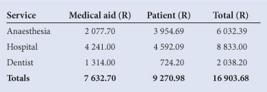
These extraordinarily exorbitant charges for a minor procedure illustrate the conundrum of runaway private healthcare costs that has publicly infuriated Health Minister Aaron Motsoaledi, and inspired the recent and unprecedented rebellion by members of Discovery Health Medical Scheme.
Why is private healthcare so outrageously expensive? The medical aid schemes are usually the scapegoat in the public perception, but it is the system that is deeply flawed. Medical aid scheme equivalents operate successfully in appropriately regulated environments in Western Europe. Addressing the US Congress in 2003, Marcia Angell, former editor of the New England Journal of Medicine and a fervent campaigner for healthcare reform in the USA, said: 'The underlying problem is that we treat healthcare like a market commodity instead of a social service. Healthcare is targeted not to medical need, but to the ability to pay. Markets are good for many things, but they are not a good way to distribute healthcare.'1
Private hospital facilities are predominantly owned by three major hospital groups, namely Netcare, Medi-Clinic and Life Healthcare, all strongly profit driven and listed on the JSE. Collectively, they own and operate more than three-quarters of all private sector beds and more than 80% of all private sector theatre facilities. Private hospitals primarily serve medical aid beneficiaries and look to the medical schemes to make their profit. Accordingly, their geographical distribution virtually mirrors that of medical aid scheme beneficiaries. The monopolistic configuration of the hospital industry means that many medical schemes are individually not well placed to negotiate competitive rates for hospital services. Schemes are not allowed, in terms of a 2004 ruling by the Competition Commissioner, to negotiate collectively for competitive rates. Competition regulators clearly treat healthcare as a commodity governed by free-market rules. Reference price lists for medical service providers are therefore proscribed, giving them free rein to charge what the market will bear. Private hospital costs accounted for 40.5% of healthcare benefits in the medical scheme risk pool in 2010.
The same applies to the procurement of pharmaceuticals, which accounted for 14.7% of medical aid disbursements in 2010 according to the Council for Medical Schemes, which the state is able to purchase at much lower cost for the public sector. As Discovery Heath CEO Jonathan Broomberg told the Sunday Independent of15 July 2012, 'new drugs and new technology often come onto the market at prices 5 or 10 times higher than the older technologies they are replacing'. Pharmaceutical pricing is complex, and prices can vary greatly between and within countries depending largely on the ability to bargain. Thus the same medicines are much cheaper in Canada than in the USA, whose private sector and competition regulations are similar to ours. The unregulated and unco-ordinated acquisition of sophisticated and highly expensive equipment contributes to inefficient use, and is ultimately paid for by the medical aids. In some cases, South Africa has a higher density of such equipment per population served than OECD countries.
The other major contributor to cost escalation is the fee-for-service reimbursement system for practitioners. With reference to South Africa, Bloomberg and Price have written that 'The "information gap" between doctors and their patients allows doctors to induce demand for their services. This leads to the potential for doctors to increase the supply of services when they stand to gain financially from doing so. There is extensive international evidence, at both national and micro levels, of the link between increased utilisation and the fee-for-service payment system.'2Sunday Independent cited above.
No wonder then that medical aid contributions have been increasing far above inflation at the same time as benefits have been progressively trimmed. With National Health Insurance apparently still at least 25 years away from full implementation, there is clearly an urgent need for a game plan to rescue the private sector from its self-destructive path.

Daniel J Ncayiyana
Editor
References
-
1. Angell M. http://www.pnhp.org/facts/statement_of_dr_marcia_angell_introducing_the_us_national_health_ insurance_act.php (accessed 19 September 2012).
» http://www.pnhp.org/facts/statement_of_dr_marcia_angell_introducing_the_us_national_health_ insurance_act.php - 2. Bloomberg J, Price MR. The impact of the fee-for-service reimbursement system on the utilisation of health services. Part I. A review ofthe determinants of doctors' practice patterns. S Afr Med J 1990;78(3):130-132.
