The complexity of HIV vasculopathy
We present a case and discuss stroke related to human immunodeficiency virus (HIV) infection and the difficulties of reaching a firm diagnosis of the cause of the aneurysmal vasculopathy. In the absence of a clear aetiology we suggest looking for varicella zoster virus (VZV) replication in the cerebrospinal fluid (CSF) by polymerase chain reaction (PCR) and treating with intravenous acyclovir, aiming for HIV control with appropriate antiretroviral therapy and providing suitable antiplatelet agents. If there is a high index of suspicion of VZV, therapy with acyclovir may be prudent even if the CSF PCR is negative (as may occur after the first 2 weeks of reactivation of infection). Determination of a VZV plasma:CSF IgG ratio is not readily available and would only provide surrogate support for a previous VZV infection in the central nervous system compartment.
FORUM
CLINICAL PRACTICE
The complexity of HIV vasculopathy
Alan StanleyI; Sally CandyII; Candyce LevinIII; Jeannine M HeckmannIV
IAlan Stanley is a senior lecturer and consultant in the Department of Medicine, University of Cape Town, with a research interest in HIV-related cerebrovascular disease
IISally Candy is a consultant neuroradiologist, in the Department of Radiology, University of Cape Town and Groote Schuur Hospital, Cape Town
IIICandyce Levin is a medical intern in the Department of Medicine, Victoria Hospital, Cape Town
IVJeannine Heckmann is Associate Professor of Neurology, Department of Medicine, University of Cape Town and Groote Schuur Hospital, with research interests in neuromuscular disease particularly myasthenia gravis and HIV-associated neuromuscular disease
We present a case and discuss stroke related to human immunodeficiency virus (HIV) infection and the difficulties of reaching a firm diagnosis of the cause of the aneurysmal vasculopathy. In the absence of a clear aetiology we suggest looking for varicella zoster virus (VZV) replication in the cerebrospinal fluid (CSF) by polymerase chain reaction (PCR) and treating with intravenous acyclovir, aiming for HIV control with appropriate antiretroviral therapy and providing suitable antiplatelet agents. If there is a high index of suspicion of VZV, therapy with acyclovir may be prudent even if the CSF PCR is negative (as may occur after the first 2 weeks of reactivation of infection). Determination of a VZV plasma:CSF IgG ratio is not readily available and would only provide surrogate support for a previous VZV infection in the central nervous system compartment.
Diffuse intracranial fusiform aneurysmal vasculopathy has been described in association with human immunodeficiency virus (HIV) infection, although much more frequently in children than in adults. This usually presents as either ischaemic or haemorrhagic stroke or subarachnoid haemorrhage, but has also been found incidentally. Neither the aetiology, nor the treatment of these strokes, is clear. We present a case in which the chronological events may shed some light on the pathogenesis of HIV-associated vasculopathy and outline the current understanding of this complex problem.
Case report
A 22-year-old woman presented with an acute stroke manifesting with left hemiparesis and hemineglect. She was HIV-positive with a CD4 count of 210/ì! and receiving second-line antiretroviral therapy (ART) consisting of tenofovir, lamivudine and Alluvia. She had a 6 pack year smoking history but had not used any recreational drugs. She had no other vascular risk factors for stroke.
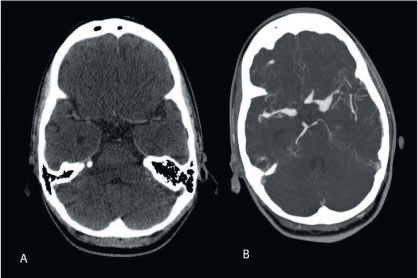
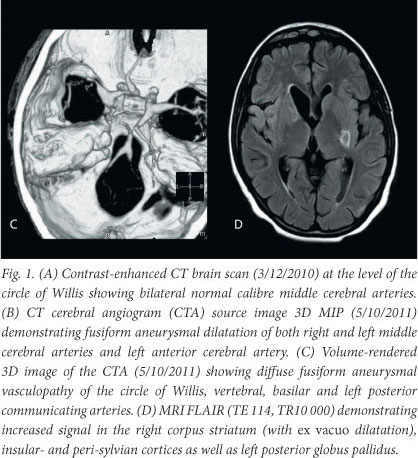
She had first been seen 13 months earlier in June 2010 when she was diagnosed with cytomegalovirus (CMV) retinitis and found to be HIV infected. A vitreous tap was performed and a polymerase chain reaction (PCR) was positive for CMV but negative for varicella zoster virus (VZV), herpes simplex virus (HSV)-1 and -2, Toxoplasma gondii and Mycobacterium tuberculosis. Her CD4 count was 76/ìÉ She was treated with intravitreous gancyclovir, and ART (lamivudine, tenofovir and nevirapine) was started in November 2010. A month later a contrast-enhanced computed tomography (CT) brain scan was normal apart from generalised cortical atrophy (Fig. 1A). Her CD4 count had increased to 99/ì!, but by January 2011 had deteriorated to 20/µl; suggesting non-adherence to therapy. Despite appropriate management her vision continued to deteriorate. A repeat vitreous tap in April 2011 showed a positive PCR for VZV in addition to CMV and she received 2 weeks of intravenous (IV) acyclovir. In July 2011 her CD4 count was 29/ì! and viral load was 2 037 280 RNA cps/ml. She admitted non-adherence to ART, possibly because of poor vision. Having failed her first ART regimen, she was switched to second-line therapy (detailed above).
Three months later she presented with right partial anterior circulation stroke. A CT brain scan confirmed a right middle cerebral artery territory infarct (not shown). In addition, a CT cerebral angiogram demonstrated diffuse fusiform aneurysmal dilatation of all vessels of the circle of Willis (Figs 1B and C). A subsequent magnetic resonance imaging (MRI) scan confirmed these abnormalities and demonstrated additional infarcts in the left posterior globus pallidus and right corpus striatum (Fig. 1D). The cerebrospinal fluid (CSF) showed an elevated protein (0.98 g/l; normal = 0.15 - 0.45), normal glucose (2.6 mmol/l; serum glucose 5.1 mmol/l) with 10 lymphocytes, 0 polymorphonuclear cells and 5 erythrocytes. The CSF IgG index was elevated at 1 (normal <0.7) as was the CSF IgG synthesis rate (>100 mg/24 h; normal ≤3.3). The fluorescent treponemal antigen (FTA), cryptococcal latex agglutination test (CLAT) and Gram stain and culture were all negative. PCR for VZV, HSV-1 and -2 and CMV were negative. She was initially treated with empirical IV acyclovir but this was discontinued when the PCR for VZV in the CSF proved negative. She was started on aspirin and made a significant recovery from the stroke although she remained functionally blind as a consequence of CMV retinitis.
Discussion
Fusiform aneurysmal vasculopathy has been reported in HIV-infected subjects with stroke although the aetiology remains uncertain.12
HIV-associated intracranial fusiform aneurysmal vasculopathy was first described in children in the 1980s and over the last decade has been increasingly reported in adult patients (71=19).1111,2 These findings are similar to those described for VZV and most reports have not systematically excluded VZV.3,4 When presence of VZV was investigated it mainly involved measuring active viral replication via CSF PCR, which, as discussed below, may not always be relevant. Nevertheless, there are several cases where VZV antigen was not histologically detected and where HIV was identified in the vessel wall by immune-histochemistry (anti-gp41) or PCR.1
Further support for HIV as the direct cause for intracranial vasculopathy comes from the fact that HIV causes an extracranial and peripheral large-vessel vasculopathy, a finding that is extremely rare with VZV.25
Stroke related to recent VZV infection is also well described with more than 70 cases reported among children. This association has also been observed in adults ,with the largest series containing 30 patients. In addition there are 8 separately described cases of VZV with an associated aneurysmal vasculopathy.44
VZV vasculopathy involves both large and small intracranial vessels. The most frequent angiographic abnormalities are segmental constriction with poststenotic dilatation. Fusiform aneurysmal dilatation is less common.3et al.6
The persistence of VZV DNA in the vessel wall after a course of IV acyclovir as found in a case at postmortem is of concern.44
The difficulty for the clinician lies in distinguishing HIV vasculopathy from VZV vasculopathy, and in determining whether aneurysmal vasculopathy represents a specific, possibly latent, VZV vasculopathy in HIV-infected hosts. Although the development of aneurysmal vasculopathy in our patient was temporally associated with VZV reactivation in the CNS, HIV replication was also uncontrolled. It is possible that an HIV-infected individual with VZV vasculopathy is at greater risk of developing the aneurysmal form of vasculopathy. An additional intriguing feature of our case is that she presented with stroke at a time when systemic immune reconstitution had occurred.
In conclusion, this case highlights some of the difficulties associated with identifying the cause of aneurysmal vasculopathy in an HIV-infected individual. In the absence of a clear aetiology we suggest looking for VZV replication in the CSF by PCR and treating with IV acyclovir, aiming for HIV control with appropriate ART and providing suitable antiplatelet agents. If there is a high index of suspicion of VZV, therapy with acyclovir may be prudent even if the CSF PCR is negative (as may occur after the first 2 weeks of reactivation of infection). It is worth noting that determination of a VZV plasma:CSF IgG ratio is not readily available and would only provide surrogate support for a previous VZV infection in the CNS compartment.
References
-
1. Goldstein DA, Timpone J, Cupps TR. HIV-associated intracranial aneurysmal vasculopathy in adults. J Rheumatol 2010;37(2):226-233. [http://dx.doi.org/10.3899/jrheum.090643]
» http://dx.doi.org/10.3899/jrheum.090643 -
2. Chetty R. Vasculitides associated with HIV infection. J Clin Pathol 2001;54(4):275-278. [http://dx.doi.org/10.1136/jcp.54.4.275]
» http://dx.doi.org/10.1136/jcp.54.4.275 -
3. Bhayani N, Ranade P, Clark NM, McGuinn M. Varicella-zoster virus and cerebral aneurysm: case report and review of the literature. Clin Infect Dis 2008;47(1):e1-3. [http://dx.doi.org/10.1086/588842]
» http://dx.doi.org/10.1086/588842 -
4. Nagel MA, Cohrs RJ, Mahalingam R, et al. The varicella zoster virus vasculopathies: clinical, CSF, imaging, and virologic features. Neurology 2008;70(11):853-860. [http://dx.doi.org/10.1212/01.wnl.0000304747.38502.e8]
» http://dx.doi.org/10.1212/01.wnl.0000304747.38502.e8 - 5. Tinkle BT, Ngo L, Luciw PA, Maciag T, Jay G. Human immunodeficiency virus-associated vasculopathy in transgenic mice. J Virol 1997;71(6):4809-4814.
-
6. Nagel MA, Traktinskiy I, Azarkh Y, et al. Varicella zoster virus vasculopathy: analysis of virus-infected arteries. Neurology 2011;77(4):364-370. [http://dx.doi.org/10.1212/WNL.0b013e3182267bfa]
» http://dx.doi.org/10.1212/WNL.0b013e3182267bfa