Medical inpatient mortality at Groote Schuur Hospital, Cape Town, 2002 - 2009
BACKGROUND: Despite the challenges facing healthcare in South Africa, empirical insights into the performance of healthcare services over time are scarce. METHODS: We analysed first admissions of adult medical inpatients to Groote Schuur Hospital, Cape Town, from January 2002 to July 2009. Data included age, sex, medical specialty, and date of admission and discharge. We used population group and hospital billing codes as proxy measures for socio-economic status (SES). We calculated the duration of stay in days from the date of admission to discharge, and inpatient mortality rates per 1 000 patient days. Poisson regression was used to estimate mortality rate ratios (MRR) in unadjusted analysis and after adjusting for potential confounders. RESULTS: There were 42 582 first admissions. Patient demographics shifted towards a lower SES. Median age decreased from 52 years in 2002 to 49 years in 2009, while patients aged 20 - 39 years increased in proportion from 26% to 31%. The unadjusted proportion of admissions which resulted in in-hospital deaths increased from 12% in 2002 to 17% in 2009. Corresponding mortality rates per 1 000 patient days were 17.0 (95% confidence interval (CI) 15.9 - 18.3) and 23.4 (95% CI 21.6 - 25.4), respectively (unadjusted MRR 1.37; 95% CI 1.23 - 1.53). Annual increases in mortality rates were highest during the first 2 days following admission (increasing from 30.1 to 50.3 deaths per 1 000), and were associated with increasing age, non-paying patient status, black population group and male sex, and were greatest in the emergency ward (adjusted MRR 1.73, comparing 2009 with 2002; 95% CI 1.49 - 2.01). DISCUSSION: Increasing medical inpatient mortality rates at a large South African academic hospital were most marked during the first 2 days after admission and appeared greatest among emergency medical inpatients.
Medical inpatient mortality at Groote Schuur Hospital, Cape Town, 2002 - 2009
L MyerI; E SmithII; B M MayosiIII
ICentre for Infectious Diseases Epidemiology and Research, School of Public Health and Family Medicine, Faculty of Medicine, University of Cape Town. MB ChB, PhD
IICentre for Infectious Diseases Epidemiology and Research, School of Public Health and Family Medicine, Faculty of Medicine, University of Cape Town. MPH, FCP (SA)
IIIDepartment of Medicine, Faculty of Health Sciences, Groote Schuur Hospital and University of Cape Town. DPhil
Corresponding author
ABSTRACTBACKGROUND: Despite the challenges facing healthcare in South Africa, empirical insights into the performance of healthcare services over time are scarce.
METHODS: We analysed first admissions of adult medical inpatients to Groote Schuur Hospital, Cape Town, from January 2002 to July 2009. Data included age, sex, medical specialty, and date of admission and discharge. We used population group and hospital billing codes as proxy measures for socio-economic status (SES). We calculated the duration of stay in days from the date of admission to discharge, and inpatient mortality rates per 1 000 patient days. Poisson regression was used to estimate mortality rate ratios (MRR) in unadjusted analysis and after adjusting for potential confounders.
RESULTS: There were 42 582 first admissions. Patient demographics shifted towards a lower SES. Median age decreased from 52 years in 2002 to 49 years in 2009, while patients aged 20 - 39 years increased in proportion from 26% to 31%. The unadjusted proportion of admissions which resulted in in-hospital deaths increased from 12% in 2002 to 17% in 2009. Corresponding mortality rates per 1 000 patient days were 17.0 (95% confidence interval (CI) 15.9 - 18.3) and 23.4 (95% CI 21.6 - 25.4), respectively (unadjusted MRR 1.37; 95% CI 1.23 - 1.53). Annual increases in mortality rates were highest during the first 2 days following admission (increasing from 30.1 to 50.3 deaths per 1 000), and were associated with increasing age, non-paying patient status, black population group and male sex, and were greatest in the emergency ward (adjusted MRR 1.73, comparing 2009 with 2002; 95% CI 1.49 - 2.01).
DISCUSSION: Increasing medical inpatient mortality rates at a large South African academic hospital were most marked during the first 2 days after admission and appeared greatest among emergency medical inpatients.
Over the past decade, the public health system in South Africa (SA) has struggled to develop and extend its services in the face of a complex burden of disease.1per capita public health expenditure markedly less than that of the private healthcare system, expanding access to services to marginalised populations remains a challenge nationwide.234,5
This unique burden of disease has placed stress on a public healthcare system that seeks to increase access to services, and limits the country's ability to achieve Millennium Development Goals.6
Methods
Our analysis focused on adult medical inpatients at Groote Schuur Hospital (GSH) - a tertiary academic hospital in Cape Town. An historic centre of excellence in SA,7
Facility management and the Research Ethics Committee of the University of Cape Town granted permission to use anonymous patient information from the hospital admissions database. Data available included basic demographic information (such as age and sex) and hospital information (medical specialty, dates of admission and discharge). Given the significant inequalities in socioeconomic status (SES) across SA,8
We included only individuals' first admissions in the analysis to account for repeated admissions of chronic cases (e.g. for renal dialysis). We excluded repeat admissions, individuals aged <15 years, and records pre-dating 1 January 2002, when the hospital database was not used regularly. We calculated the duration of stay in days from the date of admission to discharge, and inpatient mortality rates per 1 000 patient days.
Poisson regression was used to estimate mortality rate ratios (MRR) in unadjusted (crude) analysis and after adjusting for potential confounders. Estimates of mortality rates and MRR are accompanied by 95% confidence intervals (CIs).
Results
From January 2002 to July 2009, there were 63 172 admissions to the medical wards identified in the hospital database, representing 42 582 patients. Overall, 9 958 (23%) had more than one admission during this period, accounting for an additional 19 802 admissions. Hereafter, analysis is restricted to the 42 582 first admissions.
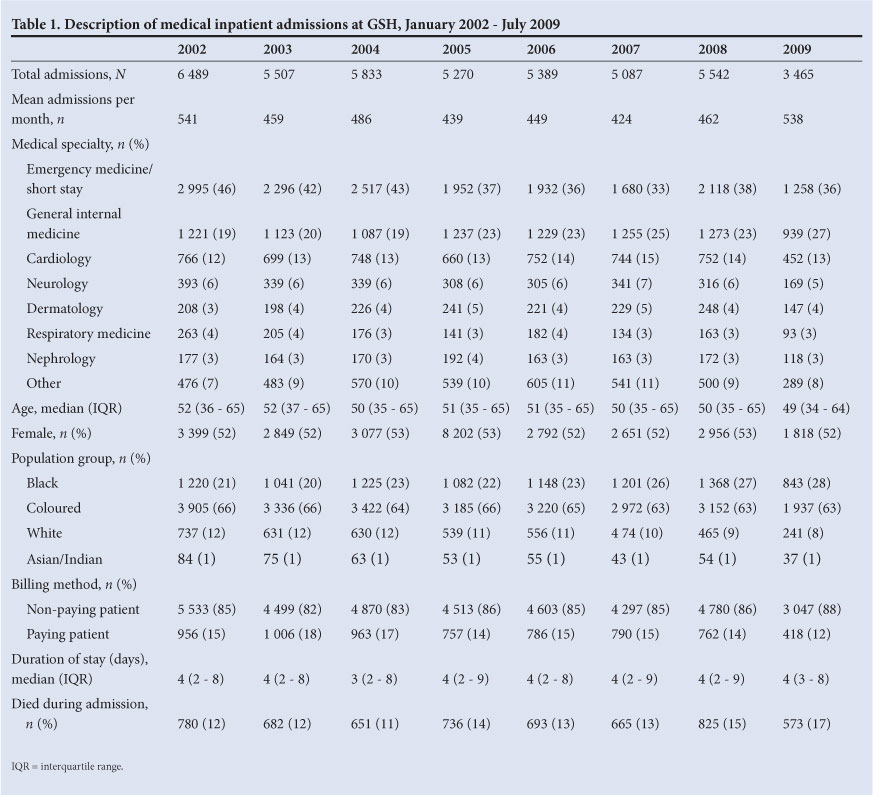
Table 1 describes the medical inpatient admissions by calendar year. The number of admissions per month and the duration of stay across all medical wards remained constant over time.
The overall distribution of patients across specialties changed minimally, with a reduction in emergency medicine/short-stay ward inpatients mirrored by an increase in general medical inpatients. Patient demographics shifted towards an increasing proportion of patients of low SES, with an increase in the proportions of patients classified as black and patients deemed unable to pay hospital fees. The median age of patients decreased from 52 years in 2002 to 49 years in 2009, with an increased proportion of patients aged 20 - 39 years (26 - 31%).
Overall, the crude proportion of adult medical admissions which resulted in in-hospital death increased from 12% in 2002 to 17% in 2009. The corresponding mortality rates were 17.0/1 000 patient days (95% CI 15.9 - 18.3) and 23.4/1 000 patient days (95% CI 21.6 - 25.4), respectively (crude MRR 1.37; 95% CI 1.23 - 1.53) (Fig. 1a). The annual increases in mortality rates were highest during the first 2 days following admission (increasing from 30.1 to 50.3 deaths per 1 000), with mortality rates beyond 2 days of admission appearing relatively constant over consecutive calendar years (Fig. 1b).
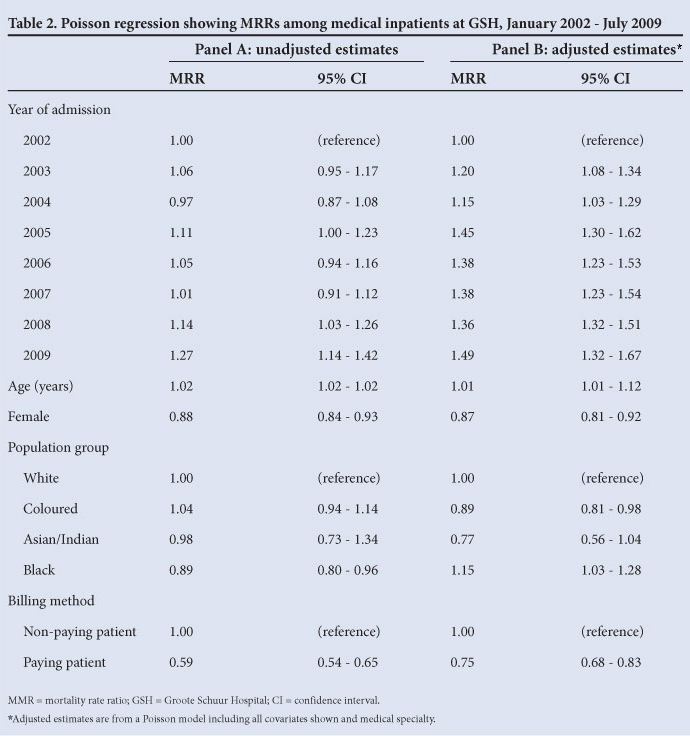
Mortality rates were highest in the short-stay medical ward (62.0/1 000 patient days; 95% CI 59.9 - 64.2) and respiratory medicine ward (including the respiratory ICU) (34.4/1 000 patient days; 95% CI 31.4 - 37.6). Mortality was lowest among dermatology inpatients (1.0/1 000 patient days; 95% CI 0.7 - 1.4). Increasing inpatient mortality rates were also associated with increasing age, non-paying patient status, black population group and male sex (Table 2). The annual increases in mortality persisted after adjusting for medical specialty and these individual patient characteristics (adjusted MRR comparing 2009 with 2002, 1.49; 95% CI 1.32 - 1.67). In analyses restricted by medical specialty, the annual increases in inpatient mortality were greatest in the emergency medicine/short-stay ward (adjusted MRR 1.73, comparing 2009 with 2002; 95% CI 1.49 - 2.01).
Discussion
These data suggest that medical inpatient mortality rates at a large SA academic hospital have increased over the past decade. Furthermore, the overall hospital mortality rate of 12 - 17% is comparable to rates observed in North America during the mid-19th century and is substantially higher than the 2.1% mortality rate documented in contemporary Massachusetts.9,10
These increases in mortality rate are most marked during the first 2 days after admission and appear greatest among emergency medicine/short-stay medical inpatients. These death rate trends appear independent of shifts in the demographic characteristics of medical inpatients. They also reverse a trend of improving inpatient mortality rates for medical patients at GSH, from 21% the 1940s to 10% in the 1980s.11,12
Several explanations may help us understand these increases in hospital mortality. First, it is plausible that increasing mortality rates reflect greater morbidity in the populations served by GSH.1314
Second, increased access to healthcare services may enable individuals with more advanced morbidity to access tertiary care. Since 1994 there has been a movement across SA to increase access to public health services through an expanded PHC platform.1516
Finally, increasing inpatient mortality may reflect changes in the quality of medical care. Over the past decade public healthcare resource allocation has shifted to PHC services at the expense of tertiary hospital budgets.1517
This analysis of hospital-wide mortality is unique in sub-Saharan Africa; few public health facilities of the size of our centre have high-quality electronic medical records systems. However, these data remain subject to significant limitations. Measures to understand the reasons for inpatient death, such as the underlying diagnosis and the degree of morbidity upon arrival at hospital, are not available. This analysis also focuses on a single tertiary institution during a 7-year period, and the results should be generalised with caution, particularly given the context-specific nature of health systems.
In summary, mortality among medical inpatients is increasing in this SA tertiary hospital, a trend most marked by increasing deaths soon after admission. This phenomenon likely reflects increasing morbidity of the local population and the increasing accessibility of tertiary healthcare services with the expansion of PHC. These findings point to the challenges facing tertiary hospitals, and healthcare services more generally, in SA.
Acknowledgements. We thank Wendy Bryant at the GSH Informatics Department for assistance with data collection. B M Mayosi is funded in part by the Lily and Ernst Hausmann Research Trust, the South African Medical Research Council, and the National Research Foundation of South Africa.
References
-
1. Coovadia H, Jewkes R, Barron P, Sanders D, McIntyre D. The health and health system of South Africa: Historical roots of current public health challenges. Lancet 2009;374(9692):817-834. [http://dx.doi.org/10.1016/S0140-6736(09)60951-X]
» http://dx.doi.org/10.1016/S0140-6736(09)60951-X -
2. Mills A, Ataguba JE, Akazili J, et al. Equity in financing and use of healthcare in Ghana, South Africa, and Tanzania: implications for paths to universal coverage. Lancet 2012;380(9837):126-133. [http://dx.doi.org/10.1016/S0140-6736(12)60357-2]
» http://dx.doi.org/10.1016/S0140-6736(12)60357-2 -
3. Karim SSA, Churchyard GJ, Karim QA, Lawn SD. HIV infection and tuberculosis in South Africa: an urgent need to escalate the public health response. Lancet 2009;374(9693):921-933. [http://dx.doi.org/10.1016/S0140-6736(09)60916-8]
» http://dx.doi.org/10.1016/S0140-6736(09)60916-8 - 4. Puoane T, Steyn K, Bradshaw D, et al. Obesity in South Africa: The South African demographic and health survey. Obes Res 2002;10(10):1038-1048.
-
5. Mayosi BM, Flisher AJ, Lalloo UG, Sitas F, Tollman SM, Bradshaw D. The burden of non-communicable diseases in South Africa. Lancet 2009;374(9693):934-947. [http://dx.doi.org/10.1016/S0140-6736(09)61087-4]
» http://dx.doi.org/10.1016/S0140-6736(09)61087-4 -
6. Chopra M, Lawn JE, Sanders D, et al. Achieving the health Millennium Development Goals for South Africa: challenges and priorities. Lancet 2009;374(9694):1023-1031. [http://dx.doi.org/10.1016/S0140-6736(09)61122-3]
» http://dx.doi.org/10.1016/S0140-6736(09)61122-3 - 7. Digby A, Phillips H. At the Heart of Healing: Groote Schuur Hospital, 1938 - 2008. Johannesburg: Jacana, 2008.
- 8. Schneider M, Bradshaw D, Steyn K, Norman R, Laubscher R. Poverty and non-communicable diseases in South Africa. Scand J Public Health 2009;37(2):176-186. [http://dx.doi.org/10.1177/1403494808100272]
- 9. Meyer GS, Demehin AA, Liu X, Neuhauser D. Two hundred years of hospital costs and mortality - MGH and four eras of value in medicine. N Engl J Med 2012;366(23):2147-2149.
- 10. Shahian DM, Wolf RE, Iezzoni LI, Kirle L, Normand S-LT. Variability in the measurement of hospital-wide mortality rates. N Engl J Med 2010;363(26):2530-2539.
- 11. Brock JF. Changing pattern of morbidity at Groote Schuur Hospital, 1939 - 1965. S Afr Med J 1967;41(12):739-747.
- 12. Benatar SR, Saven A. Morbidity trends in the medical wards at Groote Schuur Hospital - 1971 and 1982. S Afr Med J 1985;67(24):968-974.
- 13. De Vries E, Raubenheimer P, Kies B, Burch VC. Acute hospitalisation needs of adults admitted to public facilities in the Cape Town Metro district. S Afr Med J 2011;101(1):760-764.
-
14. Tollman SM, Kahn K, Sartorius B, Collinson MA, Clark SJ, Garenne ML. Implications of mortality transition for primary healthcare in rural South Africa: A population-based surveillance study. Lancet 2008;372(9642):893-901. [http://dx.doi.org/10.1016%2FS0140-6736(08)61399-9]
» http://dx.doi.org/10.1016%2FS0140-6736(08)61399-9 - 16. Ataguba JE, McIntyre D. Who benefits from health services in South Africa? Health Econ, Policy Law 2012;2:1-26.
-
17. Lilford RJ, Pronovost P. Using hospital mortality rates to judge hospital performance: A bad idea that just won't go away. BMJ 2010;340:c2016. [http://dx.doi.org/10.1136/bmj.c2016]
» http://dx.doi.org/10.1136/bmj.c2016
 Corresponding author:
B M Mayosi (