Bacillary angiomatosis: A rare finding in the setting of antiretroviral drugs
An HIV-positive 39-year-old man presented with generalised nodular lesions. He was apyrexial and normotensive, with a normal respiratory rate. The rest of the examination was normal. He had been on antiretroviral therapy for > 4 years; most importantly, he was on a second-line regimen (lopinavir/ritonavir (Aluvia) based). The appearance of the lesions, together with the history, led to the following possible diagnoses: bacillary angiomatosis, cutaneous cryptococcosis, nodular Kaposi sarcoma or cutaneous histoplasmosis.
CASE REPORT
Bacillary angiomatosis: A rare finding in the setting of antiretroviral drugs
M C Madua
MB ChB, FCP (SA); Rob Ferreira Hospital, Nelspruit, South Africa
ABSTRACTAn HIV-positive 39-year-old man presented with generalised nodular lesions. He was apyrexial and normotensive, with a normal respiratory rate. The rest of the examination was normal. He had been on antiretroviral therapy for > 4 years; most importantly, he was on a second-line regimen (lopinavir/ritonavir (Aluvia) based). The appearance of the lesions, together with the history, led to the following possible diagnoses: bacillary angiomatosis, cutaneous cryptococcosis, nodular Kaposi sarcoma or cutaneous histoplasmosis.
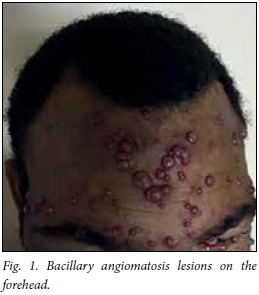
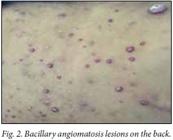
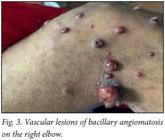
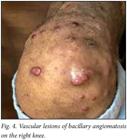
An HIV-positive 39-year-old man presented with generalised nodular lesions (Figs 1 - 4). He was apyrexial and normotensive, with a normal respiratory rate. The rest of the examination was normal. He had been on antiretroviral therapy for >4 years; most importantly, he was on a second-line regimen (lopinavir/ritonavir (Aluvia) based). The appearance of the lesions, along with the history, led to the following possible diagnoses: bacillary angiomatosis, cutaneous cryptococcosis, nodular Kaposi sarcoma or cutaneous histoplasmosis.
Investigations revealed the following:
• absolute CD4 count: 15 x 106
• HIV viral load: 1 764 copies/mL
• blood cultures: aerobic and anaerobic -negative
• full blood count: normocytic anaemia, with haemoglobin: 8 g/dL (14.3 - 18.3)
• urea and electrolytes: normal
• liver function test: normal
• calcium, magnesium and phosphate: normal
• urine microscopy culture and sensitivity: negative
• sputum for GeneXpert for tuberculosis: negative
• bone marrow trephine biopsy: multi-factorial cause of anaemia, no obvious infiltrates
• skin biopsy - vascular proliferative lesions in keeping with Bartonella, substantiated by a polymerase chain reaction (PCR)
• tissue culture: no growth
• chest radiography: normal.
A diagnosis of bacillary angiomatosis is clinical and can be confirmed by serology, blood culture and histology.[1-3] It is difficult to culture Bartonella;[1-2] serology cannot differentiate between species.[1,2] Warthin-Starry silver staining is the gold standard for diagnosis, revealing clusters of bacilli.[1,2]
Vascular proliferative lesions are typical histological features.[1,2] In our case, however, Warthin-Starry silver staining did not reveal the bacilli; therefore, tissue was sent for PCR testing, which confirmed the diagnosis. Nested PCR yielded 19 positive results from 188 specimens from HIV-positive patients.[4] After being treated with erythromycin and rifampicin for 1 month, our patient's lesions regressed.
Discussion
There are > 30 different species of Bartonella,[1,2] of which 13 have been isolated in humans.[1,2] Bartonella species are fastidious, facultative, intracellular, slowgrowing Gram-negative bacteria that cause a broad spectrum of diseases in humans.[1] The two most commonly associated with HIV are B. quintana and B. henselae.[1,2,5] Transmission of Bartonella to humans occurs via a cat scratch that is contaminated with Bartonella-infected fleas.[1,2,5,6] The prevalence of Bartonella in HIV-positive persons is reported to be very low.[1,2,6] Various organs or systems may be involved in Bartonella infection, ranging from skin, subcutaneous tissue, bones, mucosa, central nervous system, lymph nodes, liver and spleen.[1,2,7-10] Unspecific manifestations, such as bacteraemia, endocarditis and unexplained fever, have also been reported.11,2
References
- 1. Longo D, Fauci A, Kasper DL, et al., eds. Harrison's Principles of Internal Medicine. 18th ed. New York: McGraw-Hill, 2011.
- 2. Goldman L, Schafer AI. Goldman's Cecil Medicine. 24th ed. New York: Saunders, 2012.
- 3. Koehler JE, Sanchez MA, Garrido CS, et al. Molecular epidemiology of Bartonella infections in patients with bacillary angiomatosis-peliosis. N Engl J Med 1997;337(26):1876-1883.
- 4. Frean J, Arndt S, Spencer D. High rate of Bartonella henselae infection in HIV-positive outpatients in Johannesburg, South Africa. Trans R Soc Trop Med Hyg 2002;96:549-550.
- 5. Tappero JW, Perkins BA, Wenger JD, et al. Cutaneous manifestations of opportunistic infections in patients infected with human immunodeficiency virus. Clin Microbiol Rev 1995;8(3):440-450.
- 6. Plettenberg A, Lorenzen T, Burtsche BT, et al. Bacillary angiomatosis in HIV-infected patients - an epidemiological and clinical study. Dermatology 2000;201:326-331.
- 7. Koehler JE, Quinn FD, Berger TG, et al Isolation of Rochalimaea species from cutaneous and osseous lesions of bacillary angiomatosis. N Engl J Med 1992;327:1625-1631.
- 8. Perkocha LA, Geaghan SM, Yen TSB, et al. Clinical and pathological features of bacillary peliosis hepatis in association with human immunodeficiency virus infection. N Engl J Med 1990;323:1586.
- 9. Spach DH, Panther LA, Thorning DR, et al. Intracerebral bacillary angiomatosis in a patient infected with human immunodefiency virus. Ann Intern Med 1992;116:740-742.
- 10. Mohle-Boetani JC, Koehler JE, Berger TG, et al. Bacillary angiomatosis and bacillary peliosis in patients infected with human immunodeficiency virus: Clinical characteristics in a case-control study. Clin Infect Dis 1996;22:794-800.