Cytomegalovirus antibodies among healthy blood donors at Lagos University Teaching Hospital
OBJECTIVES: Cytomegalovirus (CMV) is found worldwide in all geographical locations and socio-economic groups and is the virus most frequently transmitted to a developing child before birth. This study aimed to determine the prevalence and risk factors for CMV antibodies among healthy blood donors at Lagos University Teaching Hospital (LUTH). METHODS: A cross-sectional study was carried out among consecutively recruited replacement blood donors attending the blood donor clinic at LUTH. A 5 ml blood sample was collected from each consenting participant and serum-assayed for CMV IgG/IgM using an enzyme-linked immunosorbent assay (ELISA)-based kit. RESULTS: A total of 122 healthy donors were recruited; 96% of the donors were IgG anti-CMV positive while 19.5% were IgM anti-CMV positive. Previous history of blood transfusion was not significantly related to CMV positivity. CONCLUSIONS: The seroprevalence of CMV appears to be very high in this environment among healthy blood donors. Based on previous studies that showed a decrease in the incidence of CMV disease when blood is screened for CMV (IgM), the incidence of the disease can be decreased in Lagos if blood is screened for CMV.
Cytomegalovirus antibodies among healthy blood donors at Lagos University Teaching Hospital
A A AkinbamiI, *; A S AkanmuII; T A AdeyemoII; K O WrightIII; M O DadaII; A O DosunmuIV
IMB ChB, BSc, MSc, MPH, FMCPath, College of Medicine and Lagos University Teaching Hospital, University of Lagos, Idi-Araba, Lagos, Nigeria
IIMB BS, FMCPath, College of Medicine and Lagos University Teaching Hospital, University of Lagos, Idi-Araba, Lagos, Nigeria
IIIMB BS, MPH, FMCPH, College of Medicine and Lagos University Teaching Hospital, University of Lagos, Idi-Araba, Lagos, Nigeria
IVMB ChB, FWACP, College of Medicine and Lagos University Teaching Hospital, University of Lagos, Idi-Araba, Lagos, Nigeria
OBJECTIVES: Cytomegalovirus (CMV) is found worldwide in all geographical locations and socio-economic groups and is the virus most frequently transmitted to a developing child before birth. This study aimed to determine the prevalence and risk factors for CMV antibodies among healthy blood donors at Lagos University Teaching Hospital (LUTH).
METHODS: A cross-sectional study was carried out among consecutively recruited replacement blood donors attending the blood donor clinic at LUTH. A 5 ml blood sample was collected from each consenting participant and serum-assayed for CMV IgG/IgM using an enzyme-linked immunosorbent assay (ELISA)-based kit.
RESULTS: A total of 122 healthy donors were recruited; 96% of the donors were IgG anti-CMV positive while 19.5% were IgM anti-CMV positive. Previous history of blood transfusion was not significantly related to CMV positivity.
CONCLUSIONS: The seroprevalence of CMV appears to be very high in this environment among healthy blood donors. Based on previous studies that showed a decrease in the incidence of CMV disease when blood is screened for CMV (IgM), the incidence of the disease can be decreased in Lagos if blood is screened for CMV.
Human cytomegalovirus (CMV) is a ubiquitous agent that commonly infects individuals from diverse geographical and socio-economic backgrounds. Although most CMV infections are asymptomatic, certain patient groups are at risk of developing serious illness and long-term sequelae from CMV infection. CMV remains the leading cause of congenital viral infection and a significant cause of transfusion-acquired infections in the immunocompromised.
Blood transfusion and CMV infection
CMV-specific antibody of the IgM class is a marker of active or recent primary infection with the virus. Post-transfusion CMV infection correlates positively with the receipt of blood from CMV IgM-positive donors.45
Seroprevalence of CMV among blood donors
A World Health Organization (WHO)-sponsored survey of complement-fixing antibodies against CMV reported frequencies ranging from 40% in highly industrialised areas, to 100% in developing countries; Nigerian blood donors from Ibadan were 100% seropositive.6
A study of the seroprevalence of CMV among voluntary blood donors in India reported that none of the 200 donors tested positive for CMV IgM antibody, but 95% were positive for CMV IgG antibody.7et al. in Chandigarh, India, showed 100% seropositivity for CMV in the population aged >20 years,8et al. in Pondicherry showed that 84 - 96% of adults had the antibody.910
The American Association of Blood Banks has recommended transfusion from donors who are seronegative for CMV, or the use of deglycerolised frozen red blood cells (RBCs) for transfusion in a seronegative preterm (<1 200 g) child born to a mother with negative or unknown immune status regarding CMV infection.1112
Methods
A cross-sectional study was done at the blood donor clinic of the Lagos University Teaching Hospital, which registers an average of 30 replacement donors daily. All consenting donors were recruited consecutively between 8 July and 20 August 2006. Approval was obtained from the institution's research and ethics committee. Participants were asked and aided to fill the structured questionnaires, including demographic information and history of previous exposure to blood transfusion. Inclusion criteria were: age 18 - 60 years, weight >50 kg, haemoglobin >12.5 g/dl, and normal blood pressure, pulse and temperature. Exclusion criteria were: history of chronic illness (e.g. hypertension, diabetes, asthma), commercial sex workers and intravenous drug users.
Collection of samples
A blood sample of 5 ml was collected into a sterile un-anticoagulated bottle, which was centrifuged, serum-separated into a sterile bottle and stored at –20oC. Sera were tested for IgG and IgM CMV by the enzyme-linked immunosorbent assay (ELISA) test. The CMV-specific IgG/IgM antibodies were studied by the commercial Dia.Pro Diagnostic Bioprobes CMV IgG/IgM ELISA Kit (Italy), according to the manufacturer's instructions. All specimens were analysed using the enzyme immunoassay test. The cut-off of IgG was set at 0.5 WHO IU/ml (Calibrator 2) by the kit's manufacturer. Samples with a concentration >0.5 WHO IU/ml were considered positive for CMV IgG, with samples with concentration below the cut-off as negative results. IgM test results were interpreted as a ratio of the sample optical density (OD) of 450 nm and the sample rate/cut-off value (S/Co) as follows: <1.0=negative; 1.0 - 1.2=equivocal; and >1.2=positive. The controls and the calibrators passed the validation check recommended by the manufacturers of both the IgG and the IgM kits.
The descriptive data were given as means ± standard deviation (SD). The chi-squared test was used for the analytic assessment. The differences were considered to be statistically significant when the p-value obtained was <0.05.
Results
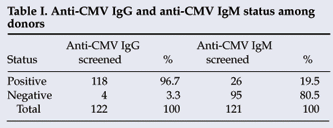
The response rate was 100%. There were 122 healthy donors; 95.4%.were men, and 2 gender records were not completed. The mean age of respondents was 31.3±8.7 years overall, and 33.2±9.0 for healthy male donors. A total of 122 donors were screened for anti-CMV IgG (Table I), of whom 96.7% were positive; 6.5% had a previous history of blood transfusion (Table II) and were all positive for anti-CMV IgG (100%). Of the 114 (93.5%) without a history of blood transfusion, 110 (96.5%) were positive for anti- CMV IgG. No statistically significant association existed among healthy donors between history of blood transfusion and being anti-CMV IgG positive. Of the 121 donors screened for anti- CMV IgM (Table I), only 19.5% were positive.
Interestingly, the 8 healthy donors who had been previously transfused were anti-CMV IgM negative (100%) (Table II) whereas 87 (76.9%) of the 114 without a history of transfusion were anti-CMV IgM negative. No significant association was established between anti-CMV IgM and history of blood transfusion among healthy blood donors.
Discussion
The 96% CMV IgG seroprevalence among blood donors in this study is in keeping with the study at Ibadan, Nigeria, with a seroprevalence of 100%.67-9 The high seroprevalence in Nigeria and India contrasts with Western literature, in which seroprevalence in blood donors ranges from 38% to 75%. A seroprevalence of 40% was found in highly industrialised nations.6
We found an anti-CMV IgM seroprevalence of 19.5% among healthy blood donors, compared with 0% found in India.81013in vivo and in vitro.
There was no statistically significant association between history of blood transfusion and being CMV IgG/IgM positive among healthy donors. Hence, previous blood transfusion is not a risk factor for CMV antibody production as seen in this study, which is at variance with the finding of Tolpin et al.1415
CMV infections are important clinical problems in patients with HIV infections and AIDS. The use of CMV-antibody-free blood component is indicated for CMV-antibody-negative AIDS patients.16
Conclusions
The seroprevalence of anti-CMV IgG and IgM is very high among blood donors in Nigeria. Based on previous studies that showed a decrease in the incidence of CMV disease when blood is screened for CMV (IgM), the incidence of the disease can be decreased in Lagos if blood is screened for CMV.
Limitations of this study
Reliability of information on blood transfusion provided by patients and the possible reasons for finding small numbers of those who have been previously transfused.
As most replacement donors in Lagos are males, because for cultural reasons many females are discouraged from blood donation, this may introduce significant gender bias to a seroprevalence study.
References
- 1. Tolpin MD, Stewart JA, Warren D, et al. Transfusion transmission of cytomegalovirus confirmed by restriction endonuclease analysis. J Pediatr 1985; 107: 953-956.
- 2. Bayer WL, Tegtmeier GE. The blood donor: detection and magnitude of cytomegalovirus carrier status and the prevalence of cytomegalovirus antibody. Yale J Biol Med 1976; 49: 5-12.
- 3. Adler S. Transfusion-associated cytomegalovirus infections. Rev Infect Dis 1983; 5: 977-993.
- 4. Lentz EB, Dock NL, McMahon CA, Fiesthumel SR, Arnold CB, Lamberson HV. Detection of anti-body of cytomegalovirus-induced early antigens and comparison with four serologic assays and presence of viruria in blood donors. J Clin Microbiol 1988; 26: 133-135.
- 5. Lamberson HV, McMillan JA, Weiner LB, et al. Screening blood donors for IgM to CMV. J Infect Dis 1988; 157: 820-823.
- 6. Krech U. Complement fixing antibodies against CMV in different parts of the world. Bull World Health Organ 1973; 49: 103-106.
- 7. Atul K, Ramachandrum VG. Seroprevalence of cytomegalovirus among voluntary blood donors in Dehli, India. J Health Popul Nutr 2002; 20(4): 348-351.
- 8. Pal SR, Chitkara NK, Krech V. Seroepidemiology of cytomegalovirus infection in and around Chandigarh. Indian J Med Res 1972; 60: 973-978.
- 9. Madhavan HN, Prakash K, Agarwal SC. Cytomegalovirus infections in Pondicherry: a serological survey. Indian J Med Res 1974; 62: 297-300.
- 10. Lamberson HV Jr, McMillan JA, Weiner LB, et al. Prevention of transfusion-associated cytomegaloviral infection in neonates by screening blood donors for IgM to CMV. J Infect Dis 1988; 157: 820-823.
- 11. Holland PV, Schmitt PJ. Standards for Blood Banks and Transfusion Services. 12th ed. Arlington, VA: Committee on Standards, American Association of Blood Banks, 1987: 30-31.
- 12. Galea G, Urbaniak SJ. Cytomegalovirus studies on blood donors in north-east Scotland and a review of UK data. Vox Sang 1993; 64: 24-30.
- 13. Mollison PL. Some unfavorable effects of transfusion. In: Blood Transfusion in Clinical Practice. 6th ed. Oxford: ELBS Blackwell Scientific Publications, 1979: 617-665.
- 14. Tolpin MD, Stewart JA, Warren D, et al. Transfusion transmission of cytomegalovirus confirmed by restriction endonuclease analysis. J Pediatr 1985; 107: 953-956.
- 15. Beneke JS, Tegtmeier GE, Alter HJ, Luetkemeyer RB, Solomon R, Bayer WL. Relation of titers of antibodies to CMV in blood donors to the transmission of cytomegalovirus infection. J Infect Dis 1984; 150: 883-888.
- 16. Mc Cullough JJ. Transfusion transmitted disease. In: Transfusion Medicine. New York: Mc Graw-Hill, 1998: 361-386.