The fiscal cost of 24-hour clinical coverage: Commuted overtime v. shift-based models in a South African regional hospital
BACKGROUND: South Africa (SA)'s public health system relies on commuted overtime (COT) to provide 24-hour medical cover in hospitals. Persistent concerns about excessive working hours, fatigue and patient safety have renewed interest in shift-based staffing models. Local evidence on the workforce and fiscal implications of such a transition remains limited. OBJECTIVES: To determine the staffing complement required to deliver continuous 24-hour surgical coverage under a shift-based system, and to model the personnel cost implications across three staffing configurations compared with the current COT arrangement. Clinical outcomes and optimal staffing levels were not assessed. METHODS: We conducted a retrospective cost analysis from a health-system perspective at a regional hospital in eThekwini District, KwaZulu-Natal Province, SA, using the Department of General Surgery as the case study. Three staffing models were compared: the current COT model; a hybrid model with medical officers (MOs) on 12-hour shifts and specialists retained on COT; and an expanded hybrid model with additional specialist posts. Annual personnel costs were calculated using 2024/25 occupation-specific dispensation salary notches under grade 1 and mixed-grade assumptions. Sensitivity analyses examined variations in specialist salaries, workload estimates and absence allowances. RESULTS: The baseline complement comprised eight MOs and four specialists. Delivering continuous shift-based coverage required scaling the MO complement to 22, a 175% increase. On a base-salary-only comparison, annual costs rose from ZAR13.54 million (all grade 1) to ZAR27.56 million under hybrid model A (+103.7%) and to ZAR31.71 million under hybrid model B (+134.3%). When estimated COT payments are incorporated into the current model baseline - using group 3 parameters and a 1.3 × ordinary hourly rate multiplier applied to 16 contracted overtime hours per week - total estimated annual remuneration rises to ZAR20.58 million (all grade 1) and ZAR23.21 million (mixed grades). Under this COT-inclusive comparison, hybrid model A represents a cost increase of ~48% and hybrid model B ~79%. Shift-based models increase total personnel expenditure under both costing approaches; the COT-inclusive figures are the primary policy-relevant comparator. Sensitivity analyses confirmed robustness across all scenarios tested. CONCLUSION: Replacing COT with a 12-hour shift system requires a substantially greater number of MOs, and increases total personnel costs by 48 - 79% when estimated overtime is included in the baseline. Hybrid models reduce but do not eliminate this impact. Any transition should be phased, locally costed using verified payroll data and aligned with national workforce planning priorities.
commuted overtime; shift work; medical officers; workforce costs; public hospitals; South Africa
The fiscal cost of 24-hour clinical coverage: Commuted overtime v. shift-based models in a South African regional hospital
J MthethwaI; H HlelaII; T MojiIII; S MtshaliIV; O MahomedV
IMPH, PhD; Dr Pixley Ka Isaka Seme Memorial Hospital, KwaZulu-Natal Department of Health, Durban, South Africa
IIMB ChB, PGDip-Health Management; Dr Pixley Ka Isaka Seme Memorial Hospital, KwaZulu-Natal Department of Health, Durban, South Africa
IIIMB ChB, MPH; General Clinical Services, KwaZulu-Natal Department of Health, Pietermaritzburg, South Africa
IVMB ChB, PhD; General Clinical Services, KwaZulu-Natal Department of Health, Pietermaritzburg, South Africa
VMMed (PHM), PhD; Discipline of Public Health Medicine, College of Health Sciences, University of KwaZulu-Natal, Durban, South Africa
BACKGROUND: South Africa (SA)'s public health system relies on commuted overtime (COT) to provide 24-hour medical cover in hospitals. Persistent concerns about excessive working hours, fatigue and patient safety have renewed interest in shift-based staffing models. Local evidence on the workforce and fiscal implications of such a transition remains limited.
OBJECTIVES: To determine the staffing complement required to deliver continuous 24-hour surgical coverage under a shift-based system, and to model the personnel cost implications across three staffing configurations compared with the current COT arrangement. Clinical outcomes and optimal staffing levels were not assessed.
METHODS: We conducted a retrospective cost analysis from a health-system perspective at a regional hospital in eThekwini District, KwaZulu-Natal Province, SA, using the Department of General Surgery as the case study. Three staffing models were compared: the current COT model; a hybrid model with medical officers (MOs) on 12-hour shifts and specialists retained on COT; and an expanded hybrid model with additional specialist posts. Annual personnel costs were calculated using 2024/25 occupation-specific dispensation salary notches under grade 1 and mixed-grade assumptions. Sensitivity analyses examined variations in specialist salaries, workload estimates and absence allowances.
RESULTS: The baseline complement comprised eight MOs and four specialists. Delivering continuous shift-based coverage required scaling the MO complement to 22, a 175% increase. On a base-salary-only comparison, annual costs rose from ZAR13.54 million (all grade 1) to ZAR27.56 million under hybrid model A (+103.7%) and to ZAR31.71 million under hybrid model B (+134.3%). When estimated COT payments are incorporated into the current model baseline - using group 3 parameters and a 1.3 × ordinary hourly rate multiplier applied to 16 contracted overtime hours per week - total estimated annual remuneration rises to ZAR20.58 million (all grade 1) and ZAR23.21 million (mixed grades). Under this COT-inclusive comparison, hybrid model A represents a cost increase of ~48% and hybrid model B ~79%. Shift-based models increase total personnel expenditure under both costing approaches; the COT-inclusive figures are the primary policy-relevant comparator. Sensitivity analyses confirmed robustness across all scenarios tested.
CONCLUSION: Replacing COT with a 12-hour shift system requires a substantially greater number of MOs, and increases total personnel costs by 48 - 79% when estimated overtime is included in the baseline. Hybrid models reduce but do not eliminate this impact. Any transition should be phased, locally costed using verified payroll data and aligned with national workforce planning priorities.
Keywords: commuted overtime, shift work, medical officers, workforce costs, public hospitals, South Africa
Providing continuous medical cover is a core requirement of hospital care, yet it remains one of the most resource-intensive aspects of service delivery. Both routine and emergency services, especially those operating outside regular hours, rely heavily on doctors, and the structure of their work has a direct impact on patient safety, workforce sustainability and costs. International experience shows that systems relying on extended duty hours differ markedly from those using regulated shift models, with important trade-offs among staffing levels, fatigue and expenditure.[1-3] Decisions about after-hours cover are therefore not only operational, but fundamentally economic.
In South Africa (SA)'s public sector, after-hours medical services are predominantly delivered through commuted overtime (COT). Under this model, doctors work a standard 40-hour week with additional contracted overtime hours. COT has enabled hospitals to maintain 24-hour services despite longstanding staff shortages. However, concerns have emerged regarding compliance with working-time norms, fatigue and rising costs. Evidence from a large tertiary hospital showed that interns frequently worked substantially more overtime than they were rostered for, often without formal recognition or compensation.[4] At the same time, national analyses have identified COT as a major and growing component of provincial compensation budgets, amounting to several billion rand annually.[5] These trends have intensified policy interest in alternative staffing models, including shift-based systems.
Despite this policy focus, there is little local evidence on the fiscal implications of replacing COT with shift-based arrangements in SA public hospitals. International studies on shift systems largely originate from high-income settings and are not directly applicable to the SA context, where staffing constraints, remuneration structures and budget ceilings differ substantially. National policy discussions have acknowledged the need for formal cost analysis to inform decisions on after-hours remuneration models.[6] However, few empirical studies have quantified the staffing requirements and budgetary impact of such a transition. This study addresses this gap by comparing the annual personnel costs of the current COT model with hybrid shift-based staffing models in the Department of General Surgery at a regional hospital in KwaZulu-Natal Province, SA, to inform evidence-based workforce and financing decisions.
Specifically, the analysis first determines the staffing requirement for continuous coverage under shift-based arrangements and then models the cost implications of that requirement - two analytically distinct questions that are addressed sequentially.
Methods
Study design and perspective
We conducted a retrospective cost analysis from a public health system perspective. The analysis compared alternative staffing models for providing continuous medical cover. The focus was on direct annual personnel costs and workforce requirements. Clinical outcomes were not assessed. It is important to note that this analysis addresses two conceptually distinct questions sequentially. The first is a workforce-planning question: how many medical officers (MOs) are required to deliver the defined service coverage under a shift system? The second is a fiscal question: what is the base salary cost of that headcount, compared with the current COT model? The workforce estimate is used as an input to the cost model. The study does not evaluate clinical quality, patient safety outcomes, or optimal staffing from a clinical governance perspective.
Study setting
The study was conducted at a regional public hospital in eThekwini District, KwaZulu-Natal Province. The hospital has ~500 beds. The Department of General Surgery served as the unit of analysis. The department offers 24-hour services and is responsible for 112 inpatient beds across multiple wards, including high care and intensive care units (ICUs). It operates a surgical outpatient clinic 5 days per week and runs two operating theatres daily for elective and emergency cases. The average monthly activity consists of ~180 general surgical cases and 200 gastrointestinal procedures. Continuous senior and junior medical cover is required.
General surgery was selected as the index department for this analysis for several reasons. Surgical services are among the highest-volume and most structurally complex service lines at the regional hospital level, combining inpatient ward care, theatre-based procedural work, outpatient services and continuous 24-hour emergency cover. This configuration generates coverage requirements across multiple concurrent service streams, thereby broadly representing high-demand hospital departments. The authors had direct access to departmental operational data, enabling accurate workload estimation. We acknowledge that results may differ in other service types, such as obstetrics, internal medicine and paediatrics, which have different coverage requirements and specialist-to-MO ratios; this is discussed further under limitations.
Data sources
Salary data were obtained from official provincial occupation-specific dispensation (OSD) salary notches for the 2024/25 financial year, as published by the Department of Public Service and Administration (DPSA). Information on existing staff establishments, service activity and coverage requirements was obtained from the hospital's human resources and clinical governance records. All data were aggregated at the departmental level.
Staffing models
Three staffing models were evaluated.
The current model (COT) reflects existing practice. The department is staffed by eight medical officers (MOs) and four specialists. All doctors are contracted for a 40-hour workweek with COT to provide after-hours cover.
Two hybrid shift-based models were developed to reflect a transition to 12-hour shifts for MOs while retaining specialists on COT.
In hybrid model A, the MO complement was increased to 22 and employed on 12-hour shifts. Four specialists were retained on COT for call duties.
In hybrid model B, 22 MOs were employed on shifts, and the specialist complement was increased to seven. Specialists remained on COT. The configuration of seven specialists was derived from a clinical supervision ratio analysis: with 22 MOs rostered across a 24-hour cycle, ~3 - 4 MOs would be concurrently on duty per shift. Applying a conservative 1:3 specialist-to-MO supervision ratio, consistent with clinical training and governance standards in Commonwealth surgical contexts, to concurrent shift coverage yields a minimum requirement of 6 - 7 specialists to ensure immediate specialist availability on each shift. Seven was therefore selected as the upper bound under conservative supervision standards. Hybrid model A, which retains four specialists, represents the lower bound, preserving the current specialist complement unchanged as a minimum feasible configuration. Indicative costs for the intermediate configurations of five and six specialists are provided in Appendix Table S1. A full shift system for specialists was not modelled, as this was considered impractical given current specialist shortages in the public sector and existing contractual arrangements.
Determination of MO requirements
The required MO headcount for a shift system was determined based on workload estimates. The total weekly doctor-hour requirement was derived from a structured analysis of the department's minimum safe coverage obligations across all service units operating within the 24-hour cycle, using actual departmental rosters and operational service records. The key service components and their estimated weekly hour contributions are summarised in Appendix Table S2. These were: inpatient ward rounds across 112 beds requiring two concurrent medical teams, 7 days per week (112 hours); continuous overnight ward cover 7 days per week (70 hours); dual-table elective theatre lists 5 days per week (80 hours); dedicated emergency theatre cover on continuous standby (168 hours); a 5-day surgical outpatient clinic (40 hours); daily high care and ICU input (28 hours); and structured clinical handover periods (14 hours). Additional weekend and public holiday cover requirements account for the remaining hours. This yields a total weekly coverage requirement of ~616 doctor-hours. For non-availability due to training, sick leave, annual leave and other unavoidable absences, we have allocated a 25% allowance. As a result, the effective productive time of each full-time equivalent was reduced to 30 hours per week. For clarity, this 30-hour effective productivity figure applies to MOs working 12-hour shifts under the proposed shift models, where formal leave entitlements are fully accommodated within the roster. Under the current COT model, MOs are contracted for 56 hours per week (40 ordinary hours plus 16 COT hours). Eight MOs at 56 hours per week yields 448 contractual hours per week. After a 25% absence allowance, effective contractual output under the current model is ~336 hours per week - substantially below the 616-hour coverage requirement. This discrepancy indicates that the current complement likely meets the 616-hour standard in part through hours worked in excess of contractual obligations.
A key assumption underlying this analysis is that both the current COT model and the proposed shift models deliver equivalent clinical service outputs, specifically, continuous 24-hour coverage across all the service units described. This assumption is necessary for a like-for-like cost comparison but may not hold in practice. If the current eight-MO complement meets coverage requirements partly because individual doctors work hours in excess of their contracted 56-hour week without formal compensation, then the effective labour input of the current model exceeds what is captured in the salary data, and the shift model represents a formalisation of that labour rather than a pure expansion. The implications of this for the cost comparison are discussed further in the discussion and limitations sections.
A requirement of roughly 20.5 full-time equivalents was calculated by dividing the total weekly requirement (616 hours) by the productive hours per full-time equivalent (30 hours). The 25% absence allowance was derived from statutory leave entitlements applicable to public sector employees under the Public Service Act 103 of 1994 and the Basic Conditions of Employment Act 75 of 1997 (BCEA), including 22 days of annual leave per annum, family responsibility leave, an average of 12 sick days per annum across the 3-year BCEA cycle, and 12 public holidays, collectively amounting to ~46 - 50 working days per year, equivalent to ~22 - 25% of available working days. We acknowledge that actual absenteeism in the SA public sector may exceed this figure in some contexts. A one-way sensitivity analysis varying the absence allowance between 20% and 40% is presented in Appendix Table S3. At higher absence rates, the required MO headcount increases from 24 to 28, further amplifying the fiscal difference between models. The base-case figure of 22 MOs should therefore be regarded as a conservative lower bound.
Salary and grade assumptions
Two grade scenarios were applied to reflect uncertainty in staff seniority. All grade 1 scenarios assumed that all MOs and specialists were appointed at entry-level salary notches. The mixed-grade scenario reflected a more realistic departmental hierarchy. MOs were assumed to comprise 50% grade 1, 25% grade 2 and 25% grade 3. The same 50/25/25 distribution was applied to specialists across grades 1, 2 and 3.
Annual base salaries for MOs in 2024/25 were:
Grade 1: ZAR1 001 349
Grade 2: ZAR1 142 553
Grade 3: ZAR1 322 352
Specialist annual salary ranges were:
Grade 1: ZAR1 341 855 - ZAR1 422 810
Grade 2: ZAR1 531 032 - ZAR1 623 609
Grade 3: ZAR1 773 222 - ZAR2 212 680
For base-case analyses, midpoint values of specialist salary ranges were used.
Costing approach
For each staffing model, the total annual personnel cost was calculated as the sum of annual base salaries for all posts included in that model. Costs were calculated in SA rand and expressed on an annual basis. The analysis was deliberately conservative and limited to direct salary costs. The following were excluded: overtime top-up payments, employer pension and medical aid contributions, Sunday or public holiday allowances, recruitment costs, and training or induction expenses. These exclusions were applied uniformly across all scenarios.
An important methodological note: the current COT model is costed on base salaries only. Actual COT payments, which represent the additional remuneration paid for overtime hours, were not incorporated, primarily because individual COT payment data at the departmental level were not accessible for this analysis. The comparison, therefore, reflects the differential in base salary cost between a COT-structured and a shift-structured workforce, rather than the full fiscal difference between these models, inclusive of overtime costs. Including actual COT payments in the baseline would increase the current model's cost and narrow the apparent fiscal gap. The fiscal differential reported in this study should be regarded as an upper-bound estimate of the true base salary difference, and this framing is explicitly acknowledged as a limitation.
Estimation of COT costs
Estimated COT payments have been incorporated into a revised analysis. At the study site, all MOs are employed under group 3 COT. This arrangement requires a total of 56 working hours per week, consisting of 40 standard hours and 16 COT hours (within the prescribed range of 13 - 20 overtime hours, standardised to 16 hours for this group). The applicable overtime rate for group 3 posts is 1.3 times the ordinary hourly rate. All overtime at this facility is performed and paid on-site; no off-site differential applies.
Estimated annual COT payments were calculated as follows. The ordinary hourly rate was derived by dividing the applicable annual base salary by 2 080 standard working hours. This rate was multiplied by 1.3 to obtain the hourly overtime rate, then multiplied by 832 annual overtime hours (16 hours per week × 52 weeks). Algebraically, this simplifies to a COT payment equal to 52% of base salary, and a total remuneration of 152% of base salary for all posts contracted on COT. This formula was applied to all eight MOs in the current model and to all specialists across all models, as specialists are retained on COT in both hybrid configurations.
Under the hybrid shift models, MOs work structured 12-hour shifts and are not contracted for overtime. Their COT component is therefore zero in hybrid models A and B. Specialists retained on COT continue to attract the full estimated COT component.
These estimates are planning approximations based on group 3 assumptions.
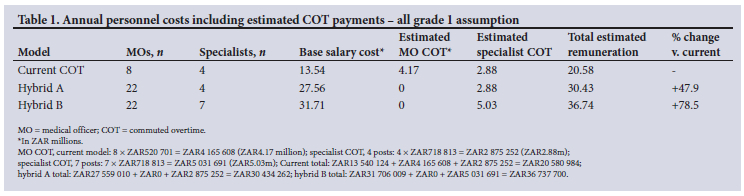
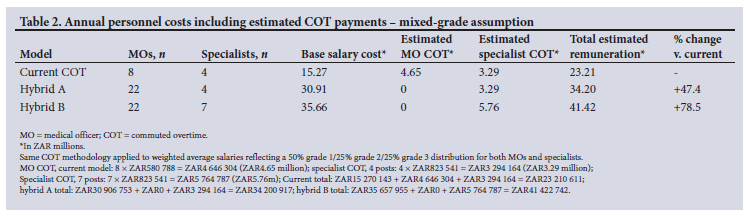
Actual COT expenditure may vary according to individual salary notch placement and the applicable KwaZulu-Natal provincial remuneration provisions. The estimates presented are based on group 3 contractual arrangements rather than verified payroll expenditure. They should not be used as a substitute for PERSAL-verified payroll data in formal budget submissions. Results incorporating these estimates are presented in Tables 1 and 2 and form the primary basis for policy-relevant cost comparison in this analysis.
Sensitivity analysis
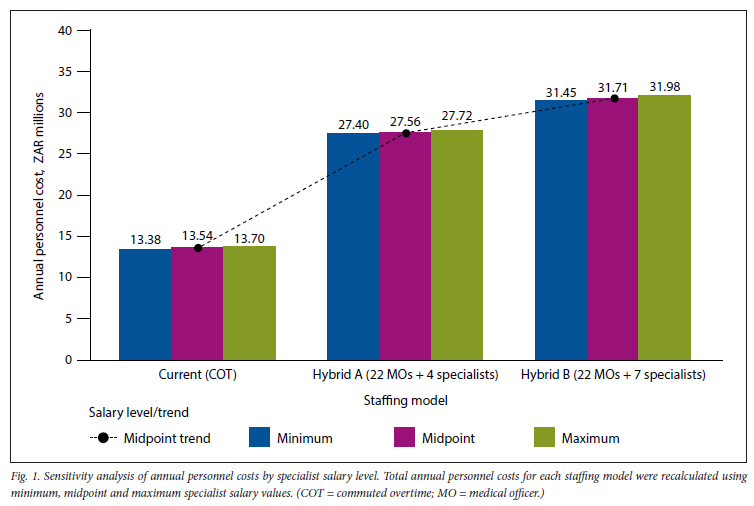
Three deterministic one-way sensitivity analyses were conducted. First, specialist salaries varied across the published OSD minimum, midpoint and maximum values for each grade, whereas MO salaries were treated as fixed-point values. This tested whether relative cost differences between staffing models were sensitive to specialist salary placement within approved ranges. Second, the weekly coverage requirement was varied between 560 and 672 hours, representing a ~10% range around the base estimate of 616 hours to account for uncertainty in workload estimation. For each value tested, the resulting MO headcount and associated total cost under hybrid model A (all grade 1) were calculated. Third, the absence allowance was varied between 20% and 40% to reflect the range of plausible absenteeism rates in the SA public sector. For each value, the resulting MO headcount and cost implications were calculated. Results of the second and third sensitivity analyses are presented in Appendix Tables S1 and S3, respectively. All calculations were performed in Excel version 2021 (Microsoft, USA.)
Ethical considerations
The study used aggregated, non-identifiable staffing and salary data. No patient-level or individual employee data were accessed. The analysis did not involve human participants. Formal research ethics approval was therefore not required. Administrative permission to conduct the study was obtained from the relevant district health office.
Results
Staffing requirements
Under the COT model, the Department of General Surgery was staffed by eight MOs and four specialists. Workload modelling indicated a requirement of ~616 doctor-hours per week to provide continuous service coverage. After applying a 25% allowance for leave, training and other absences, this translated to a requirement of 22 MOs to sustain a 12-hour shift system. This represented a 175% increase in the MO complement compared with the current establishment.
Personnel costs: All grade 1 assumptions
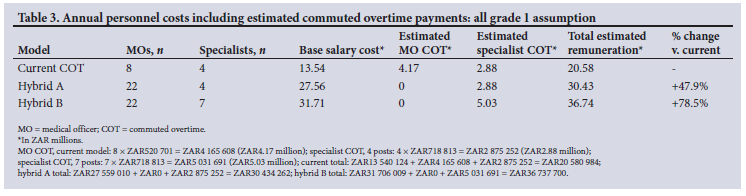
These figures reflect base salary costs only, and are retained as a methodologically conservative reference. They do not include overtime payments, employer contributions, or allowances. Assuming all staff were appointed at grade 1 entry-level salaries, the current COT model costs ZAR13.54 million per year. Hybrid model A, with 22 MOs on shifts and four specialists retained on COT, resulted in annual personnel costs of ZAR27.56 million, representing a 103.7% increase relative to the baseline. Hybrid model B, which increased the specialist complement to seven, further increased costs to ZAR31.71 million, a 134.3% increase. These figures are presented in Table 3.
Personnel costs: Mixed-grade assumption
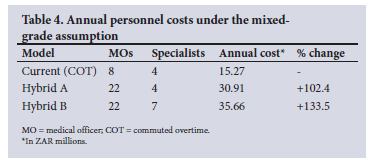
Under a mixed-grade distribution (50% grade 1, 25% grade 2 and 25% grade 3), the current COT model incurs an annual cost of ZAR15.27 million. Hybrid model A increased costs to ZAR30.91 million, a 102.4% increase, while hybrid model B increased costs to ZAR35.66 million, a 133.5% increase.
Employer contributions were excluded from the primary analysis to maintain comparability across models. For planning purposes, applying a conservative 20% loading to account for Government Employees Pension Fund contributions (16% of pensionable salary), medical scheme contributions and statutory levies yields the following indicative employment costs under all grade 1 assumptions: ZAR24.70 million for the current COT-inclusive model, ZAR36.52 million for hybrid model A and ZAR44.09 million for hybrid model B. These figures are illustrative only. The proportional cost differences between models are not materially altered by this adjustment, as shown in Table 4 and Appendix Table S4.
Personnel costs: COT-inclusive comparison
The base-salary-only comparison does not reflect the true fiscal cost of the current model because it omits the overtime payments inherent in COT-based employment. To address this, estimated COT payments have been incorporated using group 3 parameters: 16 contracted overtime hours per week (832 hours per year) at a 1.3 × multiplier of the ordinary hourly rate. Under this formula, the COT payment equals 52% of base salary, and total annual remuneration equals 152% of base salary for all posts contracted on COT. Under the hybrid shift models, MOs work structured shifts without contracted overtime and attract no COT payment. Specialists are retained on COT across all models and continue to attract the full estimated overtime component.
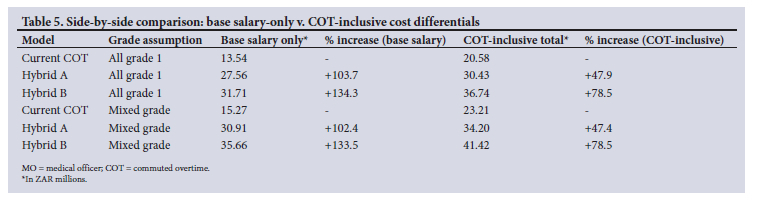
For the current model under all grade 1 assumptions, estimated COT payments for eight MOs total ZAR4.17 million and for four specialists ZAR2.88 million, yielding a total estimated annual remuneration of ZAR20.58 million - ZAR7.04 million above the base salary-only figure. Under mixed-grade assumptions, the corresponding total is ZAR23.21 million. These COT-inclusive figures represent the primary policy-relevant baseline against which the hybrid models are compared.
Under hybrid model A (all grade 1), the elimination of MO overtime is partially offset by the larger MO headcount. Total estimated annual remuneration is ZAR30.43 million, representing an increase of 47.9% over the COT-inclusive current model baseline of ZAR20.58 million. Hybrid model B, with seven specialists retained on COT, yields a total estimated remuneration of ZAR36.74 million, an increase of 78.5%. Under mixed-grade assumptions, hybrid model A increases total estimated remuneration by 47.4% (ZAR34.20 million v. ZAR23.21 million) and hybrid model B by 78.5% (ZAR41.42 million). These results are presented in Tables 1 and 2. A direct side-by-side comparison of base salary-only and COT-inclusive differentials across all models and grade assumptions is provided in Table 5.
Cost drivers
Across both grade assumptions and both costing approaches, the primary cost driver was the increase in MO numbers required to support shift-based coverage. The addition of 14 MO posts accounts for most of the cost differential between the current and hybrid models. Increasing the specialist complement from four to seven in hybrid model 1B added a further ZAR4.18 million (All grade 1, COT-inclusive) relative to hybrid model A, driven by both higher base salaries and the continued COT component for specialist posts. Specialist salary level did not alter the relative ranking of models in any scenario.
Sensitivity analysis
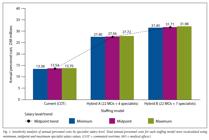
Varying specialist salaries across published minimum, midpoint and maximum values did not change the relative ranking of staffing models. In all scenarios, both hybrid models remained more than twice as expensive as the current COT model. Absolute costs varied, but percentage differences were stable. Sensitivity analyses on the workload estimate (Appendix Table S1) demonstrated that varying the weekly coverage requirement between 560 and 672 hours per week changed the required MO headcount by 1 - 2 posts in either direction, with corresponding changes in total cost of ~ZAR1 million per post. Across all tested values, both hybrid models remained substantially more expensive than the current COT arrangement. Sensitivity analysis on the absence allowance (Appendix Table S3) showed that at higher absence rates (30 - 40%), the required MO headcount increases from 24 to 28, further amplifying the cost differential. Hybrid model A would require 28 MOs, increasing total COT-inclusive estimated remuneration to ~ZAR34.9 million (all grade 1), a 69.6% increase over the current COT-inclusive baseline (Fig. 1).
Discussion
This study examined the cost implications of replacing COT with a 12-hour shift system for continuous surgical cover at a regional hospital. The main finding is that moving to a shift-based system requires a large increase in staff numbers and more than doubles annual personnel costs. Across all scenarios, costs increased by >100% and, in some cases, by >130%. However, when estimated COT payments are incorporated into the current model baseline, the fiscal differential narrows substantially. Under COT-inclusive assumptions using group 3 parameters and a 1.3 × ordinary hourly rate multiplier, hybrid model A increases total estimated remuneration by ~48% and hybrid model B by ~79%. The findings are consistent across both costing approaches: shift-based models increase total personnel expenditure in every scenario tested. However, the magnitude of the fiscal gap is substantially more moderate in the COT-inclusive analysis. This reflects a structural feature of the shift model that is obscured in base-salary comparisons: replacing contracted overtime with a larger headcount eliminates the 52% overtime premium for the MO cohort, thereby partially offsetting the cost of employing 14 additional doctors.
This distinction matters considerably for policy. A finding that shift models double personnel costs risks being dismissed as fiscally prohibitive without further deliberation. A finding that shift models increase total remuneration by 48 - 79%, while simultaneously eliminating the overtime premium currently paid to the MO cohort and replacing informal excess labour with formally rostered coverage, is a meaningfully different policy signal. It suggests that the transition, while still costly, involves a partial reallocation of existing overtime expenditure into headcount rather than a straightforward doubling of the wage bill.
The increase was driven by headcount rather than salary levels. To provide 24-hour cover without extended working hours, the number of MOs had to increase from 8 to 22. This adjustment was necessary once a standard working week and leave allowances were applied. The cost increase, therefore, reflects the need to employ more doctors to deliver the same volume of service. Under COT-inclusive assumptions, each additional MO adds ~ZAR1.52 million per year in total remuneration at grade 1, compared with ~ZAR1.0 million on a base salary-only basis. The difference reflects the overtime premium that would have been paid had those posts been COT-contracted rather than shift-based. The cost increase therefore reflects the need to employ more doctors to deliver the same volume of service, partially offset by the elimination of overtime payments for the expanded MO cohort.
These findings are consistent with existing evidence on public sector staffing pressures in SA. National expenditure reviews have shown that COT has grown steadily and now accounts for a substantial share of provincial compensation budgets, reaching almost ZAR15 billion by the 2023/24 financial year.[5] Much of this growth has been linked to increases in the number of doctors rather than changes in overtime rates. Our findings reflect the same dynamic. When systems replace extended hours with shifts, staffing numbers rise, and costs follow. It is equally important to acknowledge that the current COT model, as costed here, reflects only base salaries.
The actual COT cost includes overtime payment components that were not available at the departmental level, and therefore were not modelled. The true cost of the current model is higher than presented, indicating that the fiscal gap between the COT and shift models is smaller than the figures in this study suggest. The reported cost increase of ~100 - 134% should be interpreted as an upper bound. It is also worth noting that the current COT system has been subject to documented governance concerns beyond its fiscal scope. The Government Technical Advisory Centre's technical review and successive reports from the Auditor-General of SA[7] have identified structural weaknesses in COT monitoring and verification, including irregular payments for unverified overtime claims and cases where COT allowances were paid without corresponding documented service delivery. If a proportion of current COT cost represents payment for work not performed or inadequately verified, then the governance-adjusted cost of the current model may be lower than its nominal cost, and the relative cost advantage of a formally rostered shift system, which includes built-in attendance monitoring, may be understated in purely salary-based comparisons. Future analyses should incorporate an estimate of governance leakage in COT cost to further refine the comparison.
At the same time, concerns about the current COT system are well described. Studies from large academic hospitals have shown that doctors often work far beyond their rostered overtime hours, sometimes exceeding 150% of their scheduled time.[4] These hours are not always formally recorded or compensated. This suggests that the current model relies partly on excess labour. While this limits immediate cost, it raises concerns about fatigue, patient safety and the long-term sustainability of the workforce. Our analysis reveals that removing this informal buffer has significant financial implications.
A critical nuance in interpreting the cost differential between models is the role of this uncompensated excess labour in the cost comparison. If the current eight-MO complement delivers its coverage in part because individual MOs work substantially more than their contracted hours without formal compensation, then the current model achieves its apparent cost efficiency in part through a systematic underpayment of medical labour. Were this labour to be properly costed, either by paying at contractual overtime rates for actual hours worked, or by employing additional staff to cover excess uncontracted hours, the true cost of the current model would be higher than presented here. This means that the true fiscal gap between COT and a formally rostered shift model is narrower than the base salary comparison in this study suggests. This observation does not alter the finding that shift models are more expensive on a base-salary basis, but it is an important policy consideration: the apparent cost efficiency of COT may be partly illusory and is neither equitable nor sustainable over the long term.
International experience points in the same direction. Countries that introduced stricter controls on working hours required additional staff to maintain services. These reforms reduced fatigue and improved compliance, but increased costs and disrupted established service arrangements.[1-3] Importantly, these changes occurred in health systems with greater staffing depth and fiscal flexibility than those found in SA. The local environment is therefore considerably more constrained.
From a practical perspective, the funding implications are substantial. Each additional MO adds ~ZAR1 million in base salary per year. Increasing the complement from 8 to 22, therefore, adds ~ZAR15 million annually for a single department. Provincial health finances would be severely strained if this strategy were implemented in all regional hospitals. Beyond the direct fiscal implications modelled here, the operational feasibility of expanding the MO complement by 175% must be considered within SA's current public-sector hiring environment. Most provincial health departments are subject to personnel cost ceilings imposed by provincial treasuries as part of ongoing fiscal consolidation. In many provinces, these ceilings have translated into effective post freezes, where the creation of new funded posts requires exceptional motivation, post-establishment approval through DPSA post-provisioning norms and processes, and provincial treasury concurrence. Creating 14 additional funded MO posts in a single department at a single hospital would require additional budget increases, new work studies to be conducted to determine exact numbers required for each department and each facility, and approvals at multiple levels of government, a process that may take years and is not guaranteed in the current fiscal climate. In several provinces, personnel costs already consume 60 - 70% or more of total provincial health budgets, leaving minimal flexibility for new headcount. The finding that a 175% increase in MO complement is required should therefore be read not only as a cost finding but as a signal that the structural and administrative feasibility of reform is at least as significant a constraint as the fiscal one.
This analysis must also be situated within SA's broader fiscal context. The country's post-COVID fiscal consolidation has significantly compressed provincial health allocations, and the medium-term expenditure framework has required real reductions in some provinces' equitable share. Personnel cost is the largest and least flexible component of provincial health budgets. Any proposal to substantially expand medical headcount, therefore, competes directly with other health system priorities. Additionally, the National Health Insurance (NHI) Act, enacted in 2023, adds another layer of policy relevance. The transition to a purchasing authority model under NHI may alter how after-hours medical labour is contracted and remunerated. The implications for COT arrangements and shift-based employment within an NHI framework have not yet been formally articulated. Future analyses of COT reform should explicitly consider how NHI contracting models may affect the cost and feasibility of shift-based staffing.
The feasibility of recruiting 14 additional MOs must also be considered in light of SA's unequal workforce distribution and ongoing public-private sector competition. Medical officer vacancies are disproportionately concentrated in rural and under-resourced facilities. In urban regional hospitals such as the study site, competition with the private sector for MOs is significant, and salary differentials remain a retention challenge despite OSD improvements. A shift-based model with structured hours and predictable rosters may, in principle, improve the attractiveness of the public sector, particularly for doctors prioritising work-life balance. However, the net recruitment benefit in the SA context has not been empirically demonstrated and should not be assumed. These dynamics should be incorporated into any comprehensive policy analysis of COT reform. Hybrid models, in which MOs move to shifts while specialists remain on COT, may offer a temporary compromise. These arrangements preserve specialist incentives and limit the immediate expansion of a scarce workforce category. The COT-inclusive analysis reveals an additional structural advantage of hybrid arrangements that is not visible in base salary comparisons: by retaining specialists on COT, hybrid models avoid the headcount expansion that a full shift model would require for the specialist cohort, while the shift arrangement for MOs eliminates the MO overtime premium. The net effect is a cost profile that is more moderate than either a full-shift model or a base-salary-only analysis suggests. However, they also introduce different contractual arrangements within the same clinical team. This can lower morale and make handover and supervision procedures more difficult if it is not handled appropriately.[9]
The possible advantages of shift systems were not quantified in this study. Some of the higher expenses may be mitigated by reduced fatigue, fewer clinical errors and improved staff retention, but these effects are difficult to measure. Research suggests a connection between fatigue, increased error rates and burnout.[9,10] Additionally, shift systems create employment opportunities for unemployed doctors in a context where medical unemployment is an emerging concern in SA. At the same time, shift systems introduce costs not included here, including recruitment, onboarding, training and increased administrative requirements, which would further widen the fiscal gap during the transition period.
Study limitations
This study has several limitations that should be considered when interpreting the findings.
First, while COT-inclusive estimates have now been incorporated, these are based on group 3 planning assumptions and a 1.3 × multiplier consistent with the applicable national policy document, rather than PERSAL-verified payroll data. Actual COT costs depend on individual salary notch placement, exact hours claimed and the applicable KwaZulu-Natal provincial tariff schedule. For formal budget submissions, PERSAL-verified data should be used. Second, the 616 doctor-hours-per-week workload estimate, which drives the entire staffing calculation, was derived from a coverage requirements analysis using actual departmental rosters and operational data, rather than a prospective time-motion study. While a detailed service-unit breakdown is provided in Appendix Table S2, and sensitivity analyses demonstrate robustness across a ~10% range, uncertainty remains in this estimate. Future studies should validate workload requirements using prospective time-motion methodology.
Third, the 25% absence allowance, while grounded in statutory leave provisions, may underestimate actual absenteeism in the SA public sector. The sensitivity analysis in Appendix Table S3 demonstrates that higher absence rates materially increase the required MO headcount and cost.
Fourth, the analysis assumes equivalent service output across both the current COT model and the proposed shift models. This assumption may not hold in practice if the current model relies partly on excess uncontracted hours. The models are not fully equivalent in terms of labour inputs, and the cost comparison reflects a transition to formally contracted coverage from a system that currently relies partly on informally extracted labour.
Fifth, employer contributions (pension, medical aid, Unemployment Insurance Fund) of ~20% of base salary, and Sunday and public holiday allowances applicable to shift workers, were excluded. Their inclusion would increase absolute costs across all models, and would fall differentially on the shift models, widening the fiscal gap further.
Sixth, this is a single-department, single-hospital study. Results may not generalise to other service types, including obstetrics, internal medicine and paediatrics, other hospital levels, or other provincial contexts. The costing framework is transferable, but the specific figures require recalculation using local data.
Finally, transition costs, including recruitment, onboarding, training and induction for 14 additional MOs, were excluded from the analysis. Conservatively estimated at 1 - 3 months of salary per post in comparable SA public sector contexts, these costs represent ~ZAR1.2 - ZAR3.5 million in aggregate one-time costs above the recurrent annual cost increases modelled here.
We did not model a full-shift system for specialists owing to current shortages in the public sector.[11]
The international literature cited in this study primarily originates from European settings and reflects the implementation of the European Working Time Directive[3] in health systems with considerably greater staffing depth and fiscal flexibility than those in SA. The applicability of these findings to the local context is therefore limited. Of greater relevance to the SA situation is the growing literature on task-shifting, mid-level worker deployment and alternative staffing models from sub-Saharan African health systems. Studies from Kenya, Uganda and Mozambique have demonstrated that well-supported mid-level practitioners, including clinical officers, nurse practitioners and surgical assistants, can safely perform a defined range of medical tasks at lower cost than doctor-staffed equivalents.[12-14] In the SA context, clinical associates, a mid-level practitioner cadre introduced specifically for district and regional hospital care, represent a potential resource for after-hours cover that has received limited evaluation. Future analyses should consider whether task-shifting to mid-level practitioners could partially offset the MO headcount expansion required under shift models, moderating the fiscal impact identified in the present study.
Conclusion
In this regional hospital case study, introducing a 12-hour shift system for 24-hour surgical coverage required a substantial increase in MO numbers. On a base salary-only comparison, this resulted in more than a doubling of personnel costs. However, when estimated COT payments are incorporated into the current model baseline - using group 3 parameters and a 1.3 × ordinary hourly rate multiplier - the fiscal differential narrows considerably, with hybrid shift arrangements increasing total estimated remuneration by ~48 - 79% rather than the 102 - 134% suggested by base salary comparisons alone. Hybrid staffing arrangements, in which MOs move to structured shifts while specialists are retained on COT, reduced but did not remove this increase across both costing approaches. The current COT model remained the least costly option in every scenario tested.
While shift systems may address legitimate concerns about working hours, fatigue and patient safety, this analysis suggests that their base salary cost implications are substantial. The findings presented here should be interpreted as indicative estimates of the fiscal order of magnitude involved in a transition, not as precise projections suitable for direct budget submission. Excluding actual COT payments from the baseline may make the true fiscal differential smaller than reported. Any policy move away from COT should therefore begin with facility-level costing using actual COT cost data, followed by phased piloting with embedded evaluation. Alignment with national workforce planning frameworks and the emerging NHI contracting environment will be essential. Further research is needed, particularly on whether the potential benefits of shift systems, including reductions in fatigue-related adverse events, employment opportunities for unemployed doctors, burnout and medicolegal exposure, offset the additional personnel costs in the SA public health context.
Data availability. The study used aggregated departmental staffing, service coverage and publicly available salary data. The underlying costing calculations and assumptions are presented in the manuscript and supplementary tables. Additional aggregated data may be made available from the corresponding author on reasonable request, subject to institutional approval.
Declaration. None.
Acknowledgements. The authors acknowledge the management and administrative staff of Dr Pixley Ka Isaka Seme Memorial Hospital for facilitating access to the departmental operational and staffing information used in this study.
Author contributions. JM, HH, TM, SM and OM contributed to the study conception and design, interpretation of findings, critical revision of the manuscript and approval of the final version.
Funding. None.
Conflicts of interest. None.
References
-
1. Goddard AF. The European Working Time Directive and the impact on training: The current evidence. Clin Med 2010;10(4):317-318. https://doi.org/10.7861/clinmedicine.10-4-317
» https://doi.org/10.7861/clinmedicine.10-4-317 -
2. Datta ST, Davies SJ. Training for the future NHS: Training junior doctors in the United Kingdom within the 48-hour European working time directive. BMC Med Educ 2014;14(Suppl 1):S12. https://doi.org/10.1186/1472-6920-14-s1-s12
» https://doi.org/10.1186/1472-6920-14-s1-s12 -
3. Rodriguez-Jareño MC, Demou E, Vargas-Prada S, et al. European Working Time Directive and doctors' health: A systematic review of the available epidemiological evidence. BMJ Open 2014; 4(4):e004916. https://doi.org/10.1136/bmjopen-2014-004916
» https://doi.org/10.1136/bmjopen-2014-004916 -
4. Ramthol K, Erasmus N, Lightfoot J, Madikane S, Persadh M, Zikhali O. Actual compared with rostered overtime hours of interns at Charlotte Maxeke Johannesburg Academic Hospital, South Africa. Undergrad Res Health 2025;3(1). https://doi.org/10.7196/URHJ.2024.v3i1.2063
» https://doi.org/10.7196/URHJ.2024.v3i1.2063 - 5. Auditor-General of South Africa. Consolidated General Report on the Audit Outcomes of Provincial Departments of Health 2022/23. Pretoria: Auditor-General of South Africa, 2023.
- 6. People's Assembly. Questions asked to the Minister of Health: 2025-W531. Cape Town: Parliament of South Africa, 2025.
- 7. Government Technical Advisory Centre. Commuted overtime performed by medical doctors. Pretoria: National Treasury of South Africa, 2022.
-
8. Black P. The European working time directive. Br J Ophthalmol 2006;90(9):1082-1083. https://doi.org/10.1136/bjo.2006.097212
» https://doi.org/10.1136/bjo.2006.097212 -
9. West CP, Dyrbye LN, Shanafelt TD. Physician burnout: Contributors, consequences and solutions. J Intern Med 2018;283(6):516-529. https://doi.org/10.1111/joim.12752
» https://doi.org/10.1111/joim.12752 - 10. Rogers AE. Advances in patient safety. The effects of fatigue and sleepiness on nurse performance and patient safety. In: Hughes RG (ed). Patient Safety and Quality: An Evidence-Based Handbook for Nurses. Rockville: Agency for Healthcare Research and Quality, 2008.
- 11. National Department of Health, South Africa. Human Resources for Health Strategy 2030. Pretoria: NDoH, 2020.
-
12. Mullan F, Frehywot S. Non-physician clinicians in 47 sub-Saharan African countries. Lancet 2007; 370(9605):2158-2163. https://doi.org/10.1016/s0140-6736(07)60785-5
» https://doi.org/10.1016/s0140-6736(07)60785-5 -
13. Lehmann U, Van Damme W, Barten F, et al. Task shifting: The answer to the human resources crisis in Africa? Hum Resour Health 2009;7:49. https://doi.org/10.1186/1478-4491-7-49
» https://doi.org/10.1186/1478-4491-7-49 -
14. Ngcobo S. Clinical associates in South Africa. S Afr Med J 2019;109(10):706. https://doi.org/10.7196/SAMJ.2019.v109i10.14092
» https://doi.org/10.7196/SAMJ.2019.v109i10.14092

Accepted 7 May 2026