
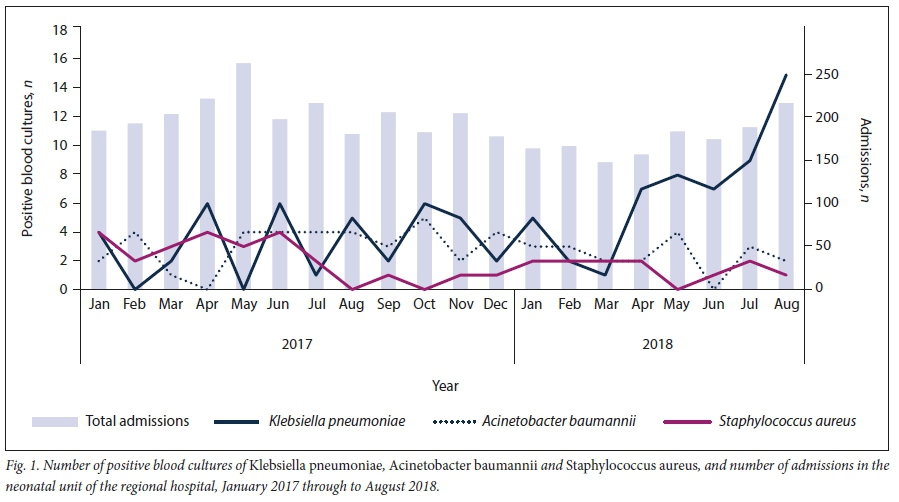
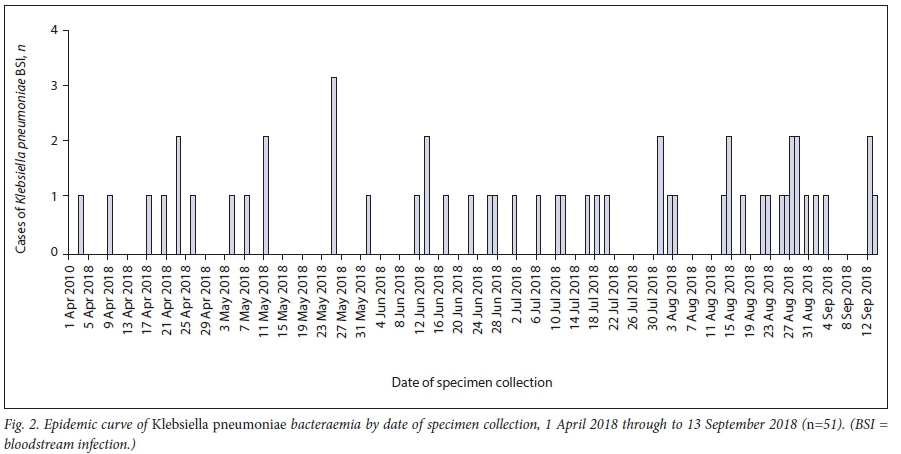
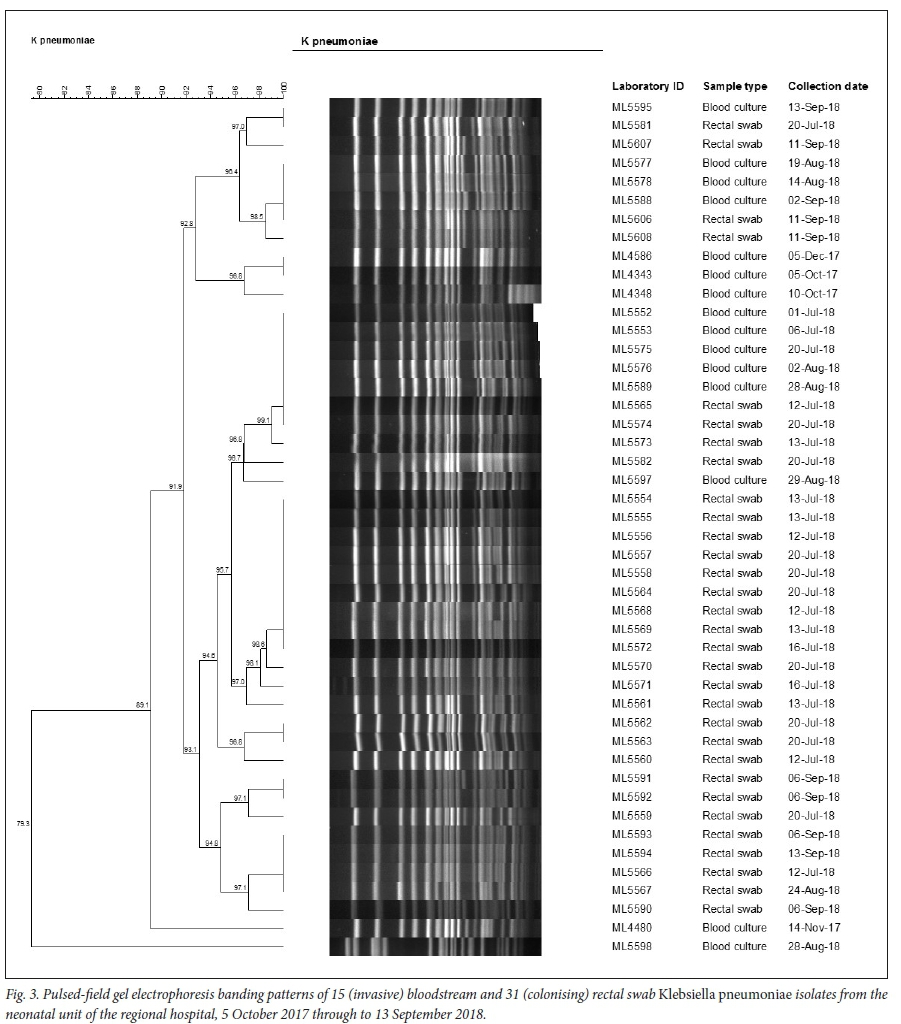
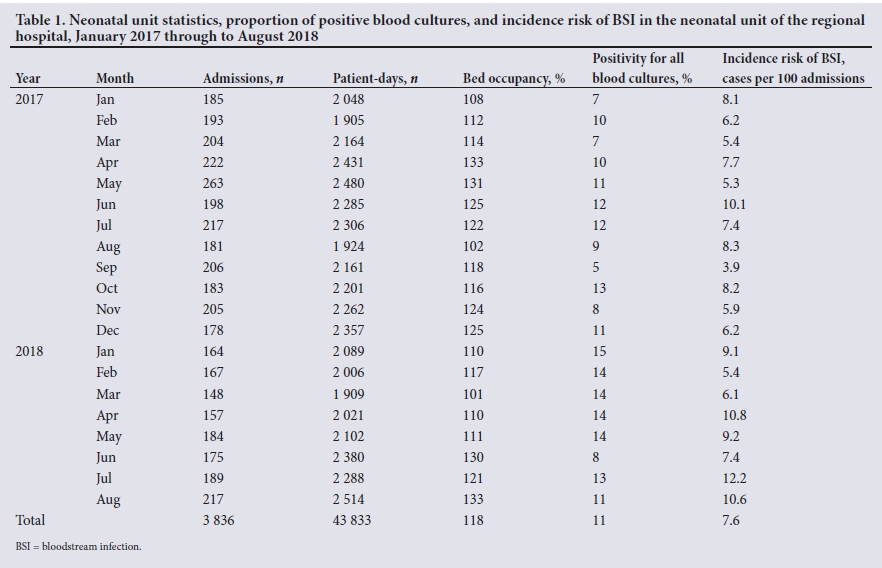
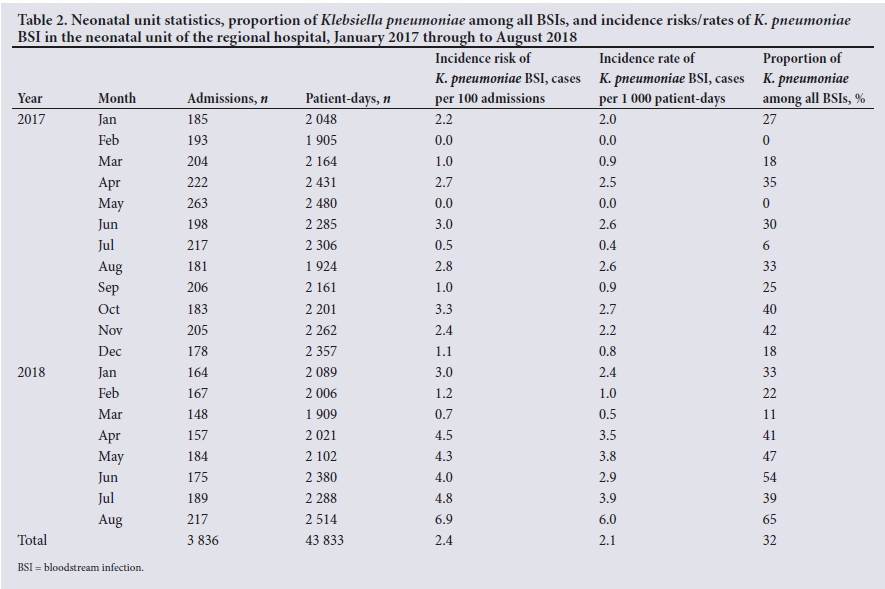
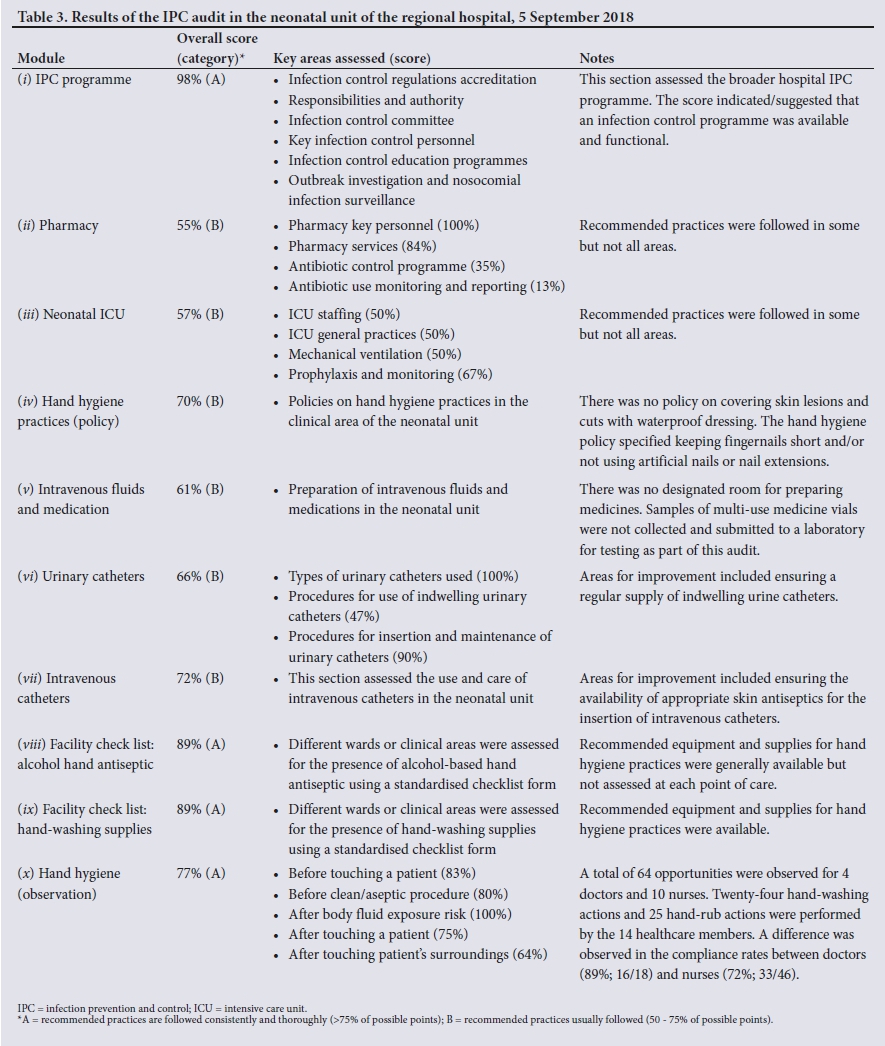
BACKGROUND. Rates of healthcare-associated infections (HAIs) among babies born in developing countries are higher than among those born in resource-rich countries, as a result of suboptimal infection prevention and control (IPC) practices. Following two reported deaths of neonates with carbapenem-resistant Klebsiella pneumoniae bloodstream infections (BSIs), we conducted an outbreak investigation in a neonatal unit of a regional hospital in Gauteng Province, South Africa. OBJECTIVES. To confirm an outbreak of K. pneumoniae BSIs and assess the IPC programme in the neonatal unit. METHODS. We calculated total and organism-specific BSI incidence risks for culture-confirmed cases in the neonatal unit for baseline and outbreak periods. We conducted a clinical record review for a subset of cases with K. pneumoniae BSI that had been reported to the investigating team by the neonatal unit. An IPC audit was performed in different areas of the neonatal unit. We confirmed species identification and antimicrobial susceptibility, and used polymerase chain reaction for confirmation of carbapenemase genes and pulsed-field gel electrophoresis (PFGE) for typing of submitted clinical isolates. RESULTS. From January 2017 to August 2018, 5 262 blood cultures were submitted, of which 11% (560/5 262) were positive. Of 560 positive blood cultures, 52% (n=292) were positive for pathogenic organisms associated with healthcare-associated BSIs. K. pneumoniae comprised the largest proportion of these cases (32%; 93/292). The total incidence risk of healthcare-associated BSI for the baseline period (January 2017 - March 2018) was 6.8 cases per 100 admissions, and that for the outbreak period (April - September 2018) was 10.1 cases per 100 admissions. The incidence risk of K. pneumoniae BSI for the baseline period was 1.6 cases per 100 admissions, compared with 5.0 cases per 100 admissions during the outbreak period. Average bed occupancy for the entire period was 118% (range 101 - 133%), that for the baseline period was 117%, and that for the outbreak period was 121%. In a subset of 12 neonates with K. pneumoniae bacteraemia, the median (interquartile range (IQR)) gestational age at birth was 27 (26 - 29) weeks, and the median (IQR) birth weight was 1 100 (880 -1 425) g. Twelve bloodstream and 31 colonising K. pneumoniae isolates were OXA-48-positive. All isolates were genetically related by PFGE analysis (89% similarity). Inadequate IPC practices were noted, including suboptimal adherence to aseptic technique and hand hygiene (57% overall score in the neonatal intensive care unit), with poor monitoring and reporting of antimicrobial use (pharmacy score 55%). CONCLUSIONS. Overcrowding and inadequate IPC and antimicrobial stewardship contributed to a large outbreak of BSIs caused by genetically related carbapenemase-producing K. pneumoniae isolates in the neonatal unit.
Research • SAMJ, S. Afr. med. j. 110
(8)
• • https://doi.org/10.7196/SAMJ.2020.v110i8.14471 linkcopy
 A multisectoral investigation of a neonatal unit outbreak of Klebsiella pneumoniae bacteraemia at a regional hospital in Gauteng Province, South Africa
- ,
- ,
- ,
- ,
- ,
- ,
- ,
- ,
- ,
- ,
- ,
- ,
About the authors
person
V Essel
school
National Institute for Communicable DiseasesDivision of Public Health Surveillance and ResponseNational Health Laboratory Service
Johannesburg
South Africa
About the authors
person
K Tshabalala
school
National Health Laboratory ServiceNational Institute for Communicable DiseasesDivision of Public Health Surveillance and Response
Johannesburg
South AfricaUniversity of the WitwatersrandFaculty of Health SciencesSchool of Public Health Medicine
Johannesburg
South Africa
About the authors
person
G Ntshoe
school
National Health Laboratory ServiceNational Institute for Communicable Diseases
Johannesburg
South AfricaUniversity of PretoriaFaculty of Health SciencesSchool of Health Systems and Public HealthSouth Africa
About the authors
person
E Mphaphuli
school
National Health Laboratory ServiceNational Institute for Communicable DiseasesDivision of Public Health Surveillance and Response
Johannesburg
South AfricaUniversity of PretoriaFaculty of Health SciencesSchool of Health Systems and Public HealthSouth Africa
About the authors
person
G Feller
school
National Institute for Communicable DiseasesOutbreak Response Unit
Johannesburg
South Africa
About the authors
person
A M Shonhiwa
school
National Institute for Communicable DiseasesDivision of Public Health Surveillance and Response
Johannesburg
South Africa
About the authors
person
K McCarthy
school
National Institute for Communicable DiseasesDivision of Public Health Surveillance and ResponseOutbreak Response Unit
Johannesburg
South Africa
About the authors
person
H Ismail
school
National Health Laboratory ServiceNational Institute for Communicable Diseases
Johannesburg
South Africa
About the authors
person
W Strasheim
school
National Health Laboratory ServiceNational Institute for Communicable DiseasesCentre for Healthcare-Associated Infections
Johannesburg
South Africa
About the authors
person
M Lowe
school
National Health Laboratory ServiceNational Institute for Communicable Diseases
Johannesburg
South Africa
About the authors
person
O Perovic
school
National Institute for Communicable DiseasesCentre for Healthcare-Associated Infections, Antimicrobial Resistance and Mycoses
Johannesburg
South AfricaUniversity of the WitwatersrandFaculty of Health SciencesSchool of Pathology
Johannesburg
South Africa
About the authors
person
M Hlonipho
school
Gauteng Provincial Health Department Infection Prevention and Control Sub-Directorate
Johannesburg
South Africa
About the authors
person
N P Govender
school
National Health Laboratory ServiceNational Institute for Communicable DiseasesCentre for Healthcare-Associated Infections, Antimicrobial Resistance and Mycoses
Johannesburg
South AfricaUniversity of the WitwatersrandFaculty of Health SciencesSchool of Pathology
Johannesburg
South Africa
SCImago Institutions Rankings
National Institute for Communicable Diseases, Division of Public Health Surveillance and Response, National Health Laboratory Service, Johannesburg, South AfricaNational Institute for Communicable DiseasesSouth AfricaJohannesburg, South AfricaNational Institute for Communicable Diseases, Division of Public Health Surveillance and Response, National Health Laboratory Service, Johannesburg, South Africa
National Health Laboratory Service, National Institute for Communicable Diseases, Division of Public Health Surveillance and Response, Johannesburg, South AfricaNational Health Laboratory ServiceSouth AfricaJohannesburg, South AfricaNational Health Laboratory Service, National Institute for Communicable Diseases, Division of Public Health Surveillance and Response, Johannesburg, South Africa
University of the Witwatersrand, Faculty of Health Sciences, School of Public Health Medicine, Johannesburg, South AfricaUniversity of the WitwatersrandSouth AfricaJohannesburg, South AfricaUniversity of the Witwatersrand, Faculty of Health Sciences, School of Public Health Medicine, Johannesburg, South Africa
National Health Laboratory Service, National Institute for Communicable Diseases, Johannesburg, South AfricaNational Health Laboratory ServiceSouth AfricaJohannesburg, South AfricaNational Health Laboratory Service, National Institute for Communicable Diseases, Johannesburg, South Africa
University of Pretoria, Faculty of Health Sciences, School of Health Systems and Public Health, South AfricaUniversity of PretoriaSouth AfricaSouth AfricaUniversity of Pretoria, Faculty of Health Sciences, School of Health Systems and Public Health, South Africa
National Health Laboratory Service, National Institute for Communicable Diseases, Division of Public Health Surveillance and Response, Johannesburg, South AfricaNational Health Laboratory ServiceSouth AfricaJohannesburg, South AfricaNational Health Laboratory Service, National Institute for Communicable Diseases, Division of Public Health Surveillance and Response, Johannesburg, South Africa
University of Pretoria, Faculty of Health Sciences, School of Health Systems and Public Health, South AfricaUniversity of PretoriaSouth AfricaSouth AfricaUniversity of Pretoria, Faculty of Health Sciences, School of Health Systems and Public Health, South Africa
National Institute for Communicable Diseases, Outbreak Response Unit, Johannesburg, South AfricaNational Institute for Communicable DiseasesSouth AfricaJohannesburg, South AfricaNational Institute for Communicable Diseases, Outbreak Response Unit, Johannesburg, South Africa
National Institute for Communicable Diseases, Division of Public Health Surveillance and Response, Johannesburg, South AfricaNational Institute for Communicable DiseasesSouth AfricaJohannesburg, South AfricaNational Institute for Communicable Diseases, Division of Public Health Surveillance and Response, Johannesburg, South Africa
National Institute for Communicable Diseases, Division of Public Health Surveillance and Response, Outbreak Response Unit, Johannesburg, South AfricaNational Institute for Communicable DiseasesSouth AfricaJohannesburg, South AfricaNational Institute for Communicable Diseases, Division of Public Health Surveillance and Response, Outbreak Response Unit, Johannesburg, South Africa
National Health Laboratory Service, National Institute for Communicable Diseases, Johannesburg, South AfricaNational Health Laboratory ServiceSouth AfricaJohannesburg, South AfricaNational Health Laboratory Service, National Institute for Communicable Diseases, Johannesburg, South Africa
National Health Laboratory Service, National Institute for Communicable Diseases, Centre for Healthcare-Associated Infections, Johannesburg, South AfricaNational Health Laboratory ServiceSouth AfricaJohannesburg, South AfricaNational Health Laboratory Service, National Institute for Communicable Diseases, Centre for Healthcare-Associated Infections, Johannesburg, South Africa
National Health Laboratory Service, National Institute for Communicable Diseases, Johannesburg, South AfricaNational Health Laboratory ServiceSouth AfricaJohannesburg, South AfricaNational Health Laboratory Service, National Institute for Communicable Diseases, Johannesburg, South Africa
National Institute for Communicable Diseases, Centre for Healthcare-Associated Infections, Antimicrobial Resistance and Mycoses, Johannesburg, South AfricaNational Institute for Communicable DiseasesSouth AfricaJohannesburg, South AfricaNational Institute for Communicable Diseases, Centre for Healthcare-Associated Infections, Antimicrobial Resistance and Mycoses, Johannesburg, South Africa
University of the Witwatersrand, Faculty of Health Sciences, School of Pathology, Johannesburg, South AfricaUniversity of the WitwatersrandSouth AfricaJohannesburg, South AfricaUniversity of the Witwatersrand, Faculty of Health Sciences, School of Pathology, Johannesburg, South Africa
Gauteng Provincial Health Department Infection Prevention and Control Sub-Directorate, Johannesburg, South AfricaGauteng Provincial Health Department Infection Prevention and Control Sub-DirectorateSouth AfricaJohannesburg, South AfricaGauteng Provincial Health Department Infection Prevention and Control Sub-Directorate, Johannesburg, South Africa
National Health Laboratory Service, National Institute for Communicable Diseases, Centre for Healthcare-Associated Infections, Antimicrobial Resistance and Mycoses, Johannesburg, South AfricaNational Health Laboratory ServiceSouth AfricaJohannesburg, South AfricaNational Health Laboratory Service, National Institute for Communicable Diseases, Centre for Healthcare-Associated Infections, Antimicrobial Resistance and Mycoses, Johannesburg, South Africa
Figures | Tables
 Thumbnail
 Thumbnail
 Thumbnail
imageFig. 1open_in_new
imageFig. 2open_in_new
imageFig. 3open_in_new
How to cite
location_on
South African Medical Association
South African Medical Association, Block F, Castle Walk Corporate Park, Nossob Street, Erasmuskloof Ext. 3, Pretoria, Gauteng, ZA, 0181, Tel: +27 12 481 2069 -
E-mail: publishing@samedical.org
rss_feed
Acompañe los números de esta revista en su lector de RSS
Versão para download de PDF
Artículos relacionados
Lista de links para artigos relacionados. Os links abrem em nova aba.
Versões e tradução automática
Escolha a versão original do texto ou utilize um serviço de tradução automática.
Versão original do texto
Como citar
Escolha um formato para exportar ou selecione um estilo de citação. O conteúdo abaixo pode ser atualizado após a seleção.