New developments with the Health Promotion Levy in South Africa
Following concerns about the rising burden of non-communicable diseases, the South African (SA) government introduced a Health Promotion Levy (HPL) in April 2018 with a specific tax structure. [1] Several other countries in sub-Saharan Africa tax sugar-sweetened beverages (SSBs), with growing evidence of effectiveness and knowledge that health taxes are the most cost-effective tools in controlling unhealthy consumption.[2] Examples of other countries include Nigeria (NGN10/L), Botswana (BWP0.02/g of sugar), Rwanda (39% of cost, insurance and freight/ex-factory prices), Kenya (KES10/L) and Tanzania (TZS54/L).[3] Outside sub-Saharan Africa, Estonia, France, Sri Lanka, the UK, the United Arab Emirates, Vanuatu and Thailand have varying tax structures.[4]
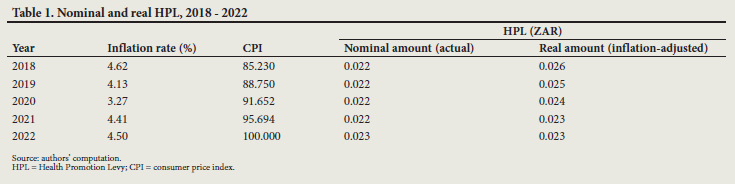
The HPL has had a significant impact on the consumption of SSBs in SA,[5-7] yet the nominal amount of the HPL has remained constant since 2018 (Table 1), with the likely result that the health effects of sugary drink consumption may take longer to manifest.[8,9] Consumption of SSBs has a significant impact on non-communicable disease (NCD) risk. Even in the absence of weight gain, SSBs contribute to a high glycaemic load, increasing the risk of diseases such as diabetes and coronary heart disease.[8,10] If SA sustains low consumption of SSBs, obesity rates and NCDs will also decline in the long term.
In line with health promotion goals, SA's HPL is based on the sugar content of the beverage. In essence, manufacturers can avoid or reduce their tax liability by reducing the amount of sugar in each beverage. In fact, the HPL aims to incentivise manufacturers to move towards zero sugar or reduce sugar content through reformulation. To determine the tax liability of manufacturers, the South African Revenue Service (SARS) requires manufacturers to obtain an assessment report from recognised agencies such as the South African National Accreditation System and the International Laboratory Accreditation Cooperation.[11] The report is intended to provide details on the total sugar content in g/100 mL of the beverage. In the absence of such a report, SARS uses 20 g/100 mL to determine the tax liability.
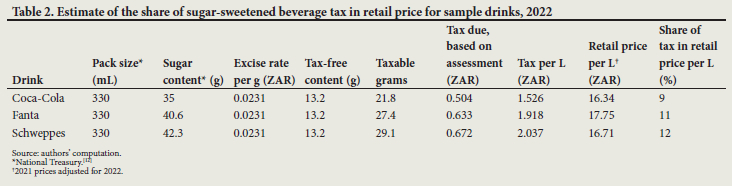
The initial tax rate in 2018 was ZAR0.0221/g of sugar for every 100 mL taxed soft drink. The first 4 g/100 mL is tax free. To determine the tax amount and the effective tax rate, one needs to obtain the sugar content and the average retail price of the beverage. In line with the operational procedures of SARS, the sugar content exceeding 4 g/100 mL is multiplied by the levy rate to obtain the tax amount payable.[11] For example, 1 litre of Coca-Cola containing 106 grams of sugar at a retail price of ZAR11.77 attracted ZAR1.46 tax in 2018, equivalent to a 12% effective tax rate. For pack sizes below a litre, such as 300 mL, the tax burden is obtained by using the appropriate retail price and the tax amount (based on sugar content), as shown in Table 2. Therefore, the higher the sugar content, the higher the tax liability.
In the budget speech of February 2022, the Minister of Finance increased the HPL from 2.21 cents/g to 2.31 cents/g, or ZAR0.0221/g to ZAR0.0231/g, with effect from 1 April 2022. In nominal terms this represents an increase of 4.5%, but is it really an increase? In the presence of the declining value of the rand in the past years, without a corresponding increase in the HPL, the HPL cannot be said to have increased. In fact, inflation eroded the value of the HPL between 2018 and 2021. In real terms, the HPL declined by 11% from ZAR0.026/g in 2018 to ZAR0.023/g in 2021 as a result of inflation (Table 1).
In a surprising move in April 2022, the government postponed the implementation of this increase to allow for broader consultation. The sugar industry has welcomed the new development.
Given the cost-effective nature of fiscal policies in controlling unhealthy consumption,[2,5-7] SA's HPL on sugary drinks must be increased regularly and should take account of inflation in view of the specific tax structure being used. Like the tobacco and alcohol industries, the sugar industry will always lobby against health taxes without any consideration of the health impact of sugary drink consumption and its true costs to society. Industry players have no place in policies that affect population health.
Micheal Kofi Boachie, Evelyn Thsehla, Karen Hofman
SAMRC/Wits Centre for Health Economics and Decision Science - PRICELESS SA, School of Public Health, University of the Witwatersrand, Johannesburg, South Africa
References
-
1. Hofman KJ, Stacey N, Swart EC, et al. South Africa's Health Promotion Levy: Excise tax findings and equity potential. Obes Rev 2021;22(9):e13301. https://doi.org/10.1111/obr.13301
» https://doi.org/10.1111/obr.13301 -
2. Boachie MK. Changing risky health behaviours through fiscal policy: The time is now. Perspect Public Health 2020;140(4):200-202. https://doi.org/10.1177/1757913919899111
» https://doi.org/10.1177/1757913919899111 -
3. Thow AM, Abdool Karim S, Mukanu MM, et al The political economy of sugar-sweetened beverage taxation: An analysis from seven countries in sub-Saharan Africa. Glob Health Action 2021;14(1):1909267. https://doi.org/10.1080/16549716.2021.1909267
» https://doi.org/10.1080/16549716.2021.1909267 -
4. Obesity Evidence Hub. Countries that have taxes on sugar-sweetened beverages (SSBs). Last updated 17 March 2022. https://www.obesityevidencehub.org.au/collections/prevention/countries-that-have-implemented-taxes-on-sugar-sweetened-beverages-ssbs (accessed 18 March 2022).
» https://www.obesityevidencehub.org.au/collections/prevention/countries-that-have-implemented-taxes-on-sugar-sweetened-beverages-ssbs -
5. Stacey N, Edoka I, Hofman K, et al. Changes in beverage purchases following the announcement and implementation of South Africa's Health Promotion Levy: An observational study. Lancet Planet Health 2021;5(4):e200-e208. https://doi.org/10.1016/S2542-5196(20)30304-1
» https://doi.org/10.1016/S2542-5196(20)30304-1 -
6. Essman M, Taillie LS, Frank T, et al Taxed and untaxed beverage intake by South African young adults after a national sugar-sweetened beverage tax: A before-and-after study. PLoS Med 2021;18(5):e1003574. https://doi.org/10.1371/journal.pmed.1003574
» https://doi.org/10.1371/journal.pmed.1003574 -
7. Wrottesley SV, Stacey N, Mukoma G, et al Assessing sugar-sweetened beverage intakes, added sugar intakes and BMI before and after the implementation of a sugar-sweetened beverage tax in South Africa. Public Health Nutr 2021;24(10):2900-2910. https://doi.org/10.1017/S1368980020005078
» https://doi.org/10.1017/S1368980020005078 -
8. Fung TT, Malik V, Rexrode KM, et al. Sweetened beverage consumption and risk of coronary heart disease in women. Am J Clin Nutr 2009;89(4):1037-1042. https://doi.org/10.3945/ajcn.2008.27140
» https://doi.org/10.3945/ajcn.2008.27140 - 9. Boggs DA, Rosenberg L, Coogan PF, et al Restaurant foods, sugar-sweetened soft drinks, and obesity risk among young African American women. Ethn Dis 2013;23(4):445-451.
-
10. Liu S, Manson JE, Buring JE, et al. Relation between a diet with a high glycemic load and plasma concentrations of high-sensitivity C-reactive protein in middle-aged women. Am J Clin Nutr 2002;75(3):492-498. https://doi.org/10.1093/ajcn/75.3.492
» https://doi.org/10.1093/ajcn/75.3.492 -
11. South African Revenue Service. Excise: Health Promotion Levy on Sugary Beverages. Pretoria: SARS, 2020. https://www.sars.gov.za/wp-content/uploads/Ops/Policies/SE-SB-02-Health-Promotion-Levy-on-Sugary-Beverages-External-Policy.pdf (accessed 15 March 2022).
» https://www.sars.gov.za/wp-content/uploads/Ops/Policies/SE-SB-02-Health-Promotion-Levy-on-Sugary-Beverages-External-Policy.pdf -
12. National Treasury. Taxation of sugar-sweetened beverages. Pretoria: National Treasury, 2016. http://www.treasury.gov.za/public%20comments/sugar%20sweetened%20beverages/policy%20paper%20and%20proposals%20on%20the%20taxation%20of%20sugar%20sweetened%20beverages-8%20july%202016.pdf (accessed 15 March 2022).
» http://www.treasury.gov.za/public%20comments/sugar%20sweetened%20beverages/policy%20paper%20and%20proposals%20on%20the%20taxation%20of%20sugar%20sweetened%20beverages-8%20july%202016.pdf