Primary care morbidity in Eastern Cape province
BACKGROUND: Primary health care in rural South Africa is predominantly provided by remote clinics and health centres. In 1994, health centres were upgraded and new health centres developed to serve as a health care filter between community clinics and district hospitals. AIM: To describe the spectrum of clinical problems encountered at a new health centre in an area of high economic deprivation and compare this with an adjacent community clinic and district hospital. DESIGN: Cross-sectional survey. SETTING: A rural clinic, health centre and district hospital in Eastern Cape Province, South Africa. METHODS: The International Classification of Primary Care-2 (ICPC-2) was used to code data collected over a 13-week period from patients presenting at a community clinic, health centre and district hospital. RESULTS: Altogether, 4 383 patient encounters were recorded across all three sites. Most contacts at the clinic (97%) and the health centre (80%) were with a nurse. Females over 15 years of age comprised over half of all contacts at health facilities (53%). The most common diagnosis category was respiratory (23%). Cough was the most common symptom. Thirty per cent of children up to 5 years of age were seen for immunisations. Most childhood immunisations (79%) were carried out at the health centre. CONCLUSION: Of all the health care facilities surveyed, the health centre had the highest throughput of patients, indicating that the health centre is an efficient filter between the community and hospital. The ICPC-2 can be successfully used to monitor encounters at similar African health care facilities.
Primary care morbidity in Eastern Cape province
Valerie BruetonI; Parimalarani YogeswaranIII; Jimmy ChandiaIV; Khaya MfenyanaV; Bernadette ModellVI; Michael ModellVII; Irwin NazarethII
IBSc, MSc. Medical Research Council, General Practice Research Framework, London, UK
IIMB BS, LRCP, LRCPS, DRCOG, FRCGP, PhD. Medical Research Council, General Practice Research Framework, London, UK
IIIMB BS, MFamMed. Department of Family Medicine, Faculty of Health Sciences, Walter Sisulu University, Mthatha, Eastern Cape
IVMB ChB, DTM&H, DPH, MPraxMed. Department of Family Medicine, Faculty of Health Sciences, Walter Sisulu University, Mthatha, Eastern Cape
VBSc, MB ChB, MPraxMed, MA. Department of Family Medicine, Faculty of Health Sciences, Walter Sisulu University, Mthatha, Eastern Cape
VIPhD, MB BChir, FRCP, FRCOG. Research Department of Primary Care and Population Health, Royal Free and University College Medical School, Hampstead Campus, London, UK
VIIMB BS, DCH, FRCP, FRCGP. Research Department of Primary Care and Population Health, Royal Free and University College Medical School, Hampstead Campus, London, UK
BACKGROUND: Primary health care in rural South Africa is predominantly provided by remote clinics and health centres. In 1994, health centres were upgraded and new health centres developed to serve as a health care filter between community clinics and district hospitals.
AIM: To describe the spectrum of clinical problems encountered at a new health centre in an area of high economic deprivation and compare this with an adjacent community clinic and district hospital.
DESIGN: Cross-sectional survey.
SETTING: A rural clinic, health centre and district hospital in Eastern Cape Province, South Africa.
METHODS: The International Classification of Primary Care-2 (ICPC-2) was used to code data collected over a 13-week period from patients presenting at a community clinic, health centre and district hospital.
RESULTS: Altogether, 4 383 patient encounters were recorded across all three sites. Most contacts at the clinic (97%) and the health centre (80%) were with a nurse. Females over 15 years of age comprised over half of all contacts at health facilities (53%). The most common diagnosis category was respiratory (23%). Cough was the most common symptom. Thirty per cent of children up to 5 years of age were seen for immunisations. Most childhood immunisations (79%) were carried out at the health centre.
CONCLUSION: Of all the health care facilities surveyed, the health centre had the highest throughput of patients, indicating that the health centre is an efficient filter between the community and hospital. The ICPC-2 can be successfully used to monitor encounters at similar African health care facilities.
Eastern Cape Province, with a population of 6.4 million, incorporates the former homelands of Transkei and Ciskei.1 1
In 1994, the government opted for a primary care-led system of health care, to ensure equitable access for all.2
Ten years ago, the British Council supported an academic collaboration between University College London (UCL) in the UK and the then University of Transkei (now Walter Sisulu University). A key aim of the collaboration and this survey was to assess whether the health centre served as a filter between the community and the hospital. We therefore described the spectrum of clinical problems encountered at one of the newly established health centres and an adjacent community clinic, and compared these with encounters at a district hospital.
Methods
We used the International Classification of Primary Care (ICPC-2)3
Data were collected from patients who presented between 09h00 and 16h00 over 13 weeks during two separate periods in winter and summer of 2001 and 2002. The clinicians (nurse/ doctor) recorded information on patients seen by them using standard data sheets designed and piloted for this study. Clinicians were trained in recording procedures by a general practitioner (Parimalarani Yogeswaran) from WSU. Data collection problems were referred back to field supervisors.
Information entered was coded using the ICPC-2 system which is widely utilised to classify primary care encounters. The codes can be cross-linked to the International Classification of Diseases (ICD-10). ICPC-2 operates a bi-axial coding structure: the first axis represents 17 body systems (e.g. alimentary, haematological), and the second represents 7 components, including: (i) complaints and symptoms; (ii) diagnostic, screening and preventive; (iii) medication, treatment procedures; (iv) test results; (v) administrative; (vi) referrals and other reasons for encounter; and (vii) diagnosis/disease. The system is widely used in Europe4 5 6 7 8
Data analysis
Coded data from information sheets were entered on Microsoft Access and analysed using Stata 8. Descriptive data on diagnoses, symptoms and referrals were produced according to consultation site. Predominating clinical presentations and diagnoses at each site (clinic, health centre and hospital) were identified. The proportion of symptoms, diagnoses and referrals per person seen at the different levels of health care were tabulated.
Results
During the study, 4 383 patient encounters were recorded across all three health care facilities, 512 (12%) at the clinic, 2 513 (57%) at the health centre, and 1 358 (31%) at the district hospital. Females >15 years of age made up over half of all contacts (2 339, 53%), representing 23% of females >15 years of age in the area, based on Yenza survey data.9 p<0.001).
Of the 4 379 patients for whom complete data were available, 2 701 (62%) were seen by a nurse, and 1 678 (38%) by a doctor. Most contacts at the clinic (495, 97%) and health centre (2 008, 80%) were seen by a nurse; the remainder were seen by a doctor. At the district hospital, most contacts were seen by a doctor (1 159, 85%).
The mean age of the sample was 29.7 (SD 21.7 years). Children aged 0 - 4 years made up 15% (637) of all encounters and contributed to 25% (122) of those seen at the clinic, 17% (435) of those seen at the health centre, and 6% (80) of those seen at the hospital. These figures represent 23% of 0 - 4-year-olds in the area, based on Yenza survey9
Most common symptoms
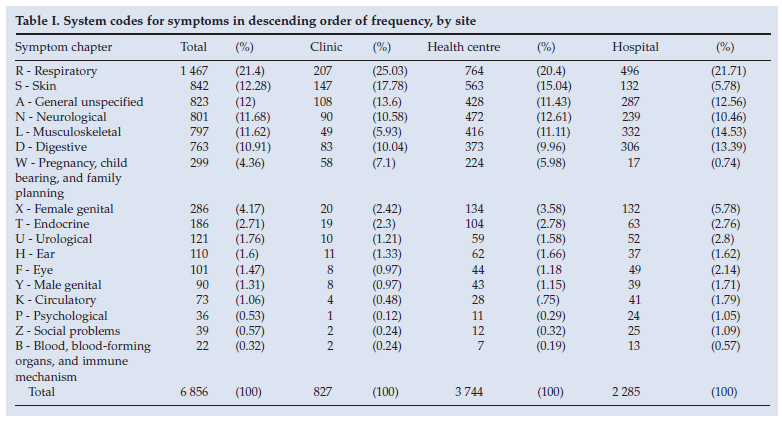
A total of 6 856 symptoms were recorded across the 3 sites (Table I). Overall, the most common symptom categories were respiratory (1 467 - 21%) and skin (842 - 12%). The order of frequency varied across the 3 sites. The most common symptoms were cough (1 026 - 15%), headache (657 - 10%) and skin symptoms/complaints (304 - 4%). No symptoms were recorded in 1 160/4 383 (26% of the total number of participants in the survey), but a diagnosis was recorded in 609/1 160 (53%). The most common diagnosis for this latter group was health maintenance (250 - 41%).
Most common diagnoses
A total of 3 054 diagnoses from 182 diagnostic codes were recorded across the 3 sites. At the clinic and hospital, 'respiratory' was the most common diagnostic category recorded (clinic 85 - 31%; hospital 267 - 25%). At the health centre, the most common diagnostic category recorded was 'general unspecified' (382 - 23%), which includes complaints of pain, fever, weakness, feeling ill, sweating, bleeding, concerns about treatment or appearance, and fear of death and disease. Blood, blood-forming organs and social problems were the least common diagnoses at the health centre and hospital. At the clinic, ear, blood and blood-forming organs were the least recorded diagnoses.
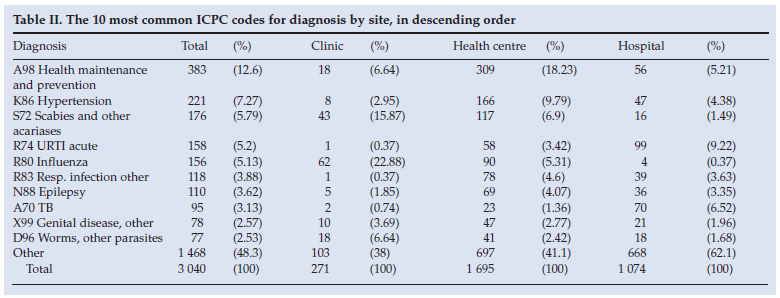
Across all sites, health maintenance and prevention (383 - 13%) was the most common diagnosis, followed by hypertension (221 - 8%) and scabies and other acariases (176 - 6%) (Table II). The same pattern was observed at the health centre. At the clinic and hospital, the pattern was different: influenza (62 - 23%), scabies and other acariases (43 - 16%), health maintenance and prevention (18 - 7%) and worms and other parasites (18 - 7%) comprised the most common presentations at the clinic. At the hospital, the most common diagnoses were acute URTIs (99 - 9%), TB (70 - 7%) and health maintenance and prevention (56 - 5%).
In 1 775/4 383 (40%) patients, no diagnosis was recorded. Of these, 1 186 (67%) had one or more symptoms recorded. The most common symptom category for this group was respiratory (444 - 18%).
Profile of patients with no symptoms and no diagnosis
A total of 580/4 383 (13%) patients had no symptoms and no diagnosis recorded; 159 (27%) were seen by a doctor and 419 (73%) by a nurse. Most were seen at the health centre (356 - 61%) and the remainder at either the hospital (148 - 25%) or clinic (75 - 13%); 228 (39%) were children <5 years old.
Analyses of ICPC-2 component 2 (diagnostic screening and preventive procedures) revealed that 203/580 (36%) patients had a partial medical examination recorded (code 31), while 34% had preventive immunisations recorded (code 44) (197/580). The majority (98%) of recorded immunisations were in children <5 years old. Overall, 30% of the 0 - 5-year age group who presented came for preventive immunisations/medications. Most childhood immunisations (79%) were carried out at the health centre, with the remainder at the clinic.
Referrals
A total of 260 referrals were recorded. The proportions of referrals of all patients seen were: clinic - 5%, health centre - 7%, hospital - 4%. Most referrals were to a physician at a health centre or hospital (172 - 66%) or to a nurse, therapist or social worker (44 - 17%). The majority of all referrals were from health centres (182 - 70%).
Discussion
Our study outlines the spectrum of problems presenting at different levels of a newly provided free-service health care system in an area of high poverty in South Africa. Our results suggest that a newly established health centre does serve as a filter between an existing clinic and a hospital in rural South Africa.
Women made up over half of all contacts with the health services surveyed. In the Soweto survey, 59% of attendees were women.6 7,8 of attendees were female. Equivalent figures in developed countries vary, the Netherlands and Japan citing 52%,4 4 5 4 1,9 The mean fertility rate for women in the area who have ceased reproduction is 5.62.9
Children aged 0 - 4 years comprised 15% of all contacts. One-third of this age group attended for immunisation. In the Eastern Cape, 44% of children are fully immunised;9 10 2 1,9
The most common diagnosis and symptom category was respiratory. Similar findings were reported in Mthatha (Umtata),11 6 4,7,8 In our survey, URTIs, influenza and respiratory infections (other) were among the 6 most common diagnoses, and 3% of patients were diagnosed with TB. The latter figure may indicate under-diagnosis of TB in the area. Cough was the most common symptom recorded, which could be a symptom of URTI or undiagnosed TB. In 2005, the incidence of TB in South Africa was 600/100 000/year. TB notification is increasing, owing to improved reporting and better case finding.12
Community-based primary health centres were established by the Walter Sisulu University Community Health Partnership Project (UCHPP) to provide appropriate health services for the local community and training for medical and nursing students - an example of a community/service/teaching partnership. The health centres contain facilities for clinical care, teaching and health promotion. Members of the local community were consulted in the development of these centres. Commonly used drugs are held at the centres, and simple pathology facilities are available. Patients are seen by a nurse and referred to a clinic doctor when appropriate. If indicated, patients are referred to the district hospital. The health centre in this survey had the highest recorded throughput of patients. The most common diagnosis was health maintenance and preventive medicine; this category includes a spectrum of reasons to attend a primary care facility, including follow-up appointments, repeat prescriptions and disease monitoring. Other diagnoses accounted for over 41% of those recorded at the health centre, and included pregnancy, asthma, injuries, genital diseases, and skin infections, and demonstrates the broad function of the health centre in disease prevention, health promotion, monitoring, diagnosis and cure. The health centre had the highest proportion of referrals, so fulfilling its function as a filter between rural clinic and hospital.
Blood (blood-forming organs), psychological and social problems were the least recorded diagnosis category; similar findings were noted in Sri Lanka and China. Under-reported psychological problems could be explained by psychological problems manifesting as physical symptoms, such as headache. However, high numbers of people at the 3 sites, especially the health centre, had a recorded diagnostic category of 'general unspecified'. This includes a constellation of complaints of pain, fever, weakness, feeling ill, sweating, bleeding, concerns about treatment or appearance, and fear of death and disease, which may well represent undetected psychological dysfunctions.
The ICPC-2 blood category includes a code for HIV. From our data, 2 patients had an HIV diagnosis which did not reflect the HIV prevalence of 18.8% in the region among 15 - 49-yearolds.13
A strength of our study is the large population surveyed, allowing future comparison with other deprived areas of rural South Africa. Collection of data during winter and summer months accounts for seasonal variations in disease presentation. Different primary care facilities were used to capture the spectrum of clinical problems. The data are considered valid as they are based on the diagnoses of the clinicians who saw the patients. Training and supervision of data collection and data entry were undertaken. Missing values for key variables such as site, date of birth and sex were 0 - 1%. The findings of this and other surveys conducted in the area can be used by policymakers to inform the development of primary health care services. A limitation of the study is the absence of longitudinal follow-up data to monitor trends in health care over time. The figures in this survey are facilitybased, and may not be representative of the wider community.
Conclusion
We found that, of the three facilities surveyed in the Eastern Cape, the health centre had the greatest throughput of patients, and was therefore serving its function as a filter between the health services. Most of the health care facilities' patients were female and were seen by a nurse. There were low levels of HIV and psychological and social problems, possibly because of under-reporting or the failure of patients to present with such problems. Children <5 years old attended for immunisation, and the majority were seen at primary care health centres. These findings helped us to examine trends and gaps in primary health care delivery in the Eastern Cape. A further cross-sectional survey of the same population would be useful in measuring health changes in morbidity, and a longitudinal follow-up study to ascertain accuracy of clinical diagnoses over time. The ICPC-2 proved to be practicable in this setting, and it can be used more widely in practice.
Ethics approval was granted by the Walter Sisulu University research ethics committee. The British Council Link Programme funded meetings between the authors to refine the study questions and to develop and conduct some of the data analysis. Data entry and analysis and writing of the study were supported by the Sir Halley Stewart Charitable Trust. There were no conflicts of interest.
References
-
1. Statistics South Africa. Census 2001: Primary Tables Eastern Cape 2004. Pretoria: Statistics South Africa, 2004: 5, Table C. http://www.statssa.gov.za/census01/html/ECPrimary.pdf (accessed 11 December 2008).
» http://www.statssa.gov.za/census01/html/ECPrimary.pdf - 2. Benatar S. Health care reform and the crisis of HIV and AIDS in South Africa. N Engl J Med 2004; 351(1): 81-92.
- 3. WONCA International Classification of Primary Care ICPC-2. 2nd ed. London: Oxford University Press, 1998.
-
4. Okkes IM, Polderman GO, Fryer GE, et al. The role of family practice in different health care systems. JFP online Jan. 2002; 51(1). http://www.jfponline.com/Pages.asp?AID=1085&issue=January%202002&UID= (accessed 11 December 2008).
» http://www.jfponline.com/Pages.asp?AID=1085& issue=January%202002& UID= -
5. Britt H, Miller G, Charles J, et al. General practice activity in Australia 2005-2006. General Practice Series No. 19. AIHW Cat. No. GEP 19. Canberra: Institute of Health and Welfare, 2007. http://www.aihw.gov.au/publications/index.cfm/title/10377#full_publication (accessed 5 July 2008).
» http://www.aihw.gov.au/publications/index.cfm/title/10377#full_publication -
6. Hoosain R. The Morbidity Patterns of Patients Attending General Practices in Soweto. MFamMed thesis, University of the Witswatersrand, 2008. http://witsetd.wits.ac.za:8080/dspace/handle/123456789/6343. (accessed 9 July 2009).
» http://witsetd.wits.ac.za:8080/dspace/handle/123456789/6343 - 7. Wun YT, Lu XQ, Liang WN, Dickson JA. The work by the developing primary care team in China: A survey in two cities. Fam Pract 2000; 17(1): 10-15.
- 8. de Silva N, Mendis K. One-day general practice morbidity survey in Sri Lanka. Fam Pract 1998; 15(4): 323-331.
- 9. Mfenyana K, Griffin M, Yogeswaran P, et al. Socio-economic inequalities as a predictor of health in South Africa - the Yenza cross-sectional study. S Afr Med J 2006; 96: 323-330.
- 10. Department of Health, Medical Research Council OrcMacro. South African Demographic and Health Survey 2003. Pretoria: Department of Health, 2007.
- 11. Ragavan M. Disease profile for adult patterns seen in the Department of Family Medicine, Umtata General Hospital. SA Family Practice 1996; 17: 316-320.
-
12. WHO Global TB Control, South Africa Country Profile. Geneva: World Health Organization, 2008. http://www.who.int/tb/publications/global_report/2006/pdf/zaf.pdf (accessed 11 December 2008).
» http://www.who.int/tb/publications/global_report/2006/pdf/zaf.pdf -
13. UNAIDS Joint United Nations Programme on HIV/AIDS: South Africa 2008. Geneva: World Health Organization, 2008. http://www.unaids.org/en/Regions_Countries/Countries/south_africa.asp (accessed 11 December 2008).
» http://www.unaids.org/en/Regions_Countries/Countries/south_africa.asp