The ancient use of faïence in paediatric illness
FORUM
HISTORY OF MEDICINE
The ancient use of faïence in paediatric illness
R J Bittle; C C Bittle
We examine the treatment of urinary incontinence in Ancient Egypt with faïence in the light of current concerns regarding the treatment of dysfunctional elimination in children with milk of magnesia.
The origins of medical science in Africa and their influence on Western medicine are attested to by surviving documents from the XVIII Dynasty of the New Kingdom period of Pharaonic Egypt. One such document is the Ebers Papyrus, an ancient medical treatise containing 108 columns of text, that represents the then current and ancient medical knowledge in Egypt from about 1536 BC, during the reign of Amenhotep I. Its translation1
One ancient practice of interest to the modern practising physician can be found in Rubric #273 (Column 49, Line 21) of the Ebers Papyrus, that involves the treatment of bed-wetting or urinary incontinence in a child. 'Do this for a child suffering from bed-wetting: Boil faïence beads until they form a pellet; if he be an older child, he should swallow it in a gulp, [but] if he be in swaddling clothes, one should rub [it] together for him in the milk, just as it flows forth from his nurse for four days.'2
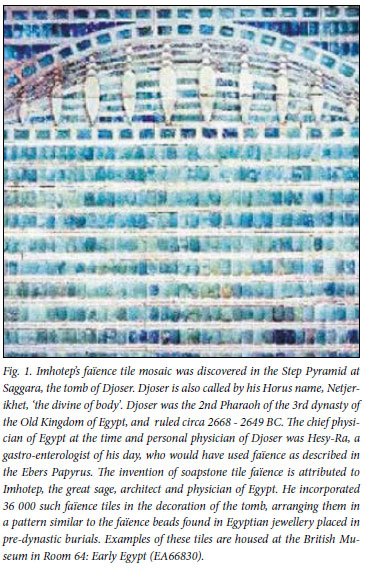
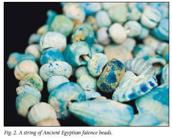
Ancient Egyptian faïence (or tjehnet) was one of the first artificial substances created by man (Figs 1 and 2). Used mainly as jewellery, this by-product of bronze-age technology was first made about 5 500 years ago. Faïence items are symbolic of life and rebirth, and many beautiful examples have been found in burial chambers dating back to the pre-dynastic age of Pharaonic Egypt.3
The most common causes of dysfunctional elimination in children include constipation, bladder instability and infrequent voiding, with constipation and faecal retention representing 50% of cases.456
The treatment of choice for functional constipation with faecal retention in children is hydration and laxatives such as milk of magnesia (which chemically is magnesium hydroxide) at 1 -2 ml/ kg/day.7
References
- 1. Ghalioungui P. The Ebers Papyrus, a new English Translation, Commentaries, and Glossary. Cairo: Academy of Science, Research and Technology, 1987:1-298.
- 2. Carpenter S, Rigaud M, Barile M, Priest TJ, Perez L, Ferguson JB. An Interlinear Translation of Portions of the Ebers Papyrus, possibly having to do with Diabetes Mellitus. New York: Bard College 1998:9-10.
- 3. Ayrton ER, Loat WFS. Predynastic cemetery at El Mahasna. London: The Egypt Exploration Fund, 1911: Pl. XVI:1.
- 4. Koff S, Wagner T, Jayanthi V. The relationship among dysfunctional elimination syndromes, primary vesicoureteric reflux and urinary tract infection in children. J Urol 1998;160:1019-1022.
- 5. Issenman R, Filmer R, Gorski P. A review of bowel and bladder control development in children: How gastrointestinal and urologic conditions relate to problems in toilet training. Pediatrics 1999;103:1346-1351.
- 6. Alova I, Lottmann HB. Vesicoureteral reflux and elimination disorders. Arch Esp Urol 2008;61:218-228.
- 7. Sondheimer JM. Gastrointestinal Tract. In: Hay WW, Levin MJ, Sondheimer JM, Deterding RR, eds. Current Pediatric Diagnosis and Treatment, 19th ed. New York: Lang Medical Books/McGraw-Hill, 2008:650.