Medical nutrition therapy in obesity management
Introduction
People living with obesity[55] and people with larger bodies are often stigmatised and scrutinised for their food choices, portions and eating behaviours.[55,56,58] Much of the social marketing efforts and public health and clinical messaging around food and eating behaviours has focused on 'eating less' or choosing 'good' foods. As a result of these messages, dieting and weight loss-focused outcomes perpetuate the notion that weight loss and/or 'health' can be achieved purely by caloric restriction (CR), food deprivation and/or 'dieting' practices. These simplistic narratives often neglect the evidence that weight loss may not be sustainable in the long term, not because of personal choices or lack of willpower, but rather as a result of strong biological or physiological mechanisms that protect the body against weight loss. (See the chapter 'The science of obesity'.) The diet industry and the weight loss-focused research field have therefore falsely advertised diet or food and eating habits as the culprit for weight gain, contributing to the bias and stigma reviewed in the chapter 'Reducing weight bias in obesity management, practice and policy'. A paradigm shift is needed in all aspects of nutrition and eating behaviour research, policies, education and health promotion to support people of all weights, body shapes and sizes to eat well without judgement, criticism or bias regarding food and eating behaviours.
This chapter outlines evidence-informed nutrition interventions from clinical and/or epidemiological studies in the context of obesity management for PLWO. It does not cover perioperative bariatric nutrition. (See the chapters 'Metabolic and bariatric surgery: Selection and preoperative work-up' and 'Metabolic and bariatric surgery: Postoperative management'.) Caution is needed when interpreting much of the nutrition-specific evidence, as weight loss is often a primary outcome in nutrition-related studies, and most studies have used the definition of obesity according to BMI classifications instead of the current definition. The recommendations and key messages in this chapter are specific for PLWO and may not be applicable to or appropriate for people with larger bodies who do not have health impacts from their weight. Furthermore, this chapter is specific for healthcare providers (HCPs) and is intended to support co-ordination of care with regulated nutrition professionals in South Africa (SA) (dietitians registered with the Health Professions Council of South Africa [HPCSA], the authority responsible for the regulation of health and healthcare professionals in SA). Future research should assess nutrition-related outcomes, health-related outcomes and behaviour changes, instead of weight loss outcomes alone, across all weight spectrums.
Traditional nutrition interventions for PLWO have focused on strategies that promote weight loss through dietary restriction. Although a caloric deficit is required to initiate weight loss, sustaining lost weight is difficult in the long term owing to compensatory mechanisms that promote positive calorie intake by increasing hunger and the drive to eat.[59-61] HCPs, policymakers, PLWO and the general public should be aware that nutrition interventions affect everyone differently, and there is therefore no single best nutrition approach or intervention.[62] As such, some people may favour an approach that is macronutrient based (consisting of higher, moderate or lower intake of carbohydrates, protein and/or fat), a CR plan, a food-based or dietary pattern approach, or a non-restrictive dieting approach. Nutrition and healthy eating are important to the health and wellbeing of all South Africans, regardless of weight, body size or health status. However, the acceptance and incorporation of nutrition strategies are also strongly influenced by socioeconomic factors in low- to middle-income countries (LMICs). It would be reasonable to predict that macronutrient-based or calorie-controlled interventions would be less impactful in this setting, while food-based and non-dieting approaches provide greater potential for health impact.
Although SA is regarded as nationally food secure, inequalities in access to resources and high unemployment continue to render a significant proportion of citizens food insecure[63] and at nutritional risk. In addition, urbanisation is contributing to changed livelihoods and diets in both rural and urban areas. Food acquisition is primarily dependent on cash within food systems that are increasingly being shaped by formal retail, international trade and globalisation.[64,65]
Shifting eating patterns, in a food environment dominated by convenient, inexpensive, high-energy foods, present a challenge to the whole population. Strategies to modify the broader food environment and 'make the healthier choice the easier choice' are an important prevention and harm-reduction initiative.[66]
An example of such an initiative was SA's Health Promotion Levy, introduced in April 2018, a tax policy based on sugar content that incentivised reformulation of sugar-sweetened beverages (SSBs), with the aim of reducing obesity and type 2 diabetes (T2DM) rates in the country.[67]
There are limited data on the dietary intake of SA adults.[68] In urban low-income older women, among whom there is a very high prevalence of PLWO, the overall low quality of the diet is associated with poor nutrition perceptions and choices, coupled with financial constraints.[69] To improve nutritional perceptions and choices, labelling legislation in SA went through several changes between 2010 and 2014 to empower consumers to make healthful choices. These changes included mandatory nutrition information as well as regulations on nutrient content claims, health claims, function claims, reduction of disease risk claims and slimming claims based on nutrient profiling. Nutrition labelling can be considered a relatively low-cost tool as a 'best buy' initiative according to the World Health Organization (WHO), which can contribute to reducing the burden of non-communicable disease. However, in a qualitative study in Cape Town (one of the largest metropoles in SA, with various ethnic groups, extreme income and educational inequalities,[70] and a population with different backgrounds, lifestyles, cultures and eating patterns), food price was sometimes the only consideration when selecting food products, irrespective of their quality and nutritional value.[71] Poor understanding and poor nutrition literacy of food labels, time constraints and lack of interest, and a lack of trust in food labelling information were among other reasons why food label information often went ignored.[71]
In addition, beyond simply fulfilling biological requirements, food holds significant psychological and sociocultural value. It can elicit both pleasure and anxiety, and plays a vital role in social communication. Within various cultural contexts, food is used to establish social bonds, foster acceptance, and convey emotions and meanings such as love, power, hospitality and social status.[72] These considerations need to be incorporated into MNT when counselling individuals with any condition, including obesity.[66]
In the context of the management of PLWO, the best nutrition approach is one an individual can maintain over the long term to achieve health-related and/or weight-related outcomes.[6] Fig. 2 and Table 1 provide an overview of the various nutrition interventions used to influence weight change, health and QoL indicators, as well as advantages and disadvantages of each.
Individualised medical nutrition therapy
Nutrition interventions should use a shared decision-making approach to improve overall health, promote a healthy relationship with food, consider the social context of eating, and promote eating behaviours that are sustainable and realistic for the individual. An HPCSA-registered dietitian should be involved in the assessment, delivery and evaluation of care wherever possible. MNT provided by an RD has demonstrated improvements in weight outcomes (body weight and BMI), waist circumference (WC) and glycaemic control, and reduction in low-density lipoprotein cholesterol (LDL-C), triglycerides and blood pressure (BP).[3-5]
Systematic reviews and meta-analyses of randomised controlled trials (RCTs) have shown that individualised nutrition consultation by an RD decreases weight by an additional -1.03 kg and BMI by -0.43 kg/ m2>25 kg/m2[3] In people living with T2DM (PLWD), MNT by an RD resulted in significant reductions in glycated haemoglobin (HbA1c), weight, BMI, WC, cholesterol and systolic BP reported by systematic reviews and meta-analyses.[5] In addition, MNT delivered by an RD to individuals and/or group-based sessions, for the prevention of T2DM, has also found a weight loss range of -1.5 kg to -13 kg (3 - 26% weight loss) with a pooled effect of -2.72 kg by meta-analysis.[4]
The RD has the expertise to individualise MNT by integrating therapeutic dietary requirements for PLWO and incorporating alternative nutrition requirements within a personalised plan to address unique health complexities, whether a comorbidity of their obesity or not, e.g. T2DM, or renal or liver disease.[66] However, in the context of resource-limited settings such as SA, HCPs and community health workers (CHWs) need to be capacitated to address PLWO with the objective of applying protocols/algorithms for obesity screening and management and referral guidelines to specialist obesity centres.'73- This is considered a feasible approach in the Strategy for the Prevention and Management of Obesity in South Africa 2023 - 2028.[73]
A recent survey of dietetic management of PLWO among European dietitians showed inconsistencies in the approaches used, and recommended that clinical guidelines were needed in this area to support dietetic practice.[74] The field of obesity medicine and management has evolved rapidly in the past few years, and along with this there has been a paradigm shift in MNT from weight-centric to health-centric approaches. This current adapted SA guideline can support RDs with the delivery of best-practice MNT interventions within the context of a structured NCP. The NCP offers RDs a standardised process and language by which to document nutrition assessment, nutrition diagnosis, nutrition intervention and monitoring, and provides a structured checklist for all clinical nutrition care including obesity management.[66,75]
Table 1 provides outcomes measures for health, QoL and weight parameters when using individualised MNT by an RD.
Nutrition interventions
Nutrition interventions that are safe, effective, nutritionally adequate, culturally acceptable and affordable for long-term adherence should be considered for PLWO.[2] HCPs should adapt nutrition interventions and/or adjunct therapy to meet the PLWO's individual values, preferences and treatment goals. However, to date, no single best nutrition intervention has been shown to sustain weight loss in the long term, and the literature continues to support the importance of long-term adherence, regardless of the intervention.[6,76] Efforts should be directed towards flexibly combining beneficial aspects of different nutrition strategies, prioritising health outcomes rather than a weight-centric approach and thereby improving long-term sustainability.
Caloric restriction
Studies on CR generally fall into three categories: moderate calorie (1 300 - 1 500 kcal/day), low calorie (900 - 1 200 kcal/day) and very low calorie (<800 kcal/day), with intervention periods ranging from 3 months to 3 years.
An RCT of women (aged 25 - 75 years, mean ± standard deviation BMI 37.84 ± 3.94 kg/m2[77] At 12 months a significantly greater percentage of participants prescribed 1 000 kcal/day had body weight reductions of 5% or more compared with those assigned 1 500 kcal/day. However, a 1 000 kcal/day prescription may be more difficult to sustain, especially for individuals for whom the CR is 50% or more from their usual intake.[77]
An RCT of older adults (>65 years old) who were advised to reduce their caloric intake by 500 kcal/day below their estimated caloric needs with a minimum intake of 1 000 kcal/day had a significant decrease in body weight (4%) at 12 months, as well as significant improvements in blood glucose and high-density lipoprotein cholesterol (HDL-C).[78]
A systematic review and meta-analysis of RCTs using very low-calorie diets (VLCDs), with or without meal replacements, for weight loss found that using a VLCD within a behavioural weight loss programme produced greater weight loss at 12 months compared with a behavioural programme alone (-3.9 kg), and the difference at 24 months was -1.4 kg.[79] There was no evidence that a VLCD intervention without behavioural support is effective.[79]
Although MNT that achieves a caloric deficit can result in weight loss in the short term (6 - 12 months), the weight change is often not sustained over time. Furthermore, the common recommendation that a caloric deficit of 500 kcal/day or 3 500 kcal/week would produce 1 lb (0.45 kg) of weight loss is not valid, in that weight loss is not linear.[80,81] Polidori et al.[82] first quantified the amount of calorie intake compensated for weight loss changes in free-living humans and estimated that appetite increased by ~100 kcal/day for every kilogram of weight lost, contributing to weight gain over time. In some PLWO, CR may lead to pathophysiological drivers to promote weight gain via increased hunger and appetite and decreased satiety.[61] In addition, CR may have negative consequences for skeletal health[83] and muscle strength,[84] contributing to the role of individualising nutrition interventions that are safe and effective, and meet the values and preferences of PLWO. Indirect calorimetry should be considered if energy expenditure and/or caloric targets are indicated.[85]
In clinical practice in SA, indirect calorimetry is rarely available, so the use of predictive energy equations may need to be considered. There are limitations to the use of such equations, and no single predictive equation provides accurate and precise estimates in all PLWO. A recent UK systematic review reaffirmed the Mifflin St Jeor equation as the most accurate in determining resting metabolic rate (RMR) in this population.[86] It is important that RDs recognise that calculations for RMR as part of a CR plan are not precise and only provide a starting point for discussions about energy needs. The now-recognised counter-regulatory mechanisms to CR may well influence the accuracy of such calculations and the efficacy of such interventions.
Caloric restriction in older adults
The population of older adults (age >65 years) living with obesity (BMI >30 kg/m2[87,88] Sarcopenic obesity has been defined as obesity that occurs in combination with low muscle mass and function, which is typically evident in older adults. Sarcopenic obesity is associated with accelerated functional decline, frailty, and increased morbidity and mortality and should be screened for as part of the Edmonton Obesity Staging System (EOSS).[89,90] There is a large variability in the prevalence of sarcopenic obesity across LMICs, with India, Ghana, Mexico and SA reporting prevalences of 1.3%, 5.4%, 10.2% and 10.3%, respectively.[91,92]
The safety of CR in older adults remains incompletely understood and faces two notable obstacles, i.e. adoption of CR and long-term compliance. Furthermore, there is a continuing debate about the net benefits of CR-induced weight loss in older adults because of the concern that CR may worsen the age-related loss of muscle mass, increasing the risk of sarcopenia, frailty, functional decline, osteopenia and malnutrition.[93] However, CR-induced weight loss in older adults may delay functional decline and medical complications as well as improve QoL. Despite lower muscle mass during CR, muscle strength was preserved, indicating improvement in muscle quality. The mechanisms by which CR improves physical function could include the reduction in relative sarcopenia (improved muscle mass relative to body weight owing to the larger reduction in fat mass relative to lean body mass) as well as the loss of excess total body mass that can interfere with range of motion, gait, etc.[94] Moreover, CR is likely to improve muscle quality by reducing muscle lipid content and reducing local and systemic inflammation, which can interfere with muscle fibre contractility. Indeed, various cytokines are secreted from adipose tissue, and excess fat induces a pro-inflammatory state that is associated with lower muscle strength and incident disability.[95]
Older PLWO should be individually assessed (including functional resources, metabolic risk, comorbidities, the individual's perspective and priorities, and estimated effects on his or her QoL) to consider the potential impact of a weight loss nutrition intervention. Where a weight loss nutrition intervention is deemed to be beneficial, energy restriction should be moderate to achieve slow weight loss and preserve muscle mass. The European Society for Clinical Nutrition and Metabolism (ESPEN) recommends maintaining a minimum intake of 1 000 - 1 200 kcal/day, a protein intake of at least 1 g/kg body weight per day and an appropriate intake of micronutrients.[93] The American Society for Parenteral and Enteral Nutrition (ASPEN) cautions against using adjusted body weight in PLWO owing to a lack of validation studies and variable definitions in the literature, and recommends rather that protein should be provided in a range of >2.0 g/kg ideal body weight per day for persons with a BMI 30 - 40 kg/m22[96] A protein intake of 1.5 g/kg of fat-free mass per day is considered more accurate, but requires body composition data for precise calculation. Calculations in a primary care/general practice setting, especially if these require lean body mass measurements, are not typically feasible in the SA context. Alternatively, setting an absolute protein target of 80 - 120 g/day, or 16 - 24% energy on a 2 000 kcal/day diet, may enhance adherence while ensuring adequate intake.[97] Nutrition interventions with very low energy intakes (<1 000 kcal/day) are discouraged owing to the risk of developing malnutrition and promoting functional decline. In PLWO, nutrition interventions should be combined with physical activity where possible as this can help to attenuate the loss of muscle mass and accompanying functional decline.[66,98]
Macronutrient-based approaches
Macronutrients are the main source of calories in the diet. The dietary reference intakes are a comprehensive set of nutrient reference values for healthy populations that can be used for assessing and planning eating patterns.[99]
The dietary reference intakes permit wide acceptable macronutrient distribution ranges. They allow, for example, 45 - 65% of calories from carbohydrate, 10 - 35% of calories from protein and 20 - 35% of calories from fat (with 5 - 10% of calories derived from linoleic acid and 0.6 -1.2% of calories derived from alpha-linolenic acid).[100]
Several macronutrient-based approaches have been investigated within and outside these ranges. Researchers have evaluated, for instance, low-carbohydrate diets that substitute fat and protein at the expense of carbohydrate but include adequate protein (15 - 20% of calories). Studies have also investigated extremely low-carbohydrate (<10% of calories) variants, including variants such as the ketogenic diet which are extremely high in fat (>75% of calories). No meaningful advantages of one macronutrient distribution over another have reliably been shown. A network meta-analysis was undertaken of 48 RCTs (N=7 286 participants) that provided dietary advice to consume varying macronutrient distributions under free-living conditions. This meta-analysis showed no differences in weight loss at 6 months and 12 months of follow-up between diets categorised broadly by their macronutrient distribution as low carbohydrate, moderate macronutrient or low fat, or categorised by their 11 popular diet names, encompassing a wide range of distributions.[6] Subsequent large RCTs have corroborated these findings.[101]
The lack of meaningful differences between different macronutrient distributions has been shown to extend to cardiometabolic risk factors. Systematic reviews and meta-analyses of randomised trials have investigated glycaemic control in PLWD (inclusive of people with a BMI >25 kg/m2<40% of calories from carbohydrate, or 21 - 70 g) in which the carbohydrate has been replaced with fat and/or protein.[102] Researchers have also assessed the effects of low-carbohydrate diets that replace carbohydrate with protein in people with or without T2DM who have a BMI >25 kg/m2[103] Any improvements in triglycerides and HDL-C have also been found to come at the expense of increases in the more atherogenic and well-established lipid targets for cardiovascular risk reduction, LDL-C, non-HDL-C and apolipoprotein B (apo B).[102,104] According to available RCTs, the most important determinants of achieving any benefit over the long term are adherence to any one macronutrient distribution and clinic attendance.[6,103,105,106]
These data from RCTs are supported by evidence from large prospective cohort studies that allow macronutrient exposures to be assessed in relation to downstream clinical outcomes of cardiometabolic diseases. The Atherosclerosis Risk in Communities (ARIC) and Prospective Urban Rural Epidemiology (PURE) cohort studies showed that no single approach appears superior, with harm observed at the extremes of intake. A systematic review and meta-analysis were undertaken of five prospective cohort studies involving 432 179 participants over a median follow-up of 25 years.[107] The evidence showed a U-shaped relationship between carbohydrate and mortality, with lower-carbohydrate (<40% of calories) and higher-carbohydrate (>70% of calories) diets associated with increased mortality, and the wide range between (40 - 70% of calories) associated with lower mortality. The PURE cohort study involved 135 335 participants from 18 low-, middle- and high-income countries; the participants were free of cardiovascular disease at baseline.[108] PURE did not show an adverse association with lower-carbohydrate interventions, and demonstrated only that higher-carbohydrate interventions (>70% of calories) were associated with increased cardiovascular and all-cause mortality over 10 years of follow-up.
The quality of the macronutrients substituted appears to be more important than the quantity. The Eco-Atkins randomised trial showed that a lower-carbohydrate intervention (26% of total calories) reduced LDL-C in 47 participants with a BMI >27 kg/m2[109,110] This intervention replaced refined, high glycaemic index carbohydrate sources with high-quality unsaturated fat from nuts and canola oil and plant-based protein from soy and pulses.
Systematic reviews and meta-analyses of RCTs of interventions that focus on the quality of the fat or protein separately have also shown advantages. Researchers have also investigated isocaloric replacement of refined carbohydrate sources with high-quality monounsaturated fatty acids (MUFAs) from canola oil and olive oil[111] or animal protein with sources of plant-based protein.[112,113] These studies have shown improvements in multiple cardiometabolic risk factors in PLWD and a BMI >25 kg/m2[111] Similarly, in individuals with a BMI >25kg/m2[114] Other systematic reviews and meta-analyses of randomised cardiovascular outcomes trials have shown that the beneficial effect of diets low in saturated fatty acids on cardiovascular events is restricted to the replacement of saturated fatty acids with polyunsaturated fatty acids,[115] especially mixed omega-3/omega-6 sources such as soybean oil and canola oil.[116]
The importance of the quality of macronutrients has been seen in the observational evidence from prospective cohort studies. Pooled analyses of the Harvard prospective cohort studies and large individual prospective cohort studies have evaluated the incidence of cardiovascular disease. These analyses suggest that replacement of saturated fatty acids with high-quality sources of MUFAs (from olive oil, canola oil, avocado, nuts and seeds) and high-quality sources of carbohydrates (from whole grains and low glycaemic index carbohydrate foods) is associated with a decreased incidence of coronary heart disease.[117,118] Replacing carbohydrates with animal fat or animal protein was associated with an increase in mortality, whereas substituting carbohydrates with plant-based unsaturated fats and protein was linked with a reduction in mortality.[107] An analysis of the PURE study showed that the highest intake of carbohydrates (from sources such as legumes and fruit) was associated with lower cardiovascular mortality and all-cause mortality.[119]
Taken together, the available evidence related to macronutrients suggests that there is a wide range of acceptable intakes, emphasising the role of individualised MNT. The data also suggest that quality may be a more important focus than quantity in the evaluation of the relationship between macronutrient distributions and cardiometabolic outcomes. This theme is reflected in the subsequent discussions of dietary patterns and food-based approaches.
Dietary fibre
High intakes of dietary fibre are recommended for the general population. The dietary reference intakes have set an adequate intake for total fibre from naturally occurring, added or supplemental sources of 25 g/day and 38 g/day for women and men 19 - 50 years of age, respectively, and 21 g/day and 30 g/day for women and men >51 years of age, respectively.[100] In SA, intakes of dietary fibre are expected to fall short of these recommendations. A cross-sectional study explored the differences in sociodemographic, dietary intake, and household foodways (cultural, socioeconomic practices that affect food purchase, consumption and preferences) of food-secure and food-insecure older women (age 65 - 85 years) living in a low-income urban setting in SA.[69] It found that fewer than 30% of participants met the WHO recommended daily servings of healthy foods (fruits, vegetables).
Several advantages have been shown for dietary fibre. The WHO commissioned a series of systematic reviews and meta-analyses of prospective cohort studies, inclusive of people without acute or chronic diseases (including individuals with prediabetes, mild to moderate hypercholesterolaemia, mild to moderate hypertension, or metabolic syndrome).[120] The evidence showed that higher intakes of total dietary fibre were associated with decreased incidences of T2DM, coronary heart disease and mortality, stroke and mortality, colorectal cancer, and total cancer and mortality. The authors did not observe differences in risk reduction by fibre type (insoluble, soluble or soluble viscous) or fibre source (cereals, fruit, vegetables or pulses). Meta-regression dose-response analyses showed that benefits were associated with intakes greater than 25 - 29 g/day.[120] Similar results have been shown in systematic reviews and meta-analyses of prospective cohort studies that did not exclude PLWD.[121]
Despite the lack of interaction by fibre type and source in the prospective cohort studies, the evidence from RCTs suggests otherwise. These data support the benefits of dietary fibre on intermediate cardiometabolic risk factors and suggest that these are largely limited to soluble viscous fibre, as found in oats, barley, psyllium and polysaccharide complex (glucomannan, xanthan gum, sodium alginate). Soluble viscous fibre is the only fibre supported by Health Canada, with approved health claims for lowering cholesterol,[122-124] and postprandial glycaemia in the case of the polysaccharide complex (glucomannan, xanthan gum, sodium alginate).[125] Systematic reviews and meta-analyses of RCTs have evaluated specific types of soluble viscous fibre. The evidence from oats (beta-glucan), barley (beta-glucan), psyllium, konjac mannan (glucomannan) and fruit and vegetables (pectin) shows improved glycaemic control by HbA1c and fasting blood glucose, insulin resistance by homeostatic model assessment of insulin resistance (HOMA-IR), BP and blood lipids, including the established therapeutic lipid targets LDL-C, non-HDL-C and apo B.[126-131] The studies also highlighted that insoluble fibre, other than its role in promoting stool bulk,[132] has not demonstrated cardiometabolic advantages compared with low-fibre controls or with viscous soluble fibre, against which it is used as a neutral comparator.[133-136]
Mixed-fibre interventions emphasising high intakes of dietary fibre from a combination of types (insoluble, soluble and soluble viscous) and sources (cereals, fruit, vegetables and/or pulses), however, have shown cardiometabolic advantages. The WHO commissioned a series of systematic reviews and meta-analyses of RCTs inclusive of people without acute or chronic diseases (including individuals with prediabetes, mild to moderate hypercholesterolaemia, mild to moderate hypertension, or metabolic syndrome), as well as earlier pooled analyses of randomised and non-randomised controlled trials in PLWD to evaluate mixed-fibre interventions. These have shown that mixed-fibre interventions result in reductions in body weight and improvements in HbA1c, postprandial glycaemia, BP and blood lipids. Dose thresholds for benefit are unclear, but generally support optimal benefits at intakes of >25 g/day of total fibre in mixed-fibre interventions providing 10 - 20 g/day of soluble viscous fibre.[120,137]
Low-calorie sweeteners
Recent syntheses of the evidence for low-calorie sweeteners and health outcomes have come to different conclusions. Important sources of disagreement appear to be failure to account for the nature of the comparator in the interpretation of RCTs and the high risk of reverse causality in the models favoured by prospective cohort studies.[138-140]
Systematic reviews and meta-analyses of RCTs as well as individual RCTs investigating the effect of low-calorie sweeteners when substituted for water, placebo or matched weight loss diets (conditions under which there is no caloric displacement) have not demonstrated weight loss or improvements in cardiometabolic risk factors,[141,142] with few exceptions.[143]
Systematic reviews and meta-analyses of RCTs along with individual RCTs have also examined the effect of the intended substitution of low-calorie sweeteners for sugars or other caloric sweeteners (conditions under which there is caloric displacement, usually from SSBs). This research has shown the expected modest weight loss and attendant improvements in cardiometabolic risk factors (blood glucose, BP and liver fat) in people with a BMI >25 kg/ m2[142,144-146] Similar disagreements in conclusions are seen depending on the models used in the prospective cohort studies.
Systematic reviews and meta-analyses of prospective cohort studies and individual large prospective cohort studies that have modelled baseline or prevalent intake of low-calorie sweeteners have shown an association with weight gain and an increased incidence of T2DM and cardiovascular disease.[141,142] Other studies have used analytical approaches to mitigate reverse causality by modelling changes in intake or substitution of low-calorie sweetened beverages for SSBs. This research has reported associations with weight loss and a decreased incidence of T2DM, cardiovascular disease and all-cause mortality[139,147,148] in populations inclusive of people with a BMI >25 kg/m2
As an example, to prevent and reduce the prevalence of obesity and T2DM, SA implemented a sugar content-based tax called the Health Promotion Levy in April 2018, one of the first SSB taxes to be based on each gram of sugar (beyond 4 g/100 mL). This tax policy not only incentivised the reformulation of SSBs but also contributed to changes in consumer behaviour. The study by Essman et al.[149] (2021) was the first to empirically quantify to what extent the overall change in sugar intake from taxed beverages came from consumers' behavioural changes versus reformulation of beverages. This before-and-after study estimated changes in taxed and untaxed beverage intake 1 year after the tax was implemented. It found that behavioural changes accounted for reductions of 24% in energy, 22% in sugar and 23% in volume, while reformulation contributed additional reductions of 8% in energy, 9% in sugar and 14% in volume from taxed beverages. This study cohort included a young (18 - 39 years of age) high-consuming, low-income population in Langa, SA. These responses to sugar-based beverage taxes may vary by socioeconomic status. At least in a low-income setting, 'making the healthier choice the easier choice' is contributing to behaviour change.[149]
Dietary patterns
Several interventions using specific dietary patterns have shown advantages for weight loss and maintenance with improvements in cardiometabolic risk factors and associated reductions in obesity-related complications (Table 1). The Mediterranean dietary pattern is a plant-based dietary pattern that emphasises a high intake of extra-virgin olive oil, nuts, fruit and vegetables, whole grains and pulses; a moderate intake of wine, fish and dairy; and a low intake of red meats. This dietary pattern has shown weight loss and improvements in glycaemic control and blood lipids compared with other dietary patterns in PLWD.[7] These improvements have been reflected in benefits in important clinical outcomes. The PREvención con DIeta MEDiterránea (PREDIMED) study was a large Spanish multicentre randomised trial that was recently retracted and republished.[8] PREDIMED investigated a calorie-unrestricted Mediterranean dietary pattern, supplemented with either extra-virgin olive oil or mixed nuts, compared with a control diet (calorie-unrestricted low-fat intake as recommended by the American Heart Association) in 7 447 participants at high cardiovascular risk. More than 90% of the participants had a BMI >25 kg/m2[8-11]
Numerous other dietary patterns have been investigated for their effects on body weight, cardiometabolic risk factors, and obesity-related complications. These include:
• Low glycaemic index. A dietary pattern that emphasises the exchange of low glycaemic index foods (temperate fruit, dietary pulses, heavy mixed-grain breads, pasta, milk, yogurt, etc.) for high glycaemic index foods.[17-22,150-152]
• Dietary Approaches to Stop Hypertension (DASH). A dietary pattern emphasising a high intake of fruit, vegetables, fat-free/ low-fat dairy, whole grains, nuts and dietary pulses and a low intake of red meat, processed meat, saturated fats, cholesterol, added sugar, salt, and SSBs and sweets.[24,25]
• Portfolio. A plant-based dietary pattern emphasising the intake of a portfolio of cholesterol-lowering foods (e.g. nuts, plant-based protein from soy and pulses, viscous fibre from oats, barley and psyllium, and plant sterols, plus MUFAs from extra-virgin olive oil or canola oil). These foods have Food and Drug Administration-, Health Canada- and/or European Food Safety Authority-approved health claims for cholesterol lowering or cardiovascular disease risk reduction.[16]
• Nordic. A dietary pattern that encourages more calories from plant foods and fewer from meat, more food from the sea and lakes, and more food from the wild countryside. This diet is characterised by a high content of fruits and vegetables (especially berries, cabbage, root vegetables and legumes), fresh herbs, potatoes, plants and mushrooms from the wild countryside, whole grains, nuts, fish and shellfish, seaweed, free-range livestock (including pigs and poultry) and game. It is a translation of the Mediterranean, Portfolio, DASH and National Cholesterol Education Program dietary patterns for their potential health-promoting properties and emphasises foods typically consumed as part of a traditional diet in Nordic countries, taking sustainability and the environment into account.[26-30,153-155]
• Vegetarian. A plant-based dietary pattern that includes four main variants, pesco vegetarian (plant-based diet including fish), lacto-ovo vegetarian (plant-based diet including dairy and egg), lacto vegetarian (plant-based diet including only dairy), and vegan (strictly plant-based diet excluding all animal products).[13-15]
Systematic reviews and meta-analyses have shown that these different dietary patterns improved cardiometabolic risk factors in RCTs. They are associated with decreased incidences of T2DM and cardiovascular disease in large prospective cohort studies inclusive of people with a BMI >25 kg/m2
Meal replacements
Partial meal replacements are used to replace one to two meals per day as part of a CR intervention. These CR interventions have been shown to reduce body weight, WC, BP and glycaemic control compared with conventional CR weight loss diets in a systematic review and meta-analysis of nine RCTs in people with a BMI >25 kg/m2[31] Another systematic review and meta-analysis of 23 RCTs reported that programmes that included partial meal replacements achieved greater weight loss at 1 year compared with weight loss programmes without use of partial meal replacements, with or without behavioural change support.[156] These results are consistent with findings from an earlier meta-analysis.[157] At 1 year, attrition rates were high, but better in the partial meal replacement group compared with the CR group (47% v. 64%, respectively), with no reported adverse effects. Recent reviews on the use of meal replacements have offered further support for their use.[31,156,158-160]
Meal replacements have also shown advantages as a key feature in intensive behavioural therapy programmes targeting >5% to 15% weight loss. The largest comprehensive behavioural intervention in PLWD, the Look AHEAD (Action for Health in Diabetes) trial, targeted >7% weight loss using meal replacements (with instructions to replace two meals per day with liquid meal replacements and one snack per day with a bar meal replacement) during weeks 3 - 19 of the intensive behavioural therapy.[161] Higher adherence to the use of meal replacements was associated with approximately four times greater likelihood of achieving the >7% weight loss goal at 1 year compared with participants with lower adherence at 1 year,[16] contributing to better glycaemic control and fewer health-related complications over the 9.6 years of follow-up.[47,51,53] The more recent Diabetes Remission Clinical Trial (DiRECT) included total liquid meal replacements for the first 12 - 20 weeks of the intensive behavioural therapy programme. DiRECT showed a nearly 20-fold greater likelihood of achieving T2DM remission at 12 months of follow-up in PLWO and PLWD.[50]
VLCDs using meal replacements should include medical supervision and extensive support (nutrition, psychological and exercise counselling) as part of the intervention. When selecting a meal replacement product, one should consider the nutritional adequacy relative to a patient's requirements, manage possible side-effects, and understand how a meal replacement influences the patient's lived experience.[162] Specific caution is advised regarding this degree of energy restriction in older adults, especially of advancing age, who may be at risk of developing or worsening sarcopenia.[66] Protein content should be adequate to mitigate potential loss of muscle mass and prevent declines in physical function and strength.[163] Long-term studies using VLCD interventions with partial meal replacements reported weight outcomes of -6.2% at 1 year and -2.3% at 3 years in those who remained in the study for 3 years and did not have added pharmacotherapy treatment.[164] As previously reported, weight loss or weight cycling can lead to biological compensatory mechanisms that can promote long-term weight regain.[59-61] Treating primary obesity with the aim of weight loss to improve obesity-related disorders requires a specific 'integrative path-out strategy' where lifestyle modifications are complemented by treatments, specifically medication and surgical interventions, as this strategy addresses both the issues of heightened appetite and the body's counter-regulatory mechanisms. (See the chapter 'The science of obesity'.)
Note: In SA, meal replacement products for use in CR interventions are currently not under any regulatory authority.
Intermittent fasting
Intermittent fasting (IF) includes a variety of meal-timing approaches that alternate periods of extended fasting (no intake, or less than 25% of needs) and periods of unrestricted intake. IF is also described as time-restricted feeding, alternate-day fasting or intermittent energy restriction; however, there are multiple variations reported in the literature.[165] There is limited evidence in human physiology and metabolism studies. In a systematic review and meta-analysis of RCTs, Cioffi et al.[32] identified 11 trials (8 - 24 weeks) that found comparable outcomes between interventions using intermittent energy restriction compared with continuous energy restriction (CER) (weight, fat mass, fat-free mass, WC, glucose, HbA1c, triglycerides and HDL-C). Further studies comparing IF with CER show some favourable effects on anthropometry, body composition and lipid profiles,[166-168] while others found no difference in anthropometry or glycaemic control at 12 - 18 months.[165,169-171] Additionally, some evidence suggests a possible negative impact on lean muscle mass in the IF group compared with CER.[172] Intermittent energy restriction was identified to reduce fasting insulin levels (pooled difference -0.89 μU/mL) when compared with the controls; however, the study authors questioned the clinical significance of this, as there were no differences in glucose, HbA1c or HOMA-IR.[32] Adherence was similar between continuous and intermittent energy restriction groups, with higher attrition rates and adverse events in the intermittent energy restriction groups.[32] Interestingly, a randomised trial assessing diet quality and eating behaviour found CER to produce more favourable changes in nutritional composition and eating behaviour than IF in both men and women living with obesity.[173]
Food-based approaches
Several dietary patterns emphasising specific food-based approaches have been shown to offer advantages (Table 1). These include pulses (beans, peas, chickpeas and lentils),[33-37] fruit and vegetables,[38,39,41,174] nuts,[42-44,175-177] whole grains (especially from oats and barley)[40,45,120,130,178,179] and dairy.[46,180-182] These food-based approaches have shown weight loss and/or weight maintenance, with improvements in cardiometabolic risk factors, in RCTs. There is also evidence of associated reductions in the incidence of T2DM and cardiovascular disease in large prospective cohort studies inclusive of people with a BMI >25 kg/m2
Behavioural approaches
All obesity management interventions require behaviour changes on the part of the PLWO (e.g. eating, activity, medication adherence), so behavioural change support should be incorporated into all obesity management plans, including the nutrition care plan and MNT.
Nutrition goals may be structured to support changes to specific eating behaviours (e.g. speed of eating, eating in the absence of hunger), eating patterns (e.g. timing of meals and snacks, eating in front of screens), food planning (e.g. food shopping, meal planning) or specific nutrition targets linked to a behaviour (e.g. increase protein intake). Behavioural support strategies should involve setting and sequencing nutrition goals that are realistic and achievable. Examples of behaviour change techniques are stimulus control, self-monitoring and analysing setbacks using problem solving and adaptive thinking (cognitive reframing), along with clarifying and reflecting on values-based nutrition behaviours.[66,183] (See the chapter 'Effective psychological and behavioural interventions in obesity management'. )
Intensive behavioural therapy programmes
Intensive behavioural therapy programmes consist of resource-intensive, comprehensive, multi-modal behavioural interventions that are delivered by MDTs (e.g. physicians, RDs, psychologists, psychiatrists, occupational therapists, nurses and kinesiologists/ biokineticists). These programmes combine nutrition interventions with increased physical activity and behavioural support, and in some cases also include anti-obesity pharmacotherapy. The intensity of follow-up varies from weekly to every 3 months, with gradually diminishing contact over the course of the programme. Intensive lifestyle intervention (ILI) programmes that target >5% to 15% weight loss have shown sustained weight loss with marked improvements in cardiometabolic risk factors and obesity-related complications with sustained weight loss. Large RCTs have shown that ILI programmes improve glycaemic control, BP and blood lipids in PLWO who have impaired glucose tolerance, prediabetes[184-186] or T2DM.[47] These RCTs have also shown important clinical benefits of ILI programmes, including:
• A reduced incidence of T2DM[48,49,184-187]
• Improvements in microvascular complications (retinopathy, nephropathy and neuropathy)[49]
• Reduced cardiovascular mortality, and all-cause mortality in PLWO who have impaired glucose tolerance[49]
• Increases in the remission of T2DM (35.6% of participants at 24 months)[50]
• Reductions in the incidence of nephropathy,[51] obstructive sleep apnoea[52] and depression[53] in adults with a BMI >25 kg/m2
The available evidence suggests an overall benefit of different ILI programmes in PLWO. However, the feasibility of implementing these programmes is dependent upon the availability of resources and access to an MDT and treatment options required to achieve the target weight loss outcome (>5% to 15%), such as meal replacements, pharmacotherapy and intensive behavioural support.
In LMICs there is a dearth of research devoted to developing and evaluating chronic disease interventions, particularly in Africa. Lifestyle Africa is a novel, culturally adapted version of the Diabetes Prevention Program (DPP), evaluated in a community-based cluster-randomised trial in an under-resourced urban community in SA. The adaptation was designed to be delivered by CHWs assisted by technology.[188]
Several key adaptations were made to the DPP to increase reach, adoption, and effectiveness within the SA context:
• Changing the mode of delivery from highly educated health professionals to video-based delivery facilitated by CHWs
• Reducing the level of health literacy and numeracy needed to deliver and participate in the programme
• Modifying content to match the language and culture of the target community
• Enhancing motivational elements of the programme
• Capitalising on the widespread use of cell phones to enhance the intervention with text messages tailored to support the intervention.[188]
Lifestyle Africa was feasible for CHWs to deliver, and although it had no effect at 7 - 9 months after enrolment on the primary outcome of weight loss or secondary outcomes of BP or triglycerides, it had a small significant effect on HbA1c. The study demonstrates the potential feasibility of CHWs delivering a programme without expert involvement by utilising video-based sessions. The intervention may hold promise for addressing cardiovascular disease and T2DM at scale in LMICs.[189]
Non-restrictive dietary approaches
Non-restrictive dietary approaches include an umbrella of concepts described in the literature that offer HCPs alternatives to weight loss-focused interventions.[190] These approaches often reject weight loss or dieting practices and typically use concepts of mindfulness in response to internal hunger, satiety, cravings and appetite instead of CR or cognitive restraint. Components of a non-dieting approach may include the following concepts: weight neutral, weight inclusive, mindful eating, mindfulness-based interventions, size or body acceptance, and/or Health at Every Size® (HAES®).
Evidence is limited for non-dieting approaches in obesity care. A systematic review and meta-analysis of nine studies (involving 1 194 participants, BMI >25 kg/m2[191] The authors concluded that the two RCTs and seven non-randomised comparative studies found no significant differences in weight loss, BMI changes, cardiometabolic outcomes (including BP, glycaemic control, lipid profile) or self-reported depression, self-esteem, QoL or diet quality. Small differences were found in self-reported bulimia and binge-eating behaviours.
One systematic review examined HAES®. HAES® does not support the medicalisation or pathological narrative that obesity is a disease. It is philosophy centred, based on respecting body shape and size diversity and health, and promoting eating and exercise behaviours focusing on non-weight-centric goals.[192] The review found that this approach improved QoL and psychological outcomes (general wellbeing, body image perceptions), with mixed results for cardiovascular outcomes (blood lipids, BP), body weight, physical activity, cognitive restraint and eating behaviours.[54]
Another systematic review of randomised and non-randomised trials found that various non-dieting approaches have evidence of positively influencing eating behaviours (including disordered eating patterns), biochemical outcomes, fitness, diet quality, body image and mental health.[193]
Mindfulness-based interventions targeting self-awareness, specifically hunger, satiety and taste satisfaction, have been found to be effective for binge-eating behaviours[194-196] and eating disorders,[194] for positively affecting eating behaviours[190] and for weight loss.[197,198] However, caution is needed when interpreting results from non-dieting approaches. There are various non-diet interventions reported in the literature. However, they lack control groups, have a high risk of bias, and use inconsistent or poorly validated tools to measure outcomes. More high-quality research is needed in this area. Nonetheless, interventions focusing on non-weight loss or weight-neutral outcomes may have less impact on weight stigma and may support health behaviours across all weight spectrums, emphasising the role non-dieting approaches could have on individualised nutrition interventions.
The concept of 'best weight', i.e. the weight that a person can achieve and maintain while living their healthiest and happiest life, is a conceptual qualitative goal first described by Obesity Canada.[199] This education should be offered as a means of reducing self-bias and supporting appropriate outcome goals that acknowledge that weight is not a behaviour or personal choice, and is appropriate in all degrees of obesity management from nutrition interventions to pharmacotherapy and metabolic and bariatric surgery (MBS). This encourages body acceptance. 'Best weight' has the potential to synergise with health-focused and non-restrictive approaches during individualised MNT interventions in obesity management, as it recognises the complex relationship between health behaviours, health outcomes and body weight. MNT interventions that prioritise sustainable health behaviours, such as stabilising meal patterns, adopting flexible rather than restrictive eating styles, and enhancing dietary quality with more nutrient-dense foods, may have parallels with interventions aimed at managing and/or reducing the risk of disordered eating.[66,200]
Clinical nutrition implications for acute weight loss
In many clinical settings (primary care, acute or tertiary care, long-term care, etc.), some PLWO may benefit from acute weight loss. Acute weight loss can be desirable for the preservation of life, prevention of organ failure and/or improving functional QoL (i.e. compromised activities of daily living). Despite the risk of possible negative consequences of weight loss (i.e. weight gain, increased appetite, loss of lean mass, etc.), acute weight loss via nutrition interventions may be a necessary and/or the preferred treatment option as with other acute interventions. For example, someone with an ischaemic bowel may require multiple bowel resections, resulting in parenteral nutrition support, intravenous vitamins/minerals, changes to macronutrient needs and lifelong monitoring of health, which may include monitoring weight for indicators of malnutrition. Similarly, someone with end-stage renal disease that requires renal replacement therapy may need MNT and food choice adjustment to maintain electrolytes, kidney function and organ preservation. Likewise, in obesity management, acute weight loss nutrition interventions may be indicated for improvements in weight outcomes or cardiometabolic factors. Even in the case of acute weight loss interventions, nutrition interventions should focus on optimising nutritional, medical, cardiometabolic, mental and functional health. HCPs should use non-judgemental approaches when educating patients/clients about the benefits and risks of any nutrition intervention, including weight loss interventions. Likewise, family members and/or the public should not judge or scrutinise individualised interventions indicated or selected by the PLWO and their HCP.
HCPs should practise caution if using nutrition interventions for acute weight loss, however, as some individuals may be at high risk for malnutrition and/or sarcopenic obesity.[201-204] For example, weight reduction for people with knee osteoarthritis is often recommended to reduce pain and decrease the risk of infection from surgery (infection rates are higher in PLWO with a BMI >30 kg/m2[205] Nutrition interventions should therefore be used for optimising nutritional, medical and functional health rather than facilitating weight loss-specific goals. Conducting a comprehensive assessment (as outlined in the chapter Assessment of people living with obesity') and collaborating with an RD are recommended for safe and effective use of nutrition interventions in acute weight loss.
Other considerations
Micronutrient deficiencies
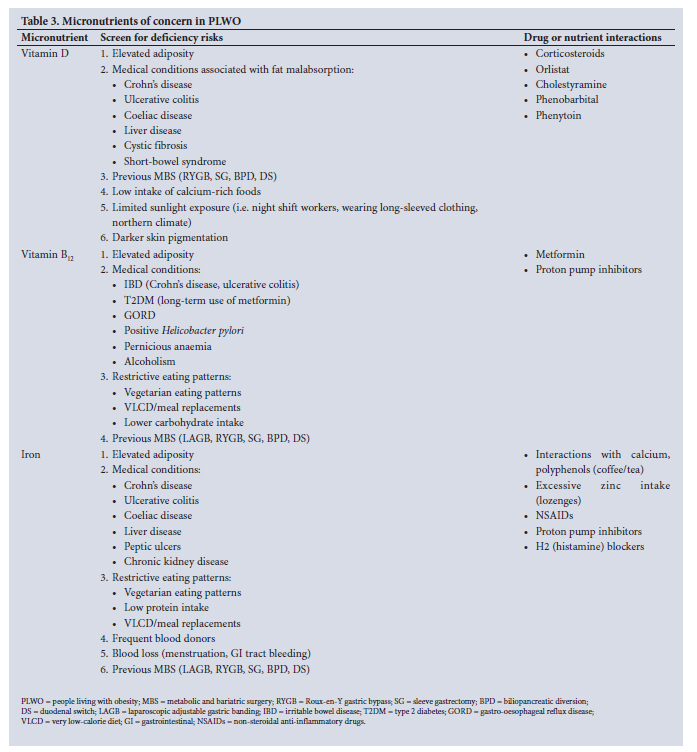
PLWO are at increased risk for micronutrient deficiencies including, but not limited to, vitamin D, vitamin B12 and iron. The prevalence of vitamin D deficiency in obesity has been reported to be as high as 90%,[206] theoretically as a result of decreased bioavailability of vitamin D, as it is sequestered in adipose tissue,[207] or due to volumetric dilution.[208] Systematic reviews and meta-analyses of RCTs indicate that higher adiposity levels (% fat mass or fat mass) are associated with lower serum 25-hydroxy (OH) vitamin D (25(OH)D) levels,[209-211] suggesting the need for HCPs to monitor vitamin D levels as part of routine assessment of PLWO. Vitamin D supplementation has not been effective in treating PLWO or for improving cardiometabolic outcomes, as shown by meta-analyses of RCTs.[210,212,213] However, vitamin D supplementation for correction and/or prevention of deficiency (<50 nmol/L as defined by the Institute of Medicine[214]) is recommended, especially in PLWO at higher risk for vitamin D deficiency (Table 3), including individuals with metabolic bone disorders, older adults with a history of falls, and those with clinically significant muscle weakness, malabsorptive conditions, liver/renal disease, chronic inflammatory conditions and use of certain medications.[215] This should be undertaken as part of a comprehensive EOSS assessment. PLWO may need a higher dose (two to three times higher; at least 6 000 - 10 000 IU/d) of vitamin D to treat deficiency.[66,216]
Restrictive eating patterns, obesity treatments (e.g. medications, MBS) and drug-nutrient interactions may also result in micronutrient deficiencies, specifically vitamin B12 and iron deficiencies.[206,217,218] There is also growing evidence for thiamine (vitamin B1) and magnesium deficiencies.[219] Vitamin B12 deficiency has been shown to be associated with higher BMI categories;[220] however, caution should be used when interpreting observational studies owing to large heterogeneity within studies. Poor iron status has also been associated with obesity, with a 1.31-fold increased risk for iron deficiency in PLWO.[217] Assessment including biochemical values can help inform recommendations for food intake, vitamin/mineral supplements, and possible drug-nutrient interactions (Table 3). Further guidance on supplementation following MBS is outlined in the chapter 'Metabolic and bariatric surgery: Postoperative management',
Disordered eating patterns
Historically, obesity and eating disorder research have developed in isolation from each other, seldom intersecting. Public health concerns have largely disregarded the important overlap between eating disorders in PLWO. It is well recognised that weight bias and weight stigma are established risk factors for disordered eating and obesity.[221,222]
HCPs may be hesitant to recommend restricting intake or VLCDs, as an early literature review found that the development of eating disorders in college-aged women was associated with a history of intentional CR for weight loss.[223] Current evidence shows mixed results, however, because limited studies have specifically assessed whether 'dieting' practices (for pursuit of an ideal body weight or shape, drive for thinness and goals of weight loss) precipitate eating disorders (such as binge-eating disorder [BED] or disordered eating behaviours). Epidemiological data from a 20-year longitudinal study indicated that eating disorders, drive for thinness, and use of diet pills, laxatives and dieting methods to control weight declined in adult women but increased for adult men.[224] However, the underlying biological factors contributing to the manifestation of eating disorders remain poorly understood.[225]
A systematic review by Da Luz et al.[226] found that VLCDs can be used without exacerbating existing eating disorders or binge-eating episodes in medically supervised programmes. Binge eating decreased in VLCD interventions. A prospective RCT found no disordered eating behaviours, no BED and decreased symptoms of depression in CR groups (1 200 - 1 500 kcal/day with conventional food, or 1 000 kcal/day with full meal replacements) compared with a non-CR approach.[227][ Symptoms of poor self-esteem and negative body image declined in all three groups over time. Furthermore, a review of cross-sectional and prospective studies on dietary restriction and the development of eating disorders or disordered eating behaviours confirmed minimal to no evidence to support the causation.[228] Caution is recommended when interpreting findings from this report, as the study intentions were not designed to specifically investigate dieting and eating disorders or disordered eating behaviours in PLWO.
Multimorbidity is common in eating disorder progression.[225] In the context of obesity, BED and night eating syndrome (NES) are prevalent and can affect the management of obesity comorbidities such as T2DM. Research indicates a higher prevalence of T2DM in people with BED (15.2%) compared with matched controls (2.2%).[229,230] HCPs should be vigilant for BED or NES in their T2DM patients, but further research is needed for concurrent management.[66]
A recent systematic review by the Australian National Eating Disorder Collaboration concluded that professional obesity management interventions (using MNT, physical activity, behaviour therapy, pharmacotherapy or surgical interventions) do not precipitate eating disorders or increase risk for eating disorders in people with a BMI >25 kg/m2[231] A recent article also suggested that there may be differences between self-directed diets that are weight-centric and restrictive, and supervised evidence-based obesity treatments that focus on sustainability and health and eating disorder risks.[200] However, eating disorders are often underdiagnosed and untreated, and some evidence suggests that people with eating disorders are more likely to seek weight loss interventions.[232] Compassion-focused therapy for eating disorders is a relatively novel approach that has been proposed for the treatment of eating disorders and elicits beneficial results in relation to the reducing of self-criticism and shame in groups of people with eating disorders.[66,233] HCPs should consider referral to mental health professionals and/or eating disorder programmes for assessment and treatment if symptoms are suspected. (See the chapter 'The role of mental health in obesity management'.)
Assess risk for malnutrition prior to metabolic and bariatric surgery
Limited high-quality evidence is available on preoperative malnutrition status in PLWO seeking MBS. Nonetheless, observational studies have indicated that PLWO have a higher risk for inadequate nutritional status[201,234,235] and malnutrition.[201-203] A large, multicentre, retrospective observational study (N=106 577) found that ~6% of PLWO undergoing MBS were malnourished and had an increased risk of death or serious morbidity and 30-day readmission rates.[202] This study also found that >10% weight loss prior to MBS was associated with nine times higher rates of death or serious disease conditions in PLWO with mild malnutrition and 10 times higher rates of death or serious disease conditions in those with severe malnutrition.[30] Similarly, a retrospective cohort study[203] concluded that 32% of the cohort (n=533) had malnutrition prior to MBS. Higher BMI was associated with increased risk for malnutrition. Postoperative nausea and vomiting were associated with preoperative malnutrition.
A cross-sectional study in Cape Town, SA, an LMIC, investigated the prevalence of micronutrient and vitamin deficiencies in PLWO scheduled to undergo MBS.[236] Participants were predominantly female, with a mean age of 45 years (range 37 - 51) and a mean preoperative BMI of 50.4 kg/m212, calcium, magnesium, phosphate) were rarely encountered and affected <1% of participants. Folate and 25(OH)D deficiency were related to obesity classification, with a higher prevalence in participants with a BMI >40 kg/m2p<0.01). A higher prevalence of some micronutrient deficiencies was noted compared with data from similar populations in the developed world.[236]
Preoperative evaluation and collaborative support from an RD are recommended for all PLWO considering MBS.[206,237] In SA, a resource-limited setting, the minimum baseline/preoperative nutrient evaluation in such populations should include 25(OH)D, iron studies and folate. Additionally, screening for T2DM is recommended.[236] (See the chapter Assessment of people living with obesity'.)
Limitations and opportunities
To support evidence-based practice, the authors of this guideline chapter examined the literature to find the highest-quality evidence to inform graded recommendations. High-quality evidence was identified for specific nutrition-related topics including MNT delivered by an RD, specific dietary patterns, certain food-based approaches, and intensive behavioural therapy. There was limited evidence for non-restrictive dietary approaches. Gaps in the literature included assessment of baseline nutrition status and social determinants of health. Most studies with a nutrition component were short- to medium-term interventions, limiting our knowledge of long-term outcomes.
Studies using BMI >25 kg/m2[238]
Weight loss was the main measure of intervention studies; however, the reason for weight change is difficult to ascertain. The success or failure of the intervention on weight outcomes is confounded by the physiological defence mechanisms in response to adiposity changes, as discussed in the chapter 'The science of obesity'.
To move nutrition and obesity practice forward, we suggest the following:
• Develop assessment tools for the primary care environment to support the use of a health complication-centric definition of obesity, rather than relying on anthropometric measures for BMI categories.
• Improve accuracy of nutrition interventions for PLWO with measurements of energy, macro/micronutrient needs and body composition (including sarcopenic obesity) and health outcomes.
• Nutrition is about more than the food we eat. Explore the relationships with food, food security, internalised weight bias, weight stigma and/or discrimination, eating behaviours and social determinants of health as part of the care and research for PLWO.
• Include the PLWO's voice in nutrition research and care to help align the interventions for PLWO and people with larger bodies with their lived experiences.
• Future research should compare nutrition interventions using new definitions of obesity, and assess nutrition-related outcomes, health-related outcomes and behaviour change instead of weight loss outcomes alone across all weight spectrums.[66]
Evidence continues to emerge that impacts on our understanding of nutrition and chronic disease. HCPs may look to enhance their professional knowledge on emerging evidence in nutrition-related topics, including:
• Neurophysiological pathways that affect hunger, appetite and reward
• Metabolic adaptation of CR
• Gut microbiota
• Nutrigenomics and personalised nutrition
• Social determinants of health
• Mental health.
Conclusion
Nutrition interventions show benefits in terms of cardiometabolic outcomes, including glycaemic control, hypertension, lipid profile and cardiovascular risk (Table 1 and Fig. 1). MNT and co-ordination of care with an RD can help PLWO improve health and QoL. The focus of all nutrition interventions should be finding a nutrition approach PLWO can incorporate into their lives that is nutritionally adequate, culturally acceptable, affordable, enjoyable, and effective for lifelong health improvements (Fig. 2).
There are multiple dietary patterns and approaches that have demonstrated clinically significant improvements in health and weight and/or adiposity outcomes. CR may be effective in the first 12 months of treatment; however, it is difficult to sustain given the physiological hunger, appetite and satiety responses to restriction. There are instances where significant weight loss (>5%) is recommended to address health outcomes (e.g. improve glycaemia in T2DM) and prepare for MBS. Micronutrient deficiencies are common among PLWO and after MBS. Full nutritional assessment and diagnoses should be documented for PLWO in the early stages of the '5As' approach to obesity management, i.e. Ask, Assess, Advise, Agree, Assist. Behaviour change techniques are used alongside MNT to support PLWO in implementing health behaviour change. Non-restrictive dietary approaches and supporting PLWO in achieving a healthy nutrition status at their 'best weight' may be appropriate. In collaboration with PLWO, the evidence presented can be used as a guide to identify and plan the most appropriate personalised nutrition therapy approach.[66]
Research in the field of obesity is continually evolving and the evidence base is growing, and with this a paradigm shift is taking place in the best care practices for the effective treatment of PLWO. The implementation of the clinical practice guideline is a unique opportunity for the improvement of care for PLWO in SA.
Acknowledgement. 'Medical nutrition therapy in obesity management' is adapted from the Canadian Adult Obesity Clinical Practice Guideline (the 'Guideline'), which Obesity Canada owns and from whom we have a licence. SAMMSS adapted the Guideline having regard for relevant context affecting South Africa using the ADAPTE Tool.
SAMMSS acknowledges that Obesity Canada and the authors of the Guideline have not formally reviewed 'Medical nutrition therapy in obesity management' and bear no responsibility for changes made to such chapter, or how the adapted Guideline is presented or disseminated. Therefore, such parties, according to their policy, disclaim any association with such adapted materials. The original Guideline may be viewed in English at: www.obesitycanada.ca/guidelines
Author contributions. VRF adapted the Canadian guideline with extensive revision of the text. All authors edited and approved the final version of the chapter.
References
-
1. Department of Health, Republic of South Africa. Food-based dietary guidelines for South Africa. S Afr J Clin Nutr 2013;26(3 Suppl):S1-S164. Available from: http://sajcn.co.za/index.php/SAJCN/issue/view/67 (accessed 9 February 2025).
» http://sajcn.co.za/index.php/SAJCN/issue/view/67 -
2. Koliaki C, Spinos T, Spinou M, Brinia M-E, Mitsopoulou D, Katsilambros N. Defining the optimal dietary approach for safe, effective and sustainable weight loss in overweight and obese adults. Healthcare (Basel) 2018;6(3):73. https://doi.org/10.3390/healthcare6030073
» ):73. https://doi.org/10.3390/healthcare6030073 -
3. Williams LT, Barnes K, Ball L, Ross LJ, Sladdin I, Mitchell LJ. How effective are dietitians in weight management? A systematic review and meta-analysis of randomised controlled trials. Healthcare (Basel) 2019;7(1):20. https://doi.org/10.3390/healthcare7010020
» https://doi.org/10.3390/healthcare7010020 -
4. Raynor HA, Davidson PG, Burns H, et al. Medical nutrition therapy and weight loss questions for the Evidence Analysis Library prevention of type 2 diabetes project: Systematic reviews. J Acad Nutr Diet 2017;117(10):1578-1611. https://doi.org/10.1016/joand.2017.06.361
» https://doi.org/10.1016/joand.2017.06.361 -
5. Razaz JM, Rahmani J, Varkaneh HK, Thompson J, Clark C, Abdulazeem HM. The health effects of medical nutrition therapy by dietitians in patients with diabetes: A systematic review and meta-analysis: Nutrition therapy and diabetes. Prim Care Diabetes 2019;13(5):399-408. https://doi.org/10.1016/j.pcd.2019.05.001
» https://doi.org/10.1016/j.pcd.2019.05.001 -
6. Johnston BC, Kanters S, Bandayrel K, et al. Comparison of weight loss among named diet programs in overweight and obese adults: A meta-analysis. JAMA 2014;312(9):923-933. https://doi.org/10.1001/jama.2014.10397
» https://doi.org/10.1001/jama.2014.10397 -
7. Pan B, Wu Y, Yang Q, et al. The impact of major dietary patterns on glycemic control, cardiovascular risk factors, and weight loss in patients with type 2 diabetes: A network meta-analysis. J Evid Based Med 2019;12(1):29-39. https://doi.org/10.1111/jebm.12312
» https://doi.org/10.1111/jebm.12312 -
8. Estruch R, Ros E, Salas-Salvadó J, et al. Primary prevention of cardiovascular disease with a Mediterranean diet supplemented with extra-virgin olive oil or nuts. N Engl J Med 2018;378(25):e34. https://doi.org/10.1056/NEJMoa1800389
» https://doi.org/10.1056/NEJMoa1800389 -
9. Salas-Salvadó J, Bulló M, Babio N, et al.; PREDIMED Study Investigators. Reduction in the incidence of type 2 diabetes with the Mediterranean diet: Results of the PREDIMED-Reus nutrition intervention randomized trial. Diabetes Care 2011;34(1):14-19. https://doi.org/10.2337/dc10-1288
» https://doi.org/10.2337/dc10-1288 -
10. Salas-Salvadó J, Bulló M, Babio N, et al.; PREDIMED Study Investigators. Erratum. Reduction in the incidence of type 2 diabetes with the mediterranean diet: Results of the PREDIMED-Reus nutrition intervention randomised trial. Diabetes Care 2011;34:14-19. Diabetes Care 2018;41(10):2259-2260. https://doi.org/10.2337/dc18-er10
» https://doi.org/10.2337/dc18-er10 -
11. Babio N, Toledo E, Estruch R, et al. Mediterranean diets and metabolic syndrome status in the PREDIMED randomized trial. CMAJ 2014;186(17):E649-E657. https://doi.org/10.1503/cmaj.140764
» https://doi.org/10.1503/cmaj.140764 -
12. The Editors of The Lancet Diabetes and Endocrinology. Retraction and republication - Effect of a high-fat Mediterranean diet on bodyweight and waist circumference: A prespecified secondary outcomes analysis of the PREDIMED randomised controlled triai Lancet Diabetes Endocrinol 2019;7(5):334. https://doi.org/10.1016/S2213-8587(19)30073-7
» https://doi.org/10.1016/S2213-8587(19)30073-7 -
13. Viguiliouk E, Kendall CW, Kahleova H, et al. Effect of vegetarian dietary patterns on cardiometabolic risk factors in diabetes: A systematic review and meta-analysis of randomized controlled trials. Clin Nutr 2019;38(3):1133-1145. https://doi.org/10.1016/j.clnu.2018.05.032
» https://doi.org/10.1016/j.clnu.2018.05.032 -
14. Lee Y, Park K. Adherence to a vegetarian diet and diabetes risk: A systematic review and meta-analysis of observational studies. Nutrients 2017;9(6):603. https://doi.org/10.3390/nu9060603
» https://doi.org/10.3390/nu9060603 -
15. Glenn AJ, Viguiliouk E, Seider M, et al. Relation of vegetarian dietary patterns with major cardiovascular outcomes: A systematic review and meta-analysis of prospective cohort studies. Front Nutr 2019;6:80. https://doi.org/10.3389/fiiut.2019.00080
» https://doi.org/10.3389/fiiut.2019.00080 -
16. Chiavaroli L, Nishi SK, Khan TA, et al. Portfolio dietary pattern and cardiovascular disease: A systematic review and meta-analysis of controlled trials. Prog Cardiovasc Dis 2018;61(1):43-53. https://doi.org/10.1016/j.pcad.2018.05.004
» https://doi.org/10.1016/j.pcad.2018.05.004 -
17. Chiavaroli L, Kendall CWC, Braunstein CR, et al. Effect of pasta in the context of low-glycaemic index dietary patterns on body weight and markers of adiposity: A systematic review and meta-analysis of randomised controlled trials in adults. BMJ Open 2018;8(3):e019438. https://doi.org/10.1136/bmjopen-2017-019438
» https://doi.org/10.1136/bmjopen-2017-019438 -
18. Wang Q, Xia W, Zhao Z, Zhang H. Effects comparison between low glycemic index diets and high glycemic index diets on HbA1c and fructosamine for patients with diabetes: A systematic review and meta-analysis. Prim Care Diabetes 2015;9(5):362-369. https://doi.org/10.1016/j.pcd.2014.10.008
» https://doi.org/10.1016/j.pcd.2014.10.008 -
19. Goff LM, Cowland DE, Hooper L, Frost GS. Low glycaemic index diets and blood lipids: A systematic review and meta-analysis of randomised controlled trials. Nutr Metab Cardiovasc Dis 2013;23(1):1-10. https://doi.org/10.1016/j.numecd.2012.06.002
» https://doi.org/10.1016/j.numecd.2012.06.002 -
20. Evans CE, Greenwood DC, Threapleton DE, Gale CP, Cleghorn CL, Burley VJ. Glycemic index, glycemic load, and blood pressure: A systematic review and meta-analysis of randomized controlled trials. Am J Clin Nutr 2017;105(5):1176-1190. https://doi.org/10.3945/ajcn.116.143685
» https://doi.org/10.3945/ajcn.116.143685 -
21. Livesey G, Taylor R, Livesey HF, et al. Dietary glycemic index and load and the risk of type 2 diabetes: A systematic review and updated meta-analyses of prospective cohort studies. Nutrients 2019;11(6):1280. https://doi.org/10.3390/nu11061280
» https://doi.org/10.3390/nu11061280 -
22. Livesey G, Livesey H. Coronary heart disease and dietary carbohydrate, glycemic index, and glycemic load: Dose-response meta-analyses of prospective cohort studies. Mayo Clin Proc Innov Qual Outcomes 2019;3(1):52-69. https://doi.org/10.1016/j.mayocpiqo.2018.12.007
» https://doi.org/10.1016/j.mayocpiqo.2018.12.007 -
23. Soltani S, Shirani F, Chitsazi MJ, Salehi-Abargouei A. The effect of Dietary Approaches to Stop Hypertension (DASH) diet on weight and body composition in adults: A systematic review and meta-analysis of randomized controlled clinical trials. Obes Rev 2016;17(5):442-454. https://doi.org/10.1111/obr.12391
» https://doi.org/10.1111/obr.12391 -
24. Chiavaroli L, Viguiliouk E, Nishi SK, et al. DASH dietary pattern and cardiometabolic outcomes: An umbrella review of systematic reviews and meta-analyses. Nutrients 2019;11(2):338. https://doi.org/10.3390/nu11020338
» https://doi.org/10.3390/nu11020338 -
25. Soltani S, Chitsazi MJ, Salehi-Abargouei A. The effect of Dietary Approaches to Stop Hypertension (DASH) on serum inflammatory markers: A systematic review and meta-analysis of randomized trials. Clin Nutr 2018;37(2):542-550. https://doi.org/10.1016/j.clnu.2017.02.018
» https://doi.org/10.1016/j.clnu.2017.02.018 -
26. Poulsen SK, Due A, Jordy AB, et al. Health effect of the New Nordic Diet in adults with increased waist circumference: A 6-mo randomised controlled trial. Am J Clin Nutr 2014;99(1):35-45. https://doi.org/10.3945/ajcn.113.069393
» https://doi.org/10.3945/ajcn.113.069393 -
27. Poulsen SK, Crone C, Astrup A, Larsen TM. Long-term adherence to the New Nordic Diet and the effects on body weight, anthropometry and blood pressure: A 12-month follow-up study. Eur J Nutr 2015;54(1):67-76. https://doi.org/10.1007/s00394-014-0686-z
» https://doi.org/10.1007/s00394-014-0686-z -
28. Adamsson V, Reumark A, Fredriksson IB, et al. Effects of a healthy Nordic diet on cardiovascular risk factors in hypercholesterolaemic subjects: A randomized controlled trial (NORDIET). J Intern Med 2011369(2):150-159. https://doi.org/10.1111/j.1365-2796.2010.02290.x
» https://doi.org/10.1111/j.1365-2796.2010.02290.x -
29. Uusitupa M, Hermansen K, Savolainen MJ, et al. Effects of an isocaloric healthy Nordic diet on insulin sensitivity, lipid profile and inflammation markers in metabolic syndrome - a randomized study (SYSDIET). J Intern Med 2013;274(1):52-66. https://doi.org/10.1111/joim.12044
» https://doi.org/10.1111/joim.12044 -
30. Lemming EW, Byberg L, Wolk A, Michaëlsson K. A comparison between two healthy diet scores, the modified Mediterranean diet score and the Healthy Nordic Food Index, in relation to all-cause and cause-specific mortality. Br J Nutr 2018;119(7):836-846. https://doi.org/10.1017/S0007114518000387
» https://doi.org/10.1017/S0007114518000387 -
31. Noronha JC, Nishi SK, Braunstein CR, et al. The effect of liquid meal replacements on cardiometabolic risk factors in overweight/obese individuals with type 2 diabetes: A systematic review and meta-analysis of randomized controlled trials. Diabetes Care 2019;42(5):767-776. https://doi.org/10.2337/dc18-2270
» https://doi.org/10.2337/dc18-2270 -
32. Cioffi I, Evangelista A, Ponzo V, et al. Intermittent versus continuous energy restriction on weight loss and cardiometabolic outcomes: A systematic review and meta-analysis of randomized controlled trials. J Transl Med 2018;16(1):371. https://doi.org/10.1186/s12967-018-1748-4
» https://doi.org/10.1186/s12967-018-1748-4 -
33. Kim SJ, de Souza RJ, Choo VL, et al. Effects of dietary pulse consumption on body weight: A systematic review and meta-analysis of randomized controlled trials. Am J Clin Nutr 2016;103(5):1213-1223. https://doi.org/10.3945/ajcn.115.124677
» https://doi.org/10.3945/ajcn.115.124677 -
34. Sievenpiper JL, Kendall CW, Esfahani A, et al. Effect of non-oil-seed pulses on glycaemic control: A systematic review and meta-analysis of randomised controlled experimental trials in people with and without diabetes. Diabetologia 2009;52(8):1479-1495. https://doi.org/10.1007/s00125-009-1395-7
» https://doi.org/10.1007/s00125-009-1395-7 -
35. Ha V, Sievenpiper JL, de Souza RJ, et al Effect of dietary pulse intake on established therapeutic lipid targets for cardiovascular risk reduction: A systematic review and meta-analysis of randomized controlled trials. CMAJ 2014;186(8):E252-E262. https://doi.org/10.1503/cmaj.131727
» https://doi.org/10.1503/cmaj.131727 -
36. Jayalath VH, de Souza RJ, Sievenpiper JL, et al Effect of dietary pulses on blood pressure: A systematic review and meta-analysis of controlled feeding trials. Am J Hypertens 2014;27(1):56-64. https://doi.org/10.1093/ajh/hpt155
» https://doi.org/10.1093/ajh/hpt155 -
37. Viguiliouk E, Blanco Mejia S, Kendall CWC, Sievenpiper JL. Can pulses play a role in improving cardiometabolic health? Evidence from systematic reviews and meta-analyses. Ann N Y Acad Sci 2017;1392(1):43-57. https://doi.org/10.1111/nyas.13312
» https://doi.org/10.1111/nyas.13312 -
38. Shin JY, Kim JY, Kang HT, Han KH, Shim JY. Effect of fruits and vegetables on metabolic syndrome: A systematic review and meta-analysis of randomized controlled trials. Int J Food Sci Nutr 2015;66(4):416-425. https://doi.org/10.3109/09637486.2015.1025716
» https://doi.org/10.3109/09637486.2015.1025716 -
39. Moazen S, Amani R, Homayouni Rad A, Shahbazian H, Ahmadi K, Taha Jalali M. Effects of freeze-dried strawberry supplementation on metabolic biomarkers of atherosclerosis in subjects with type 2 diabetes: A randomized double-blind controlled trial. Ann Nutr Metab 2013;63(3):256-264. https://doi.org/10.1159/000356053
» https://doi.org/10.1159/000356053 -
40. Schwingshackl L, Hoffmann G, Lampousi AM, et al Food groups and risk of type 2 diabetes mellitus: A systematic review and meta-analysis of prospective studies. Eur J Epidemiol 2017;32(5):363-375. https://doi.org/10.1007/s10654-017-0246-y
» https://doi.org/10.1007/s10654-017-0246-y -
41. Wang X, Ouyang Y, Liu J, et al. Fruit and vegetable consumption and mortality from all causes, cardiovascular disease, and cancer: Systematic review and dose-response meta-analysis of prospective cohort studies. BMJ 2014;349:g4490. https://doi.org/10.1136/bmj.g4490
» https://doi.org/10.1136/bmj.g4490 -
42. Viguiliouk E, Kendall CW, Blanco Mejia S, et al. Effect of tree nuts on glycemic control in diabetes: A systematic review and meta-analysis of randomized controlled dietary trials. PLoS ONE 2014;9(7):e103376. https://doi.org/10.1371/journal.pone.0103376
» https://doi.org/10.1371/journal.pone.0103376 -
43. Sabaté J, Oda K, Ros E. Nut consumption and blood lipid levels: A pooled analysis of 25 intervention trials. Arch Intern Med 2010;170(9):821-827. https://doi.org/10.1001/archinternmed.2010.79
» https://doi.org/10.1001/archinternmed.2010.79 -
44. Bao Y, Han J, Hu FB, et al Association of nut consumption with total and cause-specific mortality. N Engl J Med 2013;369(21):2001-2011. https://doi.org/10.1056/NEJMoa1307352
» https://doi.org/10.1056/NEJMoa1307352 -
45. Hollaender PL, Ross AB, Kristensen M. Whole-grain and blood lipid changes in apparently healthy adults: A systematic review and meta-analysis of randomized controlled studies. Am J Clin Nutr 2015;102(3):556-572. https://doi.org/10.3945/ajcn.115.109165
» https://doi.org/10.3945/ajcn.115.109165 -
46. Geng T, Qi L, Huang T Effects of dairy products consumption on body weight and body composition among adults: An updated meta-analysis of 37 randomized control trials. Mol Nutr Food Res 2018;62(1). https://doi.org/10.1002/mnfr.201700410
» https://doi.org/10.1002/mnfr.201700410 -
47. Look AHEAD Research Group; Wing RR, Bolin P, Brancati FL, et al. Cardiovascular effects of intensive lifestyle intervention in type 2 diabetes [erratum appears in N Engl J Med 2014; 370(19):1866]. N Engl J Med 2013;369(2):145-154. https://doi.org/10.1056/NEJMoa1212914
» https://doi.org/10.1056/NEJMoa1212914 -
48. Knowler WC, Barrett-Connor E, Fowler SE, et al. Reduction in the incidence of type 2 diabetes with lifestyle intervention or metformin. N Engl J Med 2002;346(6):393-403. https://doi.org/10.1056/NEJMoa012512
» https://doi.org/10.1056/NEJMoa012512 -
49. Gong Q, Zhang P, Wang J, et al. Morbidity and mortality after lifestyle intervention for people with impaired glucose tolerance: 30-year results of the Da Qing Diabetes Prevention Outcome Study. Lancet Diabetes Endocrinol 2019;7(6):452-461. https://doi.org/10.1016/s2213-8587(19)30093-2
» https://doi.org/10.1016/s2213-8587(19)30093-2 -
50. Lean MEJ, Leslie WS, Barnes AC, et al. Durability of a primary care-led weight-management intervention for remission of type 2 diabetes: 2-year results of the DiRECT open-label, cluster-randomised trial. Lancet Diabetes Endocrinol 2019;7(5):344-355. https://doi.org/10.1016/s2213-8587(19)30068-3
» https://doi.org/10.1016/s2213-8587(19)30068-3 -
51. Look AHEAD Research Group. Effect of a long-term behavioural weight loss intervention on nephropathy in overweight or obese adults with type 2 diabetes: A secondary analysis of the Look AHEAD randomised clinical trial. Lancet Diabetes Endocrinol 2014;2(10):801-809. https://doi.org/10.1016/s2213-8587(14)70156-1
» https://doi.org/10.1016/s2213-8587(14)70156-1 -
52. Kuna ST, Reboussin DM, Borradaile KE, et al. Long-term effect of weight loss on obstructive sleep apnea severity in obese patients with type 2 diabetes. Sleep 2013;36(5):641-649. https://doi.org/10.5665/sleep.2618
» https://doi.org/10.5665/sleep.2618 -
53. Rubin RR, Wadden TA, Bahnson JL, et al. Impact of intensive lifestyle intervention on depression and health-related quality of life in type 2 diabetes: The Look AHEAD trial. Diabetes Care 2014;37(6):1544-1553. https://doi.org/10.2337/dc13-1928
» https://doi.org/10.2337/dc13-1928 -
54. Ulian MD, Aburad L, da Silva Oliveira MS, et al Effects of Health at Every Size® interventions on health-related outcomes of people with overweight and obesity: A systematic review. Obes Rev 2018;19(12):1659-1666. https://doi.org/10.1111/obr.12749
» https://doi.org/10.1111/obr.12749 -
55. Puhl RM, Heuer CA. Obesity stigma: Important considerations for public health. Am J Public Health 2010;100(6):1019-1028. https://doi.org/10.2105/ajph.2009.159491
» https://doi.org/10.2105/ajph.2009.159491 -
56. Ramos Salas X, Forhan M, Caulfield T, Sharma AM, Raine KD. Addressing internalized weight bias and changing damaged social identities for people living with obesity. Front Psychol 2019;10:1409. https://doi.org/10.3389/fpsyg.2019.01409
» https://doi.org/10.3389/fpsyg.2019.01409 -
57. Ralston J, Brinsden H, Buse K, et al. Time for a new obesity narrative. Lancet 2018;392(10156):1384-1386. https://doi.org/10.1016/S0140-6736(18)32537-6
» https://doi.org/10.1016/S0140-6736(18)32537-6 -
58. Brownell KD, Kersh R, Ludwig DS, et al. Personal responsibility and obesity: A constructive approach to a controversial issue. Health Aff (Millwood) 2010;29(3):379-387. https://doi.org/10.1377/hlthaff.2009O739
» https://doi.org/10.1377/hlthaff.2009O739 -
59. Sumithran P, Prendergast LA, Delbridge E, et al. Long-term persistence of hormonal adaptations to weight loss. N Engl J Med 2011;365(17):1597-1604. https://doi.org/10.1056/NEJMoa1105816
» https://doi.org/10.1056/NEJMoa1105816 -
60. Rosenbaum M, Hirsch J, Gallagher DA, Leibel RL. Long-term persistence of adaptive thermogenesis in subjects who have maintained a reduced body weight. Am J Clin Nutr 2008;88(4):906-912. https://doi.org/10.1093/ajcn/88.4.906
» https://doi.org/10.1093/ajcn/88.4.906 -
61. Hall KD, Heymsfield SB, Kemnitz JW, Klein S, Schoeller DA, Speakman JR. Energy balance and its components: Implications for body weight regulation. Am J Clin Nutr 2012;95(4):989-994. https://doi.org/10.3945/ajcn.112.036350
» https://doi.org/10.3945/ajcn.112.036350 -
62. American Diabetes Association. 5. Lifestyle management: Standards of medical care in Diabetes - 2019. Diabetes Care 2019;42(Suppl 1):S46-S60. https://doi.org/10.2337/dc19-S005
» https://doi.org/10.2337/dc19-S005 -
63. Misselhorn A, Hendriks SL. A systematic review of sub-national food insecurity research in South Africa: Missed opportunities for policy insights. PLoS ONE 2017;12(8):e0182399. https://doi.org/10.1371/journal.pone.0182399
» https://doi.org/10.1371/journal.pone.0182399 -
64. Battersby J. The state of urban food insecurity in Cape Town. Urban Food Security Series No. 11. Kingston, ON, and Cape Town: African Food Security Urban Network, 2011. https://scholars.wlu.ca/afsun/21/ (accessed 9 June 2025).
» https://scholars.wlu.ca/afsun/21/ -
65. Crush J, Frayne B, Pendleton W. The crisis of food insecurity in African cities. J Hunger Environ Nutr 2012;7(2-3):271-292. https://doi.org/10.1080/19320248.2012.702448
» https://doi.org/10.1080/19320248.2012.702448 -
66. ASOI Adult Obesity Clinical Practice Guideline adaptation (ASOI version 1, 2022) by: Breen C, Browne S, Donovan C. Chapter adapted from: Browne J, Clarke C, Johnson Stoklossa C, Sievenpiper J. https://asoi.info/guidelines/nutrition/ (accessed 8 April 2025).
» https://asoi.info/guidelines/nutrition/ -
67. Hofman KJ, Stacey N, Swart EC, Popkin BM, Ng SW. South Africa's Health Promotion Levy: Excise tax findings and equity potential. Obes Rev 2021;22(9):e13301. https://doi.org/10.1111/obr.13301
» https://doi.org/10.1111/obr.13301 -
68. Mchiza ZJ, Steyn NP, Hill J, et al. A review of dietary surveys in the adult South African population from 2000 to 2015. Nutrients 2015;7(9):8227-8250. https://doi.org/10.3390/nu7095389
» https://doi.org/10.3390/nu7095389 -
69. Odunitan-Wayas FA, Faber M, Mendham AE, et al. Food security, dietary intake, and foodways of urban low-income older South African women: An exploratory study. Int J Environ Res Public Health 2021;18(8):3973. https://doi.org/10.3390/ijerph18083973
» https://doi.org/10.3390/ijerph18083973 -
70. Steyn NP, Bradshaw D, Norman R, et al. Dietary changes and the health transition in South Africa: Implications for health policy. In: The Double Burden of Malnutrition: Case Studies from Six Developing Countries. Rome: Food and Agriculture Organisation of the United Nations, 2006:1-46. https://www.fao.org/4/a0442e/a0442e0v.htm (accessed July 2025).
» https://www.fao.org/4/a0442e/a0442e0v.htm -
71. Koen N, Wentzel-Viljoen E, Blaauw R Price rather than nutrition information the main influencer of consumer food purchasing behaviour in South Africa: A qualitative study. Int J Consumer Studies 2018;42(4):409-418. https://doi.org/10.1111/ijcs.12434
» https://doi.org/10.1111/ijcs.12434 -
72. Swift JA, Tischler V. Qualitative research in nutrition and dietetics: Getting started. J Hum Nutr Diet 2010;23(6):559-566. https://doi.org/10.1111/j.1365-277X.2010.01116.x
» https://doi.org/10.1111/j.1365-277X.2010.01116.x -
73. National Department of Health, South Africa. Strategy for the Prevention and Management of Obesity in South Africa, 2023 - 2028. Pretoria: NDoH, 2023. https://www.health.gov.za/wp-content/uploads/2023/05/Obesity-Strategy-2023-2028_Final_Approved.pdf (accessed 8 July 2025).
» https://www.health.gov.za/wp-content/uploads/2023/05/Obesity-Strategy-2023-2028_Final_Approved.pdf -
74. Vlassopoulos A, Govers E, Mulrooney H, Androutsos O, Hassapidou M. Dietetic management of obesity in Europe: Gaps in current practice. Eur J Clin Nutr 2021;75(7):1155-1158. https://doi.org/10.1038/s41430-020-00820-2
» https://doi.org/10.1038/s41430-020-00820-2 - 75. Swan WI, Vivanti A, Hakel-Smith NA, et al. Nutrition care process and model update: Toward realizing people-centered care and outcomes management. J Acad Nutr Diet 2017;117(12):2003-2014. https://doi.org/10.1016/j.jand.2017.07.015
-
76. Bray GA, Heisel WE, Afshin A, et al. The science of obesity management: An Endocrine Society scientific statement. Endocr Rev 2018;39(2):79-132. https://doi.org/10.1210/er.2017-00253
» https://doi.org/10.1210/er.2017-00253 -
77. Nackers LM, Middleton KR, Dubyak PJ, Daniels MJ, Anton SD, Perri MG. Effects of prescribing 1,000 versus 1,500 kilocalories per day in the behavioral treatment of obesity: A randomized trial. Obesity (Silver Spring) 2013;21(12):2481-2487. https://doi.org/10.1002/oby.20439
» https://doi.org/10.1002/oby.20439 -
78. Ard JD, Gower B, Hunter G, et al Effects of calorie restriction in obese older adults: The CROSSROADS randomized controlled trial. J Gerontol A Biol Sci Med Sci 2017;73(1):73-80. https://doi.org/10.1093/gerona/glw237
» https://doi.org/10.1093/gerona/glw237 -
79. Parretti HM, Jebb SA, Johns DJ, et al. Clinical effectiveness of very-low-energy diets in the management of weight loss: A systematic review and meta-analysis of randomized controlled trials. Obes Rev 2016;17(3):225-234. https://doi.org/10.1111/obr.12366
» https://doi.org/10.1111/obr.12366 -
80. Thomas DM, Martin CK, Lettieri S, et al Can a weight loss of one pound a week be achieved with a 3500-kcal deficit? Commentary on a commonly accepted rule. Int J Obes (Lond) 2013;37(12):1611-1613. https://doi.org/10.1038/ijo.2013.51
» https://doi.org/10.1038/ijo.2013.51 -
81. Hall KD, Chow CC. Why is the 3500 kcal per pound weight loss rule wrong? Int J Obes (Lond) 2013;37(12):1614. https://doi.org/10.1038/ijo.2013.112
» https://doi.org/10.1038/ijo.2013.112 -
82. Polidori D, Sanghvi A, Seeley RJ, Hall KD. How strongly does appetite counter weight loss? Quantification of the feedback control of human energy intake. Obesity (Silver Spring) 2016;24(11):2289-2295. https://doi.org/10.1002/oby.21653
» https://doi.org/10.1002/oby.21653 -
83. Zibellini J, Seimon RV, Lee CMY, et al. Does diet-induced weight loss lead to bone loss in overweight or obese adults? A systematic review and meta-analysis of clinical trials. J Bone Miner Res 2015;30(12):2168-2178. https://doi.org/10.1002/jbmr.2564
» https://doi.org/10.1002/jbmr.2564 -
84. Zibellini J, Seimon RV, Lee CMY, Gibson AA, Hsu MSH, Sainsbury A. Effect of diet-induced weight loss on muscle strength in adults with overweight or obesity - a systematic review and meta-analysis of clinical trials. Obes Rev 2016;17(8):647-663. https://doi.org/10.1111/obr.12422
» https://doi.org/10.1111/obr.12422 -
85. Raynor HA, Champagne CM. Position of the Academy of Nutrition and Dietetics: Interventions for the treatment of overweight and obesity in adults. J Acad Nutr Diet 2016;116(1):129-147. https://doi.org/10.1016/j.jand.2015.10.031
» https://doi.org/10.1016/j.jand.2015.10.031 -
86. Madden AM, Mulrooney HM, Shah S. Estimation of energy expenditure using prediction equations in overweight and obese adults: A systematic review. J Hum Nutr Diet 2016;29(4):458-476. https://doi.org/10.1111/jhn.12355
» https://doi.org/10.1111/jhn.12355 -
87. Franceschi C, Campisi J. Chronic inflammation (inflammaging) and its potential contribution to age-associated diseases. J Gerontol A Biol Sci Med Sci 2014;69(Suppl 1):S4-S9. https://doi.org/10.1093/gerona/glu057
» https://doi.org/10.1093/gerona/glu057 -
88. Villareal DT, Apovian CM, Kushner RF, Klein S; American Society for Nutrition; NAASO, The Obesity Society. Obesity in older adults: Technical review and position statement of the American Society for Nutrition and NAASO, The Obesity Society. Am J Clin Nutr 2005;82(5):923-934. https://doi.org/10.1093/ajcn/82.5.923
» https://doi.org/10.1093/ajcn/82.5.923 -
89. Barazzoni R, Bischoff S, Boirie Y, et al. Sarcopenic obesity: Time to meet the challenge. Obes Facts 2018;11(4):294-305. https://doi.org/10.1159/000490361
» https://doi.org/10.1159/000490361 -
90. Barazzoni R, Gortan Cappellari G. Double burden of malnutrition in persons with obesity. Rev Endocr Metab Disord 2020;21(3):307-313. https://doi.org/10.1007/s11154-020-09578-1
» https://doi.org/10.1007/s11154-020-09578-1 -
91. Tyrovolas S, Koyanagi A, Olaya B, et al. Factors associated with skeletal muscle mass, sarcopenia, and sarcopenic obesity in older adults: A multi-continent study. J Cachexia Sarcopenia Muscle 2016;7(3):312-321. https://doi.org/10.1002/jcsm.12076
» https://doi.org/10.1002/jcsm.12076 -
92. Mendham AE, Lundin-Olsson L, Goedecke JH, et al Sarcopenic obesity in Africa: A call for diagnostic methods and appropriate interventions. Front Nutr 2021;8:661170. https://doi.org/10.3389/fnut.2021.661170
» https://doi.org/10.3389/fnut.2021.661170 -
93. Volkert D, Beck AM, Cederholm T, et al. ESPEN guideline on clinical nutrition and hydration in geriatrics. Clin Nutr 201938(1):10-47. https://doi.org/10.1016/j.clniL2018.05.024
» https://doi.org/10.1016/j.clniL2018.05.024 -
94. Villareal DT, Banks M, Siener C, Sinacore DR, Klein S. Physical frailty and body composition in obese elderly men and women. Obes Res 2004;12(6):913-920. https://doi.org/10.1038/oby.2004.111
» https://doi.org/10.1038/oby.2004.111 -
95. Waters DL, Aguirre L, Gurney B, et al Effect of aerobic or resistance exercise, or both, on intermuscular and visceral fat and physical and metabolic function in older adults with obesity while dieting. J Gerontol A Biol Sci Med Sci 202277(1):131-139. https://doi.org/10.1093/gerona/glab111
» https://doi.org/10.1093/gerona/glab111 -
96. McClave SA, Taylor BE, Martindale RG, et al. Guidelines for the provision and assessment of nutrition support therapy in the adult critically ill patient: Society of Critical Care Medicine (SCCM) and American Society for Parenteral and Enteral Nutrition (ASPEN). JPEN J Parenter Enteral Nutr 2016;40(2):159-211. https://doi.org/10.1177/0148607115621863
» https://doi.org/10.1177/0148607115621863 -
97. Mozaffarian D, Agarwal M, Aggarwal M, et al. Nutritional priorities to support GLP-1 therapy for obesity: A joint advisory from the American College of Lifestyle Medicine, the American Society for Nutrition, the Obesity Medicine Association, and the Obesity Society. Obes Pillars 2025;15:100181. https://doi.org/10.1016/j.obpill2025.100181
» https://doi.org/10.1016/j.obpill2025.100181 -
98. Volkert D, Beck AM, Cederholm T, et al. ESPEN practical guideline: Clinical nutrition and hydration in geriatrics. Clin Nutr 2022;41(4):958-989. https://doi.org/10.1016/j.clnu.2022.01.024
» https://doi.org/10.1016/j.clnu.2022.01.024 -
99. Nutrition Information Centre of the University of Stellenbosch (NICUS). How to eat correctly: Nutrients. https://www.sun.ac.za/english/faculty/healthsciences/nicus/how-to-eat-correctly/nutrients/dri (accessed February 2025).
» https://www.sun.ac.za/english/faculty/healthsciences/nicus/how-to-eat-correctly/nutrients/dri -
100. Trumbo P, Schlicker S, Yates AA, Poos M; Food and Nutrition Board of the Institute of Medicine, The National Academies. Dietary reference intakes for energy, carbohydrate, fiber, fat, fatty acids, cholesterol, protein and amino acids. J Am Diet Assoc 2002;102(11):1621-1630. https://doi.org/10.1016/s0002-8223(02)90346-9
» https://doi.org/10.1016/s0002-8223(02)90346-9 -
101. Gardner CD, Trepanowski JF, del Gobbo LC, et al. Effect of low-fat vs low-carbohydrate diet on 12-month weight loss in overweight adults and the association with genotype pattern or insulin secretion: The DIETFITS randomized clinical trial. JAMA 2018;319(7):667-679. https://doi.org/10.1001/jama.2018.0245
» https://doi.org/10.1001/jama.2018.0245 -
102. Korsmo-Haugen HK, Brurberg KG, Mann J, Aas AM. Carbohydrate quantity in the dietary management of type 2 diabetes: A systematic review and meta-analysis. Diabetes Obes Metab 2019;21(1):15-27. https://doi.org/10.1111/dom.13499
» https://doi.org/10.1111/dom.13499 -
103. Clifton PM, Condo D, Keogh JB. Long term weight maintenance after advice to consume low carbohydrate, higher protein diets - a systematic review and meta analysis. Nutr Metab Cardiovasc Dis 2014;24(3):224-235. https://doi.org/10.1016/j.numecd.2013.11.006
» https://doi.org/10.1016/j.numecd.2013.11.006 -
104. Mansoor N, Vinknes KJ, Veierod MB, Retterstol K. Effects of low-carbohydrate diets v. low-fat diets on body weight and cardiovascular risk factors: A meta-analysis of randomised controlled trials. Br J Nutr 2016;115(3):466-479. https://doi.org/10.1017/S0007114515004699
» https://doi.org/10.1017/S0007114515004699 -
105. Sacks FM, Bray GA, Carey VJ, et al. Comparison of weight-loss diets with different compositions of fat, protein, and carbohydrates. N Engl J Med 2009;360(9):859-873. https://doi.org/10.1056/NEJMoa0804748
» https://doi.org/10.1056/NEJMoa0804748 -
106. Dansinger ML, Gleason JA, Griffith JL, Selker HP, Schaefer EJ. Comparison of the Atkins, Ornish, Weight Watchers, and Zone diets for weight loss and heart disease risk reduction: A randomized trial. JAMA 2005;293(1):43-53. https://doi.org/10.1001/jama.293.1.43
» https://doi.org/10.1001/jama.293.1.43 -
107. Seidelmann SB, Claggett B, Cheng S, et al. Dietary carbohydrate intake and mortality: A prospective cohort study and meta-analysis. Lancet Public Health 2018;3(9):e419-e428. https://doi.org/10.1016/S2468-2667(18)30135-X
» https://doi.org/10.1016/S2468-2667(18)30135-X -
108. Dehghan M, Mente A, Zhang X, et al. Associations of fats and carbohydrate intake with cardiovascular disease and mortality in 18 countries from five continents (PURE): A prospective cohort study. Lancet 2017;390(10107):2050-2062. https://doi.org/10.1016/s0140-6736(17)32252-3
» https://doi.org/10.1016/s0140-6736(17)32252-3 -
109. Jenkins DJA, Wong JMW, Kendall CWC, et al The effect of a plant-based low-carbohydrate ('Eco-Atkins') diet on body weight and blood lipid concentrations in hyperlipidemic subjects. Arch Intern Med 2009;169(11):1046-1054. https://doi.org/10.1001/archinternmed.2009.115
» https://doi.org/10.1001/archinternmed.2009.115 -
110. Jenkins DJA, Wong JMW, Kendall CWC, et al. Effect of a 6-month vegan low-carbohydrate ('Eco-Atkins') diet on cardiovascular risk factors and body weight in hyperlipidaemic adults: A randomised controlled trial. BMJ Open 2014;4(2):e003505. https://doi.org/10.1136/bmjopen-2013-003505
» https://doi.org/10.1136/bmjopen-2013-003505 -
111. Qian F, Korat AA, Malik V, Hu FB. Metabolic effects of monounsaturated fatty acid-enriched diets compared with carbohydrate or polyunsaturated fatty acid-enriched diets in patients with type 2 diabetes: A systematic review and meta-analysis of randomized controlled trials. Diabetes Care 2016;39(8):1448-1457. https://doi.org/10.2337/dc16-0513
» https://doi.org/10.2337/dc16-0513 -
112. Viguiliouk E, Stewart SE, Jayalath VH, et al Effect of replacing animal protein with plant protein on glycemic control in Diabetes: A systematic review and meta-analysis of randomized controlled trials. Nutrients 2015;7(12):9804-9824. https://doi.org/10.3390/nu7125509
» https://doi.org/10.3390/nu7125509 -
113. Li SS, Blanco Mejia S, Lytvyn L, et al Effect of plant protein on blood lipids: A systematic review and meta-analysis of randomized controlled trials. J Am Heart Assoc 2017;6(12):e006659. https://doi.org/10.1161/JAHA.117.006659
» https://doi.org/10.1161/JAHA.117.006659 -
114. Wirunsawanya K, Upala S, Jaruvongvanich V, Sanguankeo A. Whey protein supplementation improves body composition and cardiovascular risk factors in overweight and obese patients: A systematic review and meta-analysis. J Am Coll Nutr 2018;37(1):60-70. https://doi.org/10.1080/07315724.2017.1344591
» https://doi.org/10.1080/07315724.2017.1344591 -
115. Hooper L, Martin N, Abdelhamid A, et al. Reduction in saturated fat intake for cardiovascular disease. Cochrane Database Syst Rev 2020, Issue 8. Art. No.: CD011737. https://doi.org/10.1002/14651858.CD011737
» https://doi.org/10.1002/14651858.CD011737 -
116. Ramsden CE, Zamora D, Leelarthaepin B, et al. Use of dietary linoleic acid for secondary prevention of coronary heart disease and death: Evaluation of recovered data from the Sydney Diet Heart Study and updated meta-analysis. BMJ 2013;346:e8707. https://doi.org/10.1136/bmj.e8707
» https://doi.org/10.1136/bmj.e8707 -
117. Li Y, Hruby A, Bernstein AM, et al. Saturated fats compared with unsaturated fats and sources of carbohydrates in relation to risk of coronary heart disease: A prospective cohort study. J Am Coll Cardiol 2015;66(14):1538-1548. https://doi.org/10.1016/j.jacc.2015.07.055
» https://doi.org/10.1016/j.jacc.2015.07.055 -
118. Jakobsen MU, Dethlefsen C, Joensen AM, et al. Intake of carbohydrates compared with intake of saturated fatty acids and risk of myocardial infarction: Importance of the glycemic index. Am J Clin Nutr 2010;91(6):1764-1768. https://doi.org/10.3945/ajcn.2009.29099
» https://doi.org/10.3945/ajcn.2009.29099 -
119. Miller V, Mente A, Dehghan M, et al. Fruit, vegetable, and legume intake, and cardiovascular disease and deaths in 18 countries (PURE): A prospective cohort study. Lancet 2017;390(10107):2037-2049. https://doi.org/10.1016/S0140-6736(17)32253-5
» https://doi.org/10.1016/S0140-6736(17)32253-5 -
120. Reynolds A, Mann J, Cummings J, Winter N, Mete E, Te Morenga L. Carbohydrate quality and human health: A series of systematic reviews and meta-analyses. Lancet 2019;393(10170):434-445. https://doi.org/10.1016/S0140-6736(18)31809-9
» https://doi.org/10.1016/S0140-6736(18)31809-9 -
121. Threapleton DE, Greenwood DC, Evans CEL, et al. Dietary fibre intake and risk of cardiovascular disease: Systematic review and meta-analysis. BMJ 2013;347:f6879. https://doi.org/10.1136/bmj.f6879
» https://doi.org/10.1136/bmj.f6879 -
122. Government of Canada. Summary of Health Canada's assessment of a health claim about food products containing psyllium and blood cholesterol lowering. December 2011. https://www.canada.ca/en/health-canada/services/food-nutrition/food-labelling/health-claims/assessments/psyllium-products-blood-cholesterol-lowering-nutrition-health-claims-food-labelling.html (accessed 9 June 2025).
» https://www.canada.ca/en/health-canada/services/food-nutrition/food-labelling/health-claims/assessments/psyllium-products-blood-cholesterol-lowering-nutrition-health-claims-food-labelling.html -
123. Government of Canada. Summary of Health Canada's assessment of a health claim about barley products and blood cholesterol lowering. July 2012. https://www.canada.ca/en/health-canada/services/food-nutrition/food-labelling/health-claims/assessments/assessment-health-claim-about-barley-products-blood-cholesterol-lowering.html (accessed 9 June 2025).
» https://www.canada.ca/en/health-canada/services/food-nutrition/food-labelling/health-claims/assessments/assessment-health-claim-about-barley-products-blood-cholesterol-lowering.html -
124. Government of Canada. Oat products and blood cholesterol lowering: Summary of assessment of a health claim about oat products and blood cholesterol lowering. https://www.canada.ca/en/health-canada/services/food-nutrition/food-labelling/health-claims/assessments/products-blood-cholesterol-lowering-summary-assessment-health-claim-about-products-blood-cholesterol-lowering.html (accessed 3 June 2025).
» https://www.canada.ca/en/health-canada/services/food-nutrition/food-labelling/health-claims/assessments/products-blood-cholesterol-lowering-summary-assessment-health-claim-about-products-blood-cholesterol-lowering.html -
125. Government of Canada. Summary of Health Canada's assessment of a health claim about a polysaccharide complex (glucomannan, xanthan gum, sodium alginate) and a reduction of the post-prandial blood glucose response. May 2016. https://www.canada.ca/en/health-canada/services/food-nutrition/food-labelling/health-claims/assessments/summary-assessment-health-claim-about-polysaccharide-complex-glucomannan-xanthan-sodium-alginate-reduction-post-prandial-blood-glucose.html (accessed 3 June 2025).
» https://www.canada.ca/en/health-canada/services/food-nutrition/food-labelling/health-claims/assessments/summary-assessment-health-claim-about-polysaccharide-complex-glucomannan-xanthan-sodium-alginate-reduction-post-prandial-blood-glucose.html -
126. Jovanovski E, Khayyat R, Zurbau A, et al. Should viscous fiber supplements be considered in diabetes control? Results from a systematic review and meta-analysis of randomized controlled trials. Diabetes Care 2019;42(5):755-766. https://doi.org/10.2337/dc18-1126
» https://doi.org/10.2337/dc18-1126 -
127. Jovanovski E, Yashpal S, Komishon A, et al Effect of psyllium (Plantago ovata) fiber on LDL cholesterol and alternative lipid targets, non-HDL cholesterol and apolipoprotein B: A systematic review and meta-analysis of randomized controlled trials. Am J Clin Nutr 2018;108(5):922-932. https://doi.org/10.1093/ajcn/nqy115
» https://doi.org/10.1093/ajcn/nqy115 -
128. Khan K, Jovanovski E, Ho HVT, et al The effect of viscous soluble fiber on blood pressure: A systematic review and meta-analysis of randomized controlled trials. Nutr Metab Cardiovasc Dis 2018;28(1):3-13. https://doi.org/10.1016/j.numecd.2017.09.007
» https://doi.org/10.1016/j.numecd.2017.09.007 -
129. Ho HVT, Jovanovski E, Zurbau A, et al A systematic review and meta-analysis of randomized controlled trials of the effect of konjac glucomannan, a viscous soluble fiber, on LDL cholesterol and the new lipid targets non-HDL cholesterol and apolipoprotein B. Am J Clin Nutr 2017;105(5):1239-1247. https://doi.org/10.3945/ajcn.116.142158
» https://doi.org/10.3945/ajcn.116.142158 -
130. Ho HVT, Sievenpiper JL, Zurbau A, et al. The effect of oat β-glucan on LDL-cholesterol, non-HDL-cholesterol and apoB for CVD risk reduction: A systematic review and meta-analysis of randomised-controlled trials. Br J Nutr 2016;116(8):1369-1382. https://doi.org/10.1017/s000711451600341x
» https://doi.org/10.1017/s000711451600341x -
131. Chew KY, Brownlee IA. The impact of supplementation with dietary fibers on weight loss: A systematic review of randomised controlled trials. Bioact Carbohydrates Diet Fibre 2018;14:9-19. https://doi.org/10.1016/j.bcdf.2017.07.010
» https://doi.org/10.1016/j.bcdf.2017.07.010 -
132. Vuksan V, Jenkins AL, Jenkins DJA, Rogovik AL, Sievenpiper JL, Jovanovski E. Using cereal to increase dietary fiber intake to the recommended level and the effect of fiber on bowel function in healthy persons consuming North American diets. Am J Clin Nutr 2008;88(5):1256-1262. https://doi.org/10.3945/ajcn.2008.25956
» https://doi.org/10.3945/ajcn.2008.25956 -
133. Vuksan V, Sievenpiper JL, Owen R, et al. Beneficial effects of viscous dietary fiber from konjac-mannan in subjects with the insulin resistance syndrome: Results of a controlled metabolic trial. Diabetes Care 2000;23(1):9-14. https://doi.org/10.2337/diacare.23.1.9
» https://doi.org/10.2337/diacare.23.1.9 -
134. Vuksan V, Jenkins DJ, Spadafora P, et al. Konjac-mannan (glucomannan) improves glycemia and other associated risk factors for coronary heart disease in type 2 diabetes: A randomized controlled metabolic trial. Diabetes Care 1999;22(6):913-919. https://doi.org/10.2337/diacare.22.6.913
» https://doi.org/10.2337/diacare.22.6.913 -
135. Jenkins DJA, Kendall CWC, Augustin LSA, et al. Effect of legumes as part of a low glycemic index diet on glycemic control and cardiovascular risk factors in type 2 diabetes mellitus: A randomized controlled trial. Arch Intern Med 2012;172(21):1653-1660. https://doi.org/10.1001/2013.jamainternmed.70
» https://doi.org/10.1001/2013.jamainternmed.70 -
136. Jenkins DJA, Kendall CWC, Augustin LSA, et al Effect of wheat bran on glycemic control and risk factors for cardiovascular disease in type 2 diabetes. Diabetes Care 2002;25(9):1522-1528. https://doi.org/10.2337/diacare.25.9.1522
» https://doi.org/10.2337/diacare.25.9.1522 -
137. Anderson JW, Randles KM, Kendall CWC, Jenkins DJA. Carbohydrate and fiber recommendations for individuals with diabetes: A quantitative assessment and meta-analysis of the evidence. J Am Coll Nutr 2004;23(1):5-17. https://doi.org/10.1080/07315724.2004.10719338
» https://doi.org/10.1080/07315724.2004.10719338 -
138. Sievenpiper JL, Khan TA, Ha V, Viguiliouk E, Auyeung R. The importance of study design in the assessment of nonnutritive sweeteners and cardiometabolic health. CMAJ 2017;189(46):E1424-E1425. https://doi.org/10.1503/cmaj.733381
» https://doi.org/10.1503/cmaj.733381 -
139. Malik VS, Li Y, Pan A, et al. Long-term consumption of sugar-sweetened and artificially sweetened beverages and risk of mortality in US adults. Circulation 2019;139(18):2113-2125. https://doi.org/10.1161/CIRCULATIONAHA.118.037401
» https://doi.org/10.1161/CIRCULATIONAHA.118.037401 -
140. Khan TA, Malik VS, Sievenpiper JL. Letter by Khan et al regarding article, Artificially sweetened beverages and stroke, coronary heart disease, and all-cause mortality in the Women's Health Initiative. Stroke 2019;50(6):e167-e168. https://doi.org/10.1161/STROKEAHA.119.025571
» https://doi.org/10.1161/STROKEAHA.119.025571 -
141. Azad MB, Abou-Setta AM, Chauhan BF, et al. Nonnutritive sweeteners and cardiometabolic health: A systematic review and meta-analysis of randomized controlled trials and prospective cohort studies. CMAJ 2017;189(28):E929-E939. https://doi.org/10.1503/cmaj.161390
» https://doi.org/10.1503/cmaj.161390 -
142. Toews I, Lohner S, Kullenberg de Gaudry D, Sommer H, Meerpohl JJ. Association between intake of non-sugar sweeteners and health outcomes: Systematic review and meta-analyses of randomised and non-randomised controlled trials and observational studies. BMJ 2019;364:k4718. https://doi.org/10.1136/bmj.k4718
» https://doi.org/10.1136/bmj.k4718 -
143. Peters JC, Beck J, Cardel M, et al. The effects of water and non-nutritive sweetened beverages on weight loss and weight maintenance: A randomized clinical trial. Obesity (Silver Spring) 2016;24(2):297-304. https://doi.org/10.1002/oby.21327
» https://doi.org/10.1002/oby.21327 -
144. Rogers PJ, Hogenkamp PS, de Graaf C, et al. Does low-energy sweetener consumption affect energy intake and body weight? A systematic review, including meta-analyses, of the evidence from human and animal studies. Int J Obes (Lond) 2016;40(3):381-394. https://doi.org/10.1038/ijo.2015.177
» https://doi.org/10.1038/ijo.2015.177 -
145. Maersk M, Belza A, St0dkilde-J0rgensen H, et al. Sucrose-sweetened beverages increase fat storage in the liver, muscle, and visceral fat depot: A 6-mo randomized intervention study. Am J Clin Nutr 2012;95(2):283-289. https://doi.org/10.3945/ajcn.111.022533
» https://doi.org/10.3945/ajcn.111.022533 -
146. Raben A, Vasilaras TH, Moller AC, Astrup A. Sucrose compared with artificial sweeteners: Different effects on ad libitum food intake and body weight after 10 wk of supplementation in overweight subjects. Am J Clin Nutr 2002;76(4):721-729. https://doi.org/10.1093/ajcn/76.4.721
» https://doi.org/10.1093/ajcn/76.4.721 -
147. Smith JD, Hou T, Hu FB, et al A comparison of different methods for evaluating diet, physical activity, and long-term weight gain in 3 prospective cohort studies. J Nutr 2015;145(11):2527-2534. https://doi.org/10.3945/jn.115.214171
» https://doi.org/10.3945/jn.115.214171 -
148. Pan A, Malik VS, Schulze MB, Manson JE, Willett WC, Hu FB. Plain-water intake and risk of type 2 diabetes in young and middle-aged women. Am J Clin Nutr 2012;95(6):1454-1460. https://doi.org/10.3945/ajcn.111.032698
» https://doi.org/10.3945/ajcn.111.032698 -
149. Essman M, Taillie LS, Frank T, Ng SW, Popkin BM, Swart EC. Taxed and untaxed beverage intake by South African young adults after a national sugar-sweetened beverage tax: A before-and-after study PLoS Med 2021;18(5):e1003574. https://doi.org/10.1371/journal.pmed.1003574
» https://doi.org/10.1371/journal.pmed.1003574 -
150. Viguiliouk E, Nishi SK, Wolever TM, Sievenpiper JL. Point: Glycemic index an important but oft misunderstood marker of carbohydrate quality. Cereal Foods World 2018;63(4):158-164. https://doi.org/10.1094/CFW-63-4-0158
» https://doi.org/10.1094/CFW-63-4-0158 -
151. Thomas DE, Elliott EJ, Baur L. Low glycaemic index or low glycaemic load diets for overweight and obesity. Cochrane Database Syst Rev 2007, Issue 3. Art. No.: CD005105. https://doi.org/10.1002/14651858.CD005105.pub2
» https://doi.org/10.1002/14651858.CD005105.pub2 -
152. Livesey G, Taylor R, Hulshof T, Howlett J. Glycemic response and health - a systematic review and meta-analysis: The database, study characteristics, and macronutrient intakes. Am J Clin Nutr 2008;87(1):223S-236S. https://doi.org/10.1093/ajcn/87.L258s
» https://doi.org/10.1093/ajcn/87.L258s -
153. Galbete C, Kroger J, Jannasch F, et al. Nordic diet, Mediterranean diet, and the risk of chronic diseases: The EPIC-Potsdam study. BMC Med 2018;16(1):99. https://doi.org/10.1186/s12916-018-1082-y
» https://doi.org/10.1186/s12916-018-1082-y -
154. Roswall N, Sandin S, Lof M, et al. Adherence to the healthy Nordic food index and total and cause-specific mortality among Swedish women. Eur J Epidemiol 2015;30(6):509-517. https://doi.org/10.1007/s10654-015-0021-x
» https://doi.org/10.1007/s10654-015-0021-x -
155. Mithril C, Dragsted LO, Meyer C, et al Dietary composition and nutrient content of the New Nordic Diet. Public Health Nutr 2013;16(5):777-785. https://doi.org/10.1017/S1368980012004521
» https://doi.org/10.1017/S1368980012004521 -
156. Astbury NM, Piernas C, Hartmann-Boyce J, Lapworth S, Aveyard P, Jebb SA. A systematic review and meta-analysis of the effectiveness of meal replacements for weight loss. Obes Rev 2019;20(4):569-587. https://doi.org/10.1111/obr.12816
» https://doi.org/10.1111/obr.12816 -
157. Heymsfield SB, van Mierlo CAJ, van der Knaap HCM, et al. Weight management using a meal replacement strategy: Meta and pooling analysis from six studies. Int J Obes Relat Metab Disord 2003;27(5):537-549. https://doi.org/10.1038/sj.ijo.0802258
» https://doi.org/10.1038/sj.ijo.0802258 -
158. Rohling M, Stensitzky A, Oliveira CLP, et al. Effects of a protein-rich, low-glycaemic meal replacement on changes in dietary intake and body weight following a weight-management intervention - the ACOORH trial. Nutrients 2021;13(2):376. https://doi.org/10.3390/nu13020376
» https://doi.org/10.3390/nu13020376 -
159. Halle M, Röhling M, Banzer W, et al. Meal replacement by formula diet reduces weight more than a lifestyle intervention alone in patients with overweight or obesity and accompanied cardiovascular risk factors - the ACOORH trial. Eur J Clin Nutr 2021;75(4):661-669. https://doi.org/10.1038/s41430-020-00783-4
» https://doi.org/10.1038/s41430-020-00783-4 -
160. Guo X, Xu Y, He H, et al. Effects of a meal replacement on body composition and metabolic parameters among subjects with overweight or obesity. J Obes 2018;2018:2837367. https://doi.org/10.1155/2018/2837367
» https://doi.org/10.1155/2018/2837367 -
161. Wadden TA, West DS, Neiberg RH, et al. One-year weight losses in the Look AHEAD study: Factors associated with success. Obesity (Silver Spring) 2009;17(4):713-722. https://doi.org/10.1038/oby.2008.637
» https://doi.org/10.1038/oby.2008.637 -
162. Brown A, Leeds AR. Very low-energy and low-energy formula diets: Effects on weight loss, obesity co-morbidities and type 2 diabetes remission - an update on the evidence for their use in clinical practice. Nutr Bull 2019;44(1):7-24. https://doi.org/10.1111/nbu.12372
» https://doi.org/10.1111/nbu.12372 -
163. Janssen TAH, van Every DW, Phillips SM. The impact and utility of very low-calorie diets: The role of exercise and protein in preserving skeletal muscle mass. Curr Opin Clin Nutr Metab Care 2023;26(6):521-527. https://doi.org/10.1097/MCO.0000000000000980
» https://doi.org/10.1097/MCO.0000000000000980 -
164. Sumithran P, Prendergast LA, Haywood CJ, Houlihan CA, Proietto J. Review of 3-year outcomes of a very-low-energy diet-based outpatient obesity treatment programme. Clin Obes 2016;6(2):101-107. https://doi.org/10.1111/cob.12135
» https://doi.org/10.1111/cob.12135 -
165. Cho Y, Hong N, Kim KW, et al The effectiveness of intermittent fasting to reduce body mass index and glucose metabolism: A systematic review and meta-analysis. J Clin Med 2019;8(10):1645. https://doi.org/10.3390/jcm8101645
» https://doi.org/10.3390/jcm8101645 -
166. Enríquez Guerrero A, San Mauro Martín I, Garicano Vilar E, Camina Martín MA. Effectiveness of an intermittent fasting diet versus continuous energy restriction on anthropometric measurements, body composition and lipid profile in overweight and obese adults: A meta-analysis. Eur J Clin Nutr 2021;75(7):1024-1039. https://doi.org/10.1038/s41430-020-00821-1
» https://doi.org/10.1038/s41430-020-00821-1 -
167. Park J, Seo YG, Paek YJ, Song HJ, Park KH, Noh HM. Effect of alternate-day fasting on obesity and cardiometabolic risk: A systematic review and meta-analysis. Metabolism 2020;111:154336. https://doi.org/10.1016/j.metabol.2020.154336
» https://doi.org/10.1016/j.metabol.2020.154336 -
168. Yan S, Wang C, Zhao H, et al. Effects of fasting intervention regulating anthropometric and metabolic parameters in subjects with overweight or obesity: A systematic review and meta-analysis. Food Funct 2020;11(5):3781-3799. https://doi.org/10.1039/d0fo00287a
» https://doi.org/10.1039/d0fo00287a -
169. Headland ML, Clifton PM, Keogh JB. Effect of intermittent compared to continuous energy restriction on weight loss and weight maintenance after 12 months in healthy overweight or obese adults. Int J Obes (Lond) 2019;43(10):2028-2036. https://doi.org/10.1038/s41366-018-0247-2
» https://doi.org/10.1038/s41366-018-0247-2 -
170. Vitale R, Kim Y. The effects of intermittent fasting on glycemic control and body composition in adults with obesity and type 2 diabetes: A systematic review. Metab Syndr Relat Disord 2020;18(10):450-461. https://doi.org/10.1089/met.2020.0048
» https://doi.org/10.1089/met.2020.0048 - 171. Welton S, Minty R, O'Driscoll T, et al Intermittent fasting and weight loss: Systematic review. Can Fam Physician 2020;66(2):117-125.
-
172. Roman YM, Domínguez MC, Easow TM, Pasupuleti V, White CM, Hernandez AV. Effects of intermittent versus continuous dieting on weight and body composition in obese and overweight people: A systematic review and meta-analysis of randomized controlled trials. Int J Obes (Lond) 2019;43(10):2017-2027. https://doi.org/10.1038/s41366-018-0204-0
» https://doi.org/10.1038/s41366-018-0204-0 -
173. Sundf0r TM, Tonstad S, Svendsen M. Effects of intermittent versus continuous energy restriction for weight loss on diet quality and eating behavior: A randomized trial. Eur J Clin Nutr 2019;73(7):1006-1014. https://doi.org/10.1038/s41430-018-0370-0
» https://doi.org/10.1038/s41430-018-0370-0 -
174. Cooper AJ, Sharp SJ, Lentjes MA, et al A prospective study of the association between quantity and variety of fruit and vegetable intake and incident type 2 diabetes. Diabetes Care 2012;35(6):1293-1300. https://doi.org/10.2337/dc11-2388
» https://doi.org/10.2337/dc11-2388 -
175. Blanco Mejia S, Kendall CWC, Viguiliouk E, et al Effect of tree nuts on metabolic syndrome criteria: A systematic review and meta-analysis of randomised controlled trials. BMJ Open 2014;4(7):e004660. https://doi.org/10.1136/bmjopen-2013-004660
» https://doi.org/10.1136/bmjopen-2013-004660 -
176. Flores-Mateo G, Rojas-Rueda D, Basora J, Ros E, Salas-Salvado J. Nut intake and adiposity: Meta-analysis of clinical trials. Am J Clin Nutr 2013;97(6):1346-1355. https://doi.org/10.3945/ajcn.111.031484
» https://doi.org/10.3945/ajcn.111.031484 -
177. Afshin A, Micha R, Khatibzadeh S, Mozaffarian D. Consumption of nuts and legumes and risk of incident ischemic heart disease, stroke, and diabetes: A systematic review and meta-analysis. Am J Clin Nutr 2014;100(1):278-288. https://doi.org/10.3945/ajcn.113.076901
» https://doi.org/10.3945/ajcn.113.076901 -
178. Aune D, Keum N, Giovannucci E, et al Whole grain consumption and risk of cardiovascular disease, cancer, and all cause and cause specific mortality: Systematic review and dose-response meta-analysis of prospective studies. BMJ 2016;353:i2716. https://doi.org/10.1136/bmj.i2716
» https://doi.org/10.1136/bmj.i2716 -
179. Bao L, Cai X, Xu M, Li Y. Effect of oat intake on glycaemic control and insulin sensitivity: A meta-analysis of randomised controlled trials. Br J Nutr 2014;112(3):457-466. https://doi.org/10.1017/S0007114514000889
» https://doi.org/10.1017/S0007114514000889 -
180. Gijsbers L, Ding EL, Malik VS, de Goede J, Geleijnse JM, Soedamah-Muthu SS. Consumption of dairy foods and diabetes incidence: A dose-response meta-analysis of observational studies. Am J Clin Nutr 2016;103(4):1111-1124. https://doi.org/10.3945/ajcn.115.123216
» https://doi.org/10.3945/ajcn.115.123216 -
181. Imamura F, Fretts A, Marklund M, et al Fatty acid biomarkers of dairy fat consumption and incidence of type 2 diabetes: A pooled analysis of prospective cohort studies. PLoS Med 2018;15(10):e1002670. https://doi.org/10.1371/journal.pmed.1002670
» https://doi.org/10.1371/journal.pmed.1002670 -
182. Godos J, Tieri M, Ghelfi F, et al Dairy foods and health: An umbrella review of observational studies. Int J Food Sci Nutr 2020;71(2):138-151. https://doi.org/10.1080/09637486.2019.1625035
» https://doi.org/10.1080/09637486.2019.1625035 -
183. Michie S, Ashford S, Sniehotta FF, Dombrowski SU, Bishop A, French DP. A refined taxonomy of behaviour change techniques to help people change their physical activity and healthy eating behaviours: The CALO-RE taxonomy. Psychol Health 2011;26(11):1479-1498. https://doi.org/10.1080/08870446.2010.540664
» https://doi.org/10.1080/08870446.2010.540664 -
184. Diabetes Prevention Program Research Group; Knowler WC, Fowler SE, Hamman RF, et al 10-year follow-up of diabetes incidence and weight loss in the Diabetes Prevention Program Outcomes study. Lancet 2009;374(9702):1677-1686. https://doi.org/10.1016/s0140-6736(09)61457-4
» https://doi.org/10.1016/s0140-6736(09)61457-4 -
185. Pan X-R, Li G-W Hu Y-H, et al. Effects of diet and exercise in preventing NIDDM in people with impaired glucose tolerance: The Da Qing IGT and Diabetes study. Diabetes Care 1997;20(4):537-544. https://doi.org/10.2337/diacare.20.4.537
» https://doi.org/10.2337/diacare.20.4.537 -
186. Tuomilehto J, Lindström J, Eriksson JG, et al Prevention of type 2 diabetes mellitus by changes in lifestyle among subjects with impaired glucose tolerance. N Engl J Med 2001;344(18):1343-1350. https://doi.org/10.1056/NEJM200105033441801
» https://doi.org/10.1056/NEJM200105033441801 -
187. Lindstrom J, Peltonen M, Eriksson JG, et al.; Finnish Diabetes Prevention Study (DPS). Improved lifestyle and decreased diabetes risk over 13 years: Long-term follow-up of the randomised Finnish Diabetes Prevention Study (DPS). Diabetologia 2013;56(2):284-293. https://doi.org/10.1007/s00125-012-2752-5
» https://doi.org/10.1007/s00125-012-2752-5 -
188. Catley D, Puoane T, Goggin K, et al Adapting the Diabetes Prevention Program for low- and middle-income countries: Preliminary implementation findings from Lifestyle Africa. Transl Behav Med 2020;10(1):46-54. https://doi.org/10.1093/tbm/ibz187
» https://doi.org/10.1093/tbm/ibz187 -
189. Catley D, Puoane T, Tsolekile L, et al. Evaluation of an adapted version of the Diabetes Prevention Program for low- and middle-income countries: A cluster randomized trial to evaluate 'Lifestyle Africa' in South Africa. PLoS Med 2022;19(4):e1003964. https://doi.org/10.1371/journal.pmed.1003964
» https://doi.org/10.1371/journal.pmed.1003964 -
190. Warren JM, Smith N, Ashwell M. A structured literature review on the role of mindfulness, mindful eating and intuitive eating in changing eating behaviours: Effectiveness and associated potential mechanisms. Nutr Res Rev 2017;30(2):272-283. https://doi.org/10.1017/s0954422417000154
» https://doi.org/10.1017/s0954422417000154 -
191. Dugmore JA, Winten CG, Niven HE, Bauer J. Effects ofweight-neutral approaches compared with traditional weight-loss approaches on behavioral, physical, and psychological health outcomes: A systematic review and meta-analysis. Nutr Rev 2020;78(1):39-55. https://doi.org/10.1093/nutrit/nuz020
» https://doi.org/10.1093/nutrit/nuz020 -
192. Ulian MD, Pinto AJ, de Morais Sato P, et al Effects of a new intervention based on the Health at Every Size approach for the management of obesity: The 'Health and Wellness in Obesity' study. PLoS ONE 2018;13(7):e0198401. https://doi.org/10.1371/journal.pone.0198401
» https://doi.org/10.1371/journal.pone.0198401 -
193. Clifford D, Ozier A, Bundros J, Moore J, Kreiser A, Morris MN. Impact of non-diet approaches on attitudes, behaviors, and health outcomes: A systematic review. J Nutr Educ Behav 2015;47(2):143-155. e141. https://doi.org/10.1016/j.jneb.2014.12.002
» e141. https://doi.org/10.1016/j.jneb.2014.12.002 -
194. Ruffault A, Czernichow S, Hagger MS, et al The effects of mindfulness training on weight-loss and health-related behaviours in adults with overweight and obesity: A systematic review and meta-analysis. Obes Res Clin Pract 2017;11(5 Suppl 1):90-111. https://doi.org/10.1016/jorcp.2016.09.002
» https://doi.org/10.1016/jorcp.2016.09.002 -
195. Katterman SN, Kleinman BM, Hood MM, Nackers LM, Corsica JA. Mindfulness meditation as an intervention for binge eating, emotional eating, and weight loss: A systematic review. Eat Behav 2014;15(2):197-204. https://doi.org/10.1016/j.eatbeh.2014.01.005
» https://doi.org/10.1016/j.eatbeh.2014.01.005 -
196. O'Reilly GA, Cook L, Spruijt-Metz D, Black DS. Mindfulness-based interventions for obesity-related eating behaviours: A literature review. Obes Rev 2014;15(6):453-461. https://doi.org/10.1111/obr.12156
» https://doi.org/10.1111/obr.12156 -
197. Carriere K, Khoury B, Gunak MM, Knauper B. Mindfulness-based interventions for weight loss: A systematic review and meta-analysis. Obes Rev 2018;19(2):164-177. https://doi.org/10.1111/obr.12623
» https://doi.org/10.1111/obr.12623 -
198. Rogers JM, Ferrari M, Mosely K, Lang CP, Brennan L. Mindfulness-based interventions for adults who are overweight or obese: A meta-analysis of physical and psychological health outcomes. Obes Rev 2017;18(1):51-67. https://doi.org/10.1111/obr.12461
» https://doi.org/10.1111/obr.12461 -
199. Wharton S, Lau DCW, Vallis M, et al Obesity in adults: A clinical practice guideline. CMAJ 2020;192(31):E875-E891. https://doi.org/10.1503/cmaj.191707
» https://doi.org/10.1503/cmaj.191707 -
200. Cardel MI, Newsome FA, Pearl RL, et al Patient-centered care for obesity: How health care providers can treat obesity while actively addressing weight stigma and eating disorder risk. J Acad Nutr Diet 2022;122(6):1089-1098. https://doi.org/10.1016/j.jand.2022.01.004
» https://doi.org/10.1016/j.jand.2022.01.004 -
201. Peterson LA, Cheskin LJ, Furtado M, et al Malnutrition in bariatric surgery candidates: Multiple micronutrient deficiencies prior to surgery. Obes Surg 2016;26(4):833-838. https://doi.org/10.1007/s11695-015-1844-y
» https://doi.org/10.1007/s11695-015-1844-y -
202. Fieber JH, Sharoky CE, Wirtalla C, Williams NN, Depmsey DT, Kelz RR. The malnourished patient with obesity: A unique paradox in bariatric surgery. J Surg Res 2018;232:456-463. https://doi.org/10.1016/j.jss.2018.06.056
» https://doi.org/10.1016/j.jss.2018.06.056 -
203. Major P, Malczak P, Wysocki M, et al. Bariatric patients' nutritional status as a risk factor for postoperative complications, prolonged length of hospital stay and hospital readmission: A retrospective cohort study Int J Surg 2018;56:210-214. https://doi.org/10.1016/j.ijsu.2018.06.022
» https://doi.org/10.1016/j.ijsu.2018.06.022 -
204. Johnson Stoklossa CA, Sharma AM, Forhan M, Siervo M, Padwal RS, Prado CM. Prevalence of sarcopenic obesity in adults with class II/III obesity using different diagnostic criteria. J Nutr Metab 2017;2017:7307618. https://doi.org/10.1155/2017/7307618
» https://doi.org/10.1155/2017/7307618 -
205. Godziuk K, Prado CM, Woodhouse LJ, Forhan M. Prevalence of sarcopenic obesity in adults with end-stage knee osteoarthritis. Osteoarthritis Cartilage 2019;27(12):1735-1745. https://doi.org/10.1016/j.joca.2019.05.026
» https://doi.org/10.1016/j.joca.2019.05.026 -
206. Parrott J, Frank L, Rabena R, Craggs-Dino L, Isom KA, Greiman L. American Society for Metabolic and Bariatric Surgery integrated health nutritional guidelines for the surgical weight loss patient 2016 update: Micronutrients. Surg Obes Relat Dis 2017;13(5):727-741. https://doi.org/10.1016/j.soard.2016.12.018
» https://doi.org/10.1016/j.soard.2016.12.018 -
207. Wortsman J, Matsuoka LY Chen TC, Lu Z, Holick MF. Decreased bioavailability of vitamin D in obesity Am J Clin Nutr 2000;72(3):690-693. https://doi.org/10.1093/ajcn/72.3.690
» https://doi.org/10.1093/ajcn/72.3.690 -
208. Drincic AT, Armas LA, Van Diest EE, et al Volumetric dilution, rather than sequestration best explains the low vitamin D status of obesity. Obesity (Silver Spring) 2012;20(7):1444-1448. https://doi.org/10.1038/oby.2011.404
» https://doi.org/10.1038/oby.2011.404 -
209. Golzarand M, Hollis BW, Mirmiran P, Wagner CL, Shab-Bidar S. Vitamin D supplementation and body fat mass: A systematic review and meta-analysis. Eur J Clin Nutr 2018;72(10):1345-1357. https://doi.org/10.1038/s41430-018-0132-z
» https://doi.org/10.1038/s41430-018-0132-z -
210. Mallard SR, Howe AS, Houghton LA. Vitamin D status and weight loss: A systematic review and meta-analysis of randomized and nonrandomized controlled weight-loss trials. Am J Clin Nutr 2016;104(4):1151-1159. https://doi.org/10.3945/ajcn.116.136879
» https://doi.org/10.3945/ajcn.116.136879 -
211. Rafiq S, Jeppesen PB. Body mass index, vitamin D, and type 2 diabetes: A systematic review and meta-analysis. Nutrients 2018;10(9):1182. https://doi.org/10.3390/nu10091182
» https://doi.org/10.3390/nu10091182 -
212. Pathak K, Soares MJ, Calton EK, Zhao Y, Hallett J. Vitamin D supplementation and body weight status: A systematic review and meta-analysis of randomized controlled trials. Obes Rev 2014;15(6):528-537. https://doi.org/10.1111/obr.12162
» https://doi.org/10.1111/obr.12162 -
213. Theodoratou E, Tzoulaki I, Zgaga L, Ioannidis JPA. Vitamin D and multiple health outcomes: Umbrella review of systematic reviews and meta-analyses of observational studies and randomised trials. BMJ 2014;348:g2035. https://doi.org/10.1136/bmj.g2035
» https://doi.org/10.1136/bmj.g2035 -
214. Ross AC, Manson JE, Abrams SA, et al The 2011 report on dietary reference intakes for calcium and vitamin D from the Institute of Medicine: What clinicians need to know. J Clin Endocrinol Metab 2011;96(1):53-58. https://doi.org/10.1210/jc.2010-2704
» https://doi.org/10.1210/jc.2010-2704 -
215. Kaur J, Khare S, Sizar O, et al. Vitamin D deficiency. Treasure Island, Fla.: StatPearls Publishing, 2018. https://www.ncbi.nlm.nih.gov/books/NBK532266/ (accessed 3 February 2025).
» https://www.ncbi.nlm.nih.gov/books/NBK532266/ -
216. Holick MF, Binkley NC, Bischoff-Ferrari HA, et al. Evaluation, treatment, and prevention of vitamin D deficiency: An Endocrine Society clinical practice guideline. J Clin Endocrinol Metab 2011;96(7):1911-1930. https://doi.org/10.1210/jc.2011-0385
» https://doi.org/10.1210/jc.2011-0385 -
217. Zhao L, Zhang X, Shen Y Fang X, Wang Y Wang F. Obesity and iron deficiency: A quantitative meta-analysis. Obes Rev 2015;16(12):1081-1093. https://doi.org/10.1111/obr.12323
» https://doi.org/10.1111/obr.12323 -
218. Aroda VR, Edelstein SL, Goldberg RB, et al Long-term metformin use and vitamin B12 deficiency in the Diabetes Prevention Program Outcomes Study. J Clin Endocrinol Metab 2016;101(4):1754-1761. https://doi.org/10.1210/jc.2015-3754
» https://doi.org/10.1210/jc.2015-3754 -
219. Maguire D, Talwar D, Shiels PG, McMillan D. The role of thiamine dependent enzymes in obesity and obesity related chronic disease states: A systematic review. Clin Nutr ESPEN 2018;25:8-17. https://doi.org/10.1016/j.clnesp.2018.02.007
» https://doi.org/10.1016/j.clnesp.2018.02.007 -
220. Wiebe N, Field CJ, Tonelli M. A systematic review of the vitamin B12, folate and homocysteine triad across body mass index. Obes Rev 2018;19(11):1608-1618. https://doi.org/10.1111/obr.12724
» https://doi.org/10.1111/obr.12724 -
221. Hay P, Mitchison D. Eating disorders and obesity: The challenge for our times. Nutrients 2019;11(5):1055. https://doi.org/10.3390/nu11051055
» https://doi.org/10.3390/nu11051055 -
222. Puhl R, Suh Y. Stigma and eating and weight disorders. Curr Psychiatry Rep 2015;17(3):552. https://doi.org/10.1007/s11920-015-0552-6
» https://doi.org/10.1007/s11920-015-0552-6 -
223. Polivy J, Herman CP. Dieting and binging. A causal analysis. Am Psychol 1985;40(2):193-201. https://doi.org/10.1037//0003-066x.40.2.193
» https://doi.org/10.1037//0003-066x.40.2.193 -
224. Keel PK, Baxter MG, Heatherton TF, Joiner TE Jr. A 20-year longitudinal study of body weight, dieting, and eating disorder symptoms. J Abnorm Psychol 2007;116(2):422-432. https://doi.org/10.1037/0021-843X.116.2.422
» https://doi.org/10.1037/0021-843X.116.2.422 -
225. Ayton A, Ibrahim A. The Western diet: A blind spot of eating disorder research? - a narrative review and recommendations for treatment and research. Nutr Rev 2020;78(7):579-596. https://doi.org/10.1093/nutrit/nuz089
» https://doi.org/10.1093/nutrit/nuz089 -
226. Da Luz FQ, Hay P, Gibson AA, et al. Does severe dietary energy restriction increase binge eating in overweight or obese individuals? A systematic review. Obes Rev 2015;16(8):652-665. https://doi.org/10.1111/obr.12295
» https://doi.org/10.1111/obr.12295 -
227. Wadden TA, Foster GD, Sarwer DB, et al. Dieting and the development of eating disorders in obese women: Results of a randomized controlled trial. Am J Clin Nutr 2004;80(3):560-568. https://doi.org/10.1093/ajcn/80.3.560
» https://doi.org/10.1093/ajcn/80.3.560 -
228. National Task Force on the Prevention and Treatment of Obesity. Dieting and the development of eating disorders in overweight and obese adults. Arch Intern Med 2000;160(17):2581-2589. https://doi.org/10.1001/archinte.160.17.2581
» https://doi.org/10.1001/archinte.160.17.2581 -
229. Abbott S, Dindol N, Tahrani AA, Piya MK. Binge eating disorder and night eating syndrome in adults with type 2 diabetes: A systematic review. J Eat Disord 2018;6:36. https://doi.org/10.1186/s40337-018-0223-1
» https://doi.org/10.1186/s40337-018-0223-1 -
230. Raevuori A, Suokas J, Haukka J, et al. Highly increased risk of type 2 diabetes in patients with binge eating disorder and bulimia nervosa. Int J Eat Disord 2015;48(6):555-562. https://doi.org/10.1002/eat.22334
» https://doi.org/10.1002/eat.22334 -
231. Jebeile H, Libesman S, Melville H, et al. Eating disorder risk during behavioral weight management in adults with overweight or obesity: A systematic review with meta-analysis. Obes Rev 2023;24(6):e13561. https://doi.org/10.1111/obr.13561
» https://doi.org/10.1111/obr.13561 -
232. Hart LM, Granillo MT, Jorm AF, et al. Unmet need for treatment in the eating disorders: A systematic review of eating disorder specific treatment seeking among community cases. Clin Psychol Rev 2011;31(5):727-735. https://doi.org/10.1016/j.cpr.2011.03.004
» https://doi.org/10.1016/j.cpr.2011.03.004 -
233. Mullen G, Dowling C, Doyle J, O'Reilly G. Experiences of compassion focused therapy in eating disorder recovery: A qualitative model. Couns Psychother Res 2020;20(2):248-262. https://doi.org/10.1002/capr.12283
» https://doi.org/10.1002/capr.12283 -
234. Sánchez A, Rojas P, Basfi-Fer K, et al. Micronutrient deficiencies in morbidly obese women prior to bariatric surgery. Obes Surg 2016;26(2):361-368. https://doi.org/10.1007/s11695-015-1773-9
» https://doi.org/10.1007/s11695-015-1773-9 -
235. Sherf Dagan S, Zelber-Sagi S, Webb M, et al Nutritional status prior to laparoscopic sleeve gastrectomy surgery. Obes Surg 2016;26(9):2119-2126. https://doi.org/10.1007/s11695-016-2064-9
» https://doi.org/10.1007/s11695-016-2064-9 -
236. Sadhai P, Coetzee A, Conradie-Smit M, et al Nutritional deficiency in South African adults scheduled for bariatric surgery. Front Endocrinol (Lausanne) 2023;14:1120531. https://doi.org/10.3389/fendo.2023.1120531
» https://doi.org/10.3389/fendo.2023.1120531 -
237. Mechanick JI, Youdim A, Jones DB, et al Clinical practice guidelines for the perioperative nutritional, metabolic, and nonsurgical support of the bariatric surgery patient - 2013 update: Cosponsored by American Association of Clinical Endocrinologists, The Obesity Society, and American Society for Metabolic & Bariatric Surgery. Obesity (Silver Spring) 2013;21(Suppl 1):S1-27. https://doi.org/10.1002/oby.20461
» https://doi.org/10.1002/oby.20461 -
238. Rubino F, Cummings DE, Eckel RH, et al. Definition and diagnostic criteria of clinical obesity. Lancet Diabetes Endocrinol 2025;13(3):221-262. https://doi.org/10.1016/S2213-8587(24)00316-4
» https://doi.org/10.1016/S2213-8587(24)00316-4 -
239. Canada Health. Canada's food guide. 2019. https://food-guide.canada.ca/en/ (accessed 21 April 2022).
» https://food-guide.canada.ca/en/ -
240. Canada Health. Canada's dietary guidelines: Resources for health professionals and policy makers. 2019. https://food-guide.canada.ca/en/guidelines (accessed 21 April 2022).
» https://food-guide.canada.ca/en/guidelines - 241. Wright G, Dawson B, Jalleh G, Law S. Impact of compliance on weight loss and health profile in a very low energy diet program. Aust Fam Physician 2010;39(1):49-52.
-
242. Mulholland Y, Nicokavoura E, Broom J, Rolland C. Very-low-energy diets and morbidity: A systematic review of longer-term evidence. Br J Nutr 2012;108(5):832-851. https://doi.org/10.1017/S0007114512001924
» https://doi.org/10.1017/S0007114512001924 -
243. Benton D, Young HA. Reducing calorie intake may not help you lose body weight. Perspect Psychol Sci 2017;12(5):703-714. https://doi.org/10.1177/1745691617690878
» https://doi.org/10.1177/1745691617690878 -
244. Winkler JK, Schultz JH, Woehning A, et al. Effectiveness of a low-calorie weight loss program in moderately and severely obese patients. Obes Facts 2013;6(5):469-480. https://doi.org/10.1159/000355822
» https://doi.org/10.1159/000355822 -
245. Pal S, Ho S, Gahler RJ, Wood S. Effect on insulin, glucose and lipids in overweight/obese Australian adults of 12 months consumption of two different fibre supplements in a randomised trial. Nutrients 2017;9(2):91. https://doi.org/10.3390/nu9020091
» https://doi.org/10.3390/nu9020091 -
246. Thompson SV, Hannon BA, An R, Holscher HD. Effects of isolated soluble fiber supplementation on body weight, glycemia, and insulinemia in adults with overweight and obesity: A systematic review and meta-analysis of randomized controlled trials. Am J Clin Nutr 2017;106(6):1514-1528. https://doi.org/10.3945/ajcn.117.163246
» https://doi.org/10.3945/ajcn.117.163246 -
247. Jiao J, Xu JY, Zhang W, Han S, Qin LQ. Effect of dietary fiber on circulating C-reactive protein in overweight and obese adults: A meta-analysis of randomized controlled trials. Int J Food Sci Nutr 2015;66(1):114-119. https://doi.org/10.3109/09637486.2014.959898
» https://doi.org/10.3109/09637486.2014.959898 -
248. Hu X, Gao J, Zhang Q, et al Soy fiber improves weight loss and lipid profile in overweight and obese adults: A randomized controlled trial. Mol Nutr Food Res 2013;57(12):2147-2154. https://doi.org/10.1002/mnfr.201300159
» https://doi.org/10.1002/mnfr.201300159 -
249. Solah VA, Kerr DA, Hunt WJ, et al Effect of fibre supplementation on body weight and composition, frequency of eating and dietary choice in overweight individuals. Nutrients 2017;9(2):149. https://doi.org/10.3390/nu9020149
» https://doi.org/10.3390/nu9020149 -
250. Santos NC, de Araujo LM, de Luca Canto G, Guerra ENS, Coelho MS, Borin MF. Metabolic effects of aspartame in adulthood: A systematic review and meta-analysis of randomized clinical trials. Crit Rev Food Sci Nutr 2018;58(12):2068-2081. https://doi.org/10.1080/10408398.2017.1304358
» https://doi.org/10.1080/10408398.2017.1304358 -
251. Meckling KA, Sherfey R. A randomized trial of a hypocaloric high-protein diet, with and without exercise, on weight loss, fitness, and markers of the metabolic syndrome in overweight and obese women. Appl Physiol Nutr Metab 2007;32(4):743-752. https://doi.org/10.1139/H07-059
» https://doi.org/10.1139/H07-059 -
252. Wycherley TP, Moran LJ, Clifton PM, Noakes M, Brinkworth GD. Effects of energy-restricted high-protein, low-fat compared with standard-protein, low-fat diets: A meta-analysis of randomized controlled trials. Am J Clin Nutr 2012;96(6):1281-1298. https://doi.org/10.3945/ajcn.112.044321
» https://doi.org/10.3945/ajcn.112.044321 -
253. Evans EM, Mojtahedi MC, Thorpe MP, Valentine RJ, Kris-Etherton PM, Layman DK. Effects of protein intake and gender on body composition changes: A randomized clinical weight loss trial. Nutr Metab (Lond) 2012;9(1):55. https://doi.org/10.1186/1743-7075-9-55
» https://doi.org/10.1186/1743-7075-9-55 -
254. Parr EB, Coffey VG, Cato LE, Phillips SM, Burke LM, Hawley JA. A randomized trial of high-dairy-protein, variable-carbohydrate diets and exercise on body composition in adults with obesity. Obesity (Silver Spring) 2016;24(5):1035-1045. https://doi.org/10.1002/oby.21451
» ):1035-1045. https://doi.org/10.1002/oby.21451 -
255. Ankarfeldt MZ, Angquist L, Jakobsen MU, et al. Interactions of dietary protein and adiposity measures in relation to subsequent changes in body weight and waist circumference. Obesity (Silver Spring) 2014;22(9):2097-2103. https://doi.org/10.1002/oby.20812
» https://doi.org/10.1002/oby.20812 -
256. Maki KC, Rains TM, Kaden VN, Raneri KR, Davidson MH. Effects of a reduced-glycemic-load diet on body weight, body composition, and cardiovascular disease risk markers in overweight and obese adults. Am J Clin Nutr 2007;85(3):724-734. https://doi.org/10.1093/ajcn/85.3.724
» https://doi.org/10.1093/ajcn/85.3.724 -
257. Ebbeling CB, Leidig MM, Feldman HA, Lovesky MM, Ludwig DS. Effects of a low-glycemic load vs low-fat diet in obese young adults: A randomized trial. JAMA 2007;297(19):2092-2102. https://doi.org/10.1001/jama.297.19.2092
» https://doi.org/10.1001/jama.297.19.2092 -
258. Shiau JY, So DYF, Dent RR. Effects on diabetes medications, weight and glycated hemoglobin among adult patients with obesity and type 2 diabetes: 6-month observations from a full meal replacement, low-calorie diet weight management program. Can J Diabetes 2018;42(1):56-60. https://doi.org/10.1016/j.jcjd.2017.03.006
» https://doi.org/10.1016/j.jcjd.2017.03.006 -
259. Koohkan S, Schaffner D, Milliron BJ, et al. The impact of a weight reduction program with and without meal-replacement on health related quality of life in middle-aged obese females. BMC Women's Health 2014;14(1):45. https://doi.org/10.1186/1472-6874-14-45
» https://doi.org/10.1186/1472-6874-14-45 -
260. Daubenmier J, Moranc PJ, Kristeller J, et al Effects of a mindfulness-based weight loss intervention in adults with obesity: A randomized clinical trial. Obesity (Silver Spring) 2016;24(4):794-804. https://doi.org/10.1002/oby.21396
» https://doi.org/10.1002/oby.21396 -
261. Mason AE, Epel ES, Kristeller J, et al. Effects of a mindfulness-based intervention on mindful eating, sweets consumption, and fasting glucose levels in obese adults: Data from the SHINE randomized controlled trial. J Behav Med 2016;39(2):201-213. https://doi.org/10.1007/s10865-015-9692-8
» https://doi.org/10.1007/s10865-015-9692-8