
 Heart transplantation: research that led to the first human transplant in 1967
FORUM
HISTORY OF MEDICINE
Heart transplantation: Research that led to the first human transplant in 1967
J Hassoulas
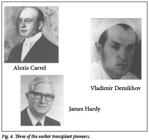
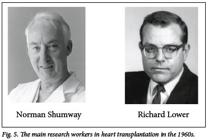
The first experimental heart transplantation was performed by Demikhov in Moscow in the very early 1940s. His experiments were discontinued during World War II but, when they resumed in 1946, he produced a large volume of work devising 24 different methods of heterotopic heart transplantation within the chest. During the 1950s, many research workers transplanted the heart in the orthotopic position and also transplanted the heart and lungs en bloc. They used various methods, including cardiopulmonary bypass (heartlung machine). During the 1960s, Lower and Shumway established beyond doubt that heart transplantation was a possibility. Christiaan Barnard, using their surgical techniques, performed the first human-to-human heart transplant, in December 1967 in Cape Town.
Early transplantation attempts1,2
The possibility of replacing diseased tissues and organs with healthy ones from the same or other species has interested man since ancient times. In the Iliad, Homer mentions a monster called the Chimera that possessed the characteristics of various animals, e.g. a lion's body with wings. There are references throughout Greek mythology to mythical humans possessing one or more animal limbs.
About 2 000 years ago in India, rhinoplasty and similar operations for the repair of various facial defects were performed by using local skin flaps, i.e. autologous skin transplants. These operations were described by Celsus in Graeco-Roman medical literature, and it seems that they were also performed in Greece and Rome. Fifteenth-century Italian surgeons also devised pedicle flaps for plastic procedures but, owing to church interference in medical matters, this technique had to be abandoned. Much later, English army doctors stationed in India rediscovered procedures for plastic operations on the nose and introduced them in England.
Apart from the successful transplantation of autologous skin, no transplantation of any tissues or organs seems likely to have taken place until about a century ago. There is evidence that successful skin transplants on sheep were performed in Milan in the 18th century, and it was claimed that these skin allografts (homografts) were successful. This might have been possible if the animals were from the same region and could therefore be genetically related, but those researchers went on to claim that xenografts took as well, and ascribed this fact to the 'good air that prevails in Milan', which casts serious doubt on the validity of these experiments. Paul Bert, a student of Claude Bernard and an early worker on transplantation research, wrote a thesis and later produced about 200 publications on the subject of animal tissue grafting. Except for autografting of the skin, he was unable to reproduce the Milanese claims. Bert's works were published in 1876 and were translated into English in 1943. He noted the behaviour of autografts, allografts and xenografts, and believed allografts could have a successful outcome.
Corneal transplants were carried out as far back as 1872 using xenografts, but were unsuccessful. Allograft corneal grafts, however, were the first successful tissues to be transplanted, the earliest being around 1930.
Organ transplantation was first attempted in the early 20th century. Previously, Murphy and Beck had devised vascular suturing methods, and these were used by Carrel in transplanting organs. Carrel observed that kidneys transplanted from one site to another in the same animal had a better survival rate than those from other animals. He believed, however, that the functioning of the transplanted organ depends on the success of the vascular anastomosis. This thinking persisted until the 1940s, with many researchers spending all their time and effort devising better and faster techniques for the anastomoses of vessels.
Some human application of these techniques was attempted. Ullman, in 1902, having experimented with kidney allograft transplantation in dogs, transplanted a pig's kidney into the elbow of a uraemic woman. The kidney did not function and he thought this was due to technical problems. At that time, many other research workers reported experimental kidney transplantation, some of whom also attempted transplantation from animals to man. The overall experience was reviewed by Guthrie in 1912, who summed up the situation as follows: 'No one, though many experiments have been reported, has yet succeeded in keeping an animal alive for any great length of time which carried the kidney or kidneys of another animal, after its own kidneys were removed ... the outlook is by no means hopeless and the principle of immunity which yields such brilliant results in many other fields would be worthy of being tested in this case'.1
Blood groups and transfusions3,4
Blood grouping and blood transfusions are an integral part of transplantation. Ancient Greek and Egyptian writings show that, even in those early times, blood transfusions were held to be both advisable and indeed possible. The first recorded attempt to use blood for therapeutic purposes was in 1492. However, in this instance, Pope Innocent VIII was probably given blood orally. Following the discovery of the circulation of blood by Harvey in 1616, several further experiments paved the way for the first transfusion. In 1656, the famous English architect Sir Christopher Wren administered beer and wine intravenously to dogs, resulting in their intoxication and thereby proving that substances can be given intravenously. In 1665, another Englishman, Lower, transfused blood from one dog into another. In 1667, a Frenchman, Denis, performed the first blood transfusion by transfusing lamb's blood into a human recipient. Using calf 's blood for his fourth blood transfusion, and the second blood transfusion for the recipient concerned, a fatal haemolytic reaction followed. Denis was tried for manslaughter and, although acquitted, transfusions were banned in Paris, London and Rome, and no further advances in this field were recorded for 150 years. Eventually, the first human-to-human blood transfusion was successfully performed in 1818 by Bundell, an English obstetrician. Interest in transfusion therapy thereby revived, but this was not used on a large scale owing to the frequent and often fatal reactions that resulted.
In 1900 and 1901, Landsteiner published his discovery of the ABO blood group system. This important discovery was not clinically applied until 1911. Discoveries such as the use of citrate as an anticoagulant in 1914, and later the addition of dextrose to the anticoagulant solution, increased the lifespan of the red blood cells in vitro. The Rh system was discovered in 1940 by Landsteiner and Wiener. During World War II, blood transfusions were commonly performed. Following this experience, blood banks were established worldwide and blood transfusion became a safe and everyday procedure.
Historical aspects of cardiac surgery
Direct surgery on the heart is a comparatively recent event. Between 1810 and 1824, the great military surgeon Larrey5 6 7
Brunton8
In 1925, Soutar, for the first and only time in his life, felt the mitral valve through the left atrial appendage and saw the possibilities of mitral valvotomy by this approach. It was, however, only after 1948 that Baily, Brock and Harken9 2
The following years saw the spectacular development and perfection of pump-oxygenators, heart valves and techniques that have made cardiac surgery an everyday procedure that can be offered to all, with a mortality and morbidity equal to or lower than other forms of major surgery.
Early experimental orthotopic heart transplantation and heart and lungtransplantation
In 1953, Neptune et al.10 et al.11,12 in India, using deep hypothermia and circulatory arrest. The basic principles of this method were established.
Orthotopic isolated transplantation of the canine heart was first performed by Goldberg et al.13 et al.14
In a series of heart transplants, heart and bilateral lung transplants, and heart and one lung transplants in 1957, Webb and Howard15 16
Experimental heterotopic heart transplantation within the chest
The transplantation of the canine heart as an additional heart within the chest was first performed by Demikhov in 1946.17
Since these experiments were done without the aid of cardiopulmonary bypass, the lengths of the various vessels of the donor heart had to be long to reach the vessels to be sutured to the recipient. Suture-line complications were the most frequent problem. Many variations of anastomosing these vessels were used, from direct suture to the use of collodion tubes over which the vessel was sutured. Use was made of a vascular suturing machine devised by Russian engineers and surgeons. Many anastomoses eroded through and many others clotted up, resulting in the rapid death of the animals. Infection was a major problem as antibiotics were not used.
However, many animals survived and observations were recorded. The peripheral pulse was double. The electrocardiograms taken showed the 2 different QRS-complexes of the 2 hearts, similar to today's human heterotopic heart transplants. Electrocardiograms done over days and weeks showed a gradual decrease in donor heart voltage and eventual ventricular fibrillation. However, Demikhov did not relate this to rejection of the graft. Although mentioning incompatibility of tissues and other physiological causes for the death of the transplanted organs, he considered the major reason to be mechanical, within the myocardium, or due to causes around it, e.g. pericardial effusion. Professor Christiaan Barnard visited Demikhov in Moscow. In his book One Life,18
Sen et al.,11
Experimental orthotopic heart transplantation in the 1960s
During this decade, the feasibility of heart transplantation was established beyond doubt. Lower and Shumway and associates emerged as the main researchers in this new and promising field. The first series of completely successful heart transplants was reported by Lower and Shumway in 1960.21
In 1961, Lower, Stofer and Shumway22
Heart and lung transplantation was also attempted by Lower et al.23
By the mid-1960s, considerable information had been obtained on many aspects of heart transplantation, such as the development of an uncomplicated surgical technique, preservation of the myocardium during interruption of coronary blood flow, adequate function of the anatomically denervated transplanted heart postoperatively, and the diagnosis and treatment of acute rejection. This provided the scientific foundation upon which clinical heart transplantation commenced.
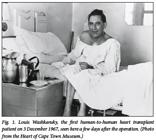
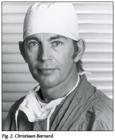
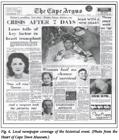
The first human-to-human heart transplant was performed on 3 December 1967 in Cape Town by Professor Christiaan Barnard. This historical event opened a new and exciting chapter in medical science. Media coverage evoked much mixed and even heated reaction at times regarding the question of ethics in organ transplantation.24 24 24
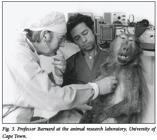
The rather poor results following this experience, however, had a negative effect on the initial enthusiasm for heart transplantation. Only a few institutions maintained active heart transplant programmes, including the University of Cape Town. Professor Barnard24
Worldwide, 101 heart transplants were performed in 1968, 47 in 1969 and, since then, an average of about 25 annually. By July 1977, 345 heart transplants had been performed by 65 transplant teams in 22 countries on 337 recipients. During the 1980s, worldwide interest in this procedure was renewed, owing to the fact that the therapeutic value of heart transplantation had been proven. During 1981, more than 100 heart transplants were again performed. It was estimated that at least 666 heart transplants had been performed worldwide by March 1982.
The registry of the International Society for Heart and Lung Transplantation: Twenty-third Official Adult Heart Transplantation Report - 2006, presents information on the 73 000 heart transplants performed worldwide from 1982 to 2005.25 26,27 will greatly extend the horizon of heart transplantation in the near future.
Currently, about 3 000 heart transplants are performed annually worldwide. However, in the USA alone, there is a need for assistance to the heart in more than 70 000 patients annually who are in terminal heart failure. They need more help than maximal medical therapy. Consequently, human-to-human heart transplantation still has very little impact on the treatment of end-stage heart failure. Therefore, an intensive search for improved, permanent mechanical devices as alternatives to heart transplantation has to continue 'on a most active scale'.24
References
- 1. Rapaport FT, Dauset J. Human Transplantation. New York: Grune & Stratton, 1968: 3.
- 2. Davis L. Christopher's Textbook of Surgery. 9th ed. Philadelphia: WB Saunders, 1969: 1424.
- 3. Malut NSR. History of blood transfusions. J Hist Med 1955;9:59-107.
- 4. Sturgis CC. Hematology. 2nd ed. Springfield, Ill: Charles C Thomas, 1955.
- 5. Norman JC. Cardiac Surgery. 2nd ed. New York: Appleton-Century-Crofts, 1972:671-674.
- 6. Block MH. Über Wunden des Herzen und des Herzbentelf. Verh Deutsch Ges Chir 1882;11:108.
- 7. Rehn. Ueber penetrirende Herzwunden und Herzhalt. Arch Klin Chir 1897;55:315.
- 8. Brunton TL. Possibility of treating mitral valve stenosis by surgical methods. Lancet 1902;1: 352.
- 9. Ellis HF. Surgery for acquired mitral valve disease. Philadelphia, USA: WB Saunders, 1967: 15-17.
- 10. Neptune WB, Cookson BA, Bailey CP. Complete homologous heart transplantation. Arch Surg (Chicago) 1953;66:174.
- 11. Sen PK, Parulkar GB, Pandy SR, Kinare SG. Homologous canine heart transplantation: A preliminary report of 100 experiments. India J Med Res 1965;53:674.
- 12. Sen PK, Shah CB, Satoskar RS. Studies on isolated heart lung preparations in the hypothermic animal. J Internat Coll Surgeons 1956;26:32.
- 13. Goldberg M, Berman EF, Akman RC. Homologous transplantation of the canine heart. J Internat Coll Surgeons 1958;30:575.
- 14. Blanco G, Adam A, Rodriques-Perez D, Fernandes A. Complete homotransplantations of the canine heart and lungs. Arch Surg (Chicago)1958;76:20.
- 15. Webb WR, Howard HS. Cardiopulmonary transplantation. Surgical Forum 1957;8:313.
- 16. Webb WR, Howard HS, Neely WA. Practical methods of homologous cardiac transplantation. J Thoracic Surg 1959;37:361.
- 17. Demikhov VP. Experimental Transplantation of Vital Organs. New York: Consultants Bureau, 1962: 54.
- 18. Barnard C, Pepper CB. Christiaan Barnard: One Life. Toronto: MacMillan, 1969.
- 19. Reemtsma K. The heart as a test organ in transplantation studies. Ann N Y Acad Sci 1964;120:778.
- 20. McGough EC, Brewer PL, Reemtsma K. The parallel heart: Studies of intra-thoracic auxiliary cardiac transplants. Surgery 1966;60:153.
- 21. Lower RR, Shumway NE. Studies on orthotopic transplantation of the canine heart. Surg Forum 1960;11:18.
- 22. Lower RR, Stofer RC, Shumway NE. Homovital transplantation of the heart. J Thorac Cardiovasc Surg 1961;41:196.
- 23. Lower RR, Stofer RC, Hurley EJ, Shumway NE. Complete homograft replacement of the heart and both lungs. Surgery 1961;50:842.
- 24. Barnard CN. Experience with human heart transplantation in "Sterilization and preservation of biological tissues by ionizing radiation". Vienna: International Atomic Energy Agency, 1970. IAEA - PL - 333/10:79-94.
- 25. Twenty-third Official Adult Heart Transplantation Report - 2006. J Heart Lung Transplant 2006;25:869-879.
- 26. Wicomb W, Cooper DK, Hassoulas J, et al: Orthotopic transplantation of the baboon heart after 20 to 24 hours' preservation by continuous hypothermic perfusion with an oxygenated hyperosmolar solution. J Thorac Cardiovasc Surg 1982;83:133-140.
- 27. Hassoulas J, Barnard CN. Heterotopic cardiac transplantation. A 7-year experience at Groote Schuur Hospital, Cape Town. S Afr Med J 1984;65(17):675-682.
