Improving poisoning diagnosis and surveillance of street pesticides
An effective surveillance system is required to reduce pesticide exposures and poisonings, especially from street pesticides (illegal, unlabelled, and decanted agricultural pesticides used predominately for urban household purposes). Poisoning from any pesticide class, not only organophosphates, constitutes a medically notifiable condition in South Africa. Current practice, however, is to report only organophosphate cases, resulting in severe under-reporting. The lack of data concerning the link between poisonings and street pesticides has led to the mistaken assumption that urban populations are not at risk from significant pesticide exposures and poisonings. Without accurate statistics, healthcare professionals and policy makers are unaware of the contribution of street pesticide poisonings to the overall health burden. Accurate diagnosis is a prerequisite for notification and subsequent surveillance. An algorithm has been developed to enable healthcare professionals to improve the diagnosis and notification of pesticide poisonings.
FORUM
ANALYSIS
Improving poisoning diagnosis and surveillance of street pesticides
Hanna-Andrea Rother
Is Head of the Health Risk Management Programme, Centre for Occupational and Environmental Health Research, School of Public Health and Family Medicine, University of Cape Town
ABSTRACTAn effective surveillance system is required to reduce pesticide exposures and poisonings, especially from street pesticides (illegal, unlabelled, and decanted agricultural pesticides used predominately for urban household purposes). Poisoning from any pesticide class, not only organophosphates, constitutes a medically notifiable condition in South Africa. Current practice, however, is to report only organophosphate cases, resulting in severe under-reporting. The lack of data concerning the link between poisonings and street pesticides has led to the mistaken assumption that urban populations are not at risk from significant pesticide exposures and poisonings. Without accurate statistics, healthcare professionals and policy makers are unaware of the contribution of street pesticide poisonings to the overall health burden. Accurate diagnosis is a prerequisite for notification and subsequent surveillance. An algorithm has been developed to enable healthcare professionals to improve the diagnosis and notification of pesticide poisonings.
Pesticide poisoning constitutes a notifiable medical condition in South Africa (SA) (National Health Act 61, 2003; referred to as 'poisoning agricultural stock remedies').12
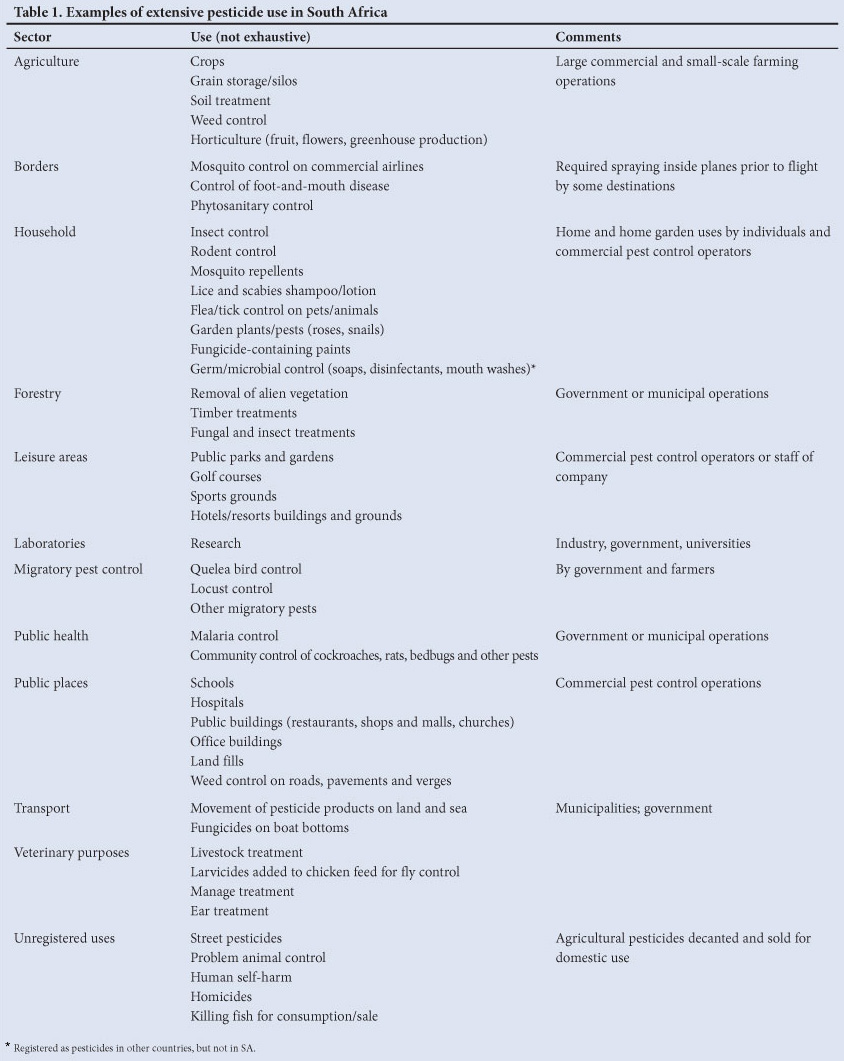
Extensive pesticide use and exposure in SA (Table 1) increases the potential for a high burden of poisoning and long-term health effects. These factors remain a low public health priority, however, as a result of difficulties in estimating overall burden.34
Training in the diagnosis of and routine screening for pesticide exposure is inadequate, especially in relation to exposed urban populations and non-OP exposures. In a study of physicians in the USA, 69% had never made a pesticide poisoning diagnosis and 53% had not considered making such a diagnosis; a further 64% believed that they lacked sufficient education to address patients' questions about pesticides.567
Street pesticides
Accurate notification of poisonings plays a vital role in the monitoring and control of street pesticides - inexpensive and predominantly illegal products sold in SA at train stations, informal markets and taxi ranks, and door-to-door by vendors.899
A recent study linked child poisoning cases in SA to street pesticides and indicated that the incorrect documentation in clinical case notes may result in the underestimation of the prevalence of such cases.109
Development of a pesticide poisoning algorithm
We established a Pesticide Policy Reference Group with multiple stakeholders from academia and government, to advise a multi-faceted project on street pesticides and child poisonings.8,9 With ethics approval from the University of Cape Town (UCT), the project entailed: (i) collecting narratives of poisoning cases at Red Cross War Memorial Children's Hospital (RCWMCH) in Cape Town, (ii) conducting reviews of poisoned children's records, (iii) interviewing informal sellers of street pesticides, (iv) analysing samples of street pesticides, and (v) conducting a township-based household survey.8,9 This research revealed that healthcare professionals face problems with the diagnosis, treatment and notification of poisoning cases -especially those involving street pesticides.
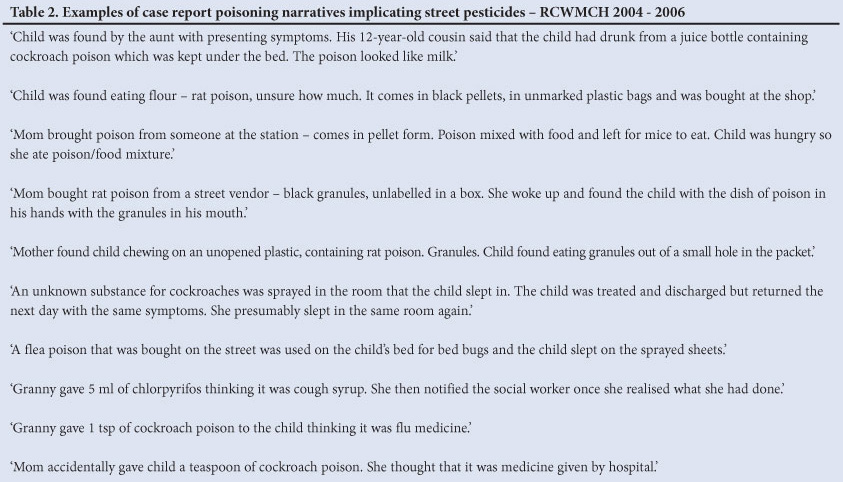
A specific concern was the identification of poisonings from exposure to unlabelled products. The review of the records of all suspected pesticide poisoning cases at RCWMCH between 2004 and 2006 (N=80) illustrated a link between suspected poisonings and street pesticides, and highlighted the importance of the provision of enough descriptive and appropriate information by physicians to establish this link (Table 2). While accurate statistics are not available owing to inherent complexity, this study estimated that at least 50% of suspected pesticide poisoning cases were related to street pesticides.
A critical issue is the standardisation of healthcare professionals' descriptive information to improve notification of these cases. Although resources are available to support healthcare professionals in identifying signs and symptoms of pesticide poisonings, no literature is available via easily accessible resources to improve notification.
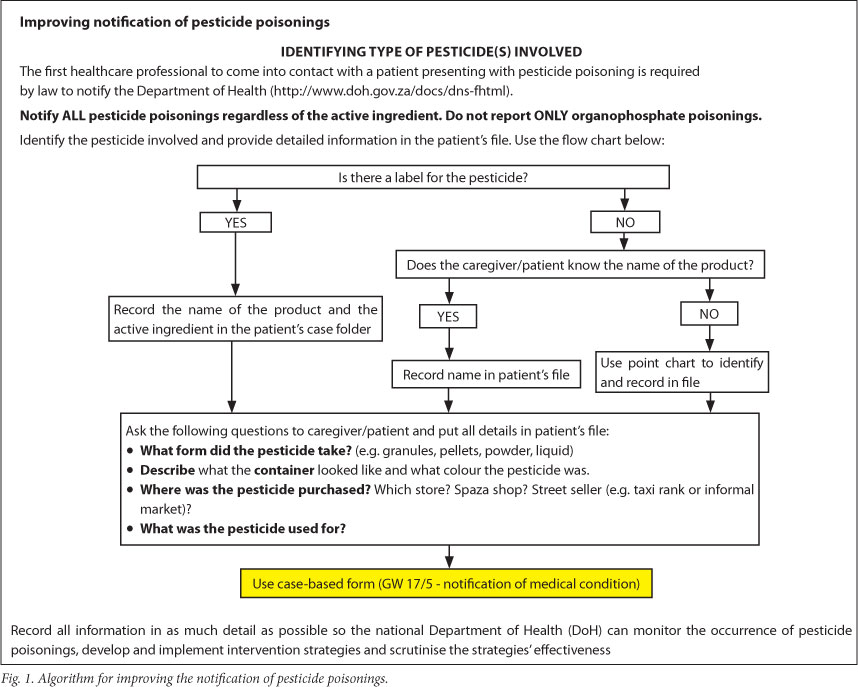
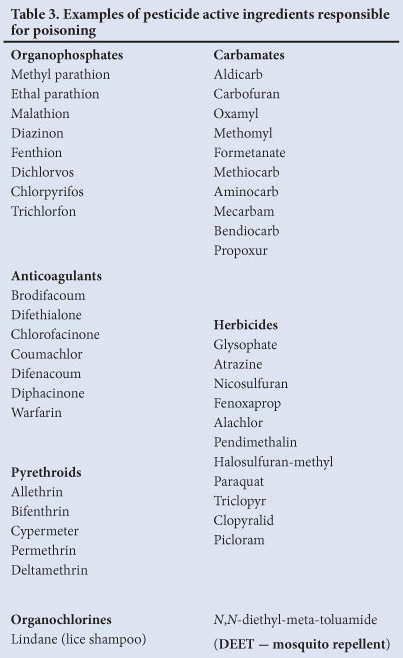
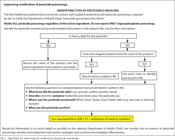
The Health Risk Management Programme (HRMP) at UCT therefore developed an algorithm for 'Improving Notification of Pesticide Poisoning' (Fig. 1) (http://www.coehr.uct.ac.za/publications/pestrel.php).The algorithm outlines the decision-making process to be followed when presented with a case of poisoning, particularly when the poison is unlabelled. To aid more accurate product (and active ingredient; Table 3) identification, it includes a point chart to enable caregivers/patients to point out the product (or a similar one) causing the poisoning. Regular algorithm monitoring and updating is required to ensure that it remains current, and research is needed to measure the algorithm's effectiveness in improving notification.
International poisoning surveillance
The algorithm is intended to promote compliance with international pesticide poisoning surveillance systems. SA is a signatory to the Rotterdam Convention, which requires countries to monitor severely hazardous pesticide formulations (SHPF): 'chemicals formulated for pesticidal use that produce severe health or environmental effects observable within a short period of time after single or multiple exposure, under conditions of use'.1112
Conclusion
The algorithm presented here has the potential to assist the notification of all pesticide poisonings, but particularly those from street pesticides. Accurate surveillance data are needed to illustrate this public health problem and associated burden. Although efforts are being made by the DoH and the Department of Agriculture to remove these pesticides from the streets, prosecution of informal vendors will have little effect on limiting access to the products as long as the problem of poverty-related pests is not simultaneously addressed. Healthcare professionals will have to continue recognising poisonings from these products.
Through application and broad implementation of the algorithm, statistics on the scope of the problem might foster national and international commitment to better controlled access to highly hazardous pesticides. Further research is needed on alternative mechanisms to improve the current notification system (e.g. mobile phone texting reporting to a central database) and health professionals' training in pesticide exposure recognition. Use of the algorithm for improved reporting is an important first step, especially to protect vulnerable children and draw attention to the importance of notifying all pesticide poisoning cases, and not just those involving OPs. Finally, it should be noted that the current poisoning notification surveillance system does not address a registry for chronic health effects resulting from pesticide exposures.
Acknowledgements
Funding was provided by the Danish International Development Agency (DANIDA) with support from the DoH and Medical Research Centre of South Africa. The author acknowledges contributions from members of the UCT Pesticide Reference Group, with special mention of Professor Leslie London and Roxanne Beauclair, who contributed considerably to development of the algorithm. This work was also supported by the UCT Vice Chancellor's award for Social Responsiveness to the author in 2010.
References
-
1. Department of Health (DoH). Disease Notification System. Pretoria: DoH, 20xx. http://www.doh.gov.za/show.php?id=2662#list (accessed 6 January 2012).
» http://www.doh.gov.za/show.php?id=2662#list -
2. London L, Ballie R. Challenges for improving surveillance for pesticide poisoning. Epidemiology 2001;30:564-570. [http://dx.doi.org/10.1093/ije/30.3.564]
» http://dx.doi.org/10.1093/ije/30.3.564 -
3. Bertolote JM, Fleischman A, Eddleston M, Gunnel D. Death from pesticide poisoning: a global response. Br J Psychiatry 2006;189:201-203. [http://dx.doi.org/10.1192/bjp.bp.105.020834]
» http://dx.doi.org/10.1192/bjp.bp.105.020834 - 4. Rother H-A, London L. Occupational health concerns with pesticides in agriculture and beyond. Continuing Medical Education 2009;27:506-508.
-
5. Balbus JM, Harvey CE, McCurdy LE. Educational needs assessment for pediatric health care providers on pesticide toxicity. J Agromedicine 2006;11:27-38. [http://dx.doi.org/10.1300/J096v11n01_04]
» http://dx.doi.org/10.1300/J096v11n01_04 -
6. Rother H-A. Guideline for Preventing Child Pesticide Poisonings in South Africa. Cape Town: University of Cape Town, 2009. http://web.uct.ac.za/depts/oehru/dox/guidelines-managing-pesticide-poisoning.pdf (accessed 9 January 2012).
» http://web.uct.ac.za/depts/oehru/dox/guidelines-managing-pesticide-poisoning.pdf -
7. Reigart JR Roberts JR, eds. Recognition and Management of Pesticide Poisoning, 5th ed.Washington: Environmental Protection Agency, 1999. http://npic.orst.edu/rmpp.htm (accessed 11 January 2012).
» http://npic.orst.edu/rmpp.htm - 8. Rother H-A. Implications of South African women controlling poverty related pests with street pesticides. Women & Environments International Magazine 2008;76/77:36-43.
-
9. Rother H-A. Falling through the regulatory cracks: street selling of pesticides and poisoning among urban youth in South Africa. Int J Occup Environ Health 2010;16:202-213. [http://dx.doi.org/10.1179/107735210799160264]
» http://dx.doi.org/10.1179/107735210799160264 -
10. Balme K, Roberts C, Glasstone M, Curling L, Rother HA, London L, Zar H, Mann M. Pesticide poisonings at a tertiary children's hospital in South Africa: an increasing problem. Clinical Toxicol 2010;48:928-934. [http://dx.doi.org/10.3109/15563650.2010.534482]
» http://dx.doi.org/10.3109/15563650.2010.534482 -
11. Rotterdam Convention. Severally Hazardous Pesticide Formulations (SHPF). http://www.pic.int/Procedures/SeverelyHazardous Pesticide Formulations/tabid/1191/language/en-US/Default.aspx (accessed 6 January 2012).
» http://www.pic.int/Procedures/SeverelyHazardous Pesticide Formulations/tabid/1191/language/en-US/Default.aspx -
12. Department of Health (DoH). Pesticide/Chemical Incident Report Form PIRF. Pretoria, DoH, 2011. http://www.doh.gov.za/docs/forms/2011/pesticide_form3.pdf (accessed 9 January 2012).
» http://www.doh.gov.za/docs/forms/2011/pesticide_form3.pdf