
 The job chooses the (wo)man
Some 1 200 - 1 300 new doctors have just graduated in South Africa. They will have begun their internships and in a year's time will commence their Community Service posts. Their thoughts will turn to their future occupations and to their choice of specialisation, including general practice or family medicine.
They may not appreciate that this choice is to some degree pre-ordained according to their personality traits. Psychiatrists, psychologists and behavioural scientists have developed a rich science of the link between personality and choice of specialty.1
Early qualitative surveys2
Recently several more comprehensive psychological frameworks, some simple, some extremely complex, have been utilised to describe personality in doctors. The most simple is the Five-Factor Model (FFM) of personality, which posits five chief personality traits. Broadly they are neuroticism (a tendency to hostility, negativity, anxiety and depression); extroversion or sociability (encompassing warmth, gregariousness and assertiveness); openness to experience (finding expression in intellectual curiosity, being excited about new techniques and technologies, having independent judgement, and needing variety); agreeableness (predicting a pleasant, empathetic and accommodating demeanour); and conscientiousness (careful behaviour, dutifulness, self-discipline and an appreciation of strict rules and principles of practice).
An extensive literature review3
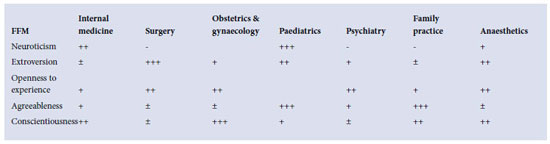
The 'support' specialists in pathology and radiology are open to experience and reasonably agreeable, probably because they must interact with colleagues in all domains; interestingly, they score lowest in the neuroticism factor, perhaps because their role is to generate a report and leave it for the action and concern of clinicians.
Taking personality into account may also be helpful to medical school personnel responsible for student recruitment and admissions and may be of particular importance where schools set out to deliberately produce, say, primary care physicians, family practitioners, generalist physicians and geriatricians, and paediatricians.452
A good personality fit determines success and satisfaction within chosen fields.167
As members of the so-called millennial generation, today's graduates are likely to factor financial reward, lifestyle preference and perceived prestige of a specialty into their choice. When settling upon their choice women, who outnumber men in current graduating classes, will also take into account running a home and raising a family.
Research continues into how personality serves as a prognosticator of specialty choice with a view to offering career advice and guidance and to enabling young doctors to choose a few specialties that might best suit their personalities. The final choice ought to be secure and happy for a career that will be typically 40 - 50 years long!

Janet Seggie
Deputy Editor
References
-
1. Maron BA, Fein S, Maron BJ, et al. Ability of prospective assessment of personality profiles to predict the practice specialty of medical students. Proceedings (Baylor University Medical Center) 2007;20:22-26. http://findarticles.com/p/articles/mi_6802/is_1_20/ai_n28408712/pg_3/2 (accessed 5 May 2011).
» http://findarticles.com/p/articles/mi_6802/is_1_20/ai_n28408712/pg_3/2 -
2. Borges NJ, Osmon WR. Personality and medical specialty choice: technique orientation versus people orientation. Journal of Vocational Behavior 2001;58:22-35 http://www.sciencedirect.com/science/article/pii/S0001879100917615 (accessed 30 May 2011).
» http://www.sciencedirect.com/science/article/pii/S0001879100917615 -
3. Borges NJ, Savickas ML. Personality and medical specialty choice. Journal of Career Assessment 2002;10:362-380. http://jca.sagepub.com/cgi/content/abstract/10/3/362 (accessed 5 May 2011).
» http://jca.sagepub.com/cgi/content/abstract/10/3/362 -
4. Markert RJ, Rodenhauser P, El-Baghdadi MM, et al. Personality as a prognostic factor for specialty choice: A prospective study of 4 medical schools classes. Medscape J Med 2008;10:4954. http://www.ncbi.nlm.nih.gov/pmc/articles/PMC2270893/ (accessed 5 May 2011).
» http://www.ncbi.nlm.nih.gov/pmc/articles/PMC2270893/ - 5. Lazarus J, Van Niekerk JPdeV. Selecting medical students: a rational approach. Med Teach 1986;8:343-357.
-
6. Landon BE, Reschovsky JD, Pham HH, Blumenthal D. Leaving medicine: The consequences of physician dissatisfaction. Medical Care 2006;44:234-242. http://www.ncbi.nlm.nih.gov/ pubmed/16501394?dopt (accessed 21 October 2011).
» http://www.ncbi.nlm.nih.gov/ -
7. Goldacre MJ, Lambert TW. Stability and change in career choices of junior doctors: Postal questionnaire surveys of the United Kingdom qualifiers of 1993. Med Educ 2000;34:700-707. http://www.ncbi.nlm.nih.gov/pubmed/10972747?dopt=Abstract (accessed 21 October 2011).
» http://www.ncbi.nlm.nih.gov/pubmed/10972747?dopt=Abstract