Child consent in South African law: implications for researchers, service providers and policy-makers
Children under 18 are legal minors who, in South African law, are not fully capable of acting independently without assistance from parents/legal guardians. However, in recognition of the evolving capacity of children, there are exceptional circumstances where the law has granted minors the capacity to act independently. We describe legal norms for child consent to health-related interventions in South Africa, and argue that the South African Parliament has taken an inconsistent approach to: the capacity of children to consent; the persons able to consent when children do not have capacity; and restrictions on the autonomy of children or their proxies to consent. In addition, the rationale for the differing age limitations, capacity requirements and public policy restrictions has not been specified. These inconsistencies make it difficult for stakeholders interacting with children to ensure that they act lawfully.
Child consent in South African law: implications for researchers, service providers and policy-makers
Ann StrodeI; Catherine SlackII; Zaynab EssackIII
ILLM. Faculty of Law and HIV/AIDS Vaccines Ethics Group, University of KwaZulu-Natal, Pietermaritzburg
IIMA Clin Psych. HIV/AIDS Vaccines Ethics Group, University of KwaZulu-Natal
IIIMSocSci Res Psych. HIV/AIDS Vaccines Ethics Group, University of KwaZulu-Natal
Children under 18 are legal minors who, in South African law, are not fully capable of acting independently without assistance from parents/legal guardians. However, in recognition of the evolving capacity of children, there are exceptional circumstances where the law has granted minors the capacity to act independently. We describe legal norms for child consent to health-related interventions in South Africa, and argue that the South African Parliament has taken an inconsistent approach to: the capacity of children to consent; the persons able to consent when children do not have capacity; and restrictions on the autonomy of children or their proxies to consent. In addition, the rationale for the differing age limitations, capacity requirements and public policy restrictions has not been specified. These inconsistencies make it difficult for stakeholders interacting with children to ensure that they act lawfully.
Children under the age of 18 are legal minors and, accordingly, have limited legal capacity to act independently without the assistance of an adult.1
Medical treatment
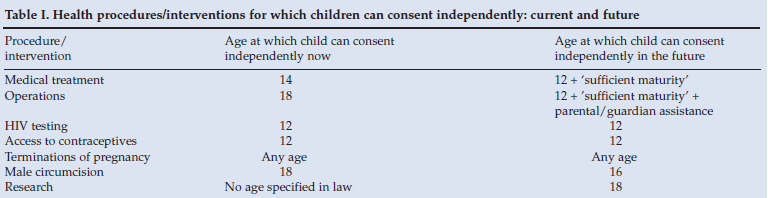
Currently, children can consent independently to medical treatment from the age of 14; those below 14 require consent from a parent, legal guardian or other designated person.2 3
HIV testing
Currently, children can consent independently to an HIV test from the age of 12, when it is in their best interests, and below the age of 12 if they demonstrate 'sufficient maturity'; i.e. they must be able to understand the benefits, risks and social implications of an HIV test.4,5 This norm is not likely to change in the immediate future.
Access to contraceptives
Currently, children can consent to contraceptives and contraceptive advice from the age of 12.6
Termination of pregnancy
Currently, girls can consent to a termination of pregnancy at any age.7
Operations
Currently, children cannot consent independently to a medical operation until they are 18.2 i) has 'sufficient maturity and has the mental capacity to understand the benefits, risks, social and other implications of the surgical operation'; and (ii) is assisted by a parent or guardian.8
Male circumcision
Currently, boys are able to consent independently to circumcision only when they are 18 as the procedure is classified as an operation. In the future, when s12(8) of the Children's Act comes into operation, boys below age 16 can only be circumcised for 'religious' or 'medical reasons on the recommendation of a medical practitioner' whereas those above 16 may undergo circumcision for any reason.10 11
Health research
Currently, there is no clear legal statute specifying when children can independently consent to research; however, there are ethical norms. For clinical trials, these norms require parental consent and child assent.12 13 all health research; in addition, children will be required to 'consent' alongside their parent if they have 'sufficient understanding'.5 14
Sex
Currently, it is an offence to have sex below the age of 16, even when sex is consensual.15
Discussion
The range of consent norms that have been applied across a spectrum of health-related interventions indicate an inconsistent approach to children's emerging autonomy:
1. For some procedures, children are given the capacity to consent on reaching a specified age; for other procedures, they must reach the specified age and demonstrate capacity requirements; and yet for other related procedures, there are neither age nor capacity requirements (Table I). For example, according to the future framework, a child can consent to an HIV test and access to contraceptives on reaching age 12 alone; however, for medical treatment, they must be 12 and demonstrate that they have 'sufficient maturity'. Since all these interventions are health-related, it seems inconsistent not to treat them alike and not have, for example, a maturity criterion for all.
A further problem with the inconsistent approach to capacity is that, concerning research (where in the future children will not be able to consent without assistance), a child's emerging autonomy is not sufficiently recognised. In the future framework, the capacity requirements for research will be extremely stringent, and children under the age of 18 will never be able to consent independently to any form of health research regardless of the risk level. Thus, consent norms for research participation will not appropriately reflect the reality that research is of varying complexity and risk. For simple and low-risk research (such as asking older adolescents for their views on violence on TV), exceptions to the norm of parental consent may be appropriate, provided that other protections are in place, such as ethical review. This strict requirement is out of keeping with socio-behavioural data indicating that older children can understand many components of research.16
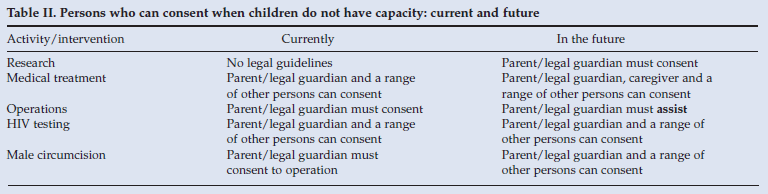
There are different approaches to the adult who is considered competent to provide proxy consent when the child does not have capacity (Table II). For operations, the Children's Act refers to the need for the 'assistance' of a parent or guardian;8 research, proxy consent is limited to a parent or legal guardian, effectively undermining research for and with orphans. For other health interventions, e.g. male circumcision and HIV testing, the consent of a range of additional persons including caregivers is permitted.
Different norms apply as to when the activity may be consented to either by children themselves or a proxy consenter (Table III). In the future, 3 health-related interventions may only be undertaken if public policy criteria are met (i.e. special protections exist). These are HIV testing, male circumcision and research which may only be undertaken if they serve the legitimate purpose described in legislation (Table III).
The rationale for limiting HIV testing appears to be a desire to end testing that is used to discriminate against children.17 18 19
Different procedural obligations are placed on persons obtaining consent during some, but not other, health interventions. For example, for pregnancy terminations, HIV testing and male circumcision, counselling must be part of the consent process - yet this is not required for other healthrelated interventions such as access to contraceptives (where counselling may go some way to reduce high-risk sexual behaviours) (Table IV).
Conclusions
Parliament has clearly adopted an inconsistent approach in setting consent norms for children. It is difficult to establish any pattern between a child's emerging capacity and the norms for various health interventions. There are several conceptual and practical difficulties for stakeholders trying to meet their legal obligations.
Researchers: Obtaining consent for the participation of children in HIV prevention trials is extremely complex; children under 18 will require consent from a parent or legal guardian, but will have the capacity to consent independently to some procedures and interventions within these trials. For example, children aged 12 and older who are enrolled in prevention trials should consent independently to HIV tests in such trials, and child research participants who are 14 and older should consent independently to procedures that amount to a diagnosis and treatment (e.g. STI treatment) within such trials. Obtaining consent will require a sound understanding of what information parents will and will not have access to, and may result in complicated consent processes. Researchers must also keep abreast of the law to establish when the age cut-offs for consent may change.
Service-providers and researchers: It is not clear what the additional capacity requirements outlined in the law actually entail. How should a service provider establish 'sufficient maturity'? It could merely entail cognitive understanding, as outlined in the law on HIV testing, where sufficient maturity is described as understanding the benefits, risks and social implications of the intervention.4 20 21 22
Policy-makers: Parliament should justify its inconsistent approach in the setting of consent norms for children. In the future, there will generally be greater consistency, as Parliament is lowering the age to 12 for consent to a range of medically related interventions. However, Parliament has introduced a range of different obligations in many of these interventions that should be reconsidered and/or carefully defended. For example, the restrictions on male circumcision need further thought, given the rampant HIV epidemic.18
References
- 1. Robinson JA, Human S, Boshoff A, Smith BS, Carnelly M. Introduction to South African Family Law. 3rd ed. London: Butterworth, 2008.
- 2. Section 39 of the Child Care Act No. 74 of 1983.
- 3. Section 129 of the Children's Act No. 38 of 2005.
- 4. Section 130 of the Children's Act No. 38 of 2005.
- 5. McQuoid-Mason D. The effect of the new Children's Act on consent to HIV testing and access to contraceptives by children. S Afr Med J 2007; 97(12): 1252-1253.
- 6. Section 134 of the Children's Act No. 38 of 2005.
- 7. Section 5 of the Choice on Termination of Pregnancy Act No. 92 of 1996.
- 8. Section 129(3) of the Children's Act No. 38 of 2005.
- 9. Section 12(9) of the Children's Act No. 38 of 2005.
- 10. Section 12(8) of the Children's Act No. 38 of 2005.
- 11. Section 12(9-10) of the Children's Act No. 38 of 2005.
- 12. Department of Health. Guidelines for Good Practice in the Conduct of Clinical Trials with Human Participants in South Africa. Pretoria: Department of Health, 2006.
- 13. National Health Research Ethics Council. Ethics in Health Research: Principles, Structures and Processes. Pretoria: Department of Health, 2004.
- 14. Section 10 of the Children's Act No. 38 of 2005.
- 15. Section 15 of the Criminal Law (Sexual Offences and Related Matters) Amendment Act, No. 32 of 2007.
- 16. Fortin J. Children's Rights and the Developing Law. London: Butterworth, 2003.
-
17. South African Law Reform Commission. Issue Paper on the Review of the Child Care Act. Pretoria: South African Law Commission, 2002. http://www.doj.gov.za/salrc/dpapers.htm (accessed 30 March 2009).
» http://www.doj.gov.za/salrc/dpapers.htm -
18. WHO-UNAIDS. New Data on Male Circumcision and HIV Prevention: Policy and Programme Implications. WHO/UNAIDS Technical Consultation Male Circumcision and HIV Prevention: Research Implications for Policy and Programming, Montreux, 6 - 8 March 2007. Geneva: WHO-UNAIDS, 2007. http://data.unaids.org/pub/Report/2007/mc_recommendations_en.pdf (accessed 15 June 2007).
» http://data.unaids.org/pub/Report/2007/mc_recommendations_en.pdf - 19. Strode A, Slack C, Wassenaar D, Singh J. One step forward two steps back - requiring ministerial consent for all 'non-therapeutic' health research involving minors. S Afr Med J 2007; 97(3): 200-202.
- 20. Cauffman E, Steinberg L. (Im)maturity of judgment in adolescence: Why adolescents may be less culpable than adults. Behav Sci Law 2000; 18: 741-760.
- 21. Section 54(1) of the Criminal Law (Sexual Offences and Related Matters) Amendment Act, No. 32 of 2007. Pretoria: Government Printer, 2007.
- 22. Strode A, Slack C. Sex, lies and disclosures: researchers and the reporting of under-age sex. South African Journal of HIV Medicine 2009; July: 8-10.