Distribution and demographics of critical care subspecialists for adult patients in South Africa
BACKGROUND. Critical care has been a recognised subspecialty in the Health Professions Council of South Africa (HPCSA) since 1992, with a formal examination to obtain the Certificate of Critical Care established in 1999 with the Colleges of Medicine of SA. SA is a country fraught with inequality, which is reflected in the population's unequal access to subspecialist-driven critical care. Intensive care units (ICUs) led by critical care subspecialists deliver more efficient and higher-quality care, with improved mortality rates and reduced lengths of ICU stay. OBJECTIVE. To count registered critical care subspecialists in SA, make comparisons with similar upper-middle-income countries, describe the workforce density across the provinces and report its make-up with regard to ethnicity and gender. METHODS. We combined a retrospective record-based review and an anonymous survey. De-identified data describing the number, location, ethnicity and gender of registered critical care subspecialists in 2023 were gathered from the HPCSA. An anonymous survey was sent to members of the Critical Care Society of Southern Africa. The density of critical care subspecialists per 100 000 adult population was calculated using publicly available data from the 2022 population census. RESULTS. As of December 2023, the total number of adult critical care subspecialists registered with the HPCSA was 82. This is almost double the number present in 2010. However, the density per 100 000 population grew by only 28%, as the adult population has also increased over time. CONCLUSION. This study has contributed new findings on the subspecialist critical care workforce by doing an official count of critical care subspecialists as recognised by the HPCSA. SA has an inadequate supply of critical care subspecialists per 100 000 population compared with similar upper-middle-income countries. There is also a maldistribution of specialists between provinces, with the more urbanised and densely populated provinces having a disproportionally high number of critical care subspecialists, leading to unequal access to this field of care.
critical care; South Africa; intensive care medicine; intensive care unit; ICU; intensivists; health workforce; ICU workforce; ICU staffing; critical care medicine
Distribution and demographics of critical care subspecialists for adult patients in South Africa
U GangenI; I JoubertII; D WagstaffIII
IMB ChB, DA (SA); Department of Critical Care, Faculty of Health Sciences, University of Cape Town, South Africa
IIFCA (SA) Cert Crit Care; Department of Critical Care, Faculty of Health Sciences, University of Cape Town, South Africa
IIIFRCA, PhD; Department of Anaesthesia and Perioperative Medicine, University College London Hospitals NHS Foundation Trust, and Division of Surgery and Interventional Science, University College London, UK
BACKGROUND. Critical care has been a recognised subspecialty in the Health Professions Council of South Africa (HPCSA) since 1992, with a formal examination to obtain the Certificate of Critical Care established in 1999 with the Colleges of Medicine of SA. SA is a country fraught with inequality, which is reflected in the population's unequal access to subspecialist-driven critical care. Intensive care units (ICUs) led by critical care subspecialists deliver more efficient and higher-quality care, with improved mortality rates and reduced lengths of ICU stay.
OBJECTIVE. To count registered critical care subspecialists in SA, make comparisons with similar upper-middle-income countries, describe the workforce density across the provinces and report its make-up with regard to ethnicity and gender.
METHODS. We combined a retrospective record-based review and an anonymous survey. De-identified data describing the number, location, ethnicity and gender of registered critical care subspecialists in 2023 were gathered from the HPCSA. An anonymous survey was sent to members of the Critical Care Society of Southern Africa. The density of critical care subspecialists per 100 000 adult population was calculated using publicly available data from the 2022 population census.
RESULTS. As of December 2023, the total number of adult critical care subspecialists registered with the HPCSA was 82. This is almost double the number present in 2010. However, the density per 100 000 population grew by only 28%, as the adult population has also increased over time.
CONCLUSION. This study has contributed new findings on the subspecialist critical care workforce by doing an official count of critical care subspecialists as recognised by the HPCSA. SA has an inadequate supply of critical care subspecialists per 100 000 population compared with similar upper-middle-income countries. There is also a maldistribution of specialists between provinces, with the more urbanised and densely populated provinces having a disproportionally high number of critical care subspecialists, leading to unequal access to this field of care.
Keywords: critical care, South Africa, intensive care medicine, intensive care unit, ICU, intensivists, health workforce, ICU workforce, ICU staffing, critical care medicine
Critical care is a multidisciplinary and interprofessional field of medicine for patients who have acute, life-threatening organ dysfunction requiring invasive support,[1,2] and critical illness is defined as 'a state of ill health with vital organ dysfunction with a high risk of imminent death if care is not provided and the potential for reversibility'.[3]
The COVID-19 pandemic revealed to the entire world the shortage of trained consultants in critical care.[4-6] Indeed, many specialists from other disciplines (surgery, anaesthesiology, internal medicine) were recruited into intensive care units (ICUs) during the pandemic. However, even after the pandemic, critical care remains underprioritised, both globally and nationally.
In South Africa (SA), critical care is a subspecialty, meaning that doctors must first qualify as specialists in fields such as anaesthesia, internal medicine, general surgery and emergency medicine, and can then complete a 2-year fellowship programme in an accredited ICU. However, the subspecialty of critical care in SA is a young one, as it was only in 1999 that the Certificate of Critical Care became a qualification under the Colleges of Medicine of SA (CMSA), which is the national examining body for medical professions.[7] Since 2001, doctors have had to pass a written examination, a paper-based objective structured clinical examination and an oral examination after completing at least 18 months of their fellowship to obtain the qualification of critical care subspecialist (synonymous with intensivist).[8,9]
Globally, it is estimated that there will be an 18-million person shortfall in healthcare workers by 2030, predominantly in low- and middle-income countries.[10] SA is classified as an upper-middle-income country as per the World Bank, with a Gini coefficient of 0.67 in 2018, indicating the high level of inequality in wealth and wages.[11] Additionally, the country faces a significant medical burden due to its triple challenge of poverty, inequality and unemployment, and its quadruple burden of disease: HIV/AIDS, tuberculosis, maternal and child mortality and high levels of violence and injuries, and now in addition a growing burden of non-communicable diseases.[9]
In 2019, the Critical Care Society of Southern Africa (CCSSA) consensus statement on ICU triage and rationing (ConICTri) stated that the number of trained critical care subspecialists in SA was unknown, as many of the consultants had not registered their qualifications with the Health Professions Council of SA (HPCSA), or had chosen to emigrate.[12] A previous article published in 2013 attempted to count the number of such subspecialists in SA, but lacked detail.[13] An accurate account of their distribution in SA would help the government to allocate adequate funding to subspecialist posts, and to increase the availability of fellowship posts. Similar studies have been undertaken for the dermatology and surgical specialties in SA by Tiwari et al.[14,15]
The aim of this study was to quantify the number of critical care subspecialists in SA, which includes those with critical care certification as well as those 'grandfathered' into the subspecialty. The term 'grandfathered' is applied to individuals who are granted the same title and privileges as critical care subspecialists based on their expertise and experience in the field, despite never having taken the Certificate of Critical Care examination. These individuals are registered as subspecialists in critical care with the HPCSA. The study also aims to quantify how many subspecialists practise in the public sector v. the private sector, or both, to describe the distribution of the critical care subspecialists across the different provinces, and will look for transformation in the demographic profile of the subspecialists.
Method
Study design and data collection
This study combines a retrospective record-based review and an anonymous survey.
Data from the HPCSA were collected between 2010 and 2023. The HPCSA is a statutory body designed to regulate and uphold the different fields of health professions such as medicine, dentistry, psychology, physiotherapy, occupational therapy and dietetics.[16]
The de-identified confidential data provided by the HPCSA had the annual number of specialists categorised by their primary specialty boards, namely anaesthesiology, emergency medicine, paediatrics, neurosurgery, medicine, obstetrics and gynaecology and surgery (these data can be provided upon authorised request from the HPCSA). The data further subclassified specialists from each primary specialty board into their respective subspecialties, with critical care as one of these.
It is important to acknowledge the exclusion criteria applied to the subspecialists in this study. Firstly, paediatric critical care subspecialists were excluded owing to the distinct nature of this subspecialty, which is exclusive to paediatricians. A separate study looking at the paediatric population and paediatric subspecialists in critical care is warranted. Secondly, specialists who work full-time in an ICU but who lack the formal accreditation of Certificate of Critical Care, or who were not formally 'grandfathered' into the subspecialty, were also excluded from this study. These exclusion criteria are important to make accurate comparisons in the subspecialty across different countries.
The data provided by the HPCSA also have specialists subcategorised under population groups, geographical population and gender, and provide the annual number of each between 2010 and 2023. The term 'population group' is derived from the previous Population Registration Act 30 of 1950, which separated SA citizens according to four major racial categories, namely, white, black, Indian and coloured. Although this legislation was abolished in 1991, racial profiling has remained important in addressing transformation in the medical field in subsequent years.
The geographical subcategorisation lists critical care subspecialists by province in SA, which was derived from the postal code provided by them on registration as a critical care subspecialist with the HPCSA.
The data collected from the HPCSA were then checked against de-identified data collected from the CCSSA, a society that is well subscribed to by critical care subspecialists in SA. An anonymous Google Forms survey was sent to the secretary of the CCSSA, who then forwarded the survey to all 1 023 email addresses registered with them (these data can be made available upon authorised request). Any health professional can register with the CCSSA. However, the email accompanying the survey clearly stated that it was to be answered specifically by doctors working in critical care.
No identifiable information was collected for the questionnaires, to protect the anonymity of the respondents.
The questionnaire consisted of five brief binary questions:
• Are you registered with the HPCSA as a critical care subspecialist?
• Do you undertake your critical care work exclusively within the public sector?
• Do you work exclusively in the private sector as a critical care subspecialist?
• Do you work in both the private and public sector as a critical care subspecialist?
• Are you currently practising as a critical care subspecialist in SA?
The SA population data were obtained from the 2022 census on the Statistics South Africa (Stats SA) website. The census includes a total adult population count, as well as population distribution per province.[17] Population estimates for interim years between census dates have also been provided by Stats SA via their website.
This study also looked at ICU bed capacity to calculate the critical care subspecialist to bed ratio. The most recent national audit of ICU beds in SA was in 2009,[18] and revealed the total number of ICU and high care beds to be 4 719. Of these, 75% were found in the private sector and 25% in the public sector. Most of the ICU beds in the public sector were in Gauteng (49%), Western Cape (15%) and KwaZulu-Natal (14%) provinces.
Data analysis
The data gathered from the HPCSA and Google Forms survey were put into an Excel (Microsoft, USA) spreadsheet and analysed using the graphing tools, functions and formulas available in Excel.
Bar graphs and tables were generated to graphically represent the data. For the population profiling, subspecialists who had marked their race as 'unknown' were included in the bar graphs and the absolute number of subspecialists. For geographical profiling, those consultants who were labelled as 'unknown' or 'foreign' were excluded from the graphs but included in the total number of subspecialists. Anonymity was ensured throughout the process as all data were de-identified prior to analysis.
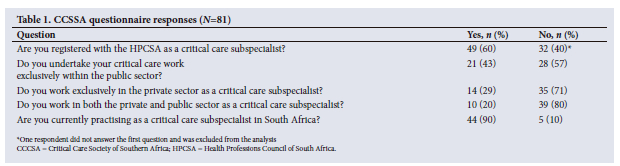
The initial question of the survey sent out through the CCSSA acted as a filter question, and only answers from consultants who had responded 'yes' to being registered with the HPCSA were further analysed. The answers to the survey are presented in tabulated form in percentages for ease of reading (Table 1).
Ethical approval
Ethical approval for this retrospective study and survey was obtained from the University of Cape Town's Human Research Ethics Committee (ref. no. 596/2023).
Results
Critical care subspecialist profile
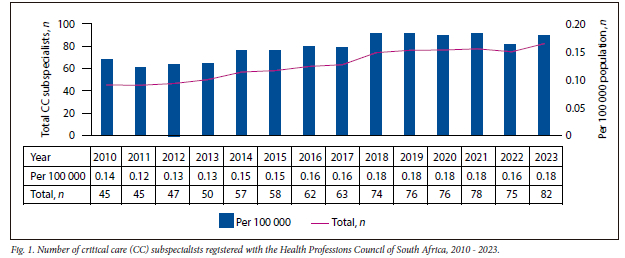
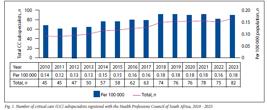
As of December 2023, the total number of adult critical care subspecialists registered with the HPCSA was 82. This is almost double the number present in 2010 (Fig. 1). However, the density per 100 000 population grew by only 28% as the adult population has increased over time.
The distribution among the various medical disciplines for 2023 is as follows: 33 from anaesthesiology, 9 from emergency medicine, 22 from medicine, 1 from neurosurgery, 2 from obstetrics and gynaecology and 15 from surgery. Anaesthesiology has been a dominant presence in the field since 2010, while neurosurgeons are the least represented in this subspecialty (Appendix A: The composition of the critical care workforce by specialty over time).
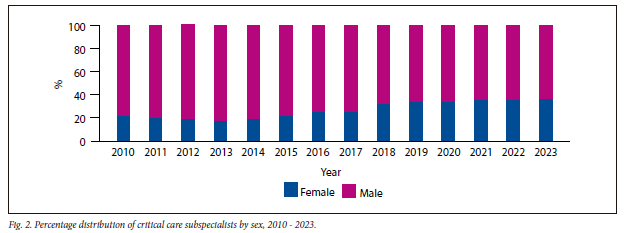
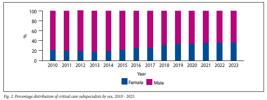
In 2023, 63% of the critical care subspecialists were male and 37% female. While there still exists a great discrepancy between the genders, the proportion of females entering the field has been on an upward trend since 2010 (Fig. 2).
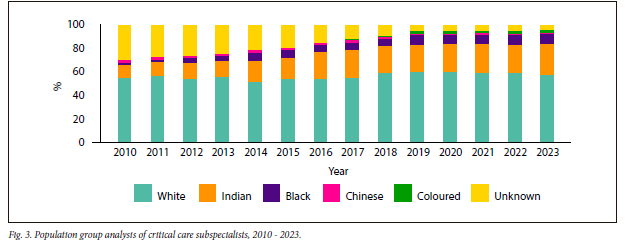
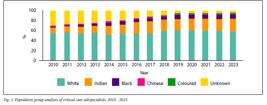
A population group analysis of the workforce since 2010 revealed that 59% of the critical care workforce comprised white consultants, 26% Indian, 9% black, 2% coloured and 1% Chinese. This distribution highlights the dominance of white consultants in this subspecialty. The most significant growth in representation has been observed in the Indian consultant population, although the sharp decrease in the unknown category over time should be noted, which distorts the data analysis pre-2019. From 2019, however, the racial distribution has remained stable (Fig. 3).
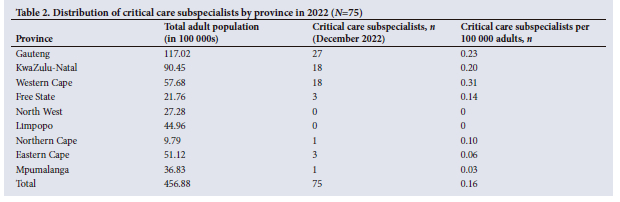
Based upon the 2022 population statistics from Stats SA,[17] most of the workforce is concentrated in the Western Cape and Gauteng provinces. In contrast, Limpopo, North West and Mpumalanga hold a disproportionately low ratio of critical care subspecialists to population size (Table 2). Note that the total value of 75 under the critical care subspecialists column was for the year 2022, and includes 4 people whose postal address was not disclosed.
Critical care capacity in South Africa
Regarding the anonymous survey sent to all 1 023 members of the CCSSA, only 82 responded. One of these respondents failed to answer the first question and was excluded from the analysis, giving a total number of 81 eligible respondents. This would give a seemingly low response rate of 8%, but, given that only a small proportion of the society are doctors, the true response rate is likely to be much higher.
Of the 49 specialists who answered yes to being a certified critical care subspecialist, 14 responded yes to working in the private sector exclusively, while 21 responded that they work in the public sector exclusively. Only 5 said that they were not currently practising as a critical care subspecialist in SA (Table 1).
Discussion
This is the first study quantifying the number of critical care subspecialists in SA to look at their distribution across the provinces, the division between the public and private sectors and the demographic composition of the workforce.
Despite transformation in the field, white males continue to dominate the workforce. Similarly, anaesthetists continue to be the main contributors to the field of critical care medicine. The workforce density was greatest in the Western Cape and Gauteng, both highly urbanised provinces, and the more rural provinces such as North West and Limpopo had no specialists at all, indicating high levels of inequality between the provinces. Additionally, ~29% of the workforce is situated in the private sector, which exacerbates the disparity between the apparent and actual availability of subspecialists.
A meta-analysis and systematic review by Wilcox et al.[19] showed a consistent trend of increased efficiency and improved patient outcomes in ICUs managed daily by critical care subspecialists. This reiterates what was published in the LeapFrog guidelines of November 2000,[20] which stated that ICUs run by intensivists showed reduced ICU mortality and length of stay. The guidelines recommended that ICUs should be staffed by board-certified intensivists, that these intensivists should be available at work during the day for 8 hours, 7 days per week and that they should respond to >95% of calls for help within 5 minutes.
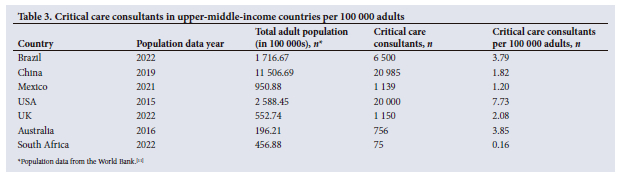
This study counted 82 critical care subspecialists in SA as of 2023. In contrast, the USA counted 20 000 full-time-equivalent intensivists in an audit in 2015,[20] the UK estimated their whole-time-equivalent intensive care medicine consultant count to be <1 150 in 2022,[21] while Australia counted 756 employed fully qualified intensivists in 2016.[22] To compare SA with similar upper-middle-income countries, Brazil estimated 6 500 intensivists in 2022,[23] Mexico had 1 139 critical care specialists in 2021 and as of 2019,[24] China had 20 985 certified critical care consultants (Table 3).[25]
The data initially suggest that the number of critical care consultants per 100 000 adult population in SA is far below the numbers in comparable upper-middle-income countries.[25,26] However, this study may be undercounting the number of critical care subspecialists in SA, because there are subspecialists who are certified in critical care but choose not to register as critical care subspecialists with the HPCSA. This decision is influenced by billing protocol within the private sector. For instance, consultants may avoid registering as critical care subspecialists to retain their billing capacity for procedures to do with their primary specialty, e.g. neurosurgical procedures, general surgical procedures and perioperative anaesthesia. Evidence supporting this is an article published in the Southern African Journal of Critical Care in 2019, which estimated that at least 113 critical care subspecialists had been certified by the Colleges of Medicine of SA since the birth of the subspecialty two decades ago.[12]
Additionally, this study did not count specialists who have ICU experience but lack formal critical care qualifications. These specialists aid in providing the population with greater access to ICU facilities. However, despite there being an underrepresentation of critical care subspecialists in the HPCSA's official count, the combined count of registered and unregistered critical care subspecialists is still likely to be well below comparable upper-middle-income countries.
This finding corroborates similar studies looking at surgical workforce densities[15] and target specialist to population ratios,[26] which found that SA's specialist density is well below international standards, and even below the National Department of Health's own recommended ratio of specialists per 100 000 population. The Percept report of 2019[27] is the most comprehensive report to date looking at the supply of and need for medical specialists in SA, but it neglected to report on the subspecialty of critical care.
The evidence provided emphasises that the subspecialty of critical care is not prioritised sufficiently in SA. Additionally, the country appears not to be training enough critical care subspecialists to meet its needs. There are very few funded fellowship posts in critical care, but the exact number is beyond the scope of this article, as the number of posts is not publicly available. Future research into this is warranted.
A similar problem is being faced by the UK, which is combatting the problem by allowing doctors to train in intensive care medicine as a 7-year standalone specialty, meaning that they do not need a base specialty.[22] Adopting a similar approach in SA could significantly enhance the training and availability of critical care subspecialists in the country, which could address the current shortfall. However, it may lead to a dearth in other specialties.
Additionally, funding more consultant and fellowship posts in critical care could alleviate the current shortfall of subspecialists, and ease the burden of critical illness, which has been proven to be higher in lower-middle-income countries and low-income countries. Increasing the availability of critical care resources has great potential to decrease the mortality rate of critically ill patients.[27]
The distribution of ICU beds within SA mirrors the inequality in the distribution of critical care subspecialists. Only 25% of ICU/ high care beds are in the public sector, which caters for around 71.5% of the total population.[13] The Western Cape Province has a public sector ICU bed:population ratio of 1:20 000 and Gauteng a ratio of 1:25 000, while Limpopo's ratio is 1:150 000 and North West 1:110 000.
To effectively address the maldistribution of critical care subspecialists across the provinces, a multifaceted approach can be adopted. Rural pay and increased benefits for doctors may attract and retain doctors in those areas. Increasing critical care fellowship posts in North West and Limpopo will attract more young doctors to those areas.
Although a significant proportion of SA's ICU beds are in the private sector,[13] the survey revealed that most certified critical care subspecialists are employed within the public sector. The rollout of the National Health Insurance (NHI) aims to promote a fair distribution of resources throughout the country.[28] With the NHI, SA's ICU bed to population ratio would be 1:10 000,[13] but there would still exist a large variation in this ratio between individual provinces. Additionally, the NHI does not help in addressing the shortage of the number of critical care subspecialists needed to run these ICUs.
Telehealth is a blanket term that covers all components and activities of healthcare and the healthcare system that are conducted through telecommunications technology, and is foreseen to play a crucial role in the delivery of medical services in SA.[29] Telehealth can assist with the shortage of critical care subspecialists by connecting patients in remote areas to critical care subspecialists in urban areas, and allowing critical care subspecialists to conduct virtual ward rounds in remote and peripheral hospitals, enabling a high level of care to be provided at these institutions despite there being no onsite subspecialists.
Recommendations
(i) A national workforce strategy needs to be developed to improve the total number, representation and distribution of critical care subspecialists.
(ii) An official count of the number of fellowship posts in critical care needs to be conducted.
(iii) Telehealth should be investigated and evaluated as a cost-effective strategy for overcoming geographical maldistribution in the country.
Study limitations
This study has several limitations.
We must acknowledge the vital role played by specialists with years of experience in working in ICU but who lack formal training in critical care. These specialists, such as anaesthetists, pulmonologists and surgeons, play an essential role in providing a greater proportion of the SA population access to ICU facilities, but were not counted in this study. Hence the real critical care workforce is underestimated in this study.
The data gathered from the HPCSA do not consider that some subspecialists may still be registered with the HPCSA despite having emigrated or retired. As mentioned, it is also believed that the number of subspecialists qualified in critical care is higher than the number provided by the HPCSA, as some may choose not to register their qualifications with the HPCSA.
The census on number of ICU beds was conducted almost a decade ago, and it is likely that there are now more ICU beds in SA, especially after the COVID-19 pandemic.
The response rate for the survey was calculated to be 8% but, as the email was sent to a number of non-doctors, the response rate of doctors is likely to be higher.
Conclusion
This study has contributed new findings to the specialist critical care workforce by doing an official count of critical care subspecialists as recognised by the HPCSA. SA has an inadequate supply of critical care subspecialists per 100 000 population compared with similar upper-middle-income countries. There is also a maldistribution of specialists between provinces, with the more urbanised and densely populated provinces having a disproportionally high number of critical care subspecialists, leading to unequal access to this field of care.
Data availability. The data used in this study are available upon request and subject to ethics approval from the HPCSA.
Declaration. None.
Acknowledgements. Thank you to Yvette Daffue at the HPCSA who assisted UG in gathering the data for this study.
Author contributions. UG conceptualised the study, designed the methodology and collected and analysed the data. DW and IJ supervised the study and revised the manuscript.
Funding. None.
Conflicts of interest. None.
References
-
1. Marshall JC, Bosco L, Adhikari NK, et al. What is an intensive care unit? A report of the task force of the World Federation of Societies of Intensive and Critical Care Medicine. J Crit Care 2017;37(1):270-276. https://doi.org/10.1016/j.jcrc.2016.07.015
» https://doi.org/10.1016/j.jcrc.2016.07.015 -
2. Adhikari NKJ, Fowler RA, Bhagwanjee S, et al. Critical care and the global burden of critical illness in adults, Lancet 2010;376(9749):1339-1346. https://doi.org/10.1016/s0140-6736(10)60446-1
» https://doi.org/10.1016/s0140-6736(10)60446-1 -
3. Kayambankadzanja RK, Schell CO, Martin GW, et al. Towards definitions of critical illness and critical care using concept analysis. BMJ Open2022;12(9):e060972. https://doi.org/10.1136/bmjopen-2022-060972
» https://doi.org/10.1136/bmjopen-2022-060972 -
4. Crawford AM, Shiferaw AA, Ntambwe P, et al. Global critical care: A call to action. Crit Care 2023;27(1):28. https://doi.org/10.1186/s13054-022-04296-3
» https://doi.org/10.1186/s13054-022-04296-3 -
5. Jatoi NN, Awan S, Abbasi M, et al. Intensivists and COVID-19 in the United States of America: A narrative review of clinical roles, current workforce, and future direction. Pan Afr Med J 2022;41(1):210. https://doi.org/10.11604/pamj.2022.41.210.29956
» https://doi.org/10.11604/pamj.2022.41.210.29956 -
6. Naidoo R, Naidoo K. Prioritising 'already-scarce' intensive care unit resources in the midst of COVID-19: A call for regional triage committees in South Africa. BMC Med Ethics 2021;22(1):28. https://doi.org/10.1186/s12910-021-00596-5
» https://doi.org/10.1186/s12910-021-00596-5 -
7. Mathiva LR. ICUs worldwide: An overview of critical care medicine in South Africa. Crit Care 2002;6(1):22-23. https://doi.org/10.1186/cc1449
» https://doi.org/10.1186/cc1449 -
8. Colleges of Medicine of South Africa. Sub-specialty certificate in critical care of the college of physicians of South Africa. Cape Town: CMSA, nd. https://www.cmsa.co.za/view_exam.aspx?QualificationID=75 (accessed 1 August 2023).
» https://www.cmsa.co.za/view_exam.aspx?QualificationID=75 -
9. National Department of Health, South Africa. 2030 Human Resources for Health Strategy: Investing in the Health Workforce for Universal Health Coverage Pretoria: NDoH, 2020. www.health.gov.za/wp-content/uploads/2023/06/2030-HRH-Strategy-Final.pdf (accessed November 2023).
» www.health.gov.za/wp-content/uploads/2023/06/2030-HRH-Strategy-Final.pdf -
10. World Health Organization. Global strategy on human resources for health: Workforce. Geneva: WHO, 2016. https://www.who.int/health-topics/health-workforce#tab=tab_1 (accessed January 2024).
» https://www.who.int/health-topics/health-workforce#tab=tab_1 -
11. World Bank. Overview: South Africa. World Bank, 2025. https://www.worldbank.org/en/country/southafrica/overview (accessed 1 August 2023).
» https://www.worldbank.org/en/country/southafrica/overview -
12. Joynt GM, Gopalan PD, Argent A, et al. The Critical Care Society of Southern Africa consensus statement on ICU triage and rationing (ConICTri). S Afr Med J 2019;109(8b):613-629. https://doi.org/10.7196/SAMJ.2019.v109i8b.13947
» https://doi.org/10.7196/SAMJ.2019.v109i8b.13947 -
13. Crippen D. Critical care in South Africa. ICU 2013;13(2). https://healthmanagement.org/c/icu/issue/icu-volume-13-issue-2-summer-2013 (accessed 28 November 2024).
» https://healthmanagement.org/c/icu/issue/icu-volume-13-issue-2-summer-2013 -
14. Tiwari R, Chikte U, Chu KM. Estimating the specialist surgical workforce density in South Africa. Ann Global Health 2021;87(1):83. https://doi.org/10.5334/aogh.3480
» https://doi.org/10.5334/aogh.3480 -
15. Tiwari R, Amien A, Visser Wi, Chikte U. Counting dermatologists in South Africa: Number, distribution and requirement. Br J Dermatol 2022;187(2):248-250. https://doi.org/10.1111/bjd.21036
» https://doi.org/10.1111/bjd.21036 -
16. Health Professions Council of South Africa. About Us. Pretoria: HPCSA, 2024. https://www.hpcsa.co.za/about-us (accessed 30 January 2024)
» https://www.hpcsa.co.za/about-us -
17. Statistics South Africa. Census 2022 Statistical Release: Report P0301.4. Pretoria: Stats SA, 2023. https://census.statssa.gov.za/assets/documents/2022/P03014_Census_2022_Statistical_Release.pdf (accessed 18 November 2025).
» https://census.statssa.gov.za/assets/documents/2022/P03014_Census_2022_Statistical_Release.pdf -
18. Naidoo K, Singh J, Lalloo U. A critical analysis of ICU/HC beds in South Africa: 2008 - 2009. S Afr Med J 2013;103(10):751-753.https://doi.org/10.7196/samj.6415
» https://doi.org/10.7196/samj.6415 -
19. Wilcox ME, Chong CAKY, Niven DJ, et al. Do intensivist staffing patterns influence hospital mortality following ICU admission? A systematic review and meta-analysis. Crit Care Med 2013;41(10):2253-2274. https://doi.org/10.1097/CCM.0b013e318292313a
» https://doi.org/10.1097/CCM.0b013e318292313a -
20. Manthous CA. Leapfrog and critical care: Evidence- and reality-based intensive care for the 21st century. Am J Med 2004;116(3):188-93. https://doi.org/10.1016/j.amjmed.2003.08.032SocietyofCriticalCareMedicine.Criticalcarestatistics.SCCM,2025. https://www.sccm.org/Communications/Critical-Care-Statistics (accessed 1 August 2023).
» https://doi.org/10.1016/j.amjmed.2003.08.032SocietyofCriticalCareMedicine.Criticalcarestatistics.SCCM,2025. https://www.sccm.org/Communications/Critical-Care-Statistics -
21. Faculty of Intensive Care Medicine. Workforce. London: FICM, 2024. https://www.ficm.ac.uk/careersworkforce/workforce (accessed 25 March 2024).
» https://www.ficm.ac.uk/careersworkforce/workforce -
22. Government of Australia. Factsheet: MDCL Intensive Care. Canberra: Government of Australia, n.d. https://hwd.health.gov.au/resources/publications/factsheet-mdcl-intensive-care (accessed 1 August 2023).
» https://hwd.health.gov.au/resources/publications/factsheet-mdcl-intensive-care -
23. Batista Filho LAC, Randhawa VK, Maciel AT, et al. We need to talk about critical care in Brazil. Clinics 2022;77(1):100096. https://doi.org/10.1016/j.clinsp.2022.100096
» https://doi.org/10.1016/j.clinsp.2022.100096 -
24. Ñamendys-Silva SA. Patients with coronavirus disease 2019 requiring invasive mechanical ventilation in Mexico in the first, second, and exponential growth phase of the third wave of the coronavirus disease 2019 pandemic. Crit Care Explorations 2021;3(10):e556. https://doi.org/10.1097/cce.0000000000000556
» https://doi.org/10.1097/cce.0000000000000556 -
25. Li L, Xi Q, Cai G, et al. Chinese critical care certified course in intensive care unit: A nationwide-based analysis. BMC Med Educ 2023;23(1):576 https://doi.org/10.1186/s12909-023-04534-4
» https://doi.org/10.1186/s12909-023-04534-4 -
26. Murthy S, Adhikari NK. Global health care of the critically ill in low-resource settings. Ann Am Thoracic Soc 2013;10(5):509-513. https://doi.org/10.1513/annalsats.201307-246ot
» https://doi.org/10.1513/annalsats.201307-246ot -
27. Wishnia JSD, Smith A, Ranchod S. The supply of and demand for medical specialists in South Africa. Percept, 2019. https://percept.co.za/2019/10/06/the-supply-of-and-demand-for-medical-specialists-in-south-africa/ (accessed 9 March 2024).
» https://percept.co.za/2019/10/06/the-supply-of-and-demand-for-medical-specialists-in-south-africa/ -
28. National Department of Health, South Africa. National Health Insurance (NHI). Pretoria: NDoH, 2020. https://www.health.gov.za/wp-content/uploads/2020/11/some-key-messages-on-nhi.pdf (accessed 30 January 2024).
» https://www.health.gov.za/wp-content/uploads/2020/11/some-key-messages-on-nhi.pdf -
29. Health Professions Council of South Africa. General ethical guidelines for good practice in telehealth: Booklet No. 10. https://www.hpcsa.co.za/?contentId=79 (accessed 10 March 2024).
» https://www.hpcsa.co.za/?contentId=79

Accepted 28 July 2025