Socio-economic predictors of stunting in preschool children: a population-based study from Johannesburg and Soweto
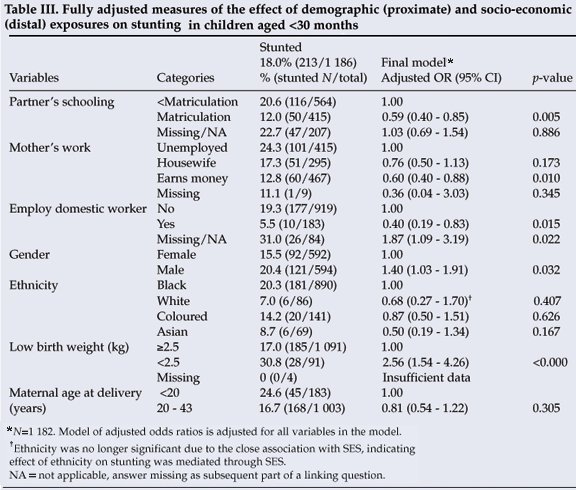
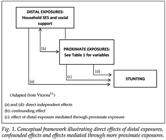
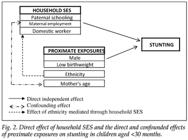
BACKGROUND: Stunting continues to be a child public health concern in many African countries, including South Africa. This study uses data from the Birth to Twenty study, held in Johannesburg, to investigate a range of household-level socio-economic and social support predictors of stunting in children aged less than 30 months. DESIGN: Logistical regression models were constructed using a conceptual framework to investigate the association between early life measures of socio-economic status and stunting (<-2 standard deviations from the WHO (2006) standard), using data collected in the Birth to Twenty study. RESULTS: Stunting prevalence was 18.0% (213/1 186). In unadjusted analyses, numerous socio-economic status exposures showed significant associations with stunting; however, in final multivariable models, decreased likelihood of stunting was seen in children born to mothers who were employed (adjusted odds ratio (AOR)=0.60, 95% confidence interval (CI) 0.40 - 0.88), those with fathers who had completed secondary school (AOR=0.59, 95% CI 0.40 - 0.85), and whose parents employed a domestic worker (AOR=0.40, 95% CI 0.19 - 0.83), while increased likelihood of stunting was seen in male children (AOR=1.40, 95% CI 1.03 - 1.91), and those born of low birth weight (AOR=2.56, 95% CI 1.54 - 4.26). CONCLUSIONS: Stunting and child malnutrition remain policy priorities for the South African Department of Health, and this study suggests that policies that aim to increase parental education level and reduce unemployment or target additional support to families with low education or unemployed parents may reduce stunting in preschool-age children in this setting.
SAMJ: South African Medical Journal
 Thumbnail
 Thumbnail