Teenage pregnancy in KwaZulu-Natal Province, South Africa: An 8-year trend analysis (2017/18 - 2024/25)
BACKGROUND: Pregnancy remains a major public health concern among young people in South Africa, particularly in KwaZulu-Natal Province (KZN), where high teenage fertility intersects with poverty, gender-based violence and limited access to reproductive health services. OBJECTIVES: This study analyses trends in teenage pregnancies in KZN from 2017/18 to 2024/25, disaggregated by age group (10 - 14 and 15 - 19 years) and district, to identify temporal patterns, geographical disparities and vulnerable populations. METHODS: Quantitative secondary analysis was conducted using routine health facility data from the District Health Information System (webDHIS). Descriptive statistics and age-specific delivery rates per 1 000 adolescent girls were calculated to assess provincial trends and district-level variation. RESULTS: Teenage deliveries increased from 32 502 in 2017/18 to a peak of 36 460 in 2019/20 (53.2 per 1 000), before declining to 29 794 in 2024/25 (42.8 per 1 000). Older teenagers (aged 15 - 19 years) accounted for >97% of deliveries, with rates declining from 51.7 per 1 000 in 2019/20 to 42.0 per 1 000 in 2024/25. Very young teenagers (aged 10 - 14 years) contributed fewer deliveries (530 - 993 annually), but with persistently high rates in rural districts such as Zululand, uMkhanyakude and King Cetshwayo (≥2 per 1 000). Population-adjusted comparisons showed that eThekwini had fewer deliveries than expected (-8.1 percentage points), while rural districts exceeded expectations (2.8 - 4.4 percentage points). CONCLUSION: Teenage pregnancies in KZN remain unevenly distributed, with rural and peri-urban districts disproportionately affected, and very young teenagers particularly vulnerable. Addressing these disparities requires interventions that target structural drivers, strengthen child protection systems, expand teenage-friendly reproductive health services and engage boys and young men in prevention efforts.
teenage pregnancy; teenagers; teenage mothers; reproductive health; KwaZulu-Natal; South Africa
Teenage pregnancy in KwaZulu-Natal Province, South Africa: An 8-year trend analysis (2017/18 - 2024/25)
T Sithole; B Mapotsi; M Mgwaba; P Maharaj
PhD; Department of Development Studies, School of Social Sciences, College of Humanities, University of KwaZulu-Natal, Durban, South Africa
ABSTRACTBACKGROUND: Pregnancy remains a major public health concern among young people in South Africa, particularly in KwaZulu-Natal Province (KZN), where high teenage fertility intersects with poverty, gender-based violence and limited access to reproductive health services.
OBJECTIVES: This study analyses trends in teenage pregnancies in KZN from 2017/18 to 2024/25, disaggregated by age group (10 - 14 and 15 - 19 years) and district, to identify temporal patterns, geographical disparities and vulnerable populations.
METHODS: Quantitative secondary analysis was conducted using routine health facility data from the District Health Information System (webDHIS). Descriptive statistics and age-specific delivery rates per 1 000 adolescent girls were calculated to assess provincial trends and district-level variation.
RESULTS: Teenage deliveries increased from 32 502 in 2017/18 to a peak of 36 460 in 2019/20 (53.2 per 1 000), before declining to 29 794 in 2024/25 (42.8 per 1 000). Older teenagers (aged 15 - 19 years) accounted for >97% of deliveries, with rates declining from 51.7 per 1 000 in 2019/20 to 42.0 per 1 000 in 2024/25. Very young teenagers (aged 10 - 14 years) contributed fewer deliveries (530 - 993 annually), but with persistently high rates in rural districts such as Zululand, uMkhanyakude and King Cetshwayo (≥2 per 1 000). Population-adjusted comparisons showed that eThekwini had fewer deliveries than expected (-8.1 percentage points), while rural districts exceeded expectations (2.8 - 4.4 percentage points).
CONCLUSION: Teenage pregnancies in KZN remain unevenly distributed, with rural and peri-urban districts disproportionately affected, and very young teenagers particularly vulnerable. Addressing these disparities requires interventions that target structural drivers, strengthen child protection systems, expand teenage-friendly reproductive health services and engage boys and young men in prevention efforts.
Keywords: teenage pregnancy, teenagers, teenage mothers, reproductive health, KwaZulu-Natal, South Africa
Teenage pregnancy remains a significant public health and social concern in South Africa (SA), with serious consequences for their adolescent girls' education and their socioeconomic wellbeing. Early childbearing is linked to higher risks of maternal morbidity and mortality, preterm birth and poor neonatal outcomes, particularly among very young teenagers (aged 10 - 14 years) whose bodies are not biologically ready for childbirth.[1,2] Beyond health concerns, teenage mothers are more likely to drop out of school, face social stigma and experience long-term economic disadvantages.[3]
Globally, teenage fertility has declined over the past two decades, but sub-Saharan Africa continues to report the highest rates, at 99 births per 1 000 girls aged 15 - 19 years, compared with 41 per 1 000 globally.[4] In SA, while teenage fertility has declined since the 1990s, progress has slowed in recent years. The 2016 SA Demographic and Health Survey reported that 16% of girls aged 15 - 19 years had begun childbearing, with higher prevalences in rural areas and among poorer households.[5]
KwaZulu-Natal Province (KZN) is one of the SA provinces most affected. It carries a high burden of teenage pregnancies, with rural districts and socioeconomically disadvantaged communities particularly vulnerable.[6] This situation is compounded by factors such as poverty, limited educational opportunities, social pressures and, in some cases, gender-based violence and coercion.[3,7] At the same time, teenage pregnancies in KZN intersect with broader challenges, including HIV prevalence, restricted access to sexual and reproductive health services, and limited social support systems.[8]
Several national-level studies have examined trends in teenage pregnancy. For example, a spatial analysis of national birth records covering 2014 - 2023 identified persistent geographical inequalities, with higher rates concentrated in rural and socioeconomically disadvantaged areas.[9] While this study provides important national insights, it relies on a different data source and does not offer a detailed provincial analysis of KZN. In addition, limited attention has been given to age-disaggregated patterns, particularly among very young adolescents (aged 10 - 14 years), and to district-level variations within provinces. Understanding these dynamics in KZN is critical for informing interventions that are context-specific and responsive to local needs. This study, therefore, examines 8-year trends in teenage pregnancies in KZN (2017/18 - 2024/25), using routine health facility data. The analysis is disaggregated by age group (10 - 14 and 15 - 19 years) and district to assess temporal trends, geographical variation and population-level differences within the province.
Methodology
Study design
This was a descriptive study using secondary data from the District Health Information System (webDHIS) for KZN province between 2017/18 and 2024/25. KZN is the second most populous province in SA and has a mix of rural and urban districts, high poverty levels, and a high prevalence of HIV, factors that contribute to teenage vulnerability.
Data source
A secondary analysis was conducted using routine health facility data extracted from the District Health Information System (webDHIS). The webDHIS is a national health information platform that consolidates service-level data from public health facilities across SA. Data are collected at the point of service delivery by clinicians using standardised registers such as the primary healthcare (PHC) tick sheet, antenatal care (ANC) registers and headcount registers. Daily facility-level summaries are verified by operational managers before submission to subdistrict offices for entry into the webDHIS. Although reporting occurs monthly, data are recorded on an ongoing basis. The system primarily captures information from public health facilities, with limited coverage of private facilities. The dataset is aggregated and does not include sociodemographic variables such as race, education or socioeconomic status.
Study population and variables
The outcome of interest was the number of deliveries among teenagers aged 10 - 19 years, disaggregated into two groups: 10 - 14 and 15 - 19 years. Deliveries were analysed by district and reporting year (2017/18 - 2024/25).
Data analysis
Analysis was performed using Stata 19 (StataCorp, USA). Descriptive statistics, including frequencies and percentages, were used to summarise trends. Differences in teenage delivery rates across years and districts were assessed using χ2p<0.05. Expected percentages of teenage deliveries were calculated based on the proportion of teenage females within each district using mid-year population estimates. Age-specific delivery rates per 1 000 girls were calculated using district-level mid-year population estimates from Statistics South Africa (Stats SA). Findings are systematically presented in tables and graphs to transform the data into interpretable visual narratives, highlighting trends, patterns and relationships over time, and geographical variations. Tables and graphs also helped to classify and interpret data, highlighting key findings, and presenting maximum data in a concise space.
Ethical considerations
This study was based on secondary analysis of aggregated routine data obtained from the KZN Department of Health (DoH). No individual identifiers were included, and no direct contact with human participants occurred. Since the study entailed use of secondary data and/or sources only, ethical exemption was granted by the School of Built Environment and Development Studies Academic Leader for Research and Ethics, University of KwaZulu-Natal (ref. no.00031320). Permission to access the dataset was granted by the KZN DoH.
Results
This study analysed teenage deliveries in KZN from 2017/18 to 2024/25, disaggregated by age group, district and year. Results are presented as absolute numbers, and delivery rates as per 1 000 girls.
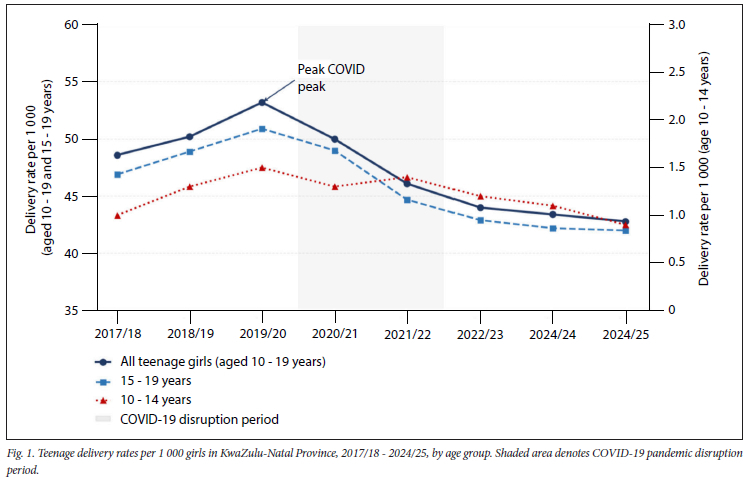
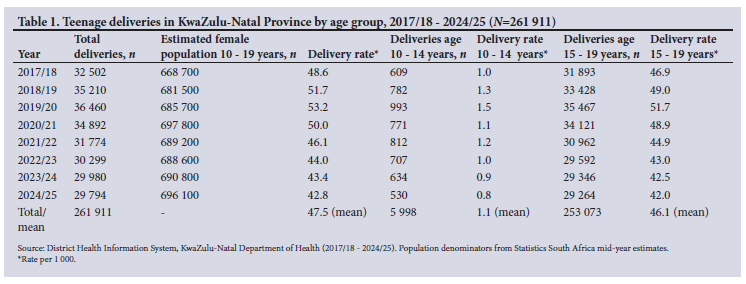
A total of 261 911 teenage facility-based deliveries were recorded in KZN over the 8-year study period. As shown in Table 1, total teenage deliveries increased from 32 502 in 2017/18 to a peak of 36 460 in 2019/20 (delivery rate: 53.2 per 1 000 girls aged 10 - 19 years), before declining progressively to 29 794 in 2024/25 (42.8 per 1 000). The peak in 2019/20 preceded the onset of the COVID-19 pandemic and the associated disruptions to health service utilisation and school attendance.
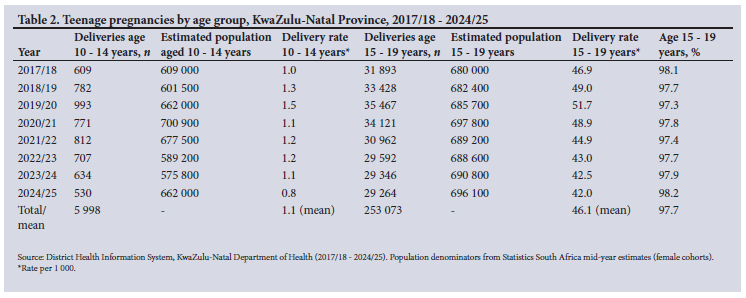
Table 2 presents deliveries disaggregated by age group. Adolescents aged 15 - 19 years accounted for >97% of all teenage deliveries throughout the study period, with rates rising from 46.9 per 1 000 in 2017/18 to 51.7 per 1 000 at the 2019/20 peak, and subsequently to 42.0 per 1 000 in 2024/25. Girls aged 10 - 14 years contributed a smaller but clinically significant proportion (range 530 - 993 deliveries annually), with rates peaking at 1.5 per 1 000 in 2019/20 and declining to 0.8 per 1 000 in 2024/25. While absolute numbers in this cohort are small, pregnancies in this age group are invariably associated with sexual coercion or abuse, constituting a child protection concern rather than a purely reproductive health outcome. Fig. 1 shows temporal trends in delivery rates for both age cohorts.
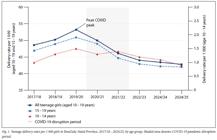
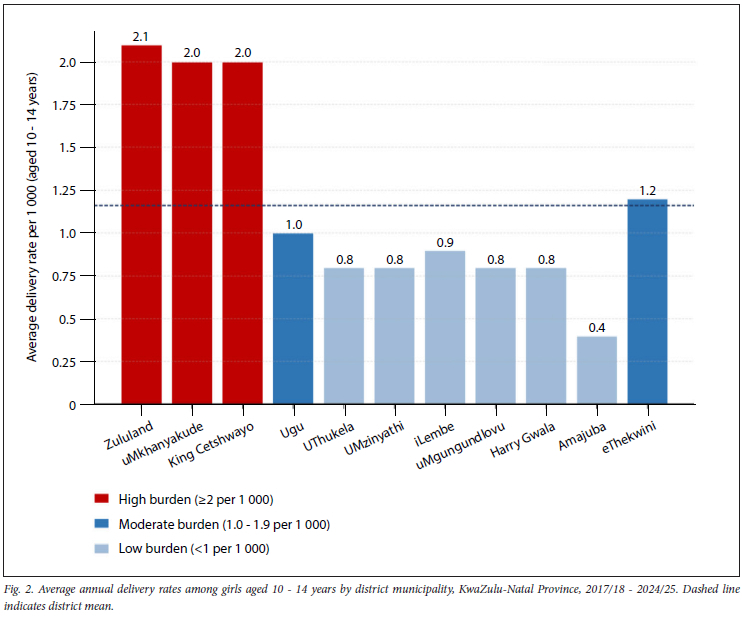
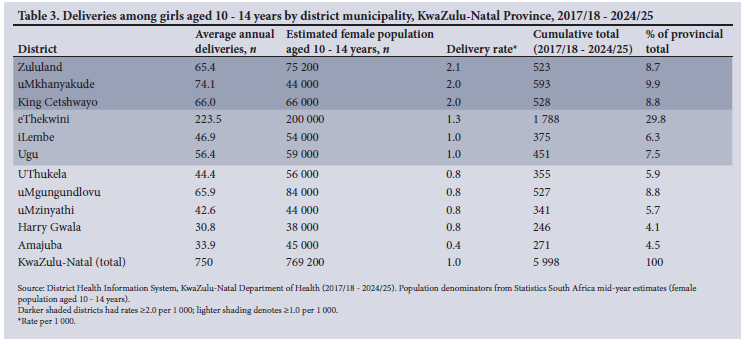
Table 3 presents the average annual deliveries and delivery rates for all 11 district municipalities among girls aged 10 - 14 years. Rural districts such as Zululand, uMkhanyakude and King Cetshwayo consistently recorded the highest rates (≥2 per 1 000), despite accounting for smaller absolute numbers than eThekwini. eThekwini Metropolitan Municipality recorded the largest cumulative total (n=1 788), reflecting its larger population, but its rate (1.3 per 1 000) was lower than the three highest-burden rural districts. Amajuba District Municipality recorded the lowest rate (0.4 per 1 000). Fig. 2 shows the district-level rate distribution.
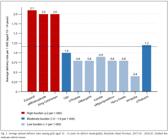
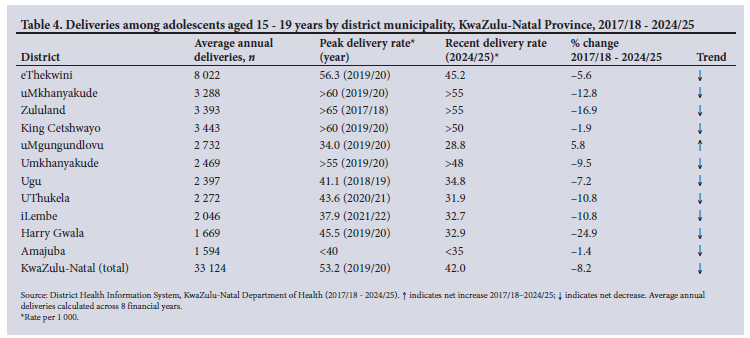
Table 4 presents peak and recent delivery rates for the 15 - 19-year age group by district. Rural districts demonstrated the highest peak rates: Zululand exceeded 65 per 1 000, and uMkhanyakude and King Cetshwayo exceeded 60 per 1 000 at their respective peaks. Despite an overall declining trend, Zululand, uMkhanyakude and King Cetshwayo remained >50 per 1 000 in 2024/25. uMgungundlovu District Municipality was the only district to record a net increase in the 15 - 19-year cohort over the study period (5.8%), increasing from 2 397 in 2017/18 to 2 535 in 2024/25, which warrants further investigation. Amajuba and Harry Gwala consistently recorded the lowest rates, remaining <40 per 1 000 throughout the study period.
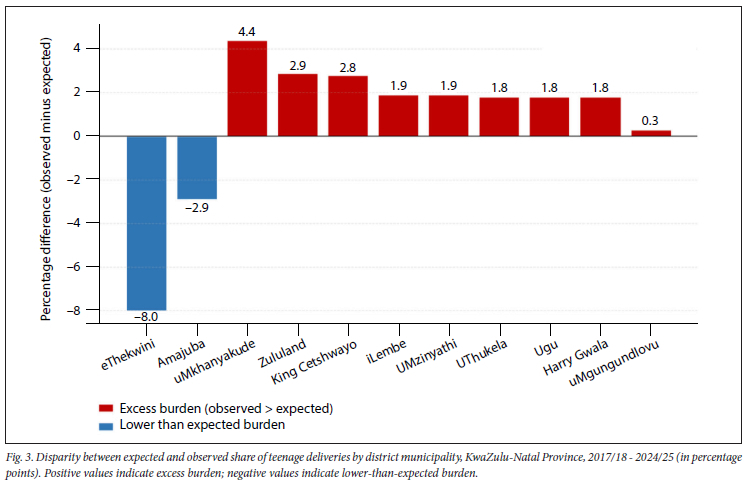
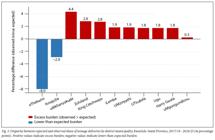
Fig. 3 presents the population-adjusted comparison of expected and observed teenage delivery shares by district. eThekwini, which contained 34.3% of the provincial female teenage population, accounted for only 26.3% of observed deliveries, a deficit of 8.1 percentage points consistent with its greater density of health services and educational opportunities. Amajuba also had fewer deliveries than expected (−2.9 percentage points). uMkhanyakude, Zululand and King Cetshwayo recorded more than their expected shares (4.4, 2.9 and 2.8 percentage points, respectively), reflecting the structural and systemic disadvantages that characterise these rural districts.
Facility-level data from 928 public health facilities across KZN showed that 208 facilities (22.4%) recorded at least one delivery among girls aged 10 - 14 years over the study period, indicating that child deliveries occurred across a wide range of facility types and geographical settings. These included district and regional hospitals, community health centres and primary care clinics. The 10 facilities with the highest cumulative totals in this age group were predominantly regional and district hospitals (Prince Mshiyeni Memorial Hospital (n=319), General Justice Gizenga Mpanza Hospital (n=286), Ezimwini Clinic (n=269), Mahatma Gandhi Hospital (n=259) and Queen Nandi Regional Hospital (n=254)), consistent with their roles as referral centres for high-risk obstetric cases. The inclusion of primary care clinics such as Ezimwini in the top 10 also suggests that a proportion of child deliveries occur in lower-level facilities, particularly in peri-urban and rural areas with limited referral capacity.
Discussion
This study shows that teenage deliveries in KZN peaked in 2019/20, before declining steadily to 2024/25. While most deliveries occurred among older teenagers (aged 15 - 19 years), very young teenagers (aged 10 - 14 years) consistently accounted for a small but important proportion, highlighting the vulnerability of this age group. District-level analyses revealed wide disparities, with rural districts such as uMkhanyakude, Zululand and King Cetshwayo carrying a disproportionate burden relative to their population size.
The overall decline in deliveries since 2020 aligns with national trends reported in routine health data.[10]
Several factors may have contributed to the decline in teenage deliveries observed from 2020 onwards. COVID-19 national lockdowns disrupted patterns of social interaction and mobility, which may have temporarily reduced sexual activity among some adolescents, although lockdown conditions also increased household-level exposure to violence and coercion for others. Beyond the pandemic, the progressive roll-out of long-acting reversible contraception methods, including subdermal implants and injectable contraceptives, through the public health system has expanded contraceptive access for adolescents attending public facilities. Nationally, the implementation of comprehensive sexuality education in secondary schools, supported by the National Adolescent and Youth Health Policy[11] and programme partners such as TB HIV Care,[12] has contributed to improved knowledge and contraceptive uptake among school-going adolescents. Sustaining the current decline will require continued investment in these supply and demand-side measures.
Deliveries among girls aged 10 - 14 years, though lower in absolute terms, are of particular concern. Pregnancies in this age group are often linked to sexual coercion, abuse, or transactional relationships, and also carry severe health risks, including obstetric complications and maternal mortality.[1,2] That rural districts report the highest rates suggests compounded vulnerability linked to isolation, weaker social support systems and under-reporting of abuse. This pattern is consistent with local evidence from KZN documenting barriers to the disclosure of sexual abuse among adolescent girls, including fear of stigma, distrust of authorities and limited access to support services.[13,14]
The geographical disparities identified in this study reflect the unequal distribution of reproductive health services across KZN's 11 districts. eThekwini benefits from a higher concentration of youth-friendly clinics, school-based health services and comprehensive sexuality education resources relative to rural districts. The KZN DoH's district health profiles indicate that uMkhanyakude, Zululand and King Cetshwayo have among the lowest densities of specialist reproductive health outreach services and trained reproductive health workers in the province.[15] These structural disadvantages, combined with higher rates of school non-attendance, poverty and transactional sexual relationships, account for the documented excess burden in these districts.[16,17] Rural districts also rely more heavily on community health workers for reproductive health outreach, limiting the frequency and consistency of service delivery. Closing these gaps requires targeted resource allocation to high-burden rural districts across reproductive health infrastructure, education, social welfare and community-based child protection.
District health authorities in uMkhanyakude, Zululand and King Cetshwayo should receive prioritised investment in reproductive health outreach and youth-friendly services, given their documented excess burden. Facilities recording deliveries among girls aged 10 - 14 years should be required to initiate mandatory referrals to social welfare and law enforcement under the Criminal Law (Sexual Offences and Related Matters) Amendment Act 32 of 2007, with compliance monitored at the district level. Comprehensive sexuality education should be expanded in all KZN schools, with dedicated attention to rural and under-resourced settings. Engagement with boys and young men as partners in prevention through school-based and community programmes remains an underutilised strategy that requires deliberate investment. Multi-sectoral collaboration between the departments of health, education, social development and justice is essential to address the structural determinants of teenage pregnancy, and to protect the most vulnerable adolescents in the province.
Study limitations
This study relied on secondary analysis of routine health facility data, which had several limitations. First, the use of facility-based deliveries as the outcome measure underestimates the true burden of teenage pregnancy. The data exclude terminated pregnancies, spontaneous miscarriages and stillbirths, meaning that actual teenage pregnancy rates are higher than those reported here. This is a particularly significant limitation for the 10 - 14-year age group, where pregnancies resulting from sexual abuse are frequently concealed and may not reach a public health facility, or may be terminated before delivery. Second, the webDHIS captures data exclusively from public health facilities; private sector deliveries are excluded. This gap is most relevant in eThekwini, where private obstetric services are more accessible than in rural districts, and may indicate that the metropolitan area's teenage delivery burden is moderately understated relative to rural districts. Third, the dataset does not include individual sociodemographic variables such as educational attainment, household income, or marital status, which limits the ability to explain the social and economic drivers of the observed patterns. Fourth, mid-year population denominators from Stats SA are model-based estimates and carry uncertainty, particularly at the district level for smaller age cohorts.
Despite these constraints, the study provides a comprehensive 8-year provincial overview using standardised, routinely collected data, offering a useful foundation for trend monitoring, resource allocation and policy planning.
Conclusion
For the 15 - 19-year age group, the downward trend in teenage deliveries is consistent and sustained, and reflects a combination of improved contraceptive access, expanded comprehensive sexuality education and the residual effects of COVID-19 disruptions on adolescent sexual behaviour. For girls aged 10 - 14 years, the picture is more complex. Deliveries in this cohort fluctuated over the study period, with a notable resurgence between 2020/21 and 2021/22. Trends in this age group should not be read primarily as a reproductive health indicator; they reflect the extent to which the child protection system is functioning. The priority in this cohort is not contraception but the prevention, identification and prosecution of sexual offences against children. Across both age groups, rural districts, particularly uMkhanyakude, Zululand and King Cetshwayo, carry a disproportionate burden relative to their population size, pointing to persistent gaps in service access, education and social protection. Closing these gaps requires sustained, targeted investment in these districts, and a multi-sectoral response that extends beyond health services alone.
Data availability. The aggregated data used in this study were obtained from the KZN DoH with its permission. The data are available from the corresponding author on reasonable request, subject to approval by the KZN DoH.
Declaration. None.
Acknowledgements. We thank the KZN DoH for providing the data.
Author contributions. All authors analysed and interpreted the data. All authors were involved in the drafting of the manuscript, revisiting it critically for intellectual content, and contributed significantly to the final version of the article. All authors read and approved the final manuscript.
Funding. None.
Conflicts of interest. None.
References
-
1. Yakubu I, Salisu WJ. Determinants of adolescent pregnancy in sub-Saharan Africa: A systematic review. Reprod Health 2018;15(1):15. https://doi.org/10.1186/s12978-018-0460-4
» https://doi.org/10.1186/s12978-018-0460-4 -
2. World Health Organization. Adolescent pregnancy. Fact sheet. Geneva: WHO, 2024. https://www.who.int/news-room/fact-sheets/detail/adolescent-pregnancy (accessed 10 September 2025).
» https://www.who.int/news-room/fact-sheets/detail/adolescent-pregnancy - 3. Haufiku AN. Educational and psychosocial experiences of women university students who became teenage mothers whilst at school. Doctoral dissertation. Stellenbosch: Stellenbosch University, 2023.
-
4. United Nations Children's Fund. Early childbearing and teenage pregnancy rates by country. New York: UNICEFData, 2024. https://data.unicef.org/topic/child-health/early-childbearing/ (accessed 10 September 2025).
» https://data.unicef.org/topic/child-health/early-childbearing/ -
5. National Department of Health, Statistics South Africa, South African Medical Research Council, ICF. South Africa Demographic and Health Survey 2016. Pretoria: NDoH, Stats SA, SAMRC, ICF, 2019. https://dhsprogram.com/pubs/pdf/FR337/FR337.pdf (accessed 10 September 2025).
» https://dhsprogram.com/pubs/pdf/FR337/FR337.pdf -
6. National Department of Health, South Africa. Saving Mothers report 2023. Pretoria: NDoH, 2023. https://www.health.gov.za/wp-content/uploads/2024/10/Saving-Mothers-Report-2023.pdf (accessed 10 September 2025).
» https://www.health.gov.za/wp-content/uploads/2024/10/Saving-Mothers-Report-2023.pdf -
7. Jewkes R, Morrell R, Christofides N. Empowering teenagers to prevent pregnancy: Lessons from South Africa. Cult Health Sex 2009;11(7):675-688. https://doi.org/10.1080/13691050902846452
» https://doi.org/10.1080/13691050902846452 - 8. Panday S, Makiwane M, Ranchod C, Letsoala T. Teenage pregnancy in South Africa: With a specific focus on school-going learners. Pretoria: Human Sciences Research Council, 2009.
-
9. Chamane S, Mabaso M. A decade of teenage pregnancy in South Africa, 2014 - 2023: A spatial analysis of national birth records. Int J Res Bus Soc Sci 2025;14(5):305-312. https://doi.org/10.20525/ijrbs.v14i5.4262
» https://doi.org/10.20525/ijrbs.v14i5.4262 -
10. Barron P, Subedar H, Letsoko M, Makua M, Pillay Y. Teenage births and pregnancies in South Africa, 2017 - 2021: A reflection of a troubled country: Analysis of public sector data. S Afr Med J 2022;112(4):252-258. https://doi.org/10.7196/SAMJ.2022.v112i4.16327
» https://doi.org/10.7196/SAMJ.2022.v112i4.16327 - 11. National Department of Health, South Africa. National adolescent and youth health policy 2017. Pretoria: NDoH, 2017.
- 12. TB HIV Care. Comprehensive sexuality education and adolescent health: Annual report 2021/2022. Cape Town: TB HIV Care, 2022.
-
13. Govender D, Naidoo S, Taylor M. Knowledge, attitudes and peer influences related to pregnancy, sexual and reproductive health among adolescents using maternal health services in Ugu, KwaZulu-Natal, South Africa. BMC Public Health 2019;19(1):928. https://doi.org/10.1186/s12889-019-7242-y
» https://doi.org/10.1186/s12889-019-7242-y -
14. Ajayi AI, Ezegbe HC. Association between sexual violence and unintended pregnancy among adolescent girls and young women in South Africa. BMC Public Health 2020;20(1):1370. https://doi.org/10.1186/s12889-020-09488-6
» https://doi.org/10.1186/s12889-020-09488-6 -
15. Human Sciences Research Council. SABSSM VI provincial dialogue: KwaZulu-Natal media pack. Pretoria: HSRC, 2024. https://hsrc.ac.za/wp-content/uploads/2024/09/SABSSM-KZN-dialogue-23-September-2024_FINAL.pdf (accessed 6 October 2026).
» https://hsrc.ac.za/wp-content/uploads/2024/09/SABSSM-KZN-dialogue-23-September-2024_FINAL.pdf -
16. Rosenberg M, Pettifor A, Miller WC, et al. Relationship between school dropout and teen pregnancy among rural South African young women. Int J Epidemiol 2015;44(3):928-936. https://doi.org/10.1093/ije/dyv007
» https://doi.org/10.1093/ije/dyv007 -
17. Temane MD, Mthimkhulu N, Gqunu S, et al. Socioeconomic factors and living conditions associated with teenage pregnancy in Soweto and Thembelihle townships, Johannesburg, South Africa: 2023 - 2024. Discover Public Health 2025;22:880. https://doi.org/10.1186/s12982-025-01301-2
» https://doi.org/10.1186/s12982-025-01301-2

Accepted 20 April 2026