Maternal and neonatal outcomes in patients with type 1 diabetes mellitus in pregnancy in a South African cohort
BACKGROUND. Women with type 1 diabetes mellitus (T1DM) are at high risk of maternal, pregnancy and neonatal complications. Limited data on this topic are available in Africa. OBJECTIVE. To describe characteristics of patients in South Africa with T1DM in pregnancy, and associated outcomes. METHODS. Clinical and biochemical data were collected on 273 women with T1DM: maternal clinical characteristics, glycated haemoglobin (HbA1c) and maternal and neonatal complications and outcomes. RESULTS. There was a statistically significant decline in HbA1c from first presentation to delivery (8.7% (standard deviation (SD) 2.2) v. 6.4% (SD 2.4)), respectively; p<0.00001). The perinatal mortality rate was 7.2%. In this cohort, 31.9% of patients experienced hypoglycaemia. Patients with hypoglycaemia had a significantly longer duration of diabetes, and higher HbA1C than those without hypoglycaemia (7.5 (SD 5.7) v. 6.1 (SD 4.5) years, p=0.002; 9.0% (SD 1.9) v. 8.5% (SD 2.3), p=0.04, respectively)). CONCLUSION. This cohort showed a high perinatal mortality rate and a high prevalence of hypoglycaemia and caesarean section. Intensification in glycaemic control is important to improve outcomes, but comes with challenges. A significant HbA1C reduction can be achieved with regular follow-up and management with a multidisciplinary team. Despite poor baseline glycaemic control, the prevalence of congenital abnormalities and macrosomia was low.
type 1 diabetes; pregnancy; hypoglycaemia; neonatal outcomes; maternal characteristics
Maternal and neonatal outcomes in patients with type 1 diabetes mellitus in pregnancy in a South African cohort
G YudelowitzI, II; N Goolam MahyoodeenI
IFCP (SA), Cert Endocrinology and Metabolism; Division of Endocrinology and Metabolism, Department of Internal Medicine, Chris Hani Baragwanath Academic Hospital, Soweto, South Africa
IIFCP (SA), Cert Endocrinology and Metabolism; Division of Endocrinology and Metabolism, Department of Internal Medicine, School of Clinical Medicine, Faculty of Health Sciences, University of the Witwatersrand, Johannesburg, South Africa
BACKGROUND. Women with type 1 diabetes mellitus (T1DM) are at high risk of maternal, pregnancy and neonatal complications. Limited data on this topic are available in Africa.
OBJECTIVE. To describe characteristics of patients in South Africa with T1DM in pregnancy, and associated outcomes.
METHODS. Clinical and biochemical data were collected on 273 women with T1DM: maternal clinical characteristics, glycated haemoglobin (HbA1c) and maternal and neonatal complications and outcomes.
RESULTS. There was a statistically significant decline in HbA1c from first presentation to delivery (8.7% (standard deviation (SD) 2.2) v. 6.4% (SD 2.4)), respectively; p<0.00001). The perinatal mortality rate was 7.2%. In this cohort, 31.9% of patients experienced hypoglycaemia. Patients with hypoglycaemia had a significantly longer duration of diabetes, and higher HbA1C than those without hypoglycaemia (7.5 (SD 5.7) v. 6.1 (SD 4.5) years, p=0.002; 9.0% (SD 1.9) v. 8.5% (SD 2.3), p=0.04, respectively)).
CONCLUSION. This cohort showed a high perinatal mortality rate and a high prevalence of hypoglycaemia and caesarean section. Intensification in glycaemic control is important to improve outcomes, but comes with challenges. A significant HbA1C reduction can be achieved with regular follow-up and management with a multidisciplinary team. Despite poor baseline glycaemic control, the prevalence of congenital abnormalities and macrosomia was low.
Keywords: type 1 diabetes, pregnancy, hypoglycaemia, neonatal outcomes, maternal characteristics
The prevalence of diabetes in pregnancy ranges between 13% and 26% globally, depending on geographical location.[1] Within Africa, the prevalence is 13%, with >450 000 live births affected by diabetes prior to pregnancy in 2021.[2,3] In 2021, South Africa (SA) recorded >105 000 births affected by diabetes prior to pregnancy.[1] Only a minority of these cases are due to type 1 diabetes mellitus (T1DM).[2]
In SA, the peak age of onset of T1DM is ~23 years.[3] Globally, pregnancies complicated by T1DM have increased by up to 44% over the last 15 years. However, there are no data on the prevalence of T1DM in SA during pregnancy.
Diabetes in pregnancy is associated with prenatal, intranatal and postnatal complications, with greater risk in patients with pre-gestational diabetes.[4,5] Additionally, the complications associated with diabetes, such as diabetic nephropathy, may increase the risk of adverse pregnancy outcomes, particularly in women with hypertension and proteinuria.[6]
Furthermore, compared with women with gestational diabetes (GDM), patients with T1DM are more insulin sensitive, and therefore at greater risk of hypoglycaemia.[7,8] Neonatal morbidity, especially hypoglycaemia, is also higher in T1DM.[5] A study by Huddle[9] in 2002 demonstrated that maternal hypoglycaemia occurred in 14% of patients with pre-gestational T1DM, compared with 7% and 0.9% of patients with pre-gestational type 2 DM and GDM, respectively.
Chris Hani Baragwanath Academic Hospital (CHBAH), located in Soweto, is the largest public hospital in SA. Approximately 60 000 patients per year are treated in the obstetrics department.[10] Patients are managed by a multidisciplinary team including endocrinologists, obstetricians, a diabetic nurse educator and allied health professionals. The aim of this study was, therefore, to describe the characteristics and associated maternal and neonatal outcomes of patients with T1DM in pregnancy seen at CHBAH from January 2012 to December 2021.
Methods
Clinical and biochemical data were collected on 273 T1DM patients seen at the gestational endocrine clinic at CHBAH from January 2012 to December 2021. Patients are managed by endocrinologists and obstetricians with multiple daily injections of insulin and self-monitored blood glucose with 6-point profiles. Patients are referred to the clinic after the diagnosis of diabetes is made, and therefore no specific pre-conception counselling is given. The inclusion criterion was attending the gestational endocrine clinic with known T1DM. T1DM was diagnosed on clinical grounds, based on patient age, previous diagnosis of T1DM and the opinion of the treating physician. Measurements of islet cell autoantibodies and C-peptide levels were not possible owing to limited resources.
The exclusion criteria were patients with other forms of diabetes, or with hyperglycaemia first detected in pregnancy. A retrospective medical record review was performed on existing medical records collected and stored at the combined gestational diabetes clinic on the hospital premises. The following data were collected: maternal clinical characteristics, glycated haemoglobin (HbAlc) and maternal and neonatal complications and outcomes.
Ethnicity was not documented; however, the demographics of the hospital drainage area, within Soweto and surrounding areas, suggest that the patient population was predominantly black African.
Retinopathy was defined as a documented history of retinopathy or retinopathy diagnosed on screening fundoscopy at baseline performed by a specialist endocrinologist. Nephropathy is defined as a documented history of renal dysfunction, presence of microalbuminuria at initial presentation, measured by microalbumin to creatinine ratio, or serum creatinine >87 umol/L.[11] Hypoglycaemia was defined by a finger-prick glucose level of <3.5 mol/L,[12] recurrent hypoglycaemia as >2 documented episodes of hypoglycaemia during the course of the pregnancy and severe hypoglycaemia as an event requiring the assistance of another person to actively administer carbohydrates or glucagon, or take other corrective actions.[13]
Neonatal outcomes were defined as follows: prematurity/preterm birth: delivery at <37 completed weeks gestational age; miscarriage: loss in pregnancy occurring at <28 completed weeks gestational age; stillbirth: loss in pregnancy occurring at >29 weeks gestational age; early neonatal death: neonatal death occurring in the first week. Intrauterine growth restriction (IUGR) was defined as estimated fetal weight <10th percentile, as documented on routine obstetric ultrasound done as part of routine care at the clinic. Macrosomia was defined as birthweight >4 kg, and large for gestational age (LGA) was defined as birthweight >90th percentile for age.[14] No identifiers were collected, and therefore informed consent was waived.
Permission was obtained from the Medical Advisory Committee for CHBAH as well as heads of the Department of Internal Medicine, the Division of Endocrinology and Metabolism and the Obstetrics and Gynaecology department.
Ethical approval
Ethical approval for this study was obtained from the University of the Witwatersrand Human Research Ethics Committee (medical) (ref. no. M220804).
Results
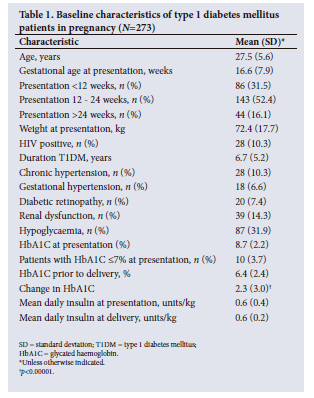
The characteristics of the study cohort are described in Table 1. The mean (standard deviation (SD)) age and weight of patients was 27.5 (5.6) years and 72.4 (17.7) kg, respectively. Most patients presented within the second trimester of pregnancy. The prevalence of HIV in the population was 10.3%. The prevalence of hypertension was 16.9%. The mean (SD) duration of diabetes at baseline was 6.7 (5.2) years. There was a statistically significant decline in HbA1c from first presentation to delivery (8.7% (2.2) v. 6.4% (2.4), respectively (p<0.00001)). In this cohort, 31.9% of patients experienced hypoglycaemia. There was no significant difference in mean insulin dose between patients with and without hypoglycaemia.
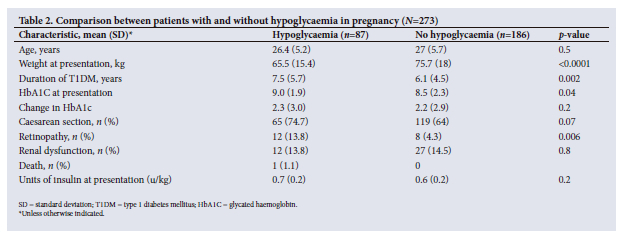
Patients who experienced hypoglycaemia had a significantly longer duration of diabetes, higher HbA1C and lower weight at presentation (7.5 ( 5.7) v. 6.1 (4.5) years, p=0.002; 9.0% (1.9) v. 8.5% (2.3), p=0.04; 65.5 (15.4) kg v. 75.7 (18.0) kg, p<0.001, respectively) than those without hypoglycaemia (Table 2). Diabetic retinopathy was observed in 7.4% of all patients, with a higher frequency seen in patients with hypoglycaemia (13.8% v. 4.3%, p=0.006). Although not statistically significant, more patients with hypoglycaemia underwent caesarean section than those without hypoglycaemia (74.7% v. 64%, p=0.07). The reasons for caesarean section were not routinely indicated. One maternal death from hypoglycaemia was reported. Logistic regression analysis showed that lower weight at presentation, and longer duration of T1DM were risk factors for hypoglycaemia (odds ratio (OR) 2.6; 95% confidence interval (CI) 2.5 - 2.7, p<0.001; OR 2.9, 95% CI (2.7 - 3.0), p<0.001). There were 41 perinatal deaths (23 miscarriages, 14 stillbirths and 4 neonatal deaths), with a perinatal mortality rate of 7.2% (14 stillbirths + 4 neonatal deaths from 250 live births) (Table 2).
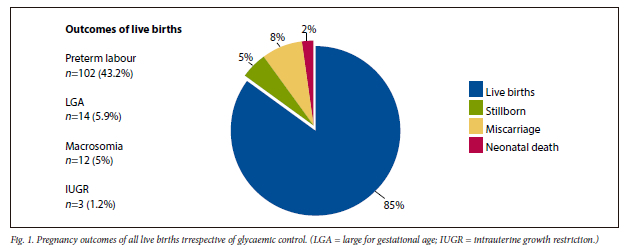
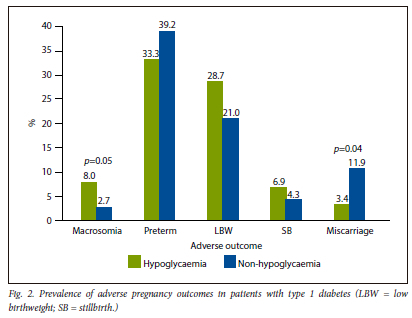
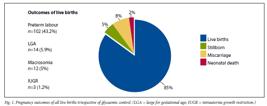
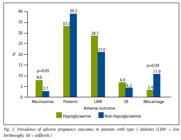
Six patients (2.2%) were admitted with diabetic ketoacidosis. Of the 87 patients who experienced hypoglycaemia, 31 (35.6%) experienced severe hypoglycaemia, 68 (78.2%) had recurrent hypoglycaemia and 16 (18.4) had recurrent severe hypoglycaemia. There were no statistically significant differences between the groups for the development of microvascular complications. The prevalences of adverse outcomes (preterm delivery, low birthweight, IUGR and macrosomia) were 43.2%, 23.5%, 1.2% and 5.0%, respectively (Fig. 1). Patients with adverse outcomes had a significantly higher HbA1c at presentation than those without adverse outcomes (9.0% (2.3) v. 8.3% (2%), p=0.01). No congenital malformations were reported. Macrosomia was observed in 5% of live births. There was a significantly higher prevalence of macrosomia in patients with hypoglycaemia (8.0 v. 2.7%, p=0.05). There was a higher prevalence of miscarriage in patients without hypoglycaemia (Fig. 2).
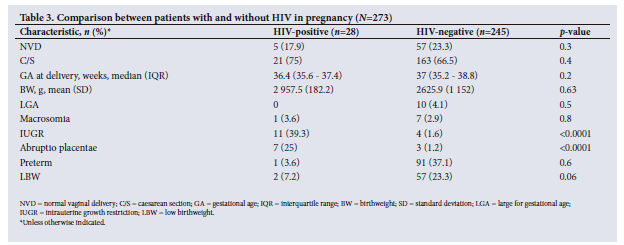
The prevalence of HIV in the population was 10.3% (n=28) (Table 3). There were significant differences in the incidence of IUGR and abruptio placentae comparing HIV-positive and negative patients (39.3% v. 1.6%, p<0.0001 and 25% v. 1.2%, p<0.0001, respectively). No comorbid hypertension was noted; however, the total numbers were small, and this likely needs further investigation. There were no other significant differences in outcome when comparing these two groups. All HIV-positive patients were initated on antiretroviral therapy according to prevention of mother-to-child transmisson guidelines; however, compliance data were not included.
Discussion
These results emphasise the complexities in managing T1DM during pregnancy, and the importance of glycaemic control. In this retrospective study we report on a cohort of 273 patients with T1DM in pregnancy managed at a tertiary hospital. Despite having known T1DM and being at high obstetric risk, patients in this cohort presented to antenatal care in the second trimester. This raises concerns about patients' compliance and access to specialist medical care, and the referral system of high-risk obstetric patients. These challenges are due to a variety of social and socioeconomic conditions within SA. They limit the quality of care and contribute to complications, as the vital first-trimester period is bypassed. The mean (SD) age of presentation was 27.5 (5.6) years, with mean duration of T1DM being 6.7 (5.2) years. This implies that the majority of patients were diagnosed in the late second to early third decade of life, in keeping with the prevalence of T1DM in Africa.[1,3] Patients had poor glycaemic control at presentation, evidenced by a mean initial HbA1c of 8.6%. Only 10 patients in this cohort were controlled prior to pregnancy, with a HbA1C <7% at presentation, highlighting the need for preconception counselling and planning in high-risk pregnancies.
Almost one-third (31.9%) of patients experienced hypoglycaemia, with these patients having a longer duration of diabetes, lower weight at presentation and higher prevalence of retinopathy than those without hypoglycaemia. Hypoglycaemia is not uncommon in patients with diabetes when therapy is intensified. However, in this cohort, patients with and without hypoglycaemia experienced a significant decline in HbA1c without a concomitant increase in insulin dose. This may, in part, be explained by a greater compliance with both dietary and lifestyle modification and medical therapy during pregnancy. There was also a high prevalence of preterm labour and caesarean section in this cohort, which may have been influenced by the prevalence of additional complications such as hypertension in pregnancy (16.9%) and microvascular disease (retinopathy (7.4%) and renal dysfunction (14.3%)). There was a higher prevalence of caesarean section in hypoglycaemic patients, although this was not statistically significant. This may be due to the overall increased caesarean section rate in high-risk patients, and there likely would be a greater difference if compared with non-diabetic patients. As expected, the perinatal mortality rate was higher than in patients with GDM in SA (7.2% in this study v. range from 2.5% to 4.9% in previous studies).[9,15,16] The perinatal mortality rate was also higher than in first-world data among T1DM pregnancies (7.2% v. 3.9% among patients in Sweden).[17] The prevalence of adverse outcomes also differs when compared with first-world data: preterm delivery 43.2% v. 3.08%, stillbirths 5% v. 3.34% and macrosomia 5.0% v. 11.05%.[17]
There was no significant difference in mean insulin dose between patients with and without hypoglycaemia. This illustrates that the intensification of treatment with insulin is not a risk factor for hypoglycaemia, but rather that other factors play an important role, such as weight and preceding duration of T1DM.
The prevalences of hypertension, renal dysfunction and retinopathy were 16.9%, 14.7% and 7.4%, respectively. Despite poor glycaemic control, no congenital abnormalities were reported. However, there was a high prevalence of miscarriage.
The prevalence of macrosomia in this cohort was lower (5% v. 12.5%) than in patients with GDM from the same hospital. [9] It was significantly higher in patients with hypoglycaemia. There was a higher prevalence of miscarriage in patients without hypoglycaemia, illustrating the pregnancy-related risks associated with hyperglycaemia in pregnancy.
Study limitations
The relative rarity of fatal maternal complications in this cohort, which was managed at a tertiary hospital by a multidisciplinary team, may not be applicable to all centres. Overall, there was a low maternal mortality rate (0.4%).
To our knowledge, this is the largest study from Africa of patients with T1DM in pregnancy. Its limitations included its retrospective study design and the fact that T1DM was diagnosed on clinical grounds. Owing to limited resources, the measurement of autoantibodies and C-peptide levels was not feasible. Therefore, a small number of young patients with type 2 diabetes may have been included in the study. Patients were monitored with HbA1C in pregnancy despite inconsistencies of HbA1C levels that vary throughout pregnancy, and the inconsistency of pregnancy-specific reference ranges for HbA1C.[18] Data on neonatal hypoglycaemia were not recorded, because neonatal records were not available. These missing data may have further implications for the interpretation of outcomes in these high-risk pregnancies.
Conclusion
While similar studies exist internationally, particularly in Europe and North America, this study fills a critical gap by providing local insights into pregnancy outcomes in women with T1DM in SA, where resource constraints pose additional challenges, and contributes valuable data to a field with limited regional studies. This study highlights the fact that T1DM is associated with multiple complications. Intensification in glycaemic control is important to improve outcomes, but is not without its challenges. Despite poor baseline glycaemic control, the prevalence of congenital abnormalities and macrosomia was low. A significant HbA1C reduction can be achieved with regular follow-up and management by a multidisciplinary team. Lower rates of macrosomia and LGA can be achieved with adequate control and regular follow-up. The risk of hypoglycaemia may be independent of insulin dose, and therefore intensification of treatment should be targeted to achieve control. A lack of pre-conception counselling may contribute to adverse outcomes, and is seen as one possible solution to improve outcomes.This study contributes to the data on T1DM in pregnancy within SA, and highlights the need to educate patients preconception to ensure better baseline glycaemic control. Further studies are required to evaluate strategies to minimise hypoglycaemia in these patients.
Data availability. The data used for this study are available from the authors on request.
Declaration. None.
Acknowledgements. Prof. KRL Huddle for reviewing and advising regarding the draft manuscript.
Author contributions. GY: collected data, statistical analysis, drafted manuscript. NGM: conceived study, data interpretation and manuscript editing.
Funding. None.
Conflicts of interest. None.
References
-
1. International Diabetes Federation. IDF Diabetes Atlas 2021. Brussels: IDF, 2021. https://diabetesatlas.org/atlas/tenth-edition/ (accessed 31 January 2022).
» https://diabetesatlas.org/atlas/tenth-edition/ - 2. Vargas R, Repke JT, Ural SH. Type 1 diabetes mellitus and pregnancy. Rev Obstet Gynecol 2010;3(3)92-100.
-
3. Kalk WJ, Huddle KRL, Raal FJ. The age of onset and sex distribution of insulin-dependent diabetes mellitus in Africans in South Africa. Postgrad Med J 1993;69(813):552-556. https://doi.org/10.1136/pgmj.69.813.552
» https://doi.org/10.1136/pgmj.69.813.552 - 4. McGrath R, Glastras S, Hocking S, Fulcher G. Large-for-gestational-age neonates in type 1 diabetes and pregnancy: Contribution of factors beyond hyperglycemia. Diabetes Care 2018;41(8):1821-1828.
-
5. Evers IM, de Valk HW, Visser GH. Risk of complications of pregnancy in women with type 1 diabetes: Nationwide prospective study in the Netherlands. BMJ 2004;328(7445):915. https://doi.org/10.1136/bmj.38043.583160.ee
» https://doi.org/10.1136/bmj.38043.583160.ee -
6. Bramham K, Rajasingham D. Pregnancy in diabetes and kidney disease. J Ren Care 2012;38(Suppl 1):S78-S89. https://pubmed.ncbi.nlm.nih.gov/22348367/ (accessed 14 April 2022).
» https://pubmed.ncbi.nlm.nih.gov/22348367/ -
7. Mackin ST, Nelson SM, Kerssens JJ, et al. Diabetes and pregnancy: National trends over a 15 year period. Diabetologia 2018;61(5):1081-1088. https://doi.org/10.1007/s00125-017-4529-3
» https://doi.org/10.1007/s00125-017-4529-3 -
8. García-Patterson A, Gich I, Amini SB, Catalano PM, de Leiva A, Corcoy R. Insulin requirements throughout pregnancy in women with type 1 diabetes mellitus: Three changes of direction. Diabetologia 2010;53(3):446-451. https://doi.org/10.1007/s00125-009-1633-z
» https://doi.org/10.1007/s00125-009-1633-z - 9. Huddle KR. Audit of the outcome of pregnancy in diabetic women in Soweto, South Africa, 1992-2002. S Afr Med J 2005;95(10):789-794.
-
10. Chris Hani Baragwanath Hospital. General information. Johannesburg: CHBAH, 2025. https://www.chrishanibaragwanathhospital.co.za/ (accessed 14 April 2022).
» https://www.chrishanibaragwanathhospital.co.za/ -
11. Wiles K, Bramham K, Seed PT, Nelson-Piercy C, Lightstone L, Chappell LC. Serum cratinine in pregnancy: A systematic review. Kidney Int Rep 2018;4(3):408-419. https://doi.org/10.1016/j.ekir.2018.10.015
» https://doi.org/10.1016/j.ekir.2018.10.015 -
12. American College of Obstetricians and Gynecologists. Diabetes mellitus. ACOG, 2019. https://www.acog.org/clinical/journals-and-publications/clinical-updates/2019/11/diabetes-mellitus (accessed 14 April 2022).
» https://www.acog.org/clinical/journals-and-publications/clinical-updates/2019/11/diabetes-mellitus -
13. Seaquist ER, Anderson J, Childs B, et al. Hypoglycemia and diabetes: A report of a workgroup of the American Diabetes Association and the Endocrine Society. Diabetes Care 2013;36(5):1384-1395. https://doi.org/10.2337/dc12-2480
» https://doi.org/10.2337/dc12-2480 -
14. Battaglia FC, Lubchenco LO. A practical classification of newborn infants by weight and gestational age. J Pediatr 1967;71(2):159-163. https://doi.org/10.1016/s0022-3476(67)80066-0
» https://doi.org/10.1016/s0022-3476(67)80066-0 -
15. Van Zyl H, Levitt NS. Pregnancy outcome in patients with pregestational and gestational diabetes attending Groote Schuur Hospital, Cape Town, South Africa. S Afr Med J 2018;108(9):772. https://doi.org/10.7196/samj.2018.v108i9.12992
» https://doi.org/10.7196/samj.2018.v108i9.12992 -
16. Nicolaou V, Soepnel L, Huddle KR, Levitt N, Klipstein-Grobusch K, Norris SA. Maternal and neonatal outcomes following the introduction of oral hypoglycaemic agents for gestational diabetes mellitus were comparable to insulin monotherapy in two historical cohorts. S Afr Med J 2020;110(2):154. https://doi.org/10.7196/samj.2020.v110i2.14024
» https://doi.org/10.7196/samj.2020.v110i2.14024 -
17. Persson M, Norman M, Hanson U. Obstetric and perinatal outcomes in type 1 diabetic pregnancies: A large, population-based study. Diabetes Care 2009;32(11):2005-2009. https://doi.org/10.2337/dc09-0656
» https://doi.org/10.2337/dc09-0656 -
18. Hughes RCE, Rowan J, Florkowski CM. Is there a role for HbA1c in pregnancy? Curr Diab Rep 2016;16:5. https://doi.org/10.1007/s11892-015-0698-y
» https://doi.org/10.1007/s11892-015-0698-y

Accepted 31 October 2025