Correlation between a new visual prostate symptom score (VPSS) and uroflowmetry parameters in men with lower urinary tract symptoms
OBJECTIVE: A visual prostate symptom score (VPSS) compared with the international prostate symptom score (IPSS) for evaluation of lower urinary tract symptoms (LUTS) can be completed without physician assistance by a significantly larger proportion of men with limited education. We aimed to evaluate the correlation of the VPSS and IPSS with uroflowmetry parameters. METHODS: Men with LUTS were requested to complete the IPSS and VPSS, consisting of pictograms to evaluate urinary frequency, nocturia, force of the stream and quality of life. The maximum (Qmax) and average urinary flow rate (Qave), voided volume (VV) and post-void residual (PVR) urine volumes were measured. Statistical analysis was performed using the Mann-Whitney and Spearman's tests. RESULTS: The study included 93 men (mean age 64 years, range 33 -85), with VV >150 ml in 66 (71%) and <150 ml in 27 (29%) subjects. In the group with VV >150 ml there were significant negative correlations between the IPSS and Qmax (r=-0.30, p=0.016), the IPSS and Qave (r=-0.29, p=0.018), the VPSS and Qmax (r=-0.38, p<0.002) and the VPSS and Qave (r=-0.37, p<0.003). The VPSS question on the subject's assessment of his urinary stream showed a significant negative correlation with the Qmax (r=-0.37, p=0.002) and Qave (r=-0.31, p=0.011), but the IPSS question on the subject's urinary stream did not correlate significantly with the Qmax or Qave. CONCLUSIONS: The VPSS is equivalent to the IPSS in terms of correlation with Qmax and Qave and can therefore be used instead of the IPSS to evaluate LUTS in men with limited education.
Correlation between a new visual prostate symptom score (VPSS) and uroflowmetry parameters in men with lower urinary tract symptoms
C F HeynsI; C L E van der WaltII; A E GroeneveldIII
IMB ChB, MMed (Urol), PhD, FCSSA (Urol). Department of Urology, Stellenbosch University and Tygerberg Hospital, Cape Town
IIMB ChB, DOM, MMed Urol (US), FC Urol (SA). Department of Urology, Stellenbosch University and Tygerberg Hospital, Cape Town
IIIMD, PhD. Department of Urology, Stellenbosch University and Tygerberg Hospital, Cape Town
OBJECTIVE: A visual prostate symptom score (VPSS) compared with the international prostate symptom score (IPSS) for evaluation of lower urinary tract symptoms (LUTS) can be completed without physician assistance by a significantly larger proportion of men with limited education. We aimed to evaluate the correlation of the VPSS and IPSS with uroflowmetry parameters.
METHODS: Men with LUTS were requested to complete the IPSS and VPSS, consisting of pictograms to evaluate urinary frequency, nocturia, force of the stream and quality of life. The maximum (Qmax) and average urinary flow rate (Qave), voided volume (VV) and post-void residual (PVR) urine volumes were measured. Statistical analysis was performed using the Mann-Whitney and Spearman's tests.
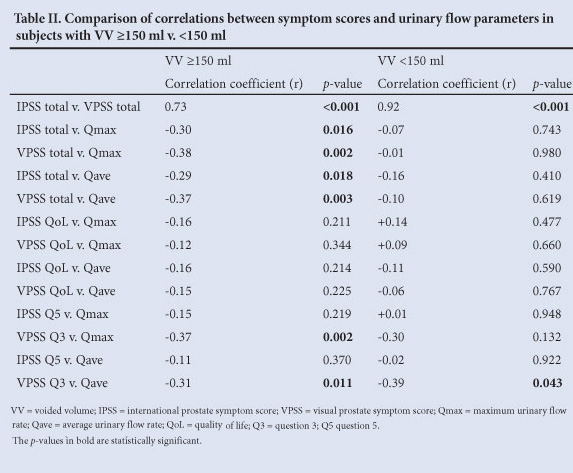
RESULTS: The study included 93 men (mean age 64 years, range 33 -85), with VV >150 ml in 66 (71%) and <150 ml in 27 (29%) subjects. In the group with VV >150 ml there were significant negative correlations between the IPSS and Qmax (r=-0.30, p=0.016), the IPSS and Qave (r=-0.29, p=0.018), the VPSS and Qmax (r=-0.38, p<0.002) and the VPSS and Qave (r=-0.37, p<0.003). The VPSS question on the subject's assessment of his urinary stream showed a significant negative correlation with the Qmax (r=-0.37, p=0.002) and Qave (r=-0.31, p=0.011), but the IPSS question on the subject's urinary stream did not correlate significantly with the Qmax or Qave.
CONCLUSIONS: The VPSS is equivalent to the IPSS in terms of correlation with Qmax and Qave and can therefore be used instead of the IPSS to evaluate LUTS in men with limited education.
The international prostate symptom score (IPSS) is widely used to assess the severity of lower urinary tract symptoms (LUTS) in men with bladder outlet obstruction (BOO) and to evaluate the response to medical or surgical therapy for benign prostatic obstruction (BPO).12-6 Some studies have indicated that, although symptom scores may correlate with certain urodynamic parameters, these parameters do not correlate well with BOO.7
It has been suggested that invasive urodynamic evaluation (pressure-flow study) is indicated to prove that a patient's LUTS are caused by BOO before invasive therapy is selected.81
An important problem with the IPSS is that many patients find it difficult to comprehend. Studies showed that 30 - 70% of men could not complete the IPSS because they found the questions difficult to understand,910
We aimed to evaluate the correlation between the VPSS and IPSS and non-invasive uroflowmetry parameters in men with LUTS.
Patients and methods
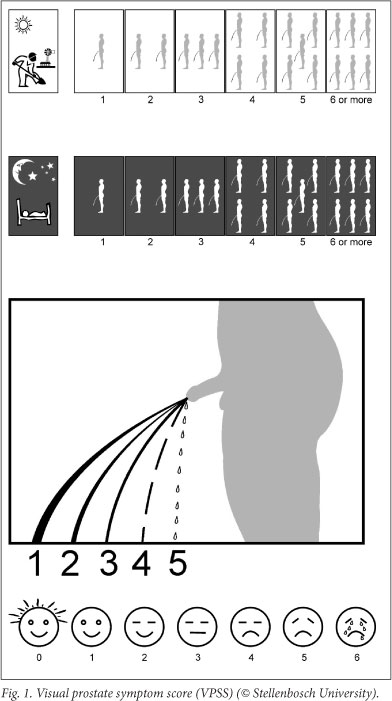
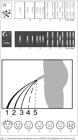
The study was approved by the local institutional human research ethics committee. Men referred with LUTS were requested to complete the IPSS comprising the following questions: Q1 -incomplete emptying, Q2 - frequency, Q3 - intermittency, Q4 -urgency, Q5 - weak stream, Q6 - straining, Q7 - nocturia, Q8 - QoL due to urinary symptoms (maximum score 41). They were also requested to complete the VPSS (Fig. 1) comprising pictograms to evaluate the following questions: Q1 - frequency, Q2 - nocturia, Q3 - force of the urinary stream, Q4 - QoL (maximum score 23). Study subjects who were unable to complete the questionnaires on their own were assisted by a doctor.
A full medical history was obtained and physical examination, digital rectal examination (DRE) and dipstick urine analysis were performed. The Qmax, average urinary flow rate (Qave) and voided volume (VV) were measured using a Urodyn 1000 Plus uroflowmeter, after which the PVR was measured using a Toshiba JustVision 200 ultrasound machine with a 2.3 MHz probe. A single urinary flow measurement was obtained in each subject. Serum creatinine and prostate-specific antigen (PSA) were also assayed.
Statistical analysis was performed using MS Excel and GraphPad Instat software, with the Mann-Whitney test for comparison of means and Spearman's test for correlation analysis. A two-tailed p-value <0.05 was accepted as statistically significant.
Results
During the period August 2009 - August 2010, a total of 96 men were enrolled (mean age 64 years, range 33 - 85). Uroflowmetry was performed in 93 men, with VV >150 ml in 66 (71%) cases and VV <150 ml in 27 (29%). The mean total IPSS was 20.9 (range 1 - 41) and the mean total VPSS was 13.7 (range 4 - 23). On DRE the prostate was clinically benign in 72 (77%) of the men and malignant in 21 (23%). The mean serum creatinine was 107.5 (range 65 - 232) µmol/l and the mean serum PSA was 30.7 (range 0.2 - 1601) ng/ml.
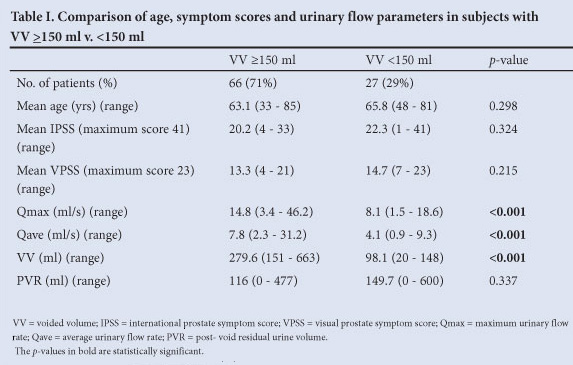
There were no significant differences with regard to age, mean IPSS and mean VPSS in the groups with VV >150 ml or <150 ml (Table I). The correlation between total IPSS and VPSS was statistically significant in both groups, but the correlations between Qmax and Qave versus total IPSS and VPSS, respectively, were only significant in the group with VV >150 ml (Table II). The correlations between Qmax and Qave and the subject's assessment of his urinary stream were statistically significant for the VPSS (Q3) but not the IPSS (Q5) in the group with VV >150 ml but not in the group with VV <150 ml (Table II).
There were statistically significant correlations between age and Qmax (r=-0.22, p=0.039), age and VV (r=-0.32, p=0.001) and age and serum PSA (r=0.21, p=0.042), but not between age and total IPSS, total VPSS, Qave, PVR or serum creatinine.
There were significant correlations between VV and Qmax (r=0.611, p<0.000) as well as Qave (r=0.543, p=0.001), and between PVR and Qmax (r=-0.225, p=0.03) as well as Qave (r=-0.284, p=0.006).
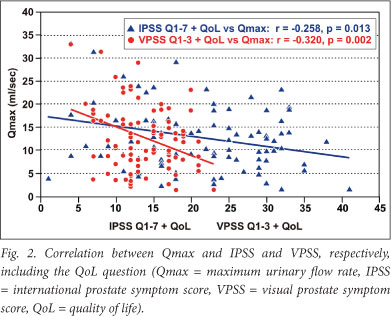
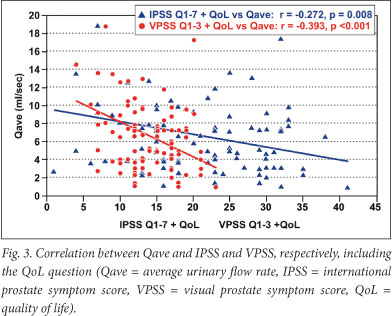
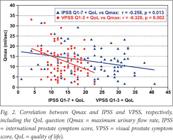
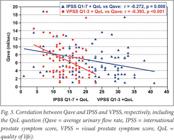
In the study group as a whole, Qmax correlated significantly with total IPSS as well as VPSS (Fig. 2). The correlations between Qave and total IPSS as well as VPSS were also significant in the study group as a whole (Fig. 3).
Discussion
The concept of the VPSS was based on the observation by an author (AEG) that illiterate or poorly educated men found it impossible to complete the IPSS, even with physician assistance. In contrast, patients easily comprehended a simple diagram showing a urinating man, in which the patient can indicate the force of the urinary stream corresponding to his own (Q3 in the VPSS, Fig. 1). However, the validity or reliability of this pictogram was not formally evaluated, and the perception of its usefulness was based on clinical observation only. The VPSS pictograms evaluating daytime urinary frequency, nocturia and QoL and the prospective evaluation protocol were developed by the first two authors and a medical illustrator.
Whereas community-based studies show a positive correlation between patient age and symptom scores evaluating LUTS, in an outpatient setting there may be a negative correlation, because older patients may visit the outpatient department with lower scores than younger patients.5,12 In our study there was no significant correlation between age and total IPSS or VPSS, although there were relatively weak but statistically significant negative correlations with Qmax and VV, and a positive correlation with serum PSA.
The International Consensus Committee on BPH recommended that uroflowmetry data with VV <150 ml should be regarded as unreliable. The proportion of men unable to produce a VV >150 ml during uroflowmetry has been reported as varying from 20% to 5%.5Table II).
Previous studies have evaluated the correlation between symptom scores and uroflowmetry parameters. An analysis of 466 men 40 - 79 years old reported the following Spearman's rank correlation coefficients: American Urological Association symptom index (AUA-SI) v. prostate volume 0.19, prostate volume v. Qmax 0.21, and AUA-SI v. Qmax -0.35 (p<0.001).2127
A study of 196 men reported the following Pearson's correlation coefficients: IPSS v. QoL 0.65 (p<0.001), IPSS v. Qmax -0.12 (not significant), QoL v. Qmax -0.19 (p=0.008), Qmax v. PVR -0.21 (p=0.003), and prostate volume v. Qmax -0.19 (p=0.008).33
In a study of 460 men 41 - 88 years old, Wadie et al.4p=0.04), total IPSS v. Qave 0.16 (p<0.01), obstructive scores v.
Qmax (0.16, p<0.01) and Qave (0.2, p<0.01), and irritative scores v. Qmax and Qave not significant.4466
Our study showed statistically significant correlations of the IPSS v. Qmax (r=-0.28) and Qave (r=-0.29), and of the VPSS v. Qmax (r=-0.42) and Qave (r=-0.41). The correlation coefficients were of similar magnitude to other studies and were slightly higher for the VPSS than the IPSS. The relatively weak correlations could be partly due to using only single-void flow rate measurements in this study.132
It is interesting that in this study there was a relatively strong correlation between total IPSS and VPSS scores in the group with VV >150 ml (0.73) and in the group with VV <150 ml (0.92, p<0.001), even though the correlations between total IPSS and VPSS on the one hand and Qmax and Qave on the other hand were not significant in the group with VV <150 ml (Table II). It is also interesting that the question relating to the force of the urinary stream in the VPSS (Q3) but not in the IPSS (Q5) showed a statistically significant correlation with Qmax and Qave in the group with VV >150 ml (Table II). This correlation was of the same order of magnitude as the correlations of total IPSS and VPSS v. Qmax and Qave (around 0.3), suggesting that Q3 of the VPSS on its own may prove as useful as the complete IPSS or VPSS. However, further study is indicated to confirm these findings.
Conclusions
The VPSS correlates significantly with the IPSS, regardless of VV, and the VPSS is equivalent to the IPSS in terms of correlation with Qmax and Qave in men with LUTS. This indicates that the VPSS can be used instead of the IPSS for the assessment of symptom severity in men with LUTS who are illiterate or have limited education.
Acknowledgements. Carol Lochner, visual artist employed by Stellenbosch University, created the pictograms for the VPSS. The South African Urological Association provided research funding for this project.
References
- 1. Roehrborn CG. BPH progression: concept and key learning from MTOPS, ALTESS, COMBAT, and ALF-ONE. BJU Int 2008;101:suppl 3,17-21.
- 2. Girman CJ, Jacobsen SJ, Guess HA, et al. Natural history of prostatism: relationship among symptoms, prostate volume and peak urinary flow rate. J Urol 1995;153(5):1510-1515.
- 3. Van Venrooij GE, Boon TA. The value of symptom score, quality of life score, maximal urinary flow rate, residual volume and prostate size for the diagnosis of obstructive benign prostatic hyperplasia: a urodynamic analysis. J Urol 1996;155(6):2014-2018.
- 4. Wadie BS, Ibrahim EH, de la Rosette JJ, Gomha MA, Ghoneim MA. The relationship of the International Prostate Symptom Score and objective parameters for diagnosing bladder outlet obstruction. Part I: when statistics fail. J Urol 2001;165(1):32-34.
- 5. Eckhardt MD, van Venrooij GE, Boon TA. Symptoms and quality of life versus age, prostate volume, and urodynamic parameters in 565 strictly selected men with lower urinary tract symptoms suggestive of benign prostatic hyperplasia. Urology 2001;57(4):695-700.
- 6. Seki N, Yunoki T, Tomoda T, Takei M, Yamaguchi A, Naito S. Association among the symptoms, quality of life and urodynamic parameters in patients with improved lower urinary tract symptoms following a transurethral resection of the prostate. Neurourol Urodyn 2008;27(3):222-225.
- 7. Netto Junior NR, D'Ancona CA, de Lima ML. Correlation between the International Prostatic Symptom Score and a pressure-flow study in the evaluation of symptomatic benign prostatic hyperplasia. J Urol 1996;155(1):200-202.
- 8. Abrams P. In support of pressure-flow studies for evaluating men with lower urinary tract symptoms. Urology 1994;44(2):153-155.
- 9. Rodrigues Netto N Jr, de Lima ML, de Andrade EF, et al. Latin American study on patient acceptance of the International Prostate Symptom Score (IPSS) in the evaluation of symptomatic benign prostatic hyperplasia. Urology 1997;49(1):46-49.
- 10. Cam K, Akman Y, Cicekci B, Senel F, Erol A. Mode of administration of international prostate symptom score in patients with lower urinary tract symptoms: physician vs self. Prostate Cancer Prostatic Dis 2004;7(1):41-44.
- 11. Van der Walt CLE, Heyns CF, Groeneveld AE, Edlin RS, van Vuuren SPJ. Prospective comparison of a new visual prostate symptom score versus the international prostate symptom score in men with lower urinary tract symptoms. Urology 2011;78(1):17-20.
- 12. Bosch JL, Hop WC, Kirkels WJ, Schroder FH. The International Prostate Symptom Score in a community-based sample of men between 55 and 74 years of age: prevalence and correlation of symptoms with age, prostate volume, flow rate and residual urine volume. Br J Urol 1995;75(5):622-630.
- 13. Golomb J, Lindner A, Siegel Y, Korczak D. Variability and circadian changes in home uroflowmetry in patients with benign prostatic hyperplasia compared to normal controls. J Urol 1992;147(4):1044-1047.