Validation of a dosing regimen for fixed-dose, weight-adjusted, subcutaneous unfractionated heparin for the acute treatment of venous thrombo-embolism in a population from a resource-constrained environment
Background
VTE is a potentially fatal disorder manifesting as deep-vein thrombosis (DVT) and pulmonary embolism (PE).123
Kearon et al. performed a randomised, open-label, adjudicator-blinded trial (FIDO) suggesting that fixed-dose, weight-adjusted SC UFH, without PTT monitoring, appeared as effective and safe as fixed-dosed, unmonitored SC LMWH in patients with acute VTE.445
Although the use of LWMH is established, the considerably less costly approach of fixed-dose, weight-adjusted, SC UFH is appealing in a resource-constrained setting. However, there appears to be no published evidence to indicate that this regimen has been validated locally in patients who differ from those in the FIDO study in age, weight, and presence of multiple co-morbidities.
Methods
The protocol was approved by the East London Hospital Complex Research and Ethics Committee. The sample size was based on a previous study that looked at optimal dosing of SC UFH for the treatment of DVT.6 >18 years; newly diagnosed VTE) admitted between November 2008 and February 2009 to internal medicine wards at Cecilia Makiwane Hospital and who had been prescribed SC UFH according to the FIDO study. All other aspects of care were delivered as standard of care. The primary measure of interest was the proportion of patients with a therapeutic PTT (patient PTT 1.5 - 2.5 times the control value) measured approximately 6 hours after the morning dose of UFH on any day from the 2nd to the 6th day of SC UFH therapy as in the FIDO regimen. Neither safety nor efficacy of patient outcomes were collected as the sample size was chosen only to validate the published dosing regimen.
Results
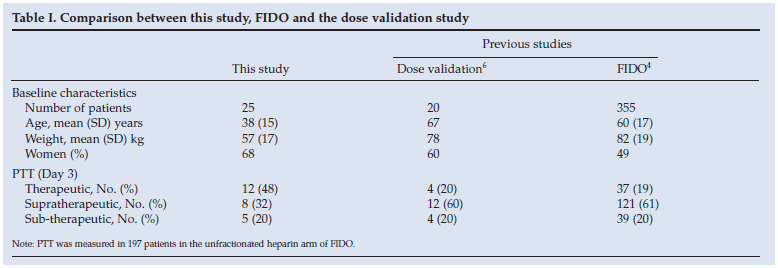
A total of 25 inpatients were recruited of whom 24 had acute DVT confirmed on Doppler ultrasound, and one had clinical evidence of PE and a strongly positive d-dimer result. The mean age of the patients was 37.6 years (SD 15.03); mean body weight 57.2 kg (SD 16.79) and 68% were female (Table I). Pulmonary tuberculosis was the most prevalent concomitant disease (64%). The mean loading and maintenance doses of UFH were 320 units/kg (SD 66.87) and 250 units/kg (SD 5.57) respectively. PTT was measured on a single blood sample obtained a mean of 6.0 hours (SD 0.37) after the morning dose and a mean of 3.48 days (SD 0.92) after starting SC UFH. Twelve (48%) of the 25 patients had a PTT within the therapeutic range, 8 (32%) patients were found to have a supratherapeutic PTT (patient value >2.5 times control value) and 5 (20%) had a sub-therapeutic PTT (patient value <1.5 times control value). The mean PTT ratio (PTT patient/PTT control) was 2.44 (SD 1.40; 95% CI 1.89 to 2.99). The mean duration of heparin therapy was 8.5 days (SD 3.39).
Discussion
Baseline characteristics of patients in this study including gender, age and weight differed from the SC UFH treatment arm in FIDO (Table I). There were relatively more women than men (68% versus 49% in FIDO) and the mean ages and weights were less (38 years v. 60 years and 57 kg v. 82 kg).
None of our patients had previous VTE, compared with 11% of patients in the SC UFH group in FIDO. Sixteen patients were diagnosed with DVT and concomitant tuberculosis but none in the SC UFH group in FIDO.
In FIDO, the PTT (therapeutic PTT: 60 -85 seconds) was measured in 197 patients, a mean of 6.0 hours after the morning dose and a mean of 2.8 days after starting UFH.44
Conclusion
In a small but real-world pragmatic study, the use of a weight-based dosing nomogram appeared feasible, and PTT results obtained were within the range achieved in a previous large trial comparing LMWH with fixed-dose, weight-based SC UFH. Our study provides preliminary support for the local generalisability of the FIDO dosing model, offering a promising alternative for the treatment of VTE in a resourceconstrained environment.
References
- 1. Haines ST, Zeolla M, Witt DM. Venous thromboembolism. In: Dipiro JT, Talbert RL, Yee GC, Matzke GR, Wells BG, Posey LM, eds. Pharmacotherapy: A Pathophysiologic Approach. 7th ed. Columbus, OH: McGraw-Hill Companies, 2008: 331-371.
- 2. Raschke RA, Reilly BM, Guidry JR, Fontana JR, Srinivas S. The weight-based heparin dosing nomogram compared with a "standard care" nomogram. Ann Intern Med 1993; 119: 874-881.
- 3. Van Dongen CJ, van den Belt AGM, Prins MH, Lensing AWA. Fixed dose subcutaneous low molecular weight heparins versus adjusted dose unfractionated heparin for venous thromboembolism. Cochrane Database of Systematic Reviews 2004, Issue 4. Art. No.: CD001100. DOI: 10.1002/14651858.CD001100.pub2.
- 4. Kearon C, Ginsberg JS, Julian JA, et al. Comparison of fixed-dose weight-adjusted unfractionated heparin and low-molecular weight heparin for acute treatment of venous thromboembolism. JAMA 2006; 296: 935-942.
- 5. Vardi M, Zittan E, Bitterman H. Subcutaneous unfractionated heparin for the initial treatment of venous thromboembolism. Cochrane Database of Systematic Reviews 2009, Issue 4. Art. No.: CD006771. DOI: 10.1002/14651858.CD006771.pub2.
- 6. Kearon C, Harrison L, Crowther M, Ginsberg JS. Optimal dosing of subcutaneous unfractionated heparin for the treatment of deep vein thrombosis. Thromb Res 2000; 97: 395-403.