Going where the data are: Connecting to Trello for daily statistics in the COVID-19 era and beyond
To the Editor: South African (SA) hospitals have had to repeatedly escalate and de-escalate services in response to three successive waves of COVID-19 infections.[1] While these measures ensure capacity to respond to the pandemic, they come at the expense of other services.[2] Up-to-date statistics are required by hospital management to timeously divert adequate resources to the COVID-19 response at times of crisis, while not unnecessarily constraining other services.
Trello (Atlassian, Australia) is a web-and application-based project management tool that displays all activities in a single landscape, called a board, visible to all members of the team.[3] It has gained traction in the SA healthcare setting, used by inpatient teams to track bed locations and co-ordinate care of patients spread throughout their hospitals. Ntshalintshali and Mnqwazi[4] previously described how we repurposed Trello to keep track of COVID-19 patients at our institution. We were retrospectively able to export these data and plot the impact of the pandemic at our institution on a day-by-day basis.[5] Trello was similarly used at other institutions.[6]
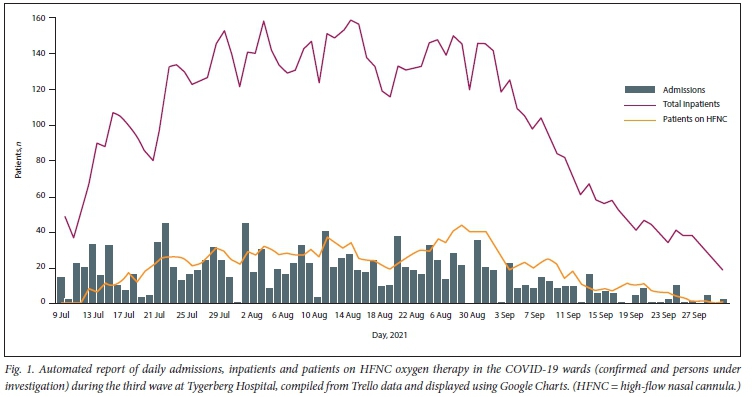
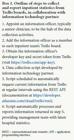
Trello makes a representational state transfer (REST) application programming interlace (API) available to software developers.[7] A REST API is a set of standards governing the transfer of information between different software or websites, in this case allowing the secure transfer of data from a Trello board to an authorised user. We were able to use this facility to collect and aggregate data from the Trello boards of all COVID-19 teams in real time and in an automated manner. As teams necessarily update these boards in the normal course of their ward rounds, we were able to automatically collect and compile the latest COVID-19 statistics at our institution and generate reports, such as trends in daily admissions, total inpatients, number of patients requiring high-flow nasal cannula oxygen therapy (Fig. 1) and outcomes, without the need for any dedicated data-capturing activities or extra work on the part of clinicians. Data capturing was therefore adapted to the clinician, rather than requiring the opposite. A detailed discussion of the technical aspects of this solution is beyond the scope of this letter, but we have summarised the key steps in Box 1.
Having up-to-date information on hospital-specific COVID-19 trends proved vitally important in making managerial decisions and, in conversation with the wider hospital, to ensure that resources were redirected as needed.
Institutions and individuals making use of Trello must be wary of potential pitfalls and consider the Protection of Personal Information Act.[8] In our experience, specific issues include incorrectly setting board visibility to 'Public' rather than 'Private', allowing stored patient information to be found on search engines and accessible by anyone on the internet, and temporary team members not leaving the Trello board once they rotate out. These problems should be audited regularly.
Healthcare workers may not be the most 'tech-sawy', and digital solutions such as the one we implemented may seem daunting or impossible. However, we should never forget that we do not operate in isolation. Many tertiary academic hospitals are part of a wider university community where the necessary skills are readily available, even at undergraduate level. We owe it to ourselves, our patients and our colleagues to look beyond our silo at emerging technologies that can benefit our field, and build bridges to promote intersectoral collaboration. The fruits of such projects will not only help us to respond more effectively to the current COVID-19 pandemic, but will be of benefit for many years to come.
Muhammad Saadiq Moolla, Sa'ad Lahri, Arifa Parker, Neshaad Schrueder
Division of General Medicine, Department of Medicine, Faculty of Medicine and Health Sciences, Stellenbosch University and Tygerberg Hospital, Cape Town, South Africa saadiq.
References
-
1. Parker A, Karamchand S, Schrueder N et al. Leadership and early strategic response to the SARS-CoV-2 pandemic at a COVID-19 designated hospital in South Africa. S Afr Med J 2020;110(10):463-465. https://doi.org/10.7196/SAMJ.2020.vll0i6.14809
» https://doi.org/10.7196/SAMJ.2020.vll0i6.14809 -
2. Laas DJ, Farina Z, Bishop DG. Effect of COVID-19 pandemic decisions on tertiary-level surgical services in Pietermaritzburg, KwaZulu-Natal Province, South Africa. S Afr Med J 2021;111(2):120-123. https://doi.org/10.7196/SAMJ.2021.v111i2.15332
» https://doi.org/10.7196/SAMJ.2021.v111i2.15332 -
3. Johnson HA. Trello. J Med Libr Assoc 2017;105(2):209-211. https://doi.org/10.5195/JMLA.2016.4S
» https://doi.org/10.5195/JMLA.2016.4S -
4. Ntshalintshali SD, Mnqwazi C. Affordable digital innovation to reduce SARS-CoV-2 transmission among healthcare workers. S Afr Med J 2020;110(7):605-606. https://doi.org/10.7196/SAMJ.2020.V11017.14879
» https://doi.org/10.7196/SAMJ.2020.V11017.14879 -
5. Parker A, Koegelenberg CF, Moolla M, et al. High HIV prevalence in an early cohort of hospital admissions with COVID-19 in Cape Town, South Africa. S Afr Med J 2020;110(10):982-987. https://doi.org/10.7196/SAMJ.2020.v110i10.15067
» https://doi.org/10.7196/SAMJ.2020.v110i10.15067 -
6. Mendelson M, Booyens L, Boutall A, et al The mechanics of setting up a COVID-19 response. Experiences of the COVID-19 epidemicfrom Groóte Schuur Hospital, Cape Town, South Africa. S Afr Med J 2020;110(10):968-972. https://doi.org/10.7196/SAMJ.2020.v110i10.15215
» https://doi.org/10.7196/SAMJ.2020.v110i10.15215 -
7. Atlassian Developer. 2021. The Trello REST API. 2021. https://developer.atlassian.com/cloud/trello/rest (accessed 13 September 2021).
» https://developer.atlassian.com/cloud/trello/rest -
8. South Africa Protection of Personal Information Act No. 4 of 2013. https://www.gov.za/sites/default/files/gcis_document/201409/3706726-11act4of2013protectionofpersonalinforcorrect.pdf (accessed 13 September 2021).
» https://www.gov.za/sites/default/files/gcis_document/201409/3706726-11act4of2013protectionofpersonalinforcorrect.pdf