Clinically significant anaerobic bacteria isolated from patients in a South African academic hospital: antimicrobial susceptibility testing
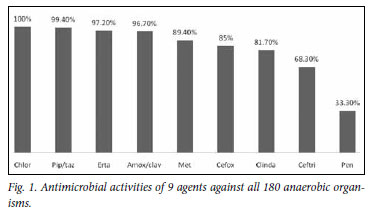
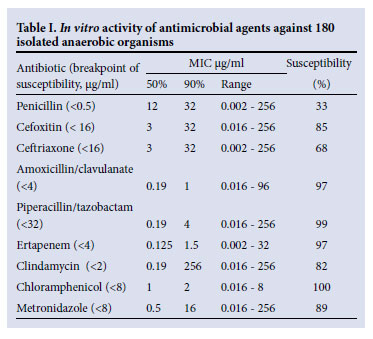
BACKGROUND: Increasing resistance to some antimicrobial agents among anaerobic bacteria has made susceptibility patterns less predictable. METHOD: This was a prospective study of the susceptibility data of anaerobic organisms isolated from clinical specimens from patients with suspected anaerobic infections from June 2005 until February 2007. Specimens were submitted to the microbiology laboratory at Charlotte Maxeke Johannesburg Academic Hospital, where microscopy, culture and susceptibility testing were performed the using E test® strip minimum inhibitory concentration method. Results were interpreted with reference to Clinical and Laboratory Standards Institute guidelines for amoxicillin-clavulanate, clindamycin, metronidazole, penicillin, ertapenem, cefoxitin, ceftriaxone, chloramphenicol and piperacillin-tazobactam. RESULTS: One hundred and eighty anaerobic isolates were submitted from 165 patients. The most active antimicrobial agents were chloramphenicol (100% susceptible), ertapenem (97.2%), piperacillin-tazobactam (99.4%) and amoxicillin-clavulanic acid (96.7%). Less active were metronidazole (89.4%), cefoxitin (85%), clindamycin (81.7%), ceftriaxone (68.3%) and penicillin (33.3%). CONCLUSION: Susceptibility testing should be performed periodically to identify emerging trends in resistance and to modify empirical treatment of anaerobic infections.
SAMJ: South African Medical Journal
 Thumbnail