The association between reproductive hormones and asthma-related outcomes in boys in the rural Western Cape Province, South Africa
BACKGROUND. Asthma is more prevalent and severe among boys than girls, but this pattern reverses after puberty. It has been suggested that reproductive hormones may play a role in explaining these sex differences after puberty. However, the evidence for this relationship remains limited, as there have been no previous studies conducted on children in low- and middle-income countries on several reproductive endocrine hormones. OBJECTIVE. To investigate the association between reproductive endocrine hormones and asthma-related outcomes among boys residing in a rural setting. METHODS. Data on asthma outcomes and hormone levels were analysed from a cross-sectional study of 314 boys (aged 6 - 18 years) in the rural Western Cape Province, South Africa (SA). These were collected using an abbreviated International Study of Asthma and Allergies in Childhood questionnaire. Testosterone (total serum testosterone (TST) and free testosterone (FT)), luteinising hormone (LH), serum follicle-stimulating hormone (FSH), oestradiol and serum hormone-binding globulin (SHBG) were assessed using electrochemiluminescence immunoassays. RESULTS. Current wheezing (CW), asthma symptom score >2 and parental-reported asthma (PA) prevalence were 6.1%, 6.7% and 8.0%, respectively. Multivariate analysis showed that increasing levels of detected TST were significantly negatively associated with CW (odds ratio (OR) 0.66, 95% confidence interval (CI) 0.45 - 0.98) and asthma symptom score (OR 0.64, 95% CI 0.43 - 0.95), while no statistically significant association was observed for PA (OR 0.86, 95% CI 0.59 - 1.25). FT levels showed an inverse association with all asthma-related outcomes, with a statistically significant association with asthma symptom score. Similar associations were found for FSH, while associations with LH were less consistent across outcomes, and no association was observed for oestradiol and SHBG. CONCLUSION. Our findings suggest that increasing serum testosterone levels (including those in the normal range and those above the normal range) detected among boys from rural settings in the Western Cape Province, SA, are associated with a reduced risk of asthma after adjusting for important underlying risk factors.
asthma; sex disparities; boys; reproductive hormones; testosterone; rural settings
The association between reproductive hormones and asthma-related outcomes in boys in the rural Western Cape Province, South Africa
M S PhutiI, II; M A DalvieIII; T OlaniyanIII; W BaseraII; M F JeebhayIV, V
IMPH; Environmental Health Division, School of Public Health, University of Cape Town, South Africa
IIMPH; Centre for Environmental and Occupational Health Research, School of Public Health, University of Cape Town, South Africa
IIIPhD; Centre for Environmental and Occupational Health Research, School of Public Health, University of Cape Town, South Africa
IVMB ChB, PhD; Centre for Environmental and Occupational Health Research, School of Public Health, University of Cape Town, South Africa
VMB ChB, PhD; Occupational Medicine Division, School of Public Health, University of Cape Town, South Africa
BACKGROUND. Asthma is more prevalent and severe among boys than girls, but this pattern reverses after puberty. It has been suggested that reproductive hormones may play a role in explaining these sex differences after puberty. However, the evidence for this relationship remains limited, as there have been no previous studies conducted on children in low- and middle-income countries on several reproductive endocrine hormones.
OBJECTIVE. To investigate the association between reproductive endocrine hormones and asthma-related outcomes among boys residing in a rural setting.
METHODS. Data on asthma outcomes and hormone levels were analysed from a cross-sectional study of 314 boys (aged 6 - 18 years) in the rural Western Cape Province, South Africa (SA). These were collected using an abbreviated International Study of Asthma and Allergies in Childhood questionnaire. Testosterone (total serum testosterone (TST) and free testosterone (FT)), luteinising hormone (LH), serum follicle-stimulating hormone (FSH), oestradiol and serum hormone-binding globulin (SHBG) were assessed using electrochemiluminescence immunoassays.
RESULTS. Current wheezing (CW), asthma symptom score >2 and parental-reported asthma (PA) prevalence were 6.1%, 6.7% and 8.0%, respectively. Multivariate analysis showed that increasing levels of detected TST were significantly negatively associated with CW (odds ratio (OR) 0.66, 95% confidence interval (CI) 0.45 - 0.98) and asthma symptom score (OR 0.64, 95% CI 0.43 - 0.95), while no statistically significant association was observed for PA (OR 0.86, 95% CI 0.59 - 1.25). FT levels showed an inverse association with all asthma-related outcomes, with a statistically significant association with asthma symptom score. Similar associations were found for FSH, while associations with LH were less consistent across outcomes, and no association was observed for oestradiol and SHBG.
CONCLUSION. Our findings suggest that increasing serum testosterone levels (including those in the normal range and those above the normal range) detected among boys from rural settings in the Western Cape Province, SA, are associated with a reduced risk of asthma after adjusting for important underlying risk factors.
Keywords: asthma, sex disparities, boys, reproductive hormones, testosterone, rural settings
Previous studies have shown that there are sex differences in asthma prevalence among children, and that these differences change over time.[1,2] Boys are twice as likely to develop asthma as girls of a similar age before puberty,[3] but this reverses after puberty, with asthma prevalence then higher in girls.[1,4] This increased asthma prevalence in the latter group after puberty has been partly attributed to reproductive hormones, which affect asthma pathophysiological mechanisms,[5] although these are not well understood.
Limited epidemiological studies on the association between reproductive hormones and asthma, mostly among adults in high-income settings, have found that increased levels of androgens, such as testosterone, were associated with reduced asthma symptoms in both males and females.[1,5-9] Laboratory studies have shown that androgens decrease adaptive and innate immunological responses, while progesterone and oestrogen may enhance Th2 allergic inflammation of the airways in asthma.[10] Additionally, serum hormone-binding globulin (SHBG), a major regulator of androgens and oestrogen, has been found to have asthma-protective effects.[9]
Overall, there is limited evidence on the relationship between reproductive hormones and asthma among children living in low- and middle-income countries, since various underlying susceptibility and multiple environmental risk factors play a significant role in asthma. This study sought to investigate the association between reproductive endocrine markers (testosterone, luteinising hormone (LH), follicle-stimulating hormone (FSH), oestradiol and sex hormone-binding globulin SHBG, which are all part of the pituitary-gonadal axis) and asthma-related outcomes in young boys residing in a rural setting in South Africa (SA).
Methods
Study design and population
This study is a sub-analysis of data collected from the Child Health Agricultural Pesticide Cohort Study in SA (CapSA), which includes 1 002 boys and girls residing in the rural Western Cape Province (the study areas were Piketberg, Grabouw and Hex River Valley), and which mainly investigated reproductive and neurobehavioural health effects associated with pesticide exposure. The full protocol of the main study, in which recruitment and the baseline study on children were conducted in 2017, and the follow-up study in 2019, is described elsewhere.[11] During the baseline and follow-up studies, children underwent testing at schools, including the collection of blood samples from only male participants (funding was available to include adequate sample size for one sex only) and anthropometric measurements. In the period between 2017 and 2019, the guardians of 670 children were administered a questionnaire including sections on asthma-related outcomes and other details of their children. The current sub-study is a cross-sectional analysis of data collected from boys (n=314) aged 6 - 18 years who participated in the baseline study and whose caregivers responded to the home-based survey. Inclusion was limited to boys within this age range, and boys >18 years old were excluded.
Schools in the three study areas formed the sampling frame in the main study. Only primary, intermediate and combined schools were considered (n=32) to avoid a loss to follow-up due to children leaving high school. Seven schools were selected, after contacting the principals and governing bodies of the most accessible but representative schools. The parents or guardians of all children in grades 2 - 9 at the schools were sent information sheets about the research and the role of the school, along with permission letters. All parents or guardians who responded positively to the study invitation were visited at their homes to obtain consent. Participants were then selected to obtain an approximately equal number of children by area, age, sex and residence (those living on farms v. those in the nearby town). Stratified random sampling was used to select the children where the number of consenting parents or guardians exceeded the number of children targeted for a particular category.
Data collection
Standardised questionnaires were administered to parents or guardians through home visits (during 2017 - 2019) conducted by trained interviewers to record information on the children's sociodemographic factors, general health status and presence of allergy and asthma-related symptoms, using an abbreviated version of the International Study of Asthma and Allergies in Childhood (ISAAC) questionnaire. The Open Data Kit application was used to capture interview information using mobile devices.
A qualified nurse collected early morning whole blood samples (5 mL) from boys at schools during the baseline study in 2017, and sent these for analysis within 24 hours to Groote Schuur Hospital's National Health Laboratory Service laboratory in Cape Town. Serum reproductive hormones measured were testosterone, LH, FSH, oestradiol and SHBG, using electrochemiluminescence immunoassays on a Cobas e601 module of the Modular Analytics E170 Roche system. Free testosterone (FT) was determined as the testosterone/SHBG ratio. The following laboratory reference values were used in the descriptive statistics: total serum testosterone (TST) normal = 2.49 - 30.6 nmol/L); LH normal = <0.1 - 4.0 IU/L; FSH normal = <0.1-8.6 IU/l; oestradiol = <20 - 40 pg/mL); SHBG = 6 - 45 nmol/L).[12,13]
Measures
The three main asthma-related outcome variables were: (i) parental-reported asthma, defined as a positive response to the question 'Has your child ever had asthma?'; (ii) current wheezing, defined as having had wheezing or whistling in the chest in the past 12 months; and (iii) asthma symptom score >2, a binary indicator (>2 symptoms v. 0 - 1 symptom) computed by the sum of answers to four questions on asthma-related symptoms reported in the past 12 months. These were: 'How often, on average, has your child's sleep been disturbed owing to wheezing?'; 'Has your child's chest sounded wheezy during or after exercise?'; 'Has the wheezing ever been serious enough to limit your child's speech to only one or two words at a time between breaths?'; and 'How many attacks of wheezing has the child had in the past 12 months?'.[14]
The independent variables were all continuous variables, including serum concentrations of hormones and SHBG. Serum total testosterone concentrations were interpreted using age-based reference ranges. In the absence of Tanner staging, we used age categories as a proxy for pubertal stage: <10 years (prepubertal), 10 - <11 years (early puberty), 12 - <13 years (mid-puberty), 14 years (late puberty) and >14 years (advanced puberty). These age categories were derived from the literature, including the Roche Elecsys assay guidelines. Testosterone values reported as below the limit of detection (i.e. <0.1) were substituted using the standard method of level of detection (LOD)/√2 (0.071 nmol/L). Based on these age groups, testosterone concentrations were categorised as within, below, or above the expected range for each developmental stage. The confounders were age, body mass index (BMI), history of allergy or family history of allergy (as a marker for atopy), passive smoking, current smoker (child), previous history of lung disease, low birthweight, fetal alcohol syndrome and living on a farm (pesticide exposure).
Statistical analysis
Data were analysed using R software (version 4.0.3, 2020 (R Foundation for Statistical Computing, Austria)). Hormone values below the level of detection (LOD) were converted using the formula LOD/√2. Testosterone was described using categorical age-based groups for descriptive summaries; however, due to the skewness of the data, each hormone was analysed as a continuous variable (log-transformed) in the regression model analysis. Multivariate logistic regression modelling was used to assess the associations between asthma-related outcomes and the various endocrine variables. The first multivariate model (model (a)) was adjusted for confounders that were statistically significant in the bivariate analysis (p<0.05). The second model (model (b)) adjusted for all the covariates used in model (a), in addition to other known a priori confounders such as BMI, whether the child was currently a smoker and family history of allergy. Concentration-response curves for the association between the log-transformed sex hormone levels and asthma-related outcomes were assessed using the lowest measured hormone level in the data as the counterfactual (i.e. the theoretical minimum). A sensitivity analysis was done of asthma-related outcomes and hormone concentrations that were dichotomised at the 75th percentile.
Ethical approval
This study was carried out according to the Declaration of Helsinki.[15] The University of Cape Town's Health Sciences Human Research Ethics Committee approved the main study (ref. no. 234/2009) and this sub-study (ref. no. 722/2021). The Department of Education also approved the study in schools. Consent to participate in the study was sought from the school principals and parents or guardians, and assent from the respective children.
Results
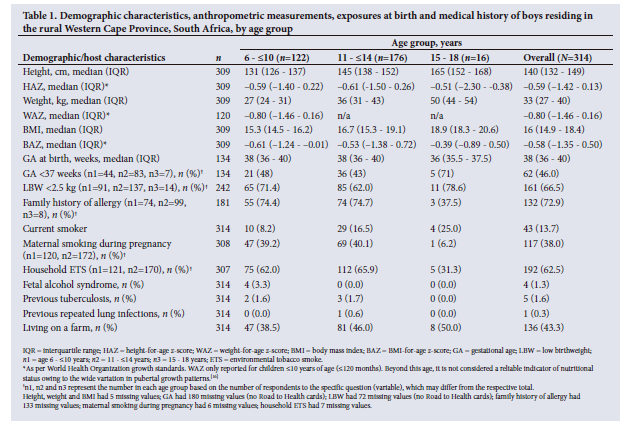
A total of 314 boys aged between 6 and 18 years, from the original cohort of 470 boys who enrolled in the main study, were included, as they had complete data on asthma outcomes and hormone levels. Their mean (standard deviation) age was 11.2 (1.71) years. There were no substantial differences between the participants selected and those excluded from the analysis with regard to demographic characteristics such as age and weight. More than half of the participants had low birthweight, and 73% reported a family history of allergy, with the latter prevalence being higher in the two younger age group categories. About a quarter of the boys in the older age group were current smokers. More than a third (38%) of mothers reported smoking during pregnancy. Almost half of the participants lived on a farm (Table 1).
Asthma outcomes and hormonal profiles by age group
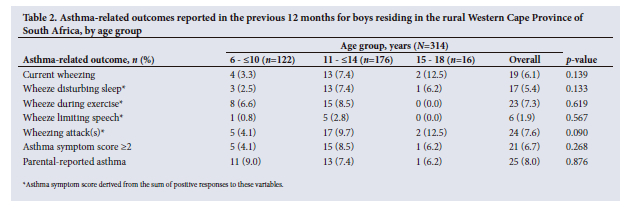
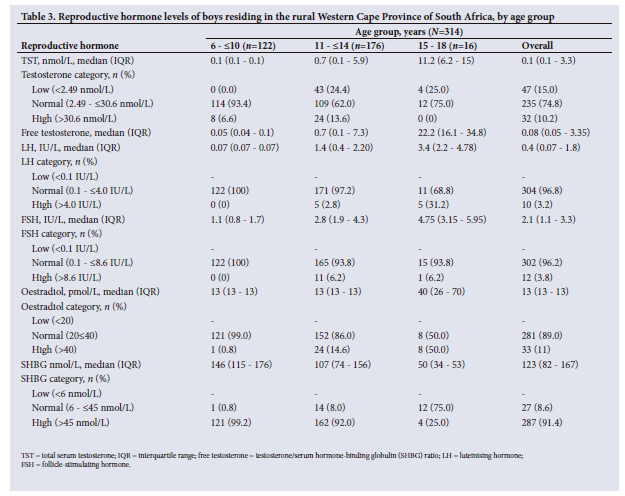
The prevalence of current wheezing, wheezing attacks and asthma symptom score >2 was higher in the two older age groups than the younger group (Table 2). However, parental-reported asthma (8%) was highest in the youngest age group. As expected, FSH, LH, FT and TST hormone levels increased across age group categories (Table 3 and Appendix Figs S1 - S3). Overall, most participants had higher-than-normal levels of SHBG (91%), whereas only a small fraction exhibited higher-than-normal levels of other hormones: 11% for oestradiol and 10.2% for testosterone, and even lower for LH and FSH, at only 3.2% and 3.8%, respectively. All measured hormone levels were positively correlated with each other and negatively correlated with SHBG (Appendix Table S1).
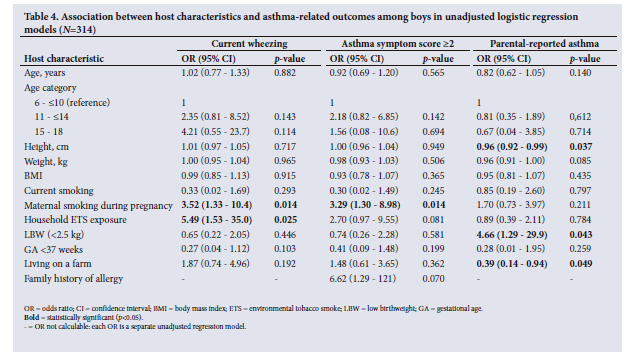
The relationship between host factors and asthma-related outcomes (Table 4) showed that maternal smoking during pregnancy was positively associated with current wheezing (OR 3.52; 95% CI 1.33 - 10.4; p=0.014) and asthma symptom score >2 (OR 3.29; 95% CI 1.30 - 8.98; p=0.014), while exposure to environmental tobacco smoke in the home was significantly associated with current wheezing (OR 5.49; 95% CI 1.53 - 35.0; p=0.025). Living on a farm was associated with reduced odds of parental-reported asthma (OR 0.39; 95% CI 0.14 - 0.94; p=0.049).
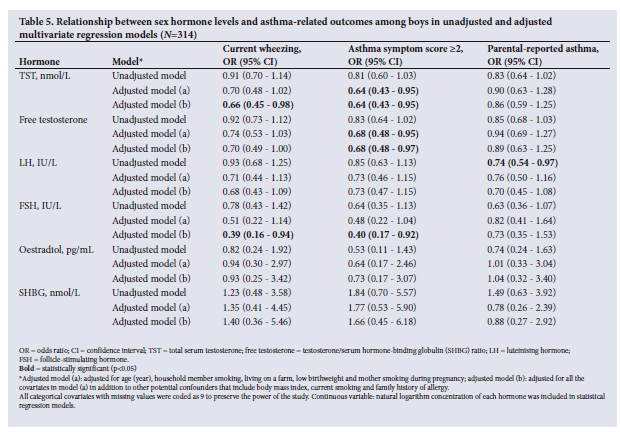
In the unadjusted simple logistic regression models, there was a negative association between LH and parental-reported asthma (OR 0.74; 95% CI 0.54 - 0.97), but no other associations between asthma outcomes and other endocrine levels were observed (Table 5). In multivariate models adjusting for relevant covariates (adjusted model (b)), higher TST levels were significantly associated with reduced odds of current wheezing (OR 0.66; 95% CI 0.45 -0.98) and asthma symptom score >2 (OR 0.64; 95% CI 0.43 - 0.95), but not with parental-reported asthma (OR 0.86; 95% CI 0.59 - 1.25). However, the inverse trend observed was consistent with other asthma-related outcomes.
Furthermore, FT was also negatively associated with asthma symptom score >2 (OR 0.68; 95% CI 0.48 - 0.97) in the adjusted model (b), although the association with current wheezing and parental-reported asthma was not statistically significant. LH was inversely associated with parental-reported asthma in unadjusted analysis (OR 0.74; 95% CI 0.54 - 0.97), but this association did not persist after adjustment. FSH was also negatively associated with current wheezing (OR 0.39; 95% CI 0.16 - 0.94) and asthma symptom score >2 (OR 0.40; 95% CI 0.17 - 0.92) in the fully adjusted model. There were no clear associations for oestradiol. Although not statistically significant, an increase in SHBG was associated with increased odds of current wheezing and asthma symptom score >2, but with reduced odds of parental-reported asthma.
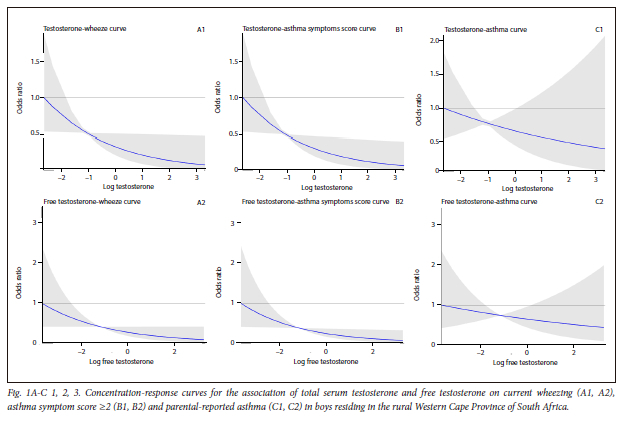
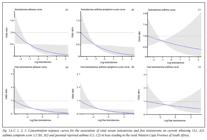
The concentration-response curves for the association with testosterone (Fig. 1) further demonstrated that relatively higher levels of testosterone in comparison with the theoretical minimum (i.e. the lowest measured levels) were associated with reduced odds of current wheezing, asthma symptom score >2 and parental-reported asthma. A sensitivity analysis of asthma-related outcomes and hormone concentrations dichotomised at the 75th percentile (Appendix Table S2), and another based on the hormone categorisation (low, normal, or high), both produced similar but weaker associations.
Discussion
This study demonstrated that increasing detected levels of TST and FT among boys in a rural SA setting are associated with reduced odds of asthma-related outcomes, after accounting for important covariates relevant to their socioeconomic and geographical setting. These findings provide further insight into the underlying susceptibility and risk factors for asthma in children. The prevalence of parental-reported asthma (8.0%) in this study was on the upper end of the range of earlier asthma prevalence studies reported in children in African settings,[17,18] but lower (6.1%) than in earlier SA studies conducted in urban and peri-urban areas.[19-21]
Living on a farm was associated with increased odds of asthma-related outcomes (current wheezing and asthma symptom score), suggesting that these symptoms may be related to increased pesticide exposure, as has been reported elsewhere.[22] By contrast, the study also showed reduced odds of parental-reported asthma, as has been found in different studies where living on a farm has a protective effect for asthma. In the present study, maternal smoking during pregnancy, exposure to environmental tobacco smoke in the household and low birthweight were associated with an increased likelihood of asthma-related outcomes, which is consistent with the reported literature.[22-25] There is a possibility of reporting bias, which could be related to parental underreporting of asthma, either due to differential health-seeking behaviours of low-income parents or a lack of recognition of asthma symptoms by these parents that may warrant a doctor's (or clinic) visit for their child.[19,26]
The negative associations observed between TST and FT concentrations and asthma-related outcomes, as demonstrated by concentration-response curves in this study, suggest that testosterone has a protective effect for asthma.[3,27] These findings are consistent with previous studies of mostly adults conducted in other settings.[6,7] Furthermore, a US study of children aged 6 - 18 years[6] found that increasing androgen levels in males were associated with improved lung function and asthma symptom control score (ACQ6, similar to the asthma symptom score computed in the current study). Similarly, a study of British children reported that increased TST and FT levels in children >11.8 years were associated with reduced odds of asthma.[9] Other studies have shown inconsistent results.[1] The findings of the present study are supported by laboratory-based studies by Fuseini et al.,[27] which showed that airway inflammation caused by Th2 cells in mice can be reduced by androgen receptor signalling.
Weak negative associations of FSH and LH levels with asthma-related outcomes observed in the present study may be explained by their positive correlation with testosterone, since both hormones are released before testosterone in the male gonadal-pituitary axis.[28,29] The lack of statistically significant associations between asthma outcomes and oestradiol levels in this study may be due to the low detectability (18%) and high variability of the hormone in the study sample, or to other unmeasured confounding factors. Contrasting results have also been reported on the association between serum oestradiol and asthma.[8] A notable finding in our study was the high prevalence (91%) of elevated SHBG levels. SHBG concentrations are influenced by factors such as low BMI (as found in this study), high physical activity and reduced insulin levels, which may be more common in rural populations.[30,31] Additionally, exposure to endocrine-disrupting pesticides applied on farms may upregulate SHBG production by affecting hepatic function.[32,33] In general, there is scant evidence on the effect of circulating SHBG on asthma. In this study, no statistically significant associations were observed between SHBG and any of the asthma-related outcomes.
Study limitations
This study has a few limitations. One of these was that hormone concentrations were only available for boys, which limited the exploration of associations common to both sexes. Since this arm of the study was cross-sectional in nature, temporality could not be evaluated, which may limit causal inference. Additionally, hormone levels and asthma symptoms may both fluctuate with pubertal development. The cross-sectional design cannot account for this dynamic interplay. Asthma-related outcomes were based solely on caregiver-reported symptoms, without other objective measures of lung function and airway inflammation evaluated to provide further specificity to the outcomes, limiting diagnostic accuracy.
Although age was adjusted for, additional adjustment for the Tanner stage of children would have strengthened the analysis, since most hormonal level changes are more closely related to pubertal stage than age alone.[34] Furthermore, the small sample size in the 15 - 18-year-old group (n=16) may have reduced statistical power for age-stratified analyses, and limits generalisability to older adolescents. Moreover, there is potential for unmeasured confounding by other pubertal or age-related factors that were not accounted for. Finally, while potential selection bias was possible owing to lack of participation of the entire cohort in the study, given the sensitivity analysis findings, it is unlikely that it played a major role.
Conclusion
This study found that increasing serum testosterone levels (including those in the normal range and those above the normal range) detected among boys from rural settings in the Western Cape Province of SA are associated with a reduced risk of asthma-related outcomes, after adjusting for important underlying risk factors. While weaker evidence suggesting a negative association between asthma-related outcomes and either FSH or LH was present, no evidence was present for oestradiol and SHBG. Since differences in sex hormone levels can affect the phenotypic manifestation of asthma in boys and girls, further studies are needed to investigate the factors that may contribute to endocrine function. These could include asthma pharmacotherapeutic medications, as well as environmental factors such as phthalates and pesticides. Furthermore, the incorporation of additional objective measures of asthma to further understand these associations, particularly among children of both sexes residing in rural low-income settings, would contribute to the body of evidence.
Data availability. The data supporting the findings of this study are available from the corresponding author upon reasonable request.
Declaration. This study was conducted as part of the requirements for MSP's degree of Master of Public Health (Environmental Health) at the University of Cape Town.
Acknowledgements. The contribution of all fieldworkers is hereby acknowledged.
Author contributions. MSP was involved in the data analysis and preparation of the original draft of the manuscript. MFJ and MAD, as supervisors, were involved in the conceptualisation of the study and oversaw the writing of the manuscript. Aside from contributing to earlier drafts of the manuscript, TO was involved in the statistical analysis and WB in the data collection. All authors edited and approved the final version of the manuscript.
Funding. The following organisations are acknowledged for funding the main study: the National Research Foundation SA Research Chairs Initiative (grant no. 94883), the Department of Science and Technology (DST/CON 0149/2017) in SA and the NRF Self-Initiated Program (grant no. 113999).
Conflicts of interest. None.
References
-
1. Bulkhi AA, Shepard KV, Casale TB, Cardet JC. Elevated testosterone is associated with decreased likelihood of current asthma regardless of sex. J Allergy Clin Immunol 2020;8(9):3029-3035.e4. https://doi.org/10.1016/j.jaip.2020.05.0222
» https://doi.org/10.1016/j.jaip.2020.05.0222 -
2. Leynaert B, Sunyer J, Garcia-Esteban R, et al. Gender differences in prevalence, diagnosis and incidence of allergic and non-allergic asthma: A population-based cohort. Thorax 2012;67(7):625-631. https://doi.org/10.1136/thoraxjnl-2011-201249
» https://doi.org/10.1136/thoraxjnl-2011-201249 -
3. Koper I, Hufnagl K, Ehmann R. Gender aspects and influence of hormones on bronchial asthma -secondary publication and update. World Allergy Org J 2017;10(1):46. https://www.10.1186/s40413-017-0177-9
» https://www.10.1186/s40413-017-0177-9 -
4. Naeem A, Silveyra P. Sex differences in paediatric and adult asthma. Euro Med J 2019;4(2):27-35. https://doi.org/10.33590/emj/10312930
» https://doi.org/10.33590/emj/10312930 -
5. Holguin F. Sex hormones and asthma. Am J Respir Crit Care Med 2020;201(2):127-128. https://doi.org/10.1164/rccm.201910-1923ED
» https://doi.org/10.1164/rccm.201910-1923ED -
6. DeBoer MD, Phillips BR, Mauger DT, et al. Effects of endogenous sex hormones on lung function and symptom control in adolescents with asthma. BMC Pulmonary Med 2018;18(1):58. https://doi.org/10.1186/s12890-018-0612-x
» https://doi.org/10.1186/s12890-018-0612-x -
7. Han Y-Y, Forno E, Celedón JC. Sex steroid hormones and asthma in a nationwide study of US adults. Am J Respir Crit Care Med 2020;201(2):158-166. https://doi.org/10.1164/rccm.201905-0996OC
» https://doi.org/10.1164/rccm.201905-0996OC -
8. Han Y-Y, Yan Q, Yang G, Chen W, Forno E, Celedon JC. Serum free testosterone and asthma, asthma hospitalisations and lung function in British adults. Thorax 2020;75(10):849-854. https://doi.org/10.1136/thoraxjnl-2020-214875
» https://doi.org/10.1136/thoraxjnl-2020-214875 -
9. Arathimos R, Granell R, Haycock P, et al. Genetic and observational evidence supports a causal role of sex hormones on the development of asthma. Thorax 2019;74(7):633-642. https://doi.org/10.1136/thoraxjnl-2018-212207
» https://doi.org/10.1136/thoraxjnl-2018-212207 -
10. Fuseini H, Newcomb DC. Mechanisms driving gender differences in asthma. Curr Allergy Asthma Rep 2017;17(3):19. https://doi.org/10.1007/s11882-017-0686-1
» https://doi.org/10.1007/s11882-017-0686-1 -
11. Chetty-Mhlanga S, Basera W, Fuhrimann S, et al. A prospective cohort study of school-going children investigating reproductive and neurobehavioral health effects due to environmental pesticide exposure in the Western Cape, South Africa: Study protocol. BMC Public Health 2018;18(1):1-13. https://doi.org/10.1186/s12889-018-5783-0
» https://doi.org/10.1186/s12889-018-5783-0 -
12. Soldin OP, Hoffman EG, Waring MA, Soldin SJ. Pediatric reference intervals for FSH, LH, oestradiol, T3, free T3, cortisol, and growth hormone on the DPC IMMULITE 1000. Clin Chim Acta 2005;355(1-2):205-210. https://doi.org/10.1016/j.cccn.2005.01.006
» https://doi.org/10.1016/j.cccn.2005.01.006 -
13. Galloway PJ, Donaldson MDC, Wallace AM. Sex hormone binding globulin concentration as a prepubertal marker for hyperinsulinaemia in obesity. Arch Dis Childhood 2001;85(6):489. https://doi.org/10.1136/adc.85.6.489
» https://doi.org/10.1136/adc.85.6.489 -
14. Sunyer J, Pekkanen J, Garcia-Esteban R, et al. Asthma score: Predictive ability and risk factors. Euro J Allergy Clin Immunol 2007;62(2):142-148. https://doi.org/10.1111/j.1398-9995.2006.01184.x
» https://doi.org/10.1111/j.1398-9995.2006.01184.x -
15. World Medical Association. World Medical Association Declaration of Helsinki ethical principles for medical research involving human subjects. JAMA 2013;310(20):2191-2194. https://doi.org/10.1001/jama.2013.281053
» https://doi.org/10.1001/jama.2013.281053 -
16. World Health Organization. The WHO Child Growth Standards. Geneva: WHO, 2007. https://www.who.int/tools/growth-reference-data-for-5to19-years/indicators/weight-for-age-5to10-years (accessed 17 June 2024).
» https://www.who.int/tools/growth-reference-data-for-5to19-years/indicators/weight-for-age-5to10-years -
17. Jassal MS. Pediatric asthma and ambient pollutant levels in industrializing nations. Int Health 2014;7(1):7-15. https://doi.org/10.1093/inthealth/ihu081
» https://doi.org/10.1093/inthealth/ihu081 -
18. To T, Stanojevic S, Moores G, et al. Global asthma prevalence in adults: Findings from the cross-sectional world health survey. BMC Public Health 2012;12:204. https://doi.org/10.1186/1471-2458-12-204
» https://doi.org/10.1186/1471-2458-12-204 -
19. Olaniyan T, Dalvie MA, Röösli M, et al. Asthma-related outcomes associated with indoor air pollutants among schoolchildren from four informal settlements in two municipalities in the Western Cape Province of South Africa. Indoor Air 2019;29(1):89-100. https://doi.org/10.1111/ina.12511
» https://doi.org/10.1111/ina.12511 -
20. Shirinde J, Wichmann J, Voyi K. Association between wheeze and selected air pollution sources in an air pollution priority area in South Africa: A cross-sectional study. Environ Health 2014;13(1):32. https://doi.org/10.1186/1476-069X-13-32
» https://doi.org/10.1186/1476-069X-13-32 -
21. Kistnasamy EJ, RobinsTG, Naidoo R, et al. The relationship between asthma and ambient air pollutants among primary school students in Durban, South Africa. Int J Environ 2008;2(3-4):365-385. https://doi.org/10.1504/IJEnvH.2008.020929
» https://doi.org/10.1504/IJEnvH.2008.020929 -
22. Toskala E, Kennedy DW. Asthma risk factors. Int Forum Allergy Rhinol 2015;5(Suppl 1):S11-S16. https://doi.org/10.1002/alr.21557
» https://doi.org/10.1002/alr.21557 -
23. Baard CB, Franckling-Smith Z, Munro J, Workman L, Zar HJ. Asthma in South African adolescents: A time trend and risk factor analysis over two decades. ERJ Open Res 2021;7(2):00576-2020. https://doi.org/10.1183/23120541.00576-2020
» https://doi.org/10.1183/23120541.00576-2020 -
24. Zacharasiewicz A. Maternal smoking in pregnancy and its influence on childhood asthma. ERJ Open Res 2016;2(3):00042-2016. https://doi.org/10.1183/23120541.00042-2016
» https://doi.org/10.1183/23120541.00042-2016 -
25. Grabenhenrich LB, Gough H, Reich A, et al. Early-life determinants of asthma from birth to age 20 years: A German birth cohort study. J Allergy Clin Immunol 2014;133(4):979-988. https://doi.org/10.1016/j.jaci.2013.11.035
» https://doi.org/10.1016/j.jaci.2013.11.035 - 26. Ehrlich RI, Jordaan E, du Toit D, Volmink JA, Weinberg E, Zwarenstein M. Underrecognition and undertreatment of asthma in Cape Town primary school children. S Afr Med J 1998;88(8):986-994.
-
27. Fuseini H, Yung JA, Cephus JY, et al. Testosterone decreases house dust mite-induced type 2 and IL-17A-mediated airway inflammation. J Immunol 2018;201(7):1843-1854. https://doi.org/10.4049/jimmunol.1800293
» https://doi.org/10.4049/jimmunol.1800293 -
28. Bridges NA, Hindmarsh PC, Pringle PJ, Matthews DR, Brook CG. The relationship between endogenous testosterone and gonadotrophin secretion. Clin Endocrinol 1993;38(4):373-378. https://doi.org/10.1111/j.1365-2265.1993.tb00517.x
» https://doi.org/10.1111/j.1365-2265.1993.tb00517.x -
29. Babu SR, Sadhnani MD, Swarna M, Padmavathi P, Reddy PP. Evaluation of FSH, LH and testosterone levels in different subgroups of infertile males. Indian J Clin Biochem 2004;19(1):45-49. https://doi.org/10.1007/bf02872388
» https://doi.org/10.1007/bf02872388 -
30. Pasquali R. Obesity and androgens: Facts and perspectives. Fertil Steril 2006;85(5):1319-1340. https://doi.org/10.1016/j.fertnstert.2005.10.054
» https://doi.org/10.1016/j.fertnstert.2005.10.054 -
31. Selby C. Sex hormone binding globulin: Origin, function and clinical significance. Ann Clin Biochemistry 1990;27(6):532-541. https://doi.org/10.1177/000456329002700603
» https://doi.org/10.1177/000456329002700603 -
32. Diamanti-Kandarakis E, Bourguignon J-P, Giudice LC, et al. Endocrine-disrupting chemicals: An Endocrine Society scientific statement. Endocrine Rev 2009;30(4):293-342. https://doi.org/10.1210/er.2009-0002
» https://doi.org/10.1210/er.2009-0002 -
33. Suárez B, Vela-Soria F, Castiello F, et al. Organophosphate pesticide exposure, hormone levels, and interaction with PON1 polymorphisms in male adolescents. Sci Total Environ 2021;769:144563. https://doi.org/10.1016/j.scitotenv.2020.144563
» https://doi.org/10.1016/j.scitotenv.2020.144563 - 34. World Health Organization. Annex H: Sexual maturity rating (Tanner staging) in adolescents. In: Antiretroviral Therapy for HIV Infection in Infants and Children: Recommendations for a Public Health Approach: 2010 Revision. Geneva: WHO, 2010.

Accepted 30 June 2025