E-cigarette, cannabis, hookah and tobacco use patterns in fee-paying South African high schools
BACKGROUND: Monitoring adolescent substance use is crucial for informing public health strategies. However, in South Africa (SA), recent large-sample data on the use and co-use of tobacco, nicotine and cannabis among youth remain scarce OBJECTIVES: To describe the use and co-use of cannabis, hookah, tobacco cigarettes and electronic cigarettes (e-cigarettes/vapes) among SA high-school learners, and to examine how these patterns vary by school-based characteristics, including grade, school fee category and school gender composition METHODS: A cross-sectional survey was administered to 25 149 learners in grades 8 - 12 from 52 fee-paying high schools across eight provinces. Learners reported their past-30-day use of cannabis, hookah, tobacco cigarettes and e-cigarettes/vapes. Key outcomes included current use of each individual product, any one of the four products, as well as dual-usage patterns. Multilevel logistic regressions examined associations between school grade, fee category (lower-, mid-, or high-fee), gender composition (co-educational, all boys, all girls) and the odds of single, any and dual product use RESULTS: Among sampled learners, 19.39% (95% confidence interval (CI) 18.91 - 19.88) reported current use of any product. Vape use was most prevalent (16.83%, 95% CI 16.37 - 17.30), followed by cannabis (5.13%, 95% CI 4.86 - 5.41), hookah (3.16%, 95% CI 2.95 - 3.39) and tobacco cigarettes (2.08%, 95% CI 1.91 - 2.27). Dual use was especially common among vape users, with more than one-third (34.31%, 95% CI 32.88 - 35.77) reporting concurrent use of at least one other product: 22.06% (95% CI 20.83 - 23.35) cannabis, 13.50% (95% CI 12.50 - 14.58) hookah and 10.13% (95% CI 9.25 - 11.08) tobacco cigarettes. Usage rates were highest among learners in Grade 12, in co-educational schools and in lower-fee schools. Multivariable regression analyses showed that advanced grade level was significantly associated with increased odds of current use across all product types. Compared with learners in all-boys schools, those in co-educational schools had significantly higher odds of cannabis use (odds ratio (OR) 1.53, p<0.05) and dual use (OR 1.42, p<0.1), while learners in all-girls schools had significantly lower odds of any product use (OR 0.75, p<0.05) and of vape use (OR 0.73, p<0.05). Regression results further revealed significantly elevated odds of hookah use and dual use among learners attending lower- and middle-fee schools compared with learners in high-fee schools CONCLUSION: The widespread use of e-cigarettes, along with dual use among e-cigarette users, in fee-paying high schools signals a significant public health concern, underscoring the need for comprehensive interventions. Elevated hookah and dual use in lower-fee schools, along with increased cannabis and dual use in co-educational settings, underscore the need for targeted interventions to address context-specific vulnerabilities among SA adolescents
adolescent; electronic cigarette; cannabis; waterpipe
E-cigarette, cannabis, hookah and tobacco use patterns in fee-paying South African high schools
S FilbyI; R van Zyl-SmitII; G SoinIII; S KurtenIV
IMSocSci (Econ Dev); Research Unit on the Economics of Excisable Products, School of Economics, University of Cape Town, South Africa
IIMB ChB, PhD; Division of Pulmonology and UCT Lung Institute, Department of Medicine, Faculty of Health Sciences, University of Cape Town and Groote Schuur Hospital, South Africa
IIIMB ChB, FCP (SA); Division of Pulmonology and UCT Lung Institute, Department of Medicine, Faculty of Health Sciences, University of Cape Town and Groote Schuur Hospital, South Africa
IVPhD; Department of Interdisciplinary Social Science, Utrecht University, Netherlands
BACKGROUND: Monitoring adolescent substance use is crucial for informing public health strategies. However, in South Africa (SA), recent large-sample data on the use and co-use of tobacco, nicotine and cannabis among youth remain scarce
OBJECTIVES: To describe the use and co-use of cannabis, hookah, tobacco cigarettes and electronic cigarettes (e-cigarettes/vapes) among SA high-school learners, and to examine how these patterns vary by school-based characteristics, including grade, school fee category and school gender composition
METHODS: A cross-sectional survey was administered to 25 149 learners in grades 8 - 12 from 52 fee-paying high schools across eight provinces. Learners reported their past-30-day use of cannabis, hookah, tobacco cigarettes and e-cigarettes/vapes. Key outcomes included current use of each individual product, any one of the four products, as well as dual-usage patterns. Multilevel logistic regressions examined associations between school grade, fee category (lower-, mid-, or high-fee), gender composition (co-educational, all boys, all girls) and the odds of single, any and dual product use
RESULTS: Among sampled learners, 19.39% (95% confidence interval (CI) 18.91 - 19.88) reported current use of any product. Vape use was most prevalent (16.83%, 95% CI 16.37 - 17.30), followed by cannabis (5.13%, 95% CI 4.86 - 5.41), hookah (3.16%, 95% CI 2.95 - 3.39) and tobacco cigarettes (2.08%, 95% CI 1.91 - 2.27). Dual use was especially common among vape users, with more than one-third (34.31%, 95% CI 32.88 - 35.77) reporting concurrent use of at least one other product: 22.06% (95% CI 20.83 - 23.35) cannabis, 13.50% (95% CI 12.50 - 14.58) hookah and 10.13% (95% CI 9.25 - 11.08) tobacco cigarettes. Usage rates were highest among learners in Grade 12, in co-educational schools and in lower-fee schools. Multivariable regression analyses showed that advanced grade level was significantly associated with increased odds of current use across all product types. Compared with learners in all-boys schools, those in co-educational schools had significantly higher odds of cannabis use (odds ratio (OR) 1.53, p<0.05) and dual use (OR 1.42, p<0.1), while learners in all-girls schools had significantly lower odds of any product use (OR 0.75, p<0.05) and of vape use (OR 0.73, p<0.05). Regression results further revealed significantly elevated odds of hookah use and dual use among learners attending lower- and middle-fee schools compared with learners in high-fee schools
CONCLUSION: The widespread use of e-cigarettes, along with dual use among e-cigarette users, in fee-paying high schools signals a significant public health concern, underscoring the need for comprehensive interventions. Elevated hookah and dual use in lower-fee schools, along with increased cannabis and dual use in co-educational settings, underscore the need for targeted interventions to address context-specific vulnerabilities among SA adolescents
Keywords: adolescent, electronic cigarette, cannabis, waterpipe, tobacco use
Adolescent use of inhaled substances such as tobacco cigarettes, electronic cigarettes (e-cigarettes/vapes), hookah (waterpipe) and cannabis poses a serious public health risk. These products deliver psychoactive compounds and harmful toxins such as nicotine and tetrahydrocannabinol directly to the lungs, with lasting effects on respiratory health, brain development and behaviour.[1,2] Adolescence is a uniquely vulnerable period, marked by rapid physiological change, heightened sensitivity to peer influence and a propensity for experimentation, making early substance use particularly concerning.[3,4] Monitoring trends in adolescent substance use is therefore critical for shaping effective public health policies, safeguarding national socioeconomic development and evaluating the effectiveness of interventions geared toward reducing adolescent substance use.
In South Africa (SA), however, recent data on adolescent inhaled substance use are limited and fragmented. The most comprehensive survey on youth tobacco use in the country, the Global Youth Tobacco Survey (GYTS),[5] was last conducted in 2011. It reported that 21.5% of grade 8 - 11 learners used tobacco products, including 12.7% who smoked cigarettes and 13.5% who used non-cigarette tobacco products. However, the GYTS implemented in SA focused exclusively on tobacco and did not include data on other inhaled substances, such as cannabis or novel nicotine products such as e-cigarettes. Additionally, it excluded grade 12 learners and learners attending private schools.
We recently published data from the Adolescent Fresh Air Project, which found that 16.8% of >25 000 high-school learners surveyed reported current e-cigarette/vape use, while 5.1% used cannabis, 3.2% used hookah and 2.1% smoked tobacco cigarettes.[6] These high rates of e-cigarette use stand in stark contrast to earlier findings from the 2016 SA Demographic and Health Survey (DHS), which estimated that only 2.0% of males and 2.9% of females aged 15 - 19 years used e-cigarettes.[7] Notably, the DHS figures were drawn from a household-based sample, suggesting a possible underestimation of current adolescent vaping trends.
Additional local data on adolescent non-vape inhaled substance use are available, although they remain limited in scope and generalisability. Mohale and Mokwena[8] studied inhaled substance use among 308 learners in four Johannesburg high schools and found that 7% of the sampled learners smoked cigarettes, 5% used hookah and 5% smoked cannabis. Naicker et al.[9] examined hookah and cigarette use among 347 grade 8 learners and 232 grade 12 learners in six Johannesburg public schools, finding notably high hookah prevalence rates of 11% among the grade 8 learners sampled, and 37% among learners in grade 12. The study also reported cigarette smoking prevalences of 5.5% and 13.8% among the sampled grade 8 and 12 learners, respectively, with co-use of hookah and cigarettes at 3.7% and 12.1% in the two grades.
Cannabis use among adolescents has also received growing attention, particularly in light of the 2018 Constitutional Court ruling decriminalising personal use among adults.[10] Swartz et al.[11] analysed adolescent admissions to the Emergency Psychiatric Unit at Groote Schuur Hospital in Cape Town, SA, before and after the ruling, finding that cannabis remained the most commonly reported substance, with a 3.7% increase in its use among post-ruling admissions. A cross-sectional study of 402 learners from four public high schools in Mpumalanga's Dr JS Moroka municipality estimated a cannabis use rate of 11% among the sampled learners.[12] Local studies also point to a troublingly early age of cannabis use initiation, with some reporting first use as early as age 11 - 12 years.[13]
While such studies offer important insights, their small sample sizes and limited geographical coverage provide only a partial or highly localised view of adolescent inhaled substance use. Additionally, while some have examined dual-usage behaviours,[9] to our knowledge none have specifically focused on dual use involving vaping. This gap is notable given the high rates of e-cigarette use previously observed among high-school learners in SA,[6] and the growing body of evidence indicating elevated health risks of dual-use product use involving vapes.[14-16]
The present study seeks to expand the evidence base on adolescent use and co-use of inhaled substances, specifically e-cigarettes, cannabis, hookah and tobacco cigarettes, by analysing data from 25 149 learners across 52 fee-paying high schools in SA. By providing an overview of the use of the e substances, co-use patterns and associated school-related predictors among a large sample of learners, this research aims to inform t rgeted public health responses and support evidence-based policy-making.
Methods
Design
This cross-sectional study used a self-administered survey to assess the use of four inhaled substances (e-cigarettes/vapes, cannabis, hookah and tobacco cigarettes) among SA high-school learners. Details of the full study have been previously published.[6] The main outcome was self-reported use of each substance within 30 days preceding the survey. All data were collected anonymously using a structured electronic questionnaire completed by learners on site at participating schools.
Permission to conduct the survey was granted by the SA National Department of Basic Education, the Provincial Departments of Basic Education, school principals and each school's governing body/ board. Ethics approval was obtained from the University of Cape Town Faculty of Health Sciences Human Research Ethics Committee (UCTHREC ref. no. 248/2022). To protect participant identity, data entry was anonymised. Only age, gender and school grade were recorded, and school identities were coded to ensure anonymity. Participation was voluntary, with informed consent provided prior to involvement in the survey.
Setting and participants
The study was conducted across high schools located in eight of SA's nine provinces, primarily in metropolitan areas such as Johannesburg, Pretoria, Cape Town and Durban, as well as in smaller urban centres such as Gqeberha, Bloemfontein, Pietermaritzburg and East London. While most rural schools were excluded due to infrastructural limitations (notably poor internet access), a small number of rural private boarding schools were included.
All participating schools were fee-paying institutions. For the analysis, schools were grouped into three categories: high income (annual fees >ZAR90 000/year, n=16); medium income (annual fees ZAR40 000 - ZAR90 000/year, n=25); and lower income (annual fees <ZAR40 000/year, n=13). High-income schools showed greater variability in fees, with some being boarding schools. We were unable to include non-fee-paying schools or rural schools with limited internet access or computer labs due to study budget constraints.
Survey enrolment was open to all learners present on the day of administration. The final sample comprised 25 149 high-school learners from grades 8 - 12 across 52 schools. The school-level response rate was 82.4% based on reported learner attendance on survey days.[6] The primary samples size calculation was based on a projected vaping rate of 15.5%, and the study exceeded this sample size.[6]
Main outcome measures
The primary outcomes assessed in this study are participants' self-reported current use of four inhaled products: e-cigarettes/ vapes, cannabis, hookah and tobacco cigarettes. These outcomes are modelled using binary indicators set to 1 if learners reported use in the past 30 days.
We also investigated current use of any one of these products, and dual-use combinations of the four products. In relation to dual-usage patterns, there are six dual-use combinations, calculated using the equation below, where n=4 (total number of inhaled products) and r=2 (pairs of product use):

In addition to assessing dual use in the full sample, we specifically investigated dual-product use among learners who vape. We further analysed the proportion of current cannabis, hookah and tobacco cigarette users who also report using e-cigarettes.
Empirical approach
The analysis proceeded in two stages. First, descriptive statistics were used to examine current-use and dual-use patterns in the full sample, followed by a presentation of patterns of use and co-use disaggregated by three school-based characteristics: grade, fee bracket and gender composition. We describe variation in usage rates across the 52 schools by reporting median school-level prevalence and the range of usage observed across individual schools, stratified by school gender composition and fee category.
In the second stage, multilevel logistic regression models assessed associations between school grade, fee category and gender composition and the odds of current use of e-cigarettes/vapes, cannabis, hookah and tobacco cigarettes, as well as any-product use and dual use. Learners were nested within schools to account for clustered data structure. Likelihood ratio tests confirmed that multilevel models provided a better fit than single-level logistic regression (p<0.01 for all models).
Sample sizes varied across models due to missing data on the outcome variables only, with no missing values for any explanatory variables. To maintain the integrity of observed usage data, no imputation was performed, and analyses included only valid responses for outcome variables.
Results
As stated, the final sample included 25 149 learners from 52 high schools across eight of SA's nine provinces. The primary descriptive data have been previously documented.[6] Briefly, the sample consists of 16 all-boys schools (40.67% of learners), 15 all-girls schools (28.44% of learners) and 21 co-educational schools (30.90% of learners). Sixteen high-fee schools account for 18.66% of the learners sampled, 25 middle-fee schools account for 64.20% and 11 lower-fee schools account for 17.15% of the learners sampled.
Learners were fairly evenly distributed across grades 8 - 11, each comprising ~21 - 22% of the sample, while only 12.75% were in grade 12 (matric). The largest proportion of respondents came from schools in the Western Cape (39.03%), followed by Gauteng (25.08%) and the Eastern Cape (19.46%) provinces. Our sample does not include any learners attending schools in North West Province.[6]
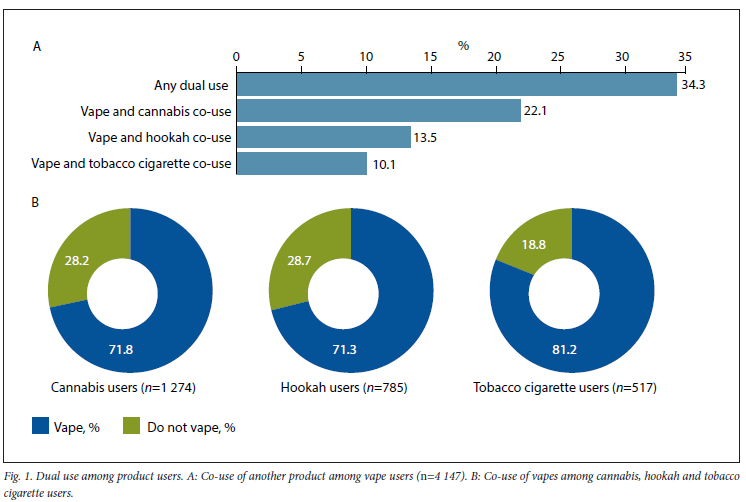
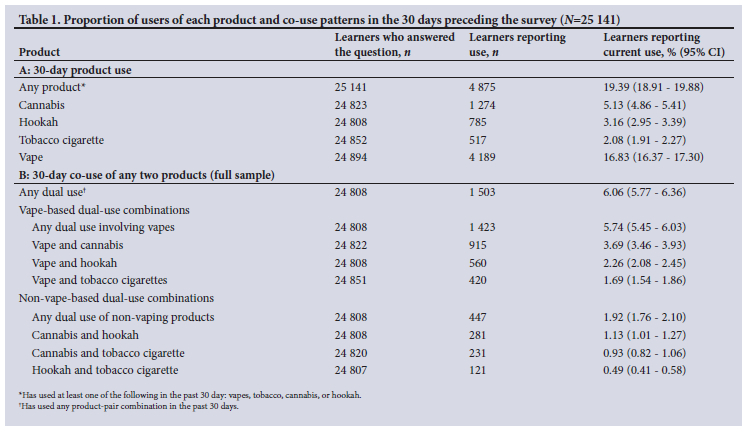
As previously published, 19.39% (18.91 - 19.88) of learners reported current use of at least one product, with 16.83% (16.37 - 17.30) currently using e-cigarettes, 5.13% (4.86 - 5.41) using cannabis, 3.16% (2.95 - 3.39) using hookah and 2.08% (1.91 - 2.27) using tobacco cigarettes (Table 1 part A).[6] Building on these findings, part B of Table 1 and Fig. 1 present new data on dual-use patterns.
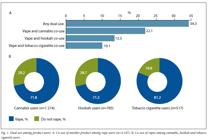
Overall, 6.06% (95% CI 5.77 - 6.36) of the sampled learners, corresponding to 1 503 of the 24 808 learners who provided complete responses on their usage patterns, reported dual use of any two products (Table 1 part B). Dual use involving vapes was most common, reported by 5.74% (95% CI 5.45 - 6.03) of learners, compared with 1.92% (95% CI 1.76 - 2.10) for dual-use combinations not involving vapes. The most frequently observed dual-use pattern was vape and cannabis use, reported by 3.69% (95% CI 3.46 - 3.93) of learners (Table 1 part B).
Among learners who reported vaping, 34.31% (95% CI 32.88 - 35.77) had also used at least one other inhaled substance in the past 30 days (Fig. 1A). The most common additional substance was cannabis, used by 22.06% (95% CI 20.83 - 23.35) of vape users, followed by hookah (13.50%, 95% CI 12.50 - 14.58) and tobacco cigarettes (10.13%, 95% CI 9.25 - 11.08). Fig. 1B further shows that the vast majority of learners who reported using cannabis, hookah, or tobacco cigarettes also reported vaping. Specifically, 71.82% (95% CI 69.28 - 74.23) of cannabis users, 71.34% (95% CI 68.07 - 74.40) of hookah users and 81.24% (95% CI 77.63 - 84.38) of tobacco-cigarette users reported concurrent e-cigarette use.
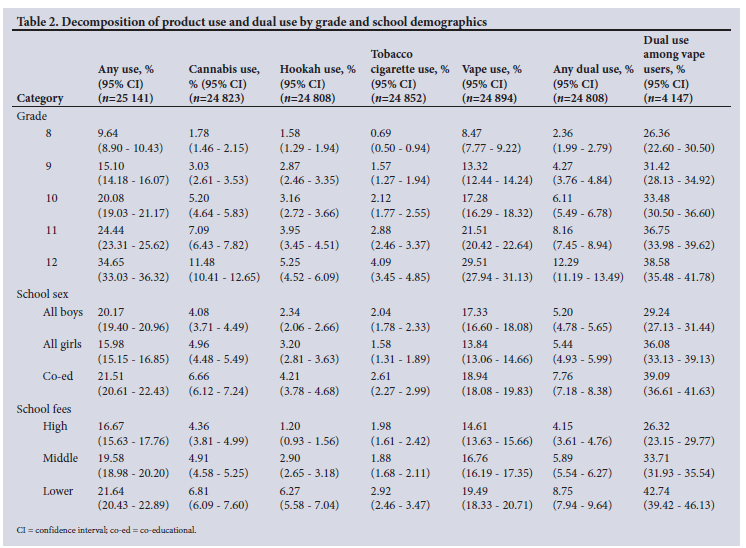
Substance use increased consistently across all product categories with each advancing grade, with particularly sharp rises observed between grade 11 and grade 12 (Table 2). The most substantial percentage point increase is seen in vape use, which climbed from 8.47% among grade 8 learners to 29.51% (95% CI 27.94 - 31.13) among learners in grade 12. Among grade 8 learners who vaped, 26.36% (95% CI 22.60 - 30.50) reported using one additional substance concurrently. This proportion rises to 38.58% (95% CI 35.48 - 41.78) among grade 12 learners reporting current vape use.
Across all outcomes, inhaled substance use is most prevalent among learners attending co-educational schools (Table 2). In this group, 21.51% (95% CI 20.61 - 22.43) reported using at least one product, with 18.94% (95% CI 18.08 - 19.83) specifically reporting vape use. Among vape users in co-educational schools, 39.09% (95% CI 36.61 - 41.63) also reported concurrent use of at least one other substance (cannabis, hookah, or tobacco cigarettes).
Distinct patterns emerged between learners attending all-boys and all-girls schools. Cannabis and hookah use were lowest among learners in all-boys schools, reported by 4.08% (95% CI 3.71 - 4.49) and 2.34% (95% CI 2.06 - 2.66), respectively. Conversely, tobacco-cigarette and vape use were lowest among learners in all-girls schools, with 1.58% (95% CI 1.31 - 1.89) reporting tobacco-cigarette use and 13.84% (95% CI 13.06 - 14.66) reporting vape use. Overall, any-substance use was least common among learners in all-girls schools (15.98%, 95% CI 15.15 - 16.85). Dual-use rates were similar among learners in single-sex schools, with 5.20% of learners in all-boys schools and 5.44% in all-girls schools reporting current use of two products. However, among vape users, dual use was higher among learners in all-girls schools (36.08%, 95% CI 33.13 - 39.13) than those in all-boys schools (29.24%, 95% CI 27.13 - 31.44) (Table 2).
Substance use was consistently highest among learners attending lower-fee schools, with a clear gradient of decreasing use among learners attending middle- and high-fee schools (Table 2). This pattern holds across all outcomes except tobacco cigarettes, where use was slightly higher among learners in high-fee schools (1.98%, 95% CI 1.61 - 2.42) than among learners attending middle-fee schools (1.88%, 95% CI 1.68 - 2.11).
Hookah use showed a particularly steep decline across fee levels: 6.27% (95% CI 5.58 - 7.04) among learners attending lower-fee schools, 2.90% (95% CI 2.65 - 3.18) among those attending middle-fee schools, and just 1.20% (95% CI 0.93 - 1.56) among learners attending high-fee schools (Table 2).
The fee-related differences extend to both any- and dual-product use. Dual use was more than twice as common among learners attending lower-fee schools (8.75%, 95% CI 7.94 - 9.64) as among those in high-fee schools (4.15%, 95% CI 3.61 - 4.76). Among vape users, co-use of another substance was also most prevalent in lower-fee schools (42.74%), compared with 33.71% (95% CI 31.93 - 35.54) in middle-fee and 26.32% (95% CI 23.15 - 29.77) in high-fee schools.
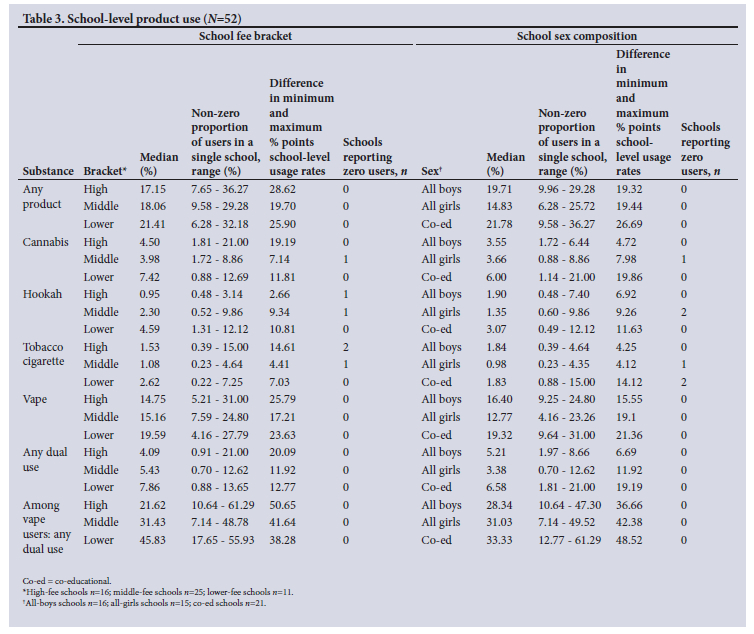
To gain further insight into the burden of inhaled substance use at the school level, usage rates for each product use category were compared across the 52 individual schools (Table 3). Among the four individual substances assessed, vape use was the only usage type reported in every school, regardless of fee bracket. Notably, however, lower-fee schools were the only group in which no schools reported zero use of hookah or tobacco cigarettes, underscoring the consistently higher prevalence of these substances in lower-fee school settings.
Across product types, high-fee schools generally exhibited the widest range in usage rates across schools. An exception is hookah use, where the greatest variability in school-level prevalence occurs within the lower-fee school category.
By school gender composition, co-educational schools generally had the highest median usage rates, except for tobacco-cigarette use, where median rates were nearly the same for all-boys and co-educational schools. School-level usage rates also varied more widely among individual co-educational schools than among single-sex schools, as seen in the broader ranges across all product categories. With the exception of tobacco-cigarette use, all-boys schools showed the narrowest ranges in usage rates, suggesting more uniform patterns of substance use within that school type.
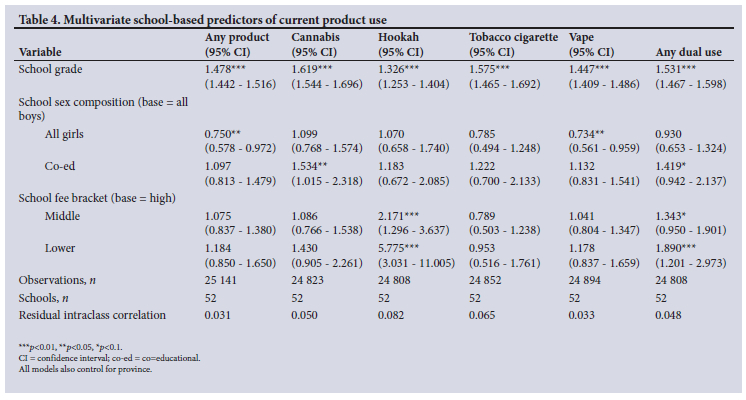
Given the observed variation in usage patterns across gender composition, school fee categories and grade levels, a multivariate regression analysis was used to assess the independent effect of each of these factors on substance use outcomes, while accounting for the influence of the others (Table 4).
Across all product-use categories considered, grade is a positive and significant predictor of current product use. A statistically significant association between school gender composition and the odds of current product use is evident for several outcomes. Learners attending all-girls schools have significantly lower odds of any product use (OR 0.75, p<0.05) and of vape use (OR 0.73, p<0.05) compared with those in all-boys schools. Attendance at a co-educational school is significantly associated with increased odds of cannabis use relative to attendance at an all-boys school (OR 1.53, p<0.05). In addition, learners in co-educational schools have marginally higher odds of any dual-product use (OR 1.34, p<0.1).
With respect to school fee brackets, fee status was not significantly associated with the odds of current use for most individual substances, except for hookah. Learners attending middle-fee and lower-fee schools had significantly higher odds of current hookah use than those in high-fee schools (OR 2.17 and OR 5.78, respectively; both p<0.01). The odds of any dual-product use were also significantly higher among learners attending middle-fee and lower-fee schools, relative to those in high-fee schools. However, the association was stronger among learners in lower-fee schools (OR 1.89, p<0.01) than among those in middle-fee schools (OR 1.34, p<0.1).
Discussion
This study investigated the use and co-use of e-cigarettes/vapes, cannabis, hookah and tobacco cigarettes among learners in 52 fee-paying SA high schools. It addresses important information gaps on adolescent e-cigarette use and dual-substance use, both of which remain understudied in the country. The broad geographical scope of this study also expands upon recent research that relied on smaller, localised samples to investigate cannabis, tobacco-cigarette and hookah use among SA adolescents.[8,9,12,17]
As previously published,[6] vape use was common, reported by 16.8% of learners, while cannabis use was notable at 5.1%. Tobacco-cigarette use was lower at 2.1%, and hookah use was reported by 3.2% of learners. One of the most concerning findings is the extent of dual use, particularly combinations involving vapes. A growing body of evidence indicates elevated health risks of dual-product use involving vapes.[14-16]
Across the full sample, 6.1% of learners reported current use of any two products. Among learners who vaped, over a third (34.3%) also reported current use of at least one other inhaled substance. Cannabis was the most commonly co-used substance, reported by 22.1% of vape users. When viewed from the perspective of the non-vape substances, the overlap is even more pronounced: 71.8% of cannabis users, 71.3% of hookah users and 81.2% of tobacco-cigarette users also reported vaping. These patterns suggest that adolescent vaping is not only widespread but also frequently occurs alongside the use of other substances, indicating potentially entrenched multi-substance use rather than isolated experimentation.
The usage patterns found in our sample indicate that vaping may act as a gateway to, or complement for, the use of other substances, raising important questions about its role in the progression of adolescent substance-use behaviours. They also highlight important implications for school-based prevention efforts. For example, in fee-paying high schools, a learner who uses cannabis or cigarettes likely also uses vaping products. While further research is needed to untangle the direction and causality of these associations, the prominent role of vaping in patterns of dual use underscores the urgent need to prioritise youth e-cigarette use in both policy and public health responses.
The dominance of vaping among the sampled learners mirrors global trends, where e-cigarettes have surpassed traditional tobacco products in popularity among youth.[18-20] The regulatory environment in SA likely contributes to this trend. While tobacco products are regulated under the 1993 Tobacco Products Control Act (amended in 2008), no comparable regulations currently apply to e-cigarettes. This gap allows for aggressive marketing, particularly via social media and retail outlets, targeting adolescents, with minimal restriction.[21] National survey data show that nearly one in four South Africans aged 16 - 19 years reported recent exposure to e-cigarette advertising.[22]
The elevated prevalence of vape use among learners in our sample suggests that enactment of the stalled 2018 Control of Tobacco Products and Electronic Delivery Systems Bill, aimed at regulating e-cigarette marketing and sales,[21] is urgently needed to curb this pathway to youth vaping. Research from across the globe has linked exposure to e-cigarette marketing with increased vaping initiation and use.[23-26] Evidence from the USA further indicates that flavour-focused social media adverts reduce the perceived harm of vaping among young people.[27]
The descriptive analysis revealed consistently higher rates of substance use across all product categories among learners attending co-educational and lower-fee schools. At the school level, vaping was widespread, with no schools reporting zero vape usage, suggesting that vape use is not a problem restricted to the most elite private/ wealthy schools.
Lower-fee schools stood out further: none reported zero hookah usage either. In the lower-fee school setting, hookah use was strikingly prevalent, with 6.27% of learners (95% CI 5.58 - 7.04) reporting current use, more than double that in middle-fee schools (2.90%, 95% CI 2.65 - 3.18) and over five times higher than the current hookah usage rates reported by learners in high-fee schools (1.20%, 95% CI 0.93 - 1.56).
Results of the multilevel regression analysis confirm the association between hookah use and school-fee bracket in the multivariable setting. Among the four individual products assessed, hookah use stood out as the only product where the odds of current use were significantly higher in lower-fee settings. We further found that attendance at lower-fee schools significantly increased the odds of any dual-product use, indicating the need for special attention to the drivers of hookah use and product co-use in these settings. Consistent with other local studies on hookah use among SA high-school students,[9,17] we suggest that further exploration of factors such as attitudes toward hookah use and peer/parental influences could provide valuable insights for designing targeted and effective interventions to reduce hookah use in lower-fee schools.
The regression analysis further showed that learners in the sampled co-educational schools had significantly higher odds of cannabis use and, to a lesser extent, dual use than those in all-boys schools. Elevated odds of cannabis and other illicit drug use in co-educational settings have also been reported among high-school learners in Nigeria, likely reflecting the social dynamics of co-educational environments, where mixed-gender peer interactions could facilitate greater exposure to substances, or normalise use through broader social networks.[28] The distinct influence of co-educational environments on cannabis use in our sample warrants further investigation about issues of access, peer influence and social norms around cannabis use in these settings.
Across all models, we found that the odds of current use increase significantly by grade, a finding that aligns with developmental theories of adolescence, where older teens, approaching late adolescence, often exhibit greater risk-taking behaviour.[29] This finding also suggests that as learners mature, they may have greater access to these substances, possibly through older peers or social networks outside school settings. The observed grade-related trend also suggests that there is scope for school-based policies to foster environments that promote positive social norms, such as mentorship programmes pairing younger learners with older, substance-free role models. These strategies could mitigate the escalating risk as learners age and progress through school, addressing both individual and contextual drivers of inhaled substance use.
Study limitations
While this study provides insights into the use and co-use of four inhaled substances among a large sample of SA adolescents attending fee-paying high schools, limitations must be acknowledged. First, the cross-sectional design limits causal inference, necessitating longitudinal studies to better explore developmental trajectories of substance use among SA high-school learners. Second, the self-reported data provided by survey respondents may introduce recall or social desirability bias, potentially distorting true prevalence among the sampled adolescents.
The study is further limited by the exclusion of learners attending non-fee-paying schools, which restricts the generalisability of the findings, particularly as learners in these schools may face different risk exposures and behavioural patterns compared with their peers in fee-paying schools. These differences could lead to distinct substance-use patterns and prevalence trends that are not captured in the current study.
Relatedly, the sample is primarily composed of adolescents from urban areas, which introduces an additional limitation in terms of geographical representativeness. Substance-use patterns may vary between urban and rural contexts owing to differences in access to resources, socioeconomic status and local cultural norms. Consequently, the findings may not fully capture the experiences of adolescents in rural or peri-urban areas, where substance use may manifest differently. Future research should aim to include both fee-paying and non-fee-paying schools across a range of geographical settings to better capture the diversity of inhaled substance-use behaviours in SA.
Additionally, while the regression model intra-class correlation coefficients suggest that school-level factors play a modest role in determining the odds of product use and co-use among the sampled adolescents, the specific mechanisms, such as peer influence, school policies, or community norms, were not explored in this study, and warrant investigation in future studies.
Conclusion
This study highlights the high rate of e-cigarette use (16.8%) among a large sample of SA learners attending fee-paying high-schools, alongside notable cannabis use (5.1%). Dual use, particularly combinations involving e-cigarettes, is an emerging concern not previously documented in this population. Over one-third (34.3%) of current vape users in our sample reported using at least one other substance, most commonly cannabis (22.1%), followed by hookah (13.5%) and tobacco cigarettes (10.1%).
These patterns point to an urgent need for comprehensive public health interventions. A broad-based strategy to restrict youth access to e-cigarettes, and their marketing, is critical, necessitating the enactment of the long-delayed 2018 Control of Tobacco Products and Electronic Delivery Systems Bill.
Multivariable analyses further revealed distinct vulnerabilities for safeguarding the health of SA's youth: learners in lower-fee schools had significantly higher odds of hookah use and dual-product use than those in high-fee schools, while learners in co-educational schools were more likely to use cannabis than those in single-sex schools. These findings suggest that socioeconomic context and school social environments may play an important role in shaping adolescent substance use. Future research should aim to include both fee-paying and non-fee-paying schools from diverse geographical areas to more comprehensively capture the range of inhaled substance-use behaviours in SA. Additionally, future studies should explore peer dynamics, school culture and community norms to inform targeted, school-based policies and interventions aimed at reducing adolescent substance use across SA high schools.
Data availability. Data collected from this study are from minors, collected with permission from the SA Department of Basic Education (DoE) and under the supervision of the University of Cape Town Faculty of Health Sciences Human Research Ethics committee (UCT FHS HREC). Data collection forms, and the data dictionary, will be provided on request. Access to the anonymised data will require permission from both the DoE and UCT FHS HREC as the research was conducted with minors, within the educational environment, and consent was only provided for the aims listed in the original study protocol.
Declaration. None.
Acknowledgements. We are grateful to the schools and participants who agreed to participate in this study.
Author contributions. SF: conceptualisation, methodology, software, validation, formal analysis, investigation, data curation, writing -original draft, writing - review and editing, visualisation. RNvZS: conceptualisation, methodology, software, validation, formal analysis, investigation, resources, data curation, writing - original draft, writing -review and editing, visualisation, supervision, project administration, funding acquisition. GS: conceptualisation, methodology, software, investigation, data curation. SK: conceptualisation, methodology, software, validation, formal analysis, writing - original draft, writing -review and editing, visualisation, supervision, funding acquisition.
Funding. This study was funded in part by a research grant from the Cambridge-Africa ALBORADA Research Fund G12753.
Conflicts of interest. None.
References
- 1. Goriounova NA, Mansvelder HD. Short- and long-term consequences of nicotine exposure during adolescence for prefrontal cortex neuronal network function. Cold Spring Harb Perspect Med 2012;2(12):a012120.
-
2. Steinfeld MR, Torregrossa MM. Consequences of adolescent drug use. Transl Psychiatry 2023;13(1):313. https://doi.org/10.1038/s41398-023-02590-4
» https://doi.org/10.1038/s41398-023-02590-4 -
3. Gray KM, Squeglia LM. Research review: What have we learned about adolescent substance use? J Child Psychol Psychiatry 2018;59(6):618-627. https://doi.org/10.1111/jcpp.12783
» https://doi.org/10.1111/jcpp.12783 -
4. Laursen B, Veenstra R. Toward understanding the functions of peer influence: A summary and synthesis of recent empirical research. J Res Adolesc 2021;31(4):889-907. https://doi.org/10.1111/jora.12606
» https://doi.org/10.1111/jora.12606 -
5. World Health Organization, US Centers for Disease Control. Global Youth Tobacco Survey: South Africa, 2011. Geneva: WHO, 2011. https://extranet.who.int/ncdsmicrodata/index.php/catalog/175 (accessed 9 June 2025).
» https://extranet.who.int/ncdsmicrodata/index.php/catalog/175 -
6. Van Zyl-Smit RN, Filby S, Soin G, et al. Electronic cigarette usage amongst high school students in South Africa: A mixed methods approach. eClinicalMedicine 2024;78:102432. https://doi.org/10.1016/j.edinm.2024.102432
» https://doi.org/10.1016/j.edinm.2024.102432 - 7. National Department of Health, South Africa, Statistics South Africa, South African Medical Research Council, ICF. South Africa Demographic and Health Survey 2016. Pretoria: NDoH, 2019.
-
8. Mohale D, Mokwena KE. Substance use amongst high school learners in the south of Johannesburg: Is this the new norm? S Afr Fam Pract 2020;62(1):e1-e6. https://doi.org/10.4102/safp.v62i1.5122
» https://doi.org/10.4102/safp.v62i1.5122 -
9. Naicker N, Teare J, Albers P, Mathee A. Prevalence of hookah pipe smoking in high-school learners in Johannesburg, South Africa. S Afr Med J 2020;110(6):546-551. https://doi.org/10.7196/SAMJ.2020.v110i6.14333
» https://doi.org/10.7196/SAMJ.2020.v110i6.14333 -
10. Parry C, Myers B, Caulkins J. Decriminalisation of recreational cannabis in South Africa. Lancet 2019;393(10183):1804-1805. https://doi.org/10.1016/S0140-6736(19)30011-X
» https://doi.org/10.1016/S0140-6736(19)30011-X -
11. Swartz MC, Dannatt L, Lachman A. Cannabis use among hospitalised adolescents before and after decriminalisation in South Africa. S Afr J Psychiatr 2024;30:2244. https://doi.org/10.4102/sajpsychiatry.v30i0.2244
» https://doi.org/10.4102/sajpsychiatry.v30i0.2244 -
12. Mmethi TG, Modjadji P, Mathibe M, et al. Substance use among school-going adolescents and young adults in rural Mpumalanga Province, South Africa. Behav Sci 2024;14(7):543. https://doi.org/10.3390/bs14070543
» https://doi.org/10.3390/bs14070543 -
13. Ramlagan S, Peltzer K, Matseke G. Epidemiology of drug abuse treatment in South Africa. S Afr J Psychiatr 2010;16(2):40-49. https://doi.org/10.4102/sajpsychiatry.v16i2.172
» https://doi.org/10.4102/sajpsychiatry.v16i2.172 -
14. Buckner JD, Morris PE, Zvolensky MJ. Cannabis use and electronic cigarette use: The role of dual use on use frequency and related problems. Psychiatry Res 2021;304:114126. https://doi.org/10.1016/j.psychres.2021.114126
» https://doi.org/10.1016/j.psychres.2021.114126 -
15. Osei AD, Mirbolouk M, Orimoloye OA, et al. Association between e-cigarette use and cardiovascular disease among never and current combustible-cigarette smokers. Am J Med 2019;132(8):949-954. https://doi.org/10.1016/j.amjmed.2019.02.016
» https://doi.org/10.1016/j.amjmed.2019.02.016 -
16. Reddy KP, Schwamm E, Kalkhoran S, et al. Respiratory symptom incidence among people using electronic cigarettes, combustible tobacco, or both. Am J Respir Crit Care Med 2021;204(2):231-234. https://doi.org/10.1164/rccm.202012-4441LE
» https://doi.org/10.1164/rccm.202012-4441LE -
17. Davids H, Roman N, Rich E. Peer pressure and social acceptability between hookah pipe users and non-users among a sample of South African adolescents. S Afr J Child Health 2022;16(3):139-145. https://doi.org/10.7196/SAJCH.2022.v16i3.1709
» https://doi.org/10.7196/SAJCH.2022.v16i3.1709 -
18. Park-Lee E, Jamal A, Cowan H, et al. Notes from the field: E-cigarette and nicotine pouch use among middle and high school students - United States, 2024. Morb Mortal Weekly Rep 2024;73(35):774-778. https://doi.org/10.15585/mmwr.mm7335a3
» https://doi.org/10.15585/mmwr.mm7335a3 -
19. Jamal A, Park-Lee E, Birdsey J, et al. Tobacco product use among middle and high school students - National Youth Tobacco Survey, United States, 2024. Morb Mortal Weekly Rep 2024;73(41):917-924. https://doi.org/10.15585/mmwr.mm7341a2
» https://doi.org/10.15585/mmwr.mm7341a2 -
20. World Health Organization. Technical note on call to action on electronic cigarettes. Geneva: WHO, 2023. https://cdn.who.int/media/docs/default-source/tobacco-hq/regulating-tobacco-products/ends-call-to-action-background.pdf (accessed 28 April 2025).
» https://cdn.who.int/media/docs/default-source/tobacco-hq/regulating-tobacco-products/ends-call-to-action-background.pdf -
21. Ayo-Yusuf O, Nkosi L, Agaku I. E-cigarette use and regulation in South Africa: A synthesis of evidence in response to industry efforts to undermine product regulation. Curr Addict Rep 2022;9(4):363-372. https://doi.org/10.1007/s40429-022-00437-3
» https://doi.org/10.1007/s40429-022-00437-3 -
22. Agaku IT, Egbe CO, Ayo-Yusuf OA. E-cigarette advertising exposure among South African adults in 2017: Findings from a nationally representative cross-sectional survey. BMJ Open 2021;11(8):e048462. https://doi.org/10.1136/bmjopen-2020-048462
» https://doi.org/10.1136/bmjopen-2020-048462 -
23. Pettigrew S, Santos JA, Pinho-Gomes AC, et al. Exposure to e-cigarette advertising and young people's use of e-cigarettes: A four-country study. Tob Induc Dis 2023;21:141. https://doi.org/10.18332/tid/1724'
» https://doi.org/10.18332/tid/1724' -
24. Camenga D, Gutierrez KM, Kong G, et al. E-cigarette advertising exposure in e-cigarette naïve adolescents and subsequent e-cigarette use: A longitudinal cohort study. Addict Behav 2018;81:78-83. https://doi.org/10.1016/j.addbeh.2018.02.005
» https://doi.org/10.1016/j.addbeh.2018.02.005 -
25. Hansen J, Hanewinkel R, Morgenstern M. Electronic cigarette advertising and teen smoking initiation. Addict Behav 2020;103:106243. https://doi.org/10.1016/j.addbeh.2019.106243
» https://doi.org/10.1016/j.addbeh.2019.106243 -
26. Wang Y, Duan Z, Weaver SR, et al. Association of e-cigarette advertising, parental influence, and peer influence with US adolescent e-cigarette use. JAMA Netw Open 2022;5(9):e2233938. https://doi.org/10.1001/jamanetworkopen.2022.33938
» https://doi.org/10.1001/jamanetworkopen.2022.33938 -
27. Struik LL, Dow-Fleisner S, Belliveau M, et al. Tactics for drawing youth to vaping: Content analysis of electronic cigarette advertisements. J Med Internet Res 2020;22(8):e18943. https://doi.org/10.2196/18943
» https://doi.org/10.2196/18943 -
28. Egga DK, Oduyoye O, Jacob IA, et al. Characterisation of substance use pattern among secondary school students in Nasarawa State, Nigeria. Discov Public Health 2024;21(1):238. https://doi.org/10.1186/s12982-024-00133-8
» https://doi.org/10.1186/s12982-024-00133-8 -
29. Steinberg L. A social neuroscience perspective on adolescent risk-taking. Dev Rev 2008;28(1):78-106. https://doi.org/10.1016/j.dr.2007.08.002
» https://doi.org/10.1016/j.dr.2007.08.002
Accepted 24 August 2025