Seroprevalence of hepatitis B surface antigen among pregnant women attending the Hospital for Women & Children in Koutiala, Mali
OBJECTIVES: To establish the rate of seroprevalence of the hepatitis B surface antigen in pregnant women in south-eastern Mali, and to decrease mother-to-child transmission. METHODS: In a descriptive cross-sectional comparison study, 3 659 pregnant women attending a non-governmental hospital in Koutiala, Mali, during 2008 and 2009 were screened for the hepatitis B surface antigen during antenatal clinic attendance or when admitted for delivery. A chart review compared the hepatitis B virus (HBV)-positive women to HBV-negative women used as controls to identify potential risk factors for HBsAg positivity. The variables compared were age, parity, type of genital excision, birthweight of baby and HIV status. RESULTS: A total of 293 (8.0%) pregnant women tested positive for HBsAg. Their average age was 27.6 years, average parity of 2.8 births, 90% had Type 2 genital excision, 21% had low-birthweight infants, and 14 (0.4%) women also tested positive for HIV. Infants born to HbsAg-positive women were immunised with the hepatitis B vaccine in the delivery room. Two hundred and eighty-four HBVnegative women were compared with the HBV-positive women. None of the differences of means or relationships was statistically insignificant. CONCLUSION: In view of the high endemicity and lack of easily identifiable risk factors, free maternal HBV screening should be provided to all women in Mali, and the infants born to HBsAgpositive women should be immunised within 12 hours of birth.
Seroprevalence of hepatitis B surface antigen among pregnant women attending the hospital for women & children in Koutiala, Mali
Brett MacLeanI; Rosanna F HessII; Edward BonvillainIII; Joseph KamateIV; Daoda DaoV; Amy CosimanoVI; Shannon HoyVII
IMD, Hospital for Women and Children, Koutiala, Mali
IICT (ASCP), Hospital for Women and Children, Koutiala, Mali
IIITSS, Hospital for Women and Children, Koutiala, Mali
IVTS, Hospital for Women and Children, Koutiala, Mali
VDNP, RN, Research For Health Inc., Cuyahoga Falls, Ohio, USA
VIEdD, MSN, RN, Creighton University, Omaha, Nebraska, USA
VIIDNP, NNP, Creighton University, Omaha, Nebraska, USA
OBJECTIVES: To establish the rate of seroprevalence of the hepatitis B surface antigen in pregnant women in south-eastern Mali, and to decrease mother-to-child transmission.
METHODS: In a descriptive cross-sectional comparison study, 3 659 pregnant women attending a non-governmental hospital in Koutiala, Mali, during 2008 and 2009 were screened for the hepatitis B surface antigen during antenatal clinic attendance or when admitted for delivery. A chart review compared the hepatitis B virus (HBV)-positive women to HBV-negative women used as controls to identify potential risk factors for HBsAg positivity. The variables compared were age, parity, type of genital excision, birthweight of baby and HIV status.
RESULTS: A total of 293 (8.0%) pregnant women tested positive for HBsAg. Their average age was 27.6 years, average parity of 2.8 births, 90% had Type 2 genital excision, 21% had low-birthweight infants, and 14 (0.4%) women also tested positive for HIV. Infants born to HbsAg-positive women were immunised with the hepatitis B vaccine in the delivery room. Two hundred and eighty-four HBVnegative women were compared with the HBV-positive women. None of the differences of means or relationships was statistically insignificant.
CONCLUSION: In view of the high endemicity and lack of easily identifiable risk factors, free maternal HBV screening should be provided to all women in Mali, and the infants born to HBsAgpositive women should be immunised within 12 hours of birth.
The hepatitis B virus (HBV) is estimated to chronically infect 350 million people worldwide,12345,6Age at infection and risk of chronicity are inversely correlated;7,8 90% of infants born to a mother who is HbeAg-positive (core-associated antigen) will become lifelong HBV carriers6-acquired chronic hepatitis B infection is linked to cirrhosis, hepatic carcinoma, glomerulonephritis and end-stage renal disease in children.7,9
From women who are seropositive for both HBsAg (surface antigen) and HBeAg (core-associated antigen), vertical transmission approaches 90%.1061,11 Use of only the hepatitis B vaccine to prevent vertical transmission has been supported in remote areas of the world.12,13 Given the impracticality of screening all pregnant women and the unavailability of the hepatitis B immune globulin (HBIG) in many developing countries, the use of the hepatitis B vaccine alone is recommended and considered appropriate treatment to prevent many cases of HBV during the perinatal period - the period of highest risk of chronicity.14
In 2008, the staff at the Hospital for Women and Children in Koutiala, Sikasso Region, south-eastern Mali, began screening pregnant women for hepatitis B and to immunise newborn infants born to women who tested positive for HBsAg. The prevalence rate data of HBsAg in Malian pregnant women in this paper are part of a larger ongoing hepatitis B prevention programme targeting infants for immunisation against hepatitis B on the first day of life.
Hepatitis B global infection rates published at www.pkids.org indicate that Mali has a 15.5% prevalence of HBV. The research literature in the last 10 years revealed few studies on the prevalence of hepatitis B in Mali in any population. A study of 11 592 blood donors in Bamako, Mali's capital city, screened during 2001 and 2002, revealed a prevalence of HBsAg of 14.9%.15161718
Methods
A descriptive comparative cross-sectional design guided this study. Ethical review and approval were received from the administration of the Koutiala Hospital for Women and Children and the Human Research Committee at Malone University, Canton, Ohio, USA. The importance of screening was explained to each woman at her first antenatal visit. HBV screening was explained to women who had not had antenatal visits at the hospital upon arrival at the maternity department for delivery. Consistent with Malian governmental guidelines, verbal consent was obtained before screening, and all results were kept confidential.
Women who came to antenatal clinic and consented to screening were directed to the hospital's laboratory. Women who tested HBsAgpositive during antenatal consultations were encouraged to return to the study-site hospital for delivery and immunisation of the newborn during its first hours of life. Women admitted to the hospital during labour without prior screening had their blood drawn in the delivery room after giving consent. SD BIO Standard Diagnostic India was used for the serum/plasma tests conducted in the laboratory, and Vikia Brasil Biomerieux was used for the serum/plasma/whole blood tests done in the delivery room.
Data collection and analysis
Data of women screened in 2008 and 2009 were included. A chart review of the women who were found to be HBsAg-positive was conducted and the following variables noted: age, parity, type of genital excision, birthweight of baby, and HIV status. Genital excision is noted as a potential risk factor for hepatitis B transmission.19,20 (A description of the types of genital excision can be found at the World Health Organization website.) HIV positivity - a noted risk factor for HBV infection - was only available for the HBV-positive women, and therefore a comparative analysis of the HIV variable was not done.
A comparison group of HBsAg-negative controls was included in the study by virtue of a random sample of charts of women who gave birth at the same hospital during the same years. To randomise the comparison sample, every 12th woman in the birth registry was chosen; if the randomly selected woman happened to be one who was HBsAg-positive, the chart of the next woman on the list was retained. SPSS version 18.0 was used for analysis of frequencies, means, chisquares, t-tests, and analysis of variance.
Results
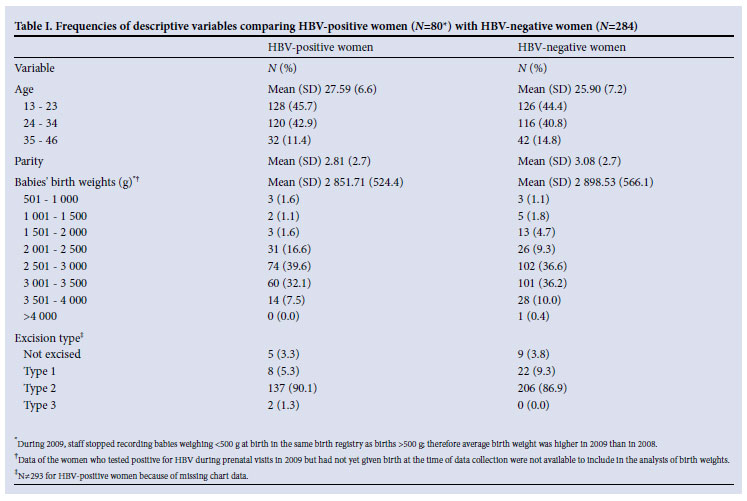
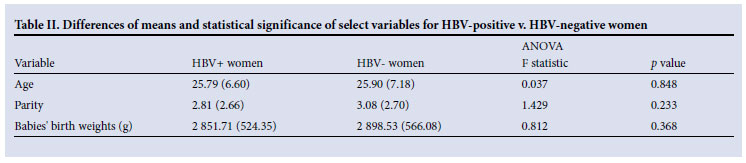
From May 2008 to end December 2009, 3 659 pregnant women were screened for HBsAg; 293 (8.0%) tested positive; 14 (0.38%) HBsAg-positive women were co-infected with HIV. Table I illustrates frequencies of descriptive variables of the sample, comparing HBVpositive and HBV-negative women. The women who screened positive for HBsAg were not demographically different from the HBsAg-negative women who gave birth during the same timeframe, and were randomly sampled from the birth registry. There was no statistically significant association between HBsAg positivity and the type of excision the woman had experienced (chi-square 5.233, df 3, p=0.155). The women who tested positive for HBsAg were almost the same mean age as the HBsAg-negative women (27.6 and 25.9 respectively) and had only a slightly lower number of pregnancies (2.8 and 3.1 respectively). The differences of means and their statistical significance for age, parity, and birthweight of baby comparing HBV-positive with HBV-negative women are displayed in Table II. None of the differences of means was statistically significant.
Discussion
The seroprevalence level of HBsAg of 8.0% in this study of Malian pregnant women was lower than the 15.5% found among pregnant women in Bamako, Mali's capital.18 The HBsAg positivity rate among pregnant women in Cote d'Ivoire was 8.5%, similar to Malian women;2122232425261927
Since maternal screening and newborn immunisation are known to reduce perinatal transmission rates,614,28
In conclusion: the 8% hepatitis B prevalence rate found is this sample of pregnant Malian women indicates a high endemicity level of HBV and a clear danger of perinatal transmission. Free screening of pregnant women in Mali is strongly recommended to spare children from the hepatitis B virus and its chronic and fatal consequences.
References
- 1. Goldstein ST, Zhou F, Hadler SC, Bell BP, Mast EE, Margolis HS. A mathematical model to estimate global hepatitis B disease burden and vaccination impact. Int J Epidemol 2005;34(6):1329-1339.
- 2. Burnett R, Francois G, Kew G, et al. Hepatitis B virus and human immunodeficiency virus co-infection in sub-Saharan Africa: a call for further action. Liver Int 2005;25:201-213.
- 3. Lavanchy D. Hepatitis B virus epidemiology, disease burden, treatment, and current and emerging prevention and control measures. J Viral Hep 2004;11:97-107.
- 4. Maddrey WC. Hepatitis B: an important public health issue. J Med Virol 2000;61:362-366.
-
5. Wolf DC. Viral hepatitis. From eMedicine Specialties> Gastroenterology> Liver. http://emedicine.medscape.com/article/185463-overview (accessed 8 March 2011).
» http://emedicine.medscape.com/article/185463-overview - 6. Tran TT. Management of hepatitis B in pregnancy: weighing the options. Cleveland Clinic J Med 2009;76(supp 3):S25-S29.
- 7. Wasmuth JC. Hepatology, Düsseldorf: Flying Publisher, 2009:7-17.
- 8. Ganem D, Prince AM. Hepatitis B virus infection - natural history and clinical consequences. N Engl J Med 2004;350(11):1118-1129.
- 9. Levy M, Gagnadoux MF. Membranous nephropathy following perinatal transmission of hepatitis B virus infection - long term follow-up study. Pediatr Nephrol 1996;10(1):76-78.
- 10. ACOG (American College of Obstetricians and Gynecologists) Practice Bulletin No. 86: Viral hepatitis in pregnancy. Obstet Gynecol 2007;10:941-956.
- 11. Wright TL. Introduction to chronic hepatitis B infection. Am J Gastroenterol 2006;101:Supplement 1:S1-S6.
- 12. Coursaget P, Yvonnet B, Chotard J, et al. Seven-year study of hepatitis B vaccine efficacy in infants from an endemic area (Senegal). Lancet 1986;2:1143-1145.
- 13. Xu ZY, Liu CB, Francis DP, et al. Prevention of perinatal acquisition of hepatitis B virus carriage using vaccine: preliminary report of a randomized, double-blind placebo-controlled and comparative trial. Pediatrics 1985;76:713-718.
- 14. Mast EE, Margolis HS, Fiore AE. A comprehensive immunisation strategy to eliminate transmission of hepatitis B virus infection in the United States. MMWR 2005;54(RR16):1-23.
- 15. Tounkara A, Sarro YS, Kristensen S, et al. Seroprevalence of HIV/HBV coinfection in Malian blood donors. J Int Assoc Physi AIDS Care 2009;8:47-51.
- 16. Diarra A, Kouriba B, Baby M, Murphy E, Lefrere JJ. HIV, HCV, HBV and syphilis rate of positive donations among blood donations in Mali: lower rates among volunteer blood donors. Transf Clin Biolo 2009;16:444-447.
- 17. Maïga I, Le Faou A, Muller CP, Venard V. Unexpected high prevalence of hepatitis B and HIV infections in Malian medical students. Eur J Clin Microbiol Infect Dis 2005;24:501-502.
- 18. Sidibe S, Sacko BY, Traoré I. Prevalence of serologic markers of the hepatitis B virus in pregnant women of Bamako, Mali. Bull Soc Pathol Exot 2001;94:339-341.
- 19. Msuya SE, Mbizvo E, Hussain A, Sundby J, Sam NE, Stray-Pedersen B. Female genital cutting in Kilimanjaro, Tanzania: changing attitudes? Trop Med Intl Health 2002;7(2):159-165.
- 20. Kandala, NB, Nwakeze, N, Ngianga, S. Spatial distribution of female genital mutilation in Nigeria. Am J Trop Med Hyg 2009;81(5):784-792.
- 21. Rouet F, Chaix, ML, Inwoley, A, et al. ANRS 1236 DITRAME-B&C Study Group. HBV and HCV prevalence and viraemia in HIV-positive and HIV-negative pregnant women in Abidjan, Côte d'Ivoire: the ANRS 1236 study. J Med Virol 2004;74:34-40.
- 22. Wurie IM, Wurie AT, Gevao SM. Sero-prevalence of hepatitis B virus among middle to high socioeconomic antenatal population in Sierra Leone. WAJM 2005;24:18-20.
- 23. Collenberg E, Ouedraogo T, Ganamé J, et al. Seroprevalence of six different viruses among pregnant women and blood donors in rural and urban Burkina Faso: a comparative analysis. J Med Virol 2006;78:683-692.
- 24. Mbaawuaga EM, Enenebeaku MNO, Okopi JA, Damen JG. Hepatitis B virus (HBV) infection among pregnant women in Makurdi, Nigeria. Af J Biomed R 2008;11:155-159.
- 25. Elsheikh RM, Daak AA, Elsheikh MA, Karsany MS, Adam I. Hepatitis B virus and hepatitis C virus in pregnant Sudanese women. Virol J 2007;4:104.
- 26. Pirillo MF, Bassani L, Germinario EAP, et al. Seroprevalence of hepatitis B and C viruses among HIVinfected pregnant women in Uganda and Rwanda. J Med Virol 2007;79: 1797-1801.
- 27. Rabiu KA, Akinola OI, Adewunmi AA, Omololu OM, Ojo TO. Risk factors for hepatitis B virus infection among pregnant women in Lagos, Nigeria. Acta Obstetricia et Gynecologica Scandinavica 2010;89(8):1024-1028.
- 28. Milne A, West DJ, Chinh DV, Moyes CD, Poerschke G. Field evaluation of the efficacy and immunogenicity of recombinant hepatitis B vaccine without HBIG in newborn Vietnamese infants. J Med Virol 2002;67(3):327-333.