
 High MDRTB risk for healthcare workers 'unnecessary'
Healthcare workers in KwaZulu-Natal have up to three times greater chance of developing drug-resistant (DR) TB than the general population and face double the average risk of their professional colleagues elsewhere in the country - whether they work exclusively with TB patients or not.
According to a study of three KwaZulu-Natal district hospitals (with specialised multidrug-resistant (MDR) TB wards) presented at the third South African TB conference in Durban in mid-June, 8% of healthcare workers were diagnosed with any form of TB and just over 1% with MDRTB.1were all reassigned to lower risk areas). In the three hospitals surveyed in the Umkhanyakude, Uthungulu and Ugu health districts (bordering the coast from Mozambique in the north to the Eastern Cape in the south), just 18.6% of staff (313 people) were screened for TB, resulting in 23 positive TB diagnoses.
KZN'S MDRTB among highest globally
Her findings come in a province that has the highest prevalence of DR TB countrywide, accounting for 38% (2 799) of the 7 350 national MDRTB case burden and half of the 536 recorded extremely drug-resistant (XDR) TB cases. KwaZulu-Natal's MDRTB incidence rate per 100 000 population is among the highest worldwide, increasing 10-fold between 2001 and 2007 with XDRTB increasing 45-fold over the same period, in large part due to tripled sampling.2
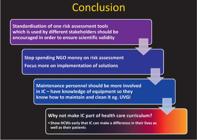
Professor Anton Stoltz, of the Steve Biko Academic Hospital and Head of the Division of Infectious Diseases and Infection Control and Prevention Unit at the University of Pretoria, told delegates that infection control in healthcare facilities 'had to begin' at managerial or administrative level and include environmental controls before moving to personal protective equipment. A study that his unit conducted in 43 primary healthcare clinics around Pretoria reflected either a misguided use of protective equipment by healthcare workers or facilities which were not properly ventilated.3
Drop costly 'assessments' - focus on infection control
Stoltz called for a standardisation of tools; 'it's high time we come together and use one tool. Another thing; we must stop wasting NGOs' money on assessments. Everyone is doing these assessments but no one is doing something about it (infection control),' he stressed.
University of Cape Town graduate and head of the TB/HIV and Wellness programmes for the Nkenke Consultancy, Dr Ausi Nkhi, shared her experience of work-acquired TB and its long-term effects. 'I'm a 38-year-old gravida IV, para 0, who is generally well and in good spirits except for a significant surgical history of five previous laparotomies and minor allergies to house-dust mite. That's just my medical history,' she said to laughter. After a diagnosis of extra-pulmonary TB of the uterus in 1994 while a medical student, she underwent five laparotomies for suspected ectopic pregnancies after she married. She made sure that she took every single dose of her TB treatment and upon its completion was TB-free. 'Unfortunately, the TB did not leave me as it found me. It left me scarred,' she said.4
Dadid Dludla (final-year Honours student, Rhodes University Journalism School) and Chris Bateman
References
-
1. Tudor C. Tuberculosis among health care workers in KwaZulu Natal, South Africa: a retrospective analysis. SATB 2012. (http:// www.tbconference.co.za/images/stories/presentations/New%20 folder/1Dr%20%20Carrie%20Tudor%20Occupational%20 Health%20Practices%20Related%20to%20TB%20in%20Health. pdf)
» http:// www.tbconference.co.za/images/stories/presentations/New%20 folder/1Dr%20%20Carrie%20Tudor%20Occupational%20 Health%20Practices%20Related%20to%20TB%20in%20Health. pdf -
2. Wallengren K, Scano F, Nunn P, Margo B, et al. Drug-resistant tuberculosis, KwaZulu-Natal, South Africa, 2001 - 2007. Emerging Infectious Diseases Journal 2011;17(10). [http:// dx.doi.org/10.3201/eid1710.100952]
» http:// dx.doi.org/10.3201/eid1710.100952 -
3. Stoltz A. Airborne infection control - a study of risk assessment, education, training and practice changes in 43 primary health care clinics. SATB 2012. (http://www.tbconference.co.za/ images/stories/presentations/New%20folder/4.%20Prof%20 Anton%20Stoltz_Airborne%20Infection%20Control-%20A%20 study%20of%20Risk.pdf).
» http://www.tbconference.co.za/ images/stories/presentations/New%20folder/4.%20Prof%20 Anton%20Stoltz_Airborne%20Infection%20Control-%20A%20 study%20of%20Risk.pdf - 4. Nkhi A. When the caregiver develops TB-a personal perspective. SATB 2012.