Road traffic injury: Prioritising interventions
Background
The Burden of Disease (BoD) Reduction Project12
According to global estimates, 1.2 million people are killed and 50 million are injured in road traffic crashes annually, with an anticipated increase of 65% over the next two decades unless there is determined commitment to prevention.334
Injuries are the second-biggest contributor (one-fifth) to the provincial BoD after the major infectious diseases of HIV and TB (comprising 22%). The road traffic injury burden for the province is 6.9%, which is 40% higher than the national figure of 5%.5
Available provincial traffic injury data and the literature on related risks and interventions were reviewed; this included information on injury-related deaths in Cape Town and Stellenbosch from the National Injury Mortality Surveillance System (NIMSS),678913
RTI risks
The focus of the BoD project is 'upstream' of RTI risks and related interventions (i.e. the more distant and structural determinants further up the causal chain) while downstream risks are closer to the injury outcome (e.g. single carriageways versus quality of emergency care). Upstream can also refer to interventions which are more remote from the risk being addressed (e.g. the legislating of speed governors in engines rather than the policing of speeding motorists). Upstream risks and interventions fall typically within the remit of sectors other than health (e.g. road design versus more rapid emergency response to crashes).
Biological risks for RTI include hearing, vision, attention, age (physical and emotional maturity, inexperience), illness and sex. Seventy-eight per cent of Cape Town traffic deaths were male.1011
Behavioural risks include substance abuse; aggressive driving (e.g. speeding, disobeying rules, taking chances); fatigue; distractions (e.g. cellphone use); and poor safety habits (e.g. non-use of seatbelts, child restraints and helmets). Cape Town mortality data highlight the alcohol-relatedness of deaths among both drivers (>55% of deaths) and pedestrians (>66%).1112-15 The South African BAC limit (0.05 g/dl) is exceeded by males <80 kg after 2 standard drinks (roughly equivalent to a beer, glass of wine or tot of spirits) and after 1 drink by women <55 kg.161718
Societal risks include a culture of impunity (lawlessness and ineffective enforcement, particularly for minibus taxi and luxury vehicle drivers); irresponsible advertising that promotes speed; unsafe behaviour and unrealistic lifestyle choices where cars are valued as status symbols above more lasting assets such as houses; social pressure to speed (aggressive tailgating); and unsafe and unregulated vehicle design. While 2% of vehicles are not registered, an additional 3% are not tested for roadworthiness on transfer. Nationally, a total of R85 365 340 in fines was outstanding as at December 2005 while, typically, only 17% of fines issued are recovered (M Vanderschuren, personal communication, 19 November 2007).
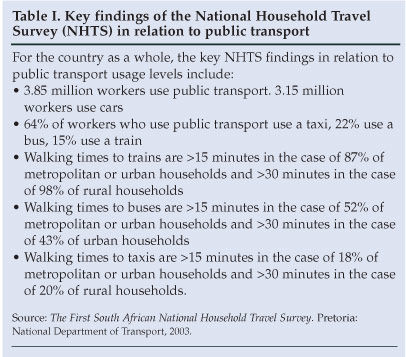
Structural risks include multiple deprivation (e.g. poverty, residence far from employment and services); rapid urbanisation (increased pedestrian and small vehicle numbers); lack of transport infrastructure that separates pedestrians, non-motorised vehicles, motorised vehicles and mass transport; unsafe vehicles (e.g. vehicles that can exceed speed limits, bullbars, lights/indicators out of order); and road design (e.g. poor maintenance, drainage and illumination and absence of absorptive crash barriers, medians and multiple carriageways). Increasing night-time road lighting by 1 candela/m219820Table I. Bus Rapid Transit, a cost-effective and environmentally friendly mass transit alternative, has been proposed and investigated for specific corridors, but has not received the necessary support.
Recommended interventions to reduce RTIs
The hierarchy of road safety interventions (as with safety in general) prioritises sustainable upstream structural interventions that substantially alter the urban and road environment, such as those that develop infrastructure for non-motorised and non-small-vehicle-based mass transport, rather than more downstream interventions targeting behaviour change in road users through, say, education campaigns. Apart from reducing RTIs and mitigating negative environmental effects of urbanisation, these strategies may also promote health if they lead to increased walking and cycling and cleaner air -provided the routes are accessible, convenient and safe. Urban transport infrastructure investment needs to be integrated with urban design and planning and community safety initiatives to ensure that networks are well utilised, highly visible and well policed, highlighting the critical need for effective inter-sectoral action integrating technical engineering and health care expertise.
While numerous interventions are possible for reducing the burden of RTI, the effectiveness of interventions in existing SA road safety strategies has not been established. A strong case can be made for implementing the few more downstream strategies aimed at road-users that have been shown to be effective across numerous settings, such as seatbelts, child restraints, helmet-wearing and the enforcement of speeding and driving-under-the-influence (DUI) legislation. Because the majority of fatally injured drivers exceed the legal BAC limit, the enforcement of DUI legislation should be the top priority intervention for local enforcement agencies and lawmakers, and should follow the implementation guidelines devised by international road safety agencies.16
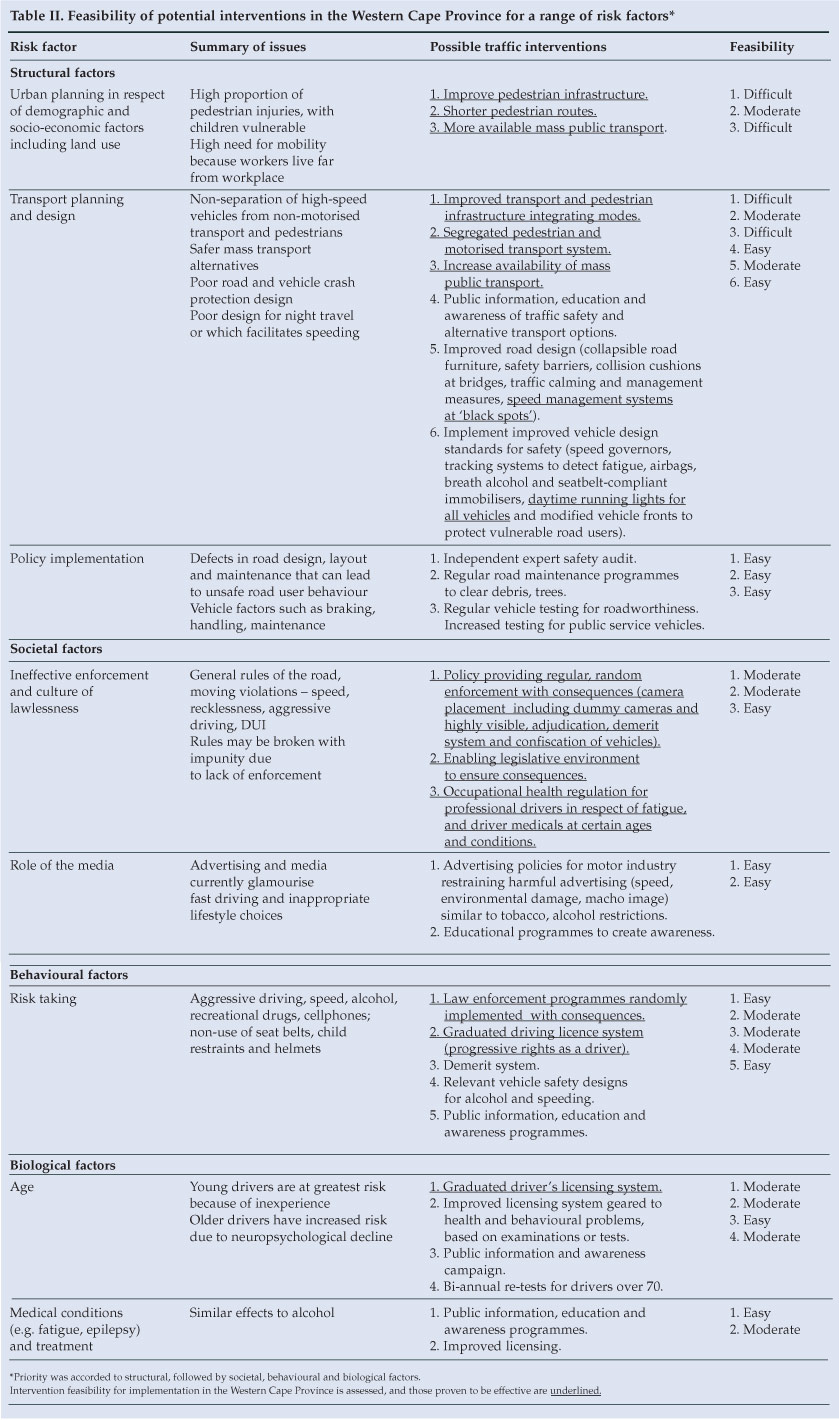
A summary of risks and associated interventions that are feasible in the Western Cape is presented in Table II.
The need for an inter-sectoral approach
It is clear that implementation of these interventions will require effective inter-sectoral action involving government, the private sector, NGOs and the research community. Currently, structures that could support the requisite inter-sectoral action are poorly developed, which hinders comprehensive approaches to prevention that could effectively reduce RTIs.
For example, every effort is required to reduce vehicle speeds, which constitute a major determinant of crash incidence and severity, particularly in areas where fast-moving vehicles, pedestrians and cyclists share the road. Speed limits on urban arterial roads with encroaching informal settlements and areas with substantial pedestrian activity (schools and shops) should be regularly surveyed with a view to road engineering, enforcement or vehicle design solutions. In addition to more effective enforcement, successful interventions will require substantive changes to the socio-cultural landscape (driving behaviours), and restrictions on motor vehicle design and advertising (facilitating and glamourising fast, aggressive driving).
All interventions should be supported by an information system capable of monitoring and evaluating effectiveness and efficiency (costs and benefits). Evaluation should be conducted by an integrated multi-disciplinary team that is independent of implementing agencies, to ensure objectivity and best practice for safety promotion and injury prevention.
Equity aspects in planning and resource allocation are paramount in seeking protection for all road users, as those who do not possess motor vehicles currently bear a disproportionate share of road injury and risk.
References
-
1. Myers JE, Naledi NT. Western Cape Burden of Disease Reduction Project: Overview of the Report. Cape Town: University of Cape Town on behalf of the Provincial; Department of Health, 2007. http://www.capegateway.gov.za/Text/2007/10/cd_volume_1_overview_and_executive_summaries180907.pdf (accessed 12 December 2007).
» http://www.capegateway.gov.za/Text/2007/10/cd_volume_1_overview_and_executive_summaries180907.pdf -
2. Matzopoulos R, Jobanputra R, Myers JE. Road Transport Injury Risk Factor Review and Intervention Analysis: Decreasing the Burden of Traffic-Related Injury. Cape Town: University of Cape Town on behalf of the Provincial Department of Health, 2007. http://www.capegateway.gov.za/Text/2007/10/cd_volume_5_violent_and_traffic_injury_revised_190907.pdf (accessed 12 December 2007).
» http://www.capegateway.gov.za/Text/2007/10/cd_volume_5_violent_and_traffic_injury_revised_190907.pdf -
3. Peden M, Scurfield R, Sleet D, et al. World Report on Road Traffic Injury Prevention. 2004. http://www.who.int/violence_injury_prevention/publications/road_traffic/world_report/en/index.html (accessed 12 December 2007).
» http://www.who.int/violence_injury_prevention/publications/road_traffic/world_report/en/index.html -
4. De Beer EJH, Van Niekerk EC. The estimation of unit costs of road traffic accidents in South Africa. 2004. http://www.arrivealive.co.za/document/FinalReportAccidentCosts2002.pdf (last accessed 7 November 2007).
» http://www.arrivealive.co.za/document/FinalReportAccidentCosts2002.pdf -
5. Bradshaw D, Nannan N, Laubscher R, et al. South African National Burden of Disease Study 2000: Estimates of Provincial Mortality. Cape Town: Medical Research Council, 2004. http://www.mrc.ac.za/bod/estimates.htm (accessed 15 September 2007).
» http://www.mrc.ac.za/bod/estimates.htm -
6. Matzopoulos R, ed. A Profile of Fatal Injuries in South Africa: 6th Annual Report of the National Injury Mortality Surveillance System. Cape Town: Medical Research Council, University of South Africa, Crime, Violence and Injury Lead Programme, 2004. http://www.sahealthinfo.org.za/violence/2004injury.htm (accessed 21 October 2007).
» http://www.sahealthinfo.org.za/violence/2004injury.htm -
7. Bourne D, Bradshaw D, Groenewald P, et al. Institutionalising a Mortality Surveillance System in the Western Cape Province to Measure the Burden of Disease and the Impact of Preventive Interventions. Cape Town: University of Cape Town on behalf of the Provincial Department of Health, 2007. http://www.capegateway.gov.za/Text/2007/6/cd_volume_2_mortality_surveillance.pdf (accessed 12 December 2007).
» http://www.capegateway.gov.za/Text/2007/6/cd_volume_2_mortality_surveillance.pdf -
8. National Department of Transport. The First South African National Household Travel Survey. 2003. http://www.transport.gov.za/projects/nts/techreport/index.html (accessed 21 October 2007).
» http://www.transport.gov.za/projects/nts/techreport/index.html -
9. Arrive Alive. Road Safety Statistics in South Africa. 2007. http://www.arrivealive.co.za/pages.asp?mc=info&nc=AccidentCrashStats (accessed 19 December 2007).
» http://www.arrivealive.co.za/pages.asp?mc=info&nc=AccidentCrashStats -
10. Prinsloo M. In: Matzopoulos R, ed. A Profle of Fatal Injuries in South Africa: 5th Annual Report of the National Injury Mortality Surveillance System. Cape Town: Medical Research Council, University of South Africa, Crime, Violence and Injury Lead Programme, 2004. http://www.sahealthinfo.org.za/violence/injury2004.htm (accessed 21 October 2007).
» http://www.sahealthinfo.org.za/violence/injury2004.htm - 11. Matzopoulos R, Du Toit N, Dawad S, Van As S. Assessing the prevention response to child traffic injuries. In: Van Niekerk A, Suffla S, Seedat M, eds. Crime, Violence and Injury Prevention in South Africa: Developments and Challenges. In press. Cape Town: Medical Research Council, University of South Africa, Crime, Violence and Injury Lead Programme.
- 12. Borkenstein RF, Crowther RF, Shumate RP, Ziel WB, Zylman R. The Role of the Drinking Driver in Traffic Accidents. Bloomington, Indiana: Department of Police Administration, Indiana University, 1964.
- 13. Compton RP, Blomberg RD, Moskowitz H, Burns M, Peck RC, Fiorentino D. Crash risk of alcohol impaired driving. In: Mayhew DR, Dussault C, eds. Proceedings of the Sixteenth International Conference on Alcohol, Drugs and Traffic Safety (ICADTS), 4 - 9 August 2002. Montreal: Société de l'Assurance Automobile du Quebec, 2002.
- 14. Hurst PM, Harte D, Frith WJ. The Grand Rapids dip revisited. Accid Anal Prev 1994; 26: 647654.
- 15. McLean AJ, Holubowycz OT. Alcohol and the risk of accident involvement. In: Goldberg L, ed. Alcohol, Drugs and Traffic Safety. Proceedings of the 8th International Conference on Alcohol, Drugs and Traffic Safety (ICADTS), 15 - 19 June 1980. Stockholm: Almqvist & Wiksell International, 1981.
-
16. Drinking and Driving: A Road Safety Manual for Decision-makers and Practitioners. Geneva: Global Road Safety Partnership, 2007. http://www.fiafoundation.com/resources/documents/128735138_Drinking_and_Driving_Manual.pdf (accessed 8 December 2007).
» http://www.fiafoundation.com/resources/documents/128735138_Drinking_and_Driving_Manual.pdf - 17. Sukhai A, Seedat M, Jordaan E, Jackson D. A city-level study of aggressive road behaviours: Magnitude, predictors and implications for traffic safety. S Afr J Psychol 2005; 35: 244-269.
- 18. Global Road Safety Partnership. Speed Management: A Road Safety Manual for Decision-Makers and Practitioners. Geneva: World Health Organization, 2008.
-
19. National Department of Transport. National Road Safety Strategy: 2006 onwards. 2006. http://www.arrivealive.co.za/documents/safetystrategy/part1.pdf (accessed 12 December 2007).
» http://www.arrivealive.co.za/documents/safetystrategy/part1.pdf - 20. Lerer LB, Matzopoulos R. Meeting the challenge of railway injury in a South African city. Lancet 1996; 348: 664-666.