Sexual and reproductive health and rights of very young adolescents in low- and middle-income countries: A narrative review
BACKGROUND. Very young adolescents (VYAs), aged 10 - 14 years, represent a critical yet frequently neglected demographic in the field of sexual and reproductive health and rights (SRHR) research and programming. This developmental stage is characterised by rapid biological, cognitive, social and emotional changes that shape future sexual and reproductive trajectories. Despite their importance, the SRHR needs of VYAs remain under-represented in policy, research and service provision, particularly in low- and middle-income countries. OBJECTIVES. To synthesise existing evidence on the SRHR needs of VYAs, examine barriers and facilitators to service access, and identify strategies to strengthen age-appropriate SRHR interventions. METHODS. A narrative review of English-language peer-reviewed literature, grey literature and global policy documents published between 2000 and 2024 was conducted using PubMed, Scopus and Google Scholar. Twenty-three relevant sources were included and synthesised thematically. RESULTS. VYAs experience intersecting vulnerabilities related to early pubertal onset, restrictive gender norms, limited access to accurate SRHR information, and health systems that are primarily oriented towards older adolescents and adults. Barriers to SRHR information and services were reported in approximately half of the reviewed sources. Evidence indicates that early, context-specific interventions -particularly comprehensive sexuality education, parental engagement and adolescent-responsive health services - can improve SRHR knowledge and protective behaviours. CONCLUSION. Addressing the SRHR needs of VYAs is essential for advancing public health equity and broader development goals. Integrating tailored, rights-based approaches across health, education and policy frameworks can support healthier transitions through early adolescence.
very young adolescents; sexual and reproductive health; rights-based approach; adolescent health services; comprehensive sexuality education; sub-Saharan Africa
Sexual and reproductive health and rights of very young adolescents in low- and middle-income countries: A narrative review
T Mohamed; Z Nene
FCOG (SA), Cert Reproductive Medicine (SA); Reproductive and Endocrine Unit, Department of Obstetrics and Gynaecology, Faculty of Health Sciences, University of Pretoria and Steve Biko Academic Hospital, Pretoria, South Africa
ABSTRACTBACKGROUND. Very young adolescents (VYAs), aged 10 - 14 years, represent a critical yet frequently neglected demographic in the field of sexual and reproductive health and rights (SRHR) research and programming. This developmental stage is characterised by rapid biological, cognitive, social and emotional changes that shape future sexual and reproductive trajectories. Despite their importance, the SRHR needs of VYAs remain under-represented in policy, research and service provision, particularly in low- and middle-income countries.
OBJECTIVES. To synthesise existing evidence on the SRHR needs of VYAs, examine barriers and facilitators to service access, and identify strategies to strengthen age-appropriate SRHR interventions.
METHODS. A narrative review of English-language peer-reviewed literature, grey literature and global policy documents published between 2000 and 2024 was conducted using PubMed, Scopus and Google Scholar. Twenty-three relevant sources were included and synthesised thematically.
RESULTS. VYAs experience intersecting vulnerabilities related to early pubertal onset, restrictive gender norms, limited access to accurate SRHR information, and health systems that are primarily oriented towards older adolescents and adults. Barriers to SRHR information and services were reported in approximately half of the reviewed sources. Evidence indicates that early, context-specific interventions -particularly comprehensive sexuality education, parental engagement and adolescent-responsive health services - can improve SRHR knowledge and protective behaviours.
CONCLUSION. Addressing the SRHR needs of VYAs is essential for advancing public health equity and broader development goals. Integrating tailored, rights-based approaches across health, education and policy frameworks can support healthier transitions through early adolescence.
Keywords: very young adolescents; sexual and reproductive health; rights-based approach; adolescent health services; comprehensive sexuality education; sub-Saharan Africa
Early adolescence is a pivotal developmental period that shapes long-term health trajectories. Very young adolescents (VYAs), aged 10 - 14 years, undergo rapid physical, cognitive and psychosocial changes that influence sexual and reproductive health and rights (SRHR) outcomes.[1,2] Despite this critical transition, VYAs remain one of the most neglected groups in SRHR research, policy and programming. Their needs are frequently subsumed under broader adolescent health agendas, or addressed primarily in relation to older adolescents, resulting in limited age-specific interventions.[3]
This gap is particularly concerning in low- and middle-income countries (LMICs), where structural inequities, poverty, entrenched gender norms and under-resourced health systems heighten vulnerability.[3,4] In sub-Saharan Africa, early sexual debut, child marriage and harmful sociocultural practices further compound SRHR risk.[4,5] At the same time, early adolescence represents a window of opportunity: timely, developmentally appropriate interventions can improve health literacy, strengthen agency and prevent adverse outcomes such as unintended pregnancy, sexually transmitted infections and gender-based violence.[6-8]
This narrative review synthesises evidence on the SRHR needs of VYAs, examines barriers to information and services, and highlights strategies to strengthen early adolescent-focused interventions.
Methods
A narrative literature review was conducted to synthesise current evidence on SRHR among very young adolescents aged 10 - 14 years. Searches were performed in PubMed, Scopus and Google Scholar for English-language publications from 2000 to 2024 using combinations of the terms 'very young adolescents', 'early adolescence', 'sexual and reproductive health', 'comprehensive sexuality education' and 'adolescent-friendly services'. Titles and abstracts were screened, followed by full-text review.
Eligible sources included peer-reviewed empirical studies, narrative and systematic reviews, and global or regional policy and programmatic documents addressing SRHR determinants, services or policy implications relevant to early adolescence, with a particular focus on LMIC settings. Grey literature from international agencies was included where relevant. After screening, 23 sources met inclusion criteria and were synthesised thematically. Given ethical and regulatory constraints limiting empirical research among adolescents aged 10 - 14 years, the review prioritised interpretive thematic synthesis rather than quantitative aggregation.[3,9]
Results
The thematic synthesis identified five inter-related domains shaping SRHR outcomes among VYAs.
Developmental transitions during early adolescence
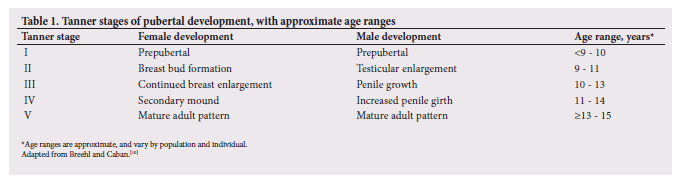
Pubertal onset introduces significant biological changes, including hormonal shifts that result in the development of age-appropriate secondary sexual characteristics (Table 1) and the acquisition of reproductive capability.[10,11] These changes occur alongside evolving cognitive capacity and heightened sensitivity to peer and social influence.[6] Earlier pubertal onset, particularly among girls, increases vulnerability to SRHR risks when not accompanied by age-appropriate information and supportive environments.[1,7]
Social and structural determinants
Gender norms, poverty, educational access and sociocultural practices strongly influence SRHR knowledge and agency among VYAs.[3,12] In many settings, girls face expectations related to virginity, marriageability and fertility, while boys encounter norms linked to masculinity and sexual dominance.[4] School retention consistently emerges as a protective factor through access to information, structured environments and social support.[13]
Barriers to SRHR information and services
Approximately half of the reviewed sources identified significant barriers to SRHR information and services for VYAs.[3,4] Health systems are often designed for adults or older adolescents, with limited adolescent-friendly infrastructure and provider training.[14] Legal and consent requirements, stigma surrounding early adolescent sexuality and provider discomfort further restrict access. Ethical and regulatory challenges also limit inclusion of VYAs in research, contributing to persistent evidence gaps.[9
Facilitators and effective interventions
Evidence supports the effectiveness of comprehensive sexuality education delivered in age-appropriate and culturally sensitive formats.[13] Programmes engaging parents and caregivers improve communication and support, while adolescent-responsive health services enhance acceptability and uptake.[14] Digital platforms and school-based interventions show promise in expanding access to SRHR information in resource-limited settings.[4]
Policy and research gaps
A lack of age-disaggregated data, limited evaluation of VYA-specific interventions and under-representation of marginalised groups remain key gaps across the literature.[3,9]
Discussion
The SRHR needs of VYAs represent a critical yet under-recognised dimension of public health. This review demonstrates that early adolescence is a period of heightened vulnerability owing to the convergence of biological maturation, evolving cognitive capacity and restrictive social environments.[1,10,11] Earlier pubertal onset, in the absence of age-appropriate information and supportive services, increases exposure to risks such as unintended pregnancy, sexually transmitted infections and gender-based violence.[6-8] At the same time, this developmental stage offers a strategic opportunity for early intervention with long-term benefits.
The findings highlight a persistent misalignment between the timing of adolescents' SRHR needs and the design of existing health and education systems. Many SRHR interventions and policies remain oriented towards older adolescents, often extrapolating approaches that may not be developmentally appropriate for younger adolescents.[3,4] Such extrapolation risks overlooking the specific informational, psychosocial and service needs of VYAs, and may limit the effectiveness of SRHR programming.
A key issue emerging from the reviewed literature is the systematic exclusion of VYAs from SRHR research. Ethical and regulatory concerns -particularly those related to informed consent, parental involvement and perceived vulnerability - frequently limit the inclusion of adolescents aged 10 - 14 years in empirical studies.[3,4] While the protection of minors is essential, overly restrictive frameworks may inadvertently contribute to evidence gaps, leaving policy-makers and practitioners without adequate data to guide age-appropriate interventions. As a result, programme design often relies on indirect evidence derived from older adolescents, which may not accurately reflect the lived experiences and developmental realities of early adolescence.[9]
Emerging scholarship emphasises the need for ethically robust and developmentally sensitive research approaches that balance protection with participation.[3,4] Strategies such as assent-based models, structured caregiver engagement and context-specific consent processes have been proposed to facilitate the ethical inclusion of VYAs in SRHR research while safeguarding their wellbeing. Strengthening ethical guidance, institutional capacity and researcher training in this area is critical to improving the quality and relevance of evidence informing policy and programme development.[13,15]
Collectively, these findings underscore the need to move beyond risk-focused approaches towards rights-based, multisectoral strategies that recognise VYAs as active agents in their own health.[13,14] Integrating tailored SRHR interventions into health, education and social systems, supported by responsive policy frameworks, is essential for advancing health equity and achieving broader public health and development goals.
Conclusion
VYAs represent a critical yet neglected population in SRHR discourse. Earlier pubertal onset combined with persistent social and structural barriers underscores the need for tailored, rights-based interventions. Strengthening access to age-appropriate education and adolescent-responsive health services during early adolescence is essential for improving long-term sexual and reproductive health outcomes and advancing public health equity.
Declaration. None.
Acknowledgements. None.
Author contributions. TM conceptualised and drafted the manuscript.
ZN critically reviewed the manuscript and provided academic oversight.
Both authors approved the final version.
Funding. None.
Conflicts of interest. None.
References
-
1. Eckert-Lind C, Busch AS, Petersen JH, et al. Worldwide secular trends in age at pubertal onset assessed by breast development among girls. JAMA Pediatr 2020;174(4):e195881. https://doi.org/10.1001/jamapediatrics.2019.5881
» https://doi.org/10.1001/jamapediatrics.2019.5881 -
2. World Health Organization. Adolescent health. Geneva: WHO, 2026. https://www.who.int/health-topics/adolescent-health (accessed 6 January 2026).
» https://www.who.int/health-topics/adolescent-health -
3. Woog V, Kâgesten A. The sexual and reproductive health needs of very young adolescents aged 10 - 14 in developing countries: What does the evidence show? New York: Guttmacher Institute, 2017. https://www.guttmacher.org/report/srh-needs-very-young-adolescents-in-developing-countries (accessed 6 January 2026).
» https://www.guttmacher.org/report/srh-needs-very-young-adolescents-in-developing-countries -
4. Jing Z, Li J, Wang Y, Zhou C. Prevalence and trends of sexual behaviours among young adolescents aged 12 - 15 years in LMICs. JMIR Public Health Surveill 2023;9:e45236. https://doi.org/10.2196/45236
» https://doi.org/10.2196/45236 -
5. Raj A, Boehmer U. Girl child marriage and its association with national rates of HIV, maternal health, and infant mortality. Violence Against Women 2013;19(4):536-551. https://doi.org/10.1177/1077801213487747
» https://doi.org/10.1177/1077801213487747 -
6. Downing J, Bellis MA. Early pubertal onset and its relationship with sexual risk taking, substance use and anti-social behaviour. BMC Public Health 2009;9:446. https://doi.org/10.1186/1471-2458-9-446
» https://doi.org/10.1186/1471-2458-9-446 -
7. Cheng TS, Ong KK, Biro FM. Adverse effects of early puberty timing in girls and potential solutions. J Pediatr Adolesc Gynecol 2022;35(5):532-535. https://doi.org/10.1016/j.jpag.2022.05.005
» https://doi.org/10.1016/j.jpag.2022.05.005 -
8. Golub MS, Collman GW, Foster PM, et al. Public health implications of altered puberty timing. Pediatrics 2008;121(Suppl 3):S218-S230. https://doi.org/10.1542/peds.2007-1813G
» https://doi.org/10.1542/peds.2007-1813G -
9. Igras SM, Macieira M, Murphy E, Lundgren R. Investing in very young adolescents' sexual and reproductive health. Glob Public Health 2014;9(5):555-569. https://doi.org/10.1080/17441692.2014.908230
» https://doi.org/10.1080/17441692.2014.908230 -
10. Breehl L, Caban O. Physiology and puberty. Treasure Island: StatPearls Publishing, 2023 (https://www.ncbi.nlm.nih.gov/books/NBK534827/) (accessed 6 January 2026).
» https://www.ncbi.nlm.nih.gov/books/NBK534827/ -
11. Cheng TS, Ong KK, Biro FM. Trends toward earlier puberty timing in girls and its likely mechanisms. J Pediatr Adolesc Gynecol 2022;35(5):527-531. https://doi.org/10.1016/j.jpag.2022.04.009
» https://doi.org/10.1016/j.jpag.2022.04.009 -
12. Barron P, Subedar H, Letsoko M, et al. Teenage births and pregnancies in South Africa, 2017 - 2021. 5 Afr Med J 2022;112(4):252-258. https://doi.org/10.7196/SAMJ.2022.v112i4.16327
» https://doi.org/10.7196/SAMJ.2022.v112i4.16327 -
13. United Nations. The Sustainable Development Goals. New York: UN, 2023. https://www.un.org/sustainabledevelopment/health/ (accessed 6 January 2026).
» https://www.un.org/sustainabledevelopment/health/ -
14. Strode A, Essack Z. Facilitating access to adolescent sexual and reproductive health services through legislative reform. S Afr Med J 2017;107(9):741-744. https://doi.org/10.7196/SAMJ.2017.v107i9.12425
» https://doi.org/10.7196/SAMJ.2017.v107i9.12425 -
15. World Health Organization. Menstrual health and rights statement. Geneva: WHO, 2022. https://www.who.int/news/item/22-06-2022-who-statement-on-menstrual-health-and-rights (accessed 6 January 2026).
» https://www.who.int/news/item/22-06-2022-who-statement-on-menstrual-health-and-rights

Accepted 7 January 2026