State hospitals, academic medicine and the decline of health care in South Africa: a cry of support from those who have left for those who stay
State hospitals, academic medicine and the decline of health care in South Africa - a cry of support from those who have left for those who stay
To the Editor: We read with much interest the comments of Dr Parkes and colleagues in the SAMJ.1
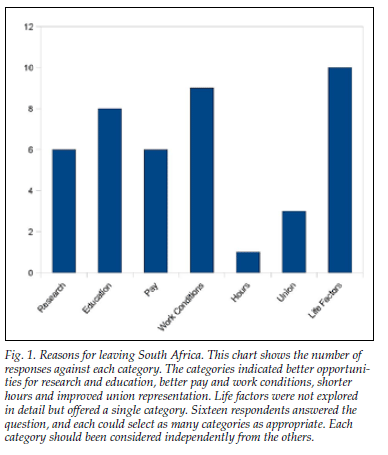
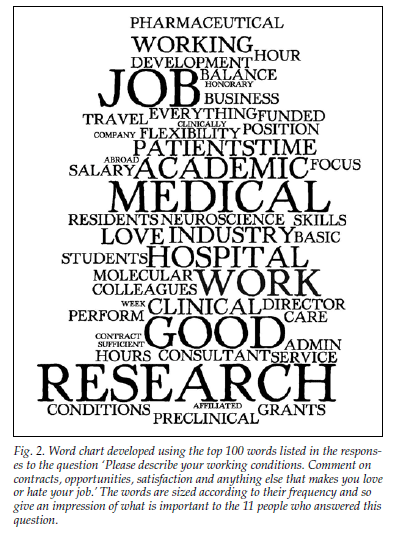
The migration of doctors from Africa to the developing world has been much discussed2-4 and has been well described in the South African context.5 5 Fig. 1, are comparable to those described by Bezuidenhout et al.5 Fig. 2 is a word chart derived from the descriptions of working environments.
The failure of government to understand that the reason for migration is poor pay and working conditions coupled with the powerlessness of doctors to change these factors has contributed to the decline of service at state hospitals and academic institutions. In a recent briefing to a parliamentary portfolio committee on health, the concern was expressed that South African medical research is heading for extinction. Many researchers in South Africa are in their 80s, and there are few publications by people under 30.6
From a distance it is difficult to comment on the effect of the loss of specialists and senior specialists on the training of medical students and registrars. However, a UK medical student has stated that is an embarrassment for medical educators in South Africa.7
We hope that the South African public supports their doctors, and particularly those who train others. The reputation of South African-trained doctors around the world is outstanding, owing to the excellent training received from the doctors who committed themselves to public service. It is sad that this service is not adequately compensated or acknowledged by the government and the people of South Africa. Those working overseas will be paid better, enjoy better benefits and have a better quality of work life with far superior support for teaching and research than classmates who choose to stay behind. We take our hats off to those who do decide to stay, as they have chosen to teach and train future South African doctors who it is hoped will be as well qualified as the previous generations. Cynically, the government may not want good doctors, in order to prevent those trained in South Africa from leaving. If that is the case every South African will have difficulty accessing decent health care in the future. It is unlikely that those who have established careers out of South Africa will return, but our plea is for South Africa to make staying an attractive and possible career choice for South African doctors. In addition, the possibility of returning would become reality if we knew that working conditions and pay were reasonable and fair.
Andrew C Don-Wauchope
Department of Pathology and Molecular Medicine
McMaster University
Hamilton, ON
Canada
Andreas Karas
Health Protection Agency
Cambridge UK
Vasudhevan T Chetty
Department of Pathology and Molecular Medicine
McMaster University
Howard K Davidson
Family Physician
Kelowna, BC
Canada
Raymond Gottschalk
Department of Medicine
McMaster University
Eugenii A Rabiner
GSK Clinical Imaging Centre
Imperial College
London
UK
Flora Sam
Department of Medicine
Division of Cardiology and Whitaker Cardiovascular Institute
Boston University School of Medicine
Boston, MA
USA
Garth P Sommerville
Department of Anaesthetics
Tunbridge Wells
UK
Jina Swartz
Eisai Ltd
Hatfield
UK
Adie Viljoen
Department of Pathology Stevenage
UK
References
- 1. Parkes JD, Abratt RP, Taylor A, et al. How has the OSD affected our state hospitals? S Afr Med J 2009; 99: 788-789.
- 2. Bundred PE, Levitt C. Medical migration: who are the real losers? Lancet 2000; 356: 245-246.
- 3. Hagopian A, Thompson MJ, Fordyce M, Johnson KE, Hart LG. The migration of physicians from sub-Saharan Africa to the United States of America: measures of the African brain drain. Hum Resour Health 2004; 2(1): 17.
- 4. Price M, Weiner R. Where have all the doctors gone? Career choices of Wits medical graduates. S Afr Med J 2005; 95(6): 414-419.
- 5. Bezuidenhout MM, Joubert G, Hiemstra LA, Struwig MC. Reasons for doctor migration from South Africa. South African Family Practice 2009; 51(3): 211-215.
-
6. Lancet Global Health Network. www.thelancetglobalhealthnetwork.com/ (accessed 28 October 2009).
» www.thelancetglobalhealthnetwork.com/ - 7. Kirkman MA. Medical electives in South Africa. S Afr Med J 2009; 99: 789-790.