Huntington's disease: Genetic heterogeneity in black African patients
OBJECTIVE: Huntington's disease (HD) has been reported to occur rarely in black patients. A new genetic variant-Huntington's disease-like 2 (HDL2) - occurring more frequently in blacks, has recently been described. The absence of an expanded trinucleotide repeat at the chromosome 4 HD locus was previously regarded as a way of excluding classic HD. The objective of this paper is to describe a number of black patients with genetically proven HD and to review its occurrence in Africa. METHODS: Eleven black families (12 subjects), with genetically proven HD, are described: 9 from the Dr George Mukhari Hospital, and 2 from private practice in Tshwane. RESULTS: Chorea was present in all 12 patients and cognitive decline in 9. Nine had an age of onset between 30 and 50 years. Six families exhibited expansion of the trinucleotide repeat at the chromosome 4, IT 15 gene (HD), and 5 a junctophilin (JPH3) trinucleotide expansion at chromosome 16 (HDL2). The HDL2 subtype showed a tendency towards a later age of onset. CONCLUSIONS: The clinical presentation of the two genotypes (i.e. HD and HDL2) appears to be similar. The actual rate of occurrence of HD in blacks may require re-assessment. Considering the number of Huntington's chorea patients occurring in our area (Garankuwa), the possibility of clustering of the condition arises.
Huntington's disease: Genetic heterogeneity in black African patients
D S MagaziI; V BonevII; M MoagiBIII; Z IqbalIV; M DludlaV; C H van der MeydenVI; A KrauseVII
IMB BCh, MMed (Neurol), FCP (Neurol) (SA). Department of Neurology, Dr George Mukhari Hospital, University of Limpopo (Medunsa campus), Gauteng
IIMB ChB, FCN (SA). Department of Neurology, Dr George Mukhari Hospital, University of Limpopo (Medunsa campus), Gauteng
IIIMB Ch. Department of Neurology, Dr George Mukhari Hospital, University of Limpopo (Medunsa campus), Gauteng
IVBSc, MBBS. Department of Neurology, Dr George Mukhari Hospital, University of Limpopo (Medunsa campus), Gauteng
VMB ChB. Department of Neurology, Dr George Mukhari Hospital, University of Limpopo (Medunsa campus), Gauteng
VIMB BCh, FCP (SA), MD. Department of Neurology, Dr George Mukhari Hospital, University of Limpopo (Medunsa campus), Gauteng
VIIMB BCh, PhD. Division of Human Genetics, School of Pathology, National Health Laboratory Service and University of the Witwatersrand, Johannesburg
OBJECTIVE: Huntington's disease (HD) has been reported to occur rarely in black patients. A new genetic variant-Huntington's disease-like 2 (HDL2) - occurring more frequently in blacks, has recently been described. The absence of an expanded trinucleotide repeat at the chromosome 4 HD locus was previously regarded as a way of excluding classic HD. The objective of this paper is to describe a number of black patients with genetically proven HD and to review its occurrence in Africa.
METHODS: Eleven black families (12 subjects), with genetically proven HD, are described: 9 from the Dr George Mukhari Hospital, and 2 from private practice in Tshwane.
RESULTS: Chorea was present in all 12 patients and cognitive decline in 9. Nine had an age of onset between 30 and 50 years. Six families exhibited expansion of the trinucleotide repeat at the chromosome 4, IT 15 gene (HD), and 5 a junctophilin (JPH3) trinucleotide expansion at chromosome 16 (HDL2). The HDL2 subtype showed a tendency towards a later age of onset.
CONCLUSIONS: The clinical presentation of the two genotypes (i.e. HD and HDL2) appears to be similar. The actual rate of occurrence of HD in blacks may require re-assessment. Considering the number of Huntington's chorea patients occurring in our area (Garankuwa), the possibility of clustering of the condition arises.
George Huntington's description of Huntington's disease (HD) in 1872 (at the age of 22 years) remains the basic pillar of diagnosis: 'A hereditary chorea, tendency to insanity and suicide and its manifesting itself as a grave disease in adulthood'.1234
Harper, in an article on the epidemiology of HD, suggested the presence of a separate mutation in people of black African origin.567
Methods
Eleven families (12 subjects) with genetically diagnosed HD were identified and described: 9 were seen at Dr George Mukhari Hospital (between January 2004 and December 2005) and 2 were from private practice in Tshwane, with 1 of the latter families seen between 2001 and 2002. The genetic tests were performed at the Division of Human Genetics, School of Pathology, National Health Laboratory Service (NHLS) and University of the Witwatersrand, Johannesburg. Every patient was assessed clinically by a qualified neurologist. A Mayo Mini Mental test8
Results
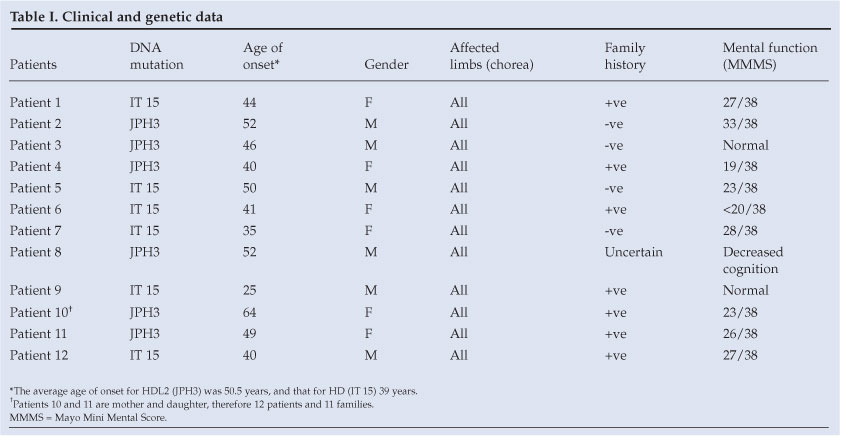
The clinical and genetic data are summarised in Table I. Six patients showed the clinical triad of an autosomal dominant family history, chorea and dementia. Nine of the 12 subjects presented with a combination of chorea and dementia. Chorea affecting all 4 limbs was present in every subject. The facial and neck movements were not observed in 1. The dementia was of a moderate to severe degree, and no patient had a picture of bradykinetic rigidity. No history of mixed ancestry could be obtained.
Six patients had an IT 15 mutation on chromosome 4 (HD1), and another 6 had a JPH3 mutation (HDL2). Those patients with a JPH3 (HDL2) abnormality tended to have a later age of onset for the chorea (average age of onset 50.5 years compared with 39 years for the IT 15 mutation). There was otherwise no recognisable difference in clinical presentation between the patients with HD1 and those with HDL2. We were unable to obtain a positive family history in 4 patients, who were proven genetically to suffer from the condition (2 with HD1, and the other 2 with HDL2).
Discussion
The diagnosis of HD has rested mainly on the clinical triad of an autosomal dominant family history, a history of progressive chorea, and dementia (usually presenting in middle adult life).1
Having undertaken a detailed enquiry, we found that 4 patients had an apparently negative family history. De novo mutations in HD have rarely been described but do not appear to be a well-recognised phenomenon.9,10 It is more likely that information was missing in the patients' histories that may require further evaluation.
The discovery of a second genetic locus, resulting in HDL2,711
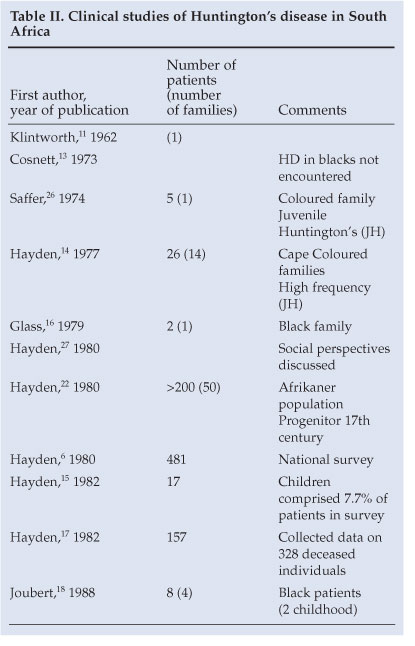
A synopsis of disease reports on clinical HD in South Africa appears in Table II. A report of a suspected patient with HD in a Zulu family appeared in 1962.12131414,15 In 1979, Glass and Saffer reported Huntington's chorea in a black family.16661718192021
HD was reported to be prevalent among the Afrikaner population of South Africa;2222
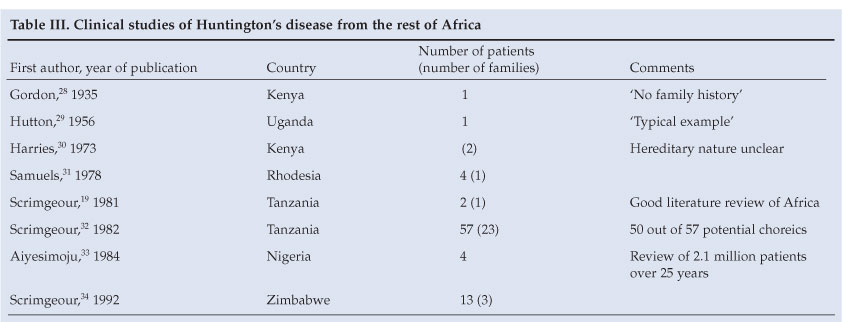
A synopsis of clinical HD reports from the rest of Africa is shown in Table III. Scrimgeour and Simpson,23
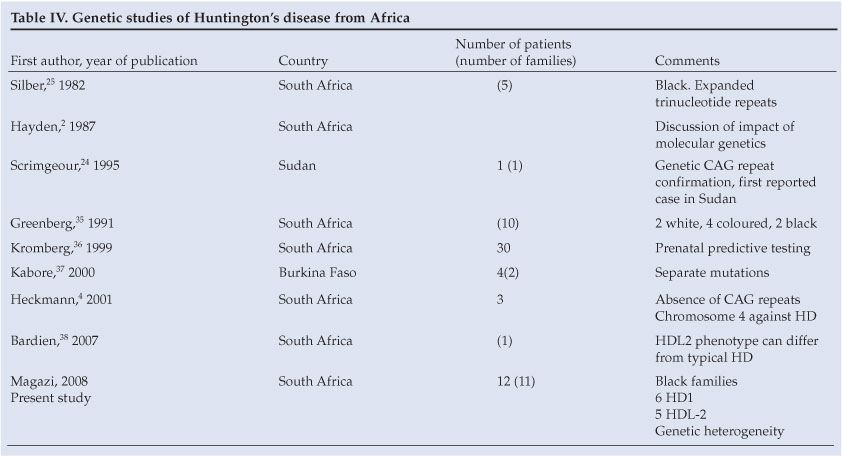
Table IV presents a summary of genetic studies on HD from Africa. Scrimgeour et al.24254
References
- 1. Huntington G. On chorea (an essay read before the Meigs and Mason Academy of Medicine at Middleport, Ohio, February 1872). Barbeau A, Chase NT, Paulson GW, eds. Advances in Neurology. New York: Raven Press, 1973: 33-35.
- 2. Hayden MR, Goldblatt J, Wallis G, Winship IM, Beighton P. Molecular genetics and Huntington's disease. The South African situation. S Afr Med J 1987; 71: 683-686.
- 3. Kremer B, Goldberg P, Andrew SE et al. A worldwide study of the Huntington's disease mutation: the sensitivity and specificity of measuring CAG repeats. N Engl J Med 1994; 330: 1401-1406.
- 4. Heckmann JM, Bryer A, Greenberg LJ. When is it not Huntington's disease? S Afr Med J 2001; 91(2): 132-133.
- 5. Harper PS. The epidemiology of Huntington's disease. Hum Genet 1992; 89: 365-376.
- 6. Hayden MR, MacGregor JM, Beighton PH. The prevalence of Huntington's chorea in South Africa. S Afr Med J 1980; 58: 193-196.
- 7. Holmes SE, O'Hearn E, Rosenblatt A, et al. A repeat expansion in the gene encoding junctophilin - 3 is associated with Huntington disease-like 2. Nat Genet 2001; 29: 377-378.
- 8. Kokmen E, Naessens JM, Offord KP. A test of mental status: a description and preliminary results. Mayo Clin Proc 1987; 62 (4): 281-288.
- 9. Bozza A, Malagu S, Calzolari E, Novelletto A, Pavoni M, del Senno L. Expansion of a (CAG)n repeat region in a sporadic case of HD. Acta Neurol Scand 1995: 92: 132-134.
- 10. Watanabe M, Satoh A, Kanemoto M, Ohkoshi N, Shoji S. De novo expansion of a CAG repeat in a Japanese patient with sporadic Huntington's disease. J Neurol Sci 2000; 178: 159-162.
- 11. Takeshima H, Komazaki S, Nishi M, Iino M, Kangawa K. Junctophilins: a novel family of junctional membrane complex proteins. Mol Cell 2000; 6(1): 11-22.
- 12. Klintworth GK. Huntington's chorea in South Africa. A preliminary communication drawing attention to its frequent occurrence. S Afr Med J 1962; 36: 896-898.
- 13. Cosnett JE. Neurological disease in Natal. In: Spillane JD, ed. Tropical Neurology. London: Oxford University Press, 1973: 259-272.
- 14. Hayden MR, Beighton P. Huntington's chorea in the Cape Coloured community of South Africa. S Afr Med J 1977; 52: 886-888.
- 15. Hayden MR, Macgregor JM, Saffer DS, Beighton PH. The high frequency of juvenile Huntington's chorea in South Africa. J Med Genet 1982; 19: 94-97.
- 16. Glass J, Saffer DS. Huntington's chorea in a black family. A report of 2 cases. S Afr Med J 1979; 56: 685-688.
- 17. Hayden MR, Beighton P. Genetic aspects of Huntington's chorea. Results of a national survey. Am J Med Genet 1982; 11: 135-141.
- 18. Joubert J, Botha MC. Huntington disease in South African blacks. A report of 8 cases. S Afr Med J 1988; 73: 489-494.
- 19. Scrimgeour EM. Huntington's disease in Tanzania. J Med Genet 1981; 18: 200-203.
- 20. Folstein SE, Chase GA, Wahl WE, McDonnell AN, Folstein MF. Huntington disease in Maryland: clinical aspects of racial variation. Am J Hum Genet 1987; 41: 168-179.
- 21. Wright HH, Still CN, Abramson RK. Huntington's disease in black kindreds in South Carolina. Arch Neurol 1981; 38: 412-414.
- 22. Hayden MR, Hopkins HC, Macrae M, Beighton PH. The origin of Huntington's chorea in the Afrikaner population of South Africa. S Afr Med J 1980; 58: 197-200.
- 23. Scrimgeour EM, Simpson SA. Huntington disease in black African populations (letter). Hum Genet 1992; 90(1-2): 186-187.
- 24. Scrimgeour EM, Samman Y, Brock DJ. Huntington's disease in a Sudanese family from Khartoum. Hum Genet 1995; 96(5): 624-625.
- 25. Silber E, Kromberg J, Temlett JA, Krause A, Saffer D. Huntington's disease confirmed by genetic testing in five African families. Mov Disord 1998; 13(4): 726-730.
- 26. Saffer DS, Nathan DC, Kahle PA, Steingo B. Huntington's disease in a coloured family. S Afr Med J 1974; 48: 2399-2402.
- 27. Hayden MR, Ehrlich R, Parker H, Ferera SJ. Social perspectives in Huntington's chorea. S Afr Med J 1980; 58: 201-203.
- 28. Gordon HL. Huntington's chorea in an East African. Proc R Soc Med 1935; 29: 1469-1470.
- 29. Hutton PW. Neurological disorders in Uganda. East Afr Med J 1956: 33: 209-223.
- 30. Harries JR. Neurological disorders in Kenya. In: Spillane JD, ed. Tropical Neurology. London: Oxford University Press, 1973: 207-222.
- 31. Samuels BL, Gelfand M. Huntington's chorea in a Black Rhodesian family. S Afr Med J 1978; 54: 648-651.
- 32. Scrimgeour EM. The Huntington's chorea register of Tanzania. East Afr Med J 1982; 59(4): 280-282.
- 33. Aiyesimoju BO, Osuntokun BO, Bademosi O, Adeuja AO. Hereditary neurodegenerative disorders in Nigerian Africans. Neurology 1984; 34: 361-362.
- 34. Scrimgeour EM, Pfumojena JW. Huntington disease in black Zimbabwean families living near the Mozambique border. Am J Med Genet 1992; 44: 762-766.
- 35. Greenberg LJ, Martell RW, Theilman J, Hayden MR, Joubert J. Genetic linkage between Huntington disease and the D4S10 locus in South African families: further evidence against non-allelic heterogeneity. Hum Genet 1991; 87: 701-708.
- 36. Kromberg JGR, Krause A, Spurdle AB, et al. Utilisation of predictive prenatal and diagnostic testing for Huntington's disease in Johannesburg. S Afr Med J 1999; 89(7): 774-778.
- 37. Kabore J, Ouedraogo A. Huntington disease in Burkina Faso. Rev Neurol (Paris) 2000;156(12): 1157-1158.
- 38. Bardien S, Abrahams F, Soodyall H, et al. A South African mixed ancestry family with Huntington disease like 2: Clinical and genetic features. Mov Disord 2007; 22(14): 2083-2089.