A paradoxical reduction in upper genital tract infection despite the massive HIV epidemic
Nomonde GumataI; Robert PattinsonII
IMB ChB, FCOG (SA) Department of Obstetrics and Gynaecology, Kalafong Hospital and University of Pretoria
IIMD, FRCOG, FCOG (SA)Department of Obstetrics and Gynaecology, Kalafong Hospital and University of Pretoria
To the Editor: Upper genital tract infection (UGTI), which is also referred to as pelvic inflammatory disease (PID), is one of the most common serious gynaecological disorders that affect women in their reproductive years, with very serious long-term consequences such as chronic pelvic pain, ectopic pregnancy and infertility.1 Nesseria gonorrhoeae, Chlamydia trachomatis and anaerobes. It can be clinically classified into uncomplicated (absence of tubo-ovarian abscess (TOA)) or complicated (presence of TOA).1
Complicated UGTI occurs in 15 - 33% of women with STI.1 1 2 2
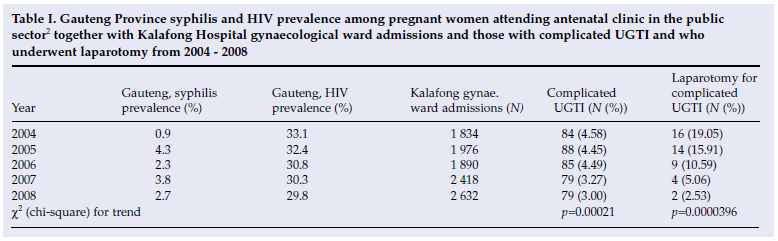
Over the past 5 years (2004 - 2008), Kalafong Hospital had a low but fairly constant number of admissions for complicated UGTI (between 3% and 4.6%) (Table I) compared with the 22% average stated in the American literature.3 4 Table I) among pregnant women attending public sector health services in Gauteng Province.5
The low rate of patients admitted with complicated UGTI seen at Kalafong Hospital is, however, consistent with the low prevalence of syphilis (which is an STI) seen among pregnant women attending antenatal visits in public sector clinics in Gauteng province over the past 5 years, which has ranged between 0.9% and 4.3% (Table I).5
Kalafong Hospital, over the same 5-year period (2004 - 2008), also experienced a significant reduction in the number of women failing to respond to treatment (p=0.00021) and necessitating surgical intervention in the form of laparotomy, from 19.5% in 2004 to 2.5% in 2008 (p=0.0000396) (Table I). This rate is lower than the 25% average rate stated in the American literature.6
These observations led to questions, speculations and postulations on possible causes for this drastic decline in surgical interventions for complicated UGTIs seen at Kalafong Hospital and an interest as to whether such a decline was seen in other provinces.
The postulations could be related mainly to strategies that target the risk factors associated with UGTI, such as young age, multiple sexual partners and poor socio-economic circumstances.7 7,8
Strategies targeting the youth have an effect on reducing STI rates.7 7 7 7
An emerging awareness of the HIV/AIDS epidemic has been shown to lead to behavioural change.7 7
Behavioural changes such as reducing the number of sexual partners have been reported to reduce STI prevalence.7 7 8,9
Appropriate syndromic management comprises the provision of antibiotics, condoms, partner notification cards and written information.9 5 5 5 9
Condom use has a proven efficacy in STI prevention.7 7 7 7 7
Conclusion
Comprehensive syndromic management of STIs (mainly antibiotics and condom use) might have contributed to a reduction in complicated UGTI warranting surgical intervention seen at Kalafong Hospital. It would be interesting to establish whether other units in the country have experienced similar effects, and especially units in KwaZulu- Natal, which has the highest HIV prevalence and the second-lowest syphilis prevalence in the country.2
References
- 1. Green-top Guidelines No. 32. Management of Pelvic Inflammatory Disease. London: Royal College of Obstetrician and Gynaecologists, 2008: 1-11.
- 2. Irwin KL, Moorman AC, O'Sillivan MJO, et al. Influence of human immunodeficiency virus infection on pelvic inflammatory disease. Obstet Gynaecol 2000; 95: 525-534.
- 3. Sweet RL. Pelvic inflammatory disease and infertility in women. Infect Dis Clin North Am 1987; 1: 199-215.
-
4. The South African HIV Survey 2008. Pretoria: Department of Health. http://www.doh.gove.za (accessed 6 April 2010).
» http://www.doh.gove.za -
5. Department of Health. National HIV, Syphilis Prevalence Survey of Women attending Public Antenatal Clinics in South Africa. 2008. Pretoria: Department of Health. http://www.doh.gov.za (accessed 6 April 2010).
» http://www.doh.gov.za - 6. Nelson AL, Sinow RM, Oliak D. Transrectal ultrasonographically guided drainage of gynaecologic pelvic abscesses. Am J Obstet Gynecol 2000; 182: 1382-1388.
- 7. Shisana O, Rehle T, Simbayi LC, et al. South African National HIV Prevalence, Incidence, Behavioural and Communication Survey: A Turning Tide among Teenagers? Cape Town: HSRC Press, 2008.
- 8. Colvin M, Bachmann MO, Homan RK, et al. Effectiveness and cost effectiveness of syndromic sexually transmitted infection packages in South African primary care: cluster randomized trial. Sex Transm Inf 2006; 82: 290-294.
- 9. Steen R, Vuylsteke BEA, DeCoito T, et al. Evidence of declining STD prevalence in a South African mining community following a core-group intervention. Sex Trans Dis 2000; 27 (1): 1-8.