Depressive symptoms among community service doctors in South Africa
BACKGROUND: Medical doctors face occupational stressors threatening their mental health, particularly junior doctors in South Africa. There is a higher prevalence of depressive symptoms among medical doctors compared with the general population. The consequences of this to health systems and the patients doctors treat is a major public health concern. In South Africa, prevalence of depressive symptoms among community service doctors servicing public sector healthcare is largely unknown. OBJECTIVES: To determine the prevalence of possible depression, and predictive factors thereof, among doctors in their community service year in South Africa. METHODS: A national descriptive cross-sectional survey was distributed electronically between October and December 2022. The Patient Health Questionnaire 9 (PHQ-9) was used to screen for depression. Demographic, occupational and individual characteristics were included as potential predictive factors. RESULTS: A total of 217 participants were included in the analyses. Prevalence of depressive symptoms was 96.3% (standard error 0.13, 95% confidence interval 92.87 - 98.40%). Predictors of higher scores included: women, drug use, feeling neutral or disagreeing that one worked outside of normal working hours, working in KwaZulu-Natal or North West, burnout (emotional exhaustion), working in orthopaedics, obstetrics and gynaecology departments or the National Health Laboratory Service, first choice of placement, financial difficulties, and accessing mental health services. Predictors of a lower score included: perceiving sufficient resources at work, using colleagues to cope, good work-life balance, and certain departments, particularly neurosurgery. CONCLUSION: There is an extremely high prevalence of depressive symptoms among community service doctors. Supporting these doctors at an individual, organisational and structural level should be a priority for national policy-makers.
mental health; medical doctors; junior doctors; South Africa; occupational health; depression; burnout
Depressive symptoms among community service doctors in South Africa
T MorarI; G M PurbrickII
IMB ChB, DMH, FCPsych (SA), MMed Psych, PG Dip HSE, MRCPsych; Department of Psychiatry, Faculty of Health Sciences, University of the Witwatersrand, Johannesburg, South Africa
IIMB BCh, DipPEC, MMED (Psych), FCPsych (SA); Department of Psychiatry, Faculty of Health Sciences, University of the Witwatersrand, Johannesburg, South Africa
BACKGROUND: Medical doctors face occupational stressors threatening their mental health, particularly junior doctors in South Africa. There is a higher prevalence of depressive symptoms among medical doctors compared with the general population. The consequences of this to health systems and the patients doctors treat is a major public health concern. In South Africa, prevalence of depressive symptoms among community service doctors servicing public sector healthcare is largely unknown.
OBJECTIVES: To determine the prevalence of possible depression, and predictive factors thereof, among doctors in their community service year in South Africa.
METHODS: A national descriptive cross-sectional survey was distributed electronically between October and December 2022. The Patient Health Questionnaire 9 (PHQ-9) was used to screen for depression. Demographic, occupational and individual characteristics were included as potential predictive factors.
RESULTS: A total of 217 participants were included in the analyses. Prevalence of depressive symptoms was 96.3% (standard error 0.13, 95% confidence interval 92.87 - 98.40%). Predictors of higher scores included: women, drug use, feeling neutral or disagreeing that one worked outside of normal working hours, working in KwaZulu-Natal or North West, burnout (emotional exhaustion), working in orthopaedics, obstetrics and gynaecology departments or the National Health Laboratory Service, first choice of placement, financial difficulties, and accessing mental health services. Predictors of a lower score included: perceiving sufficient resources at work, using colleagues to cope, good work-life balance, and certain departments, particularly neurosurgery.
CONCLUSION: There is an extremely high prevalence of depressive symptoms among community service doctors. Supporting these doctors at an individual, organisational and structural level should be a priority for national policy-makers.
Keywords: mental health, medical doctors, junior doctors, South Africa, occupational health, depression, burnout
Medical doctors face many unique occupational stressors threatening their mental health. These include high patient loads, extended working hours and overtime duties, fast-paced work environments, physical and psychological insecurity, moral injury, compassion fatigue, litigation, job insecurity, educational debt and workplace mistreatment or a lack of support.[1-3] Globally, depression in medical doctors and the consequences thereof on health systems and the patients they treat has become an important area of research.
Depression is a mood disorder characterised by anhedonia and/or low mood. Associated symptoms include changes in appetite or weight, low energy, suicidal ideation, feelings of guilt and worthlessness, sleep difficulties and potential deleterious effects on cognition including memory and concentration.[4] Junior doctors are particularly at risk for symptoms of depression as they transition from medical school into the working medical fraternity.[3,5]
In South Africa (SA), following graduation from medical school, medical doctors proceed to complete a 2-year internship and 1 year of community service before they are allowed to practise as independent practitioners.[6] In an overview of systematic reviews, Aljuwaiser et al.[3] reported a global pooled prevalence of depressive symptoms to be 43.1% to 51.0% among trainee doctors. This is significantly higher than the 5% global point prevalence of depressive disorders in adults reported in the 2022 World Mental Health Report.[7] In an SA context, Hain et al.[8] found that 33% of community service doctors (CSDs) in KwaZulu-Natal (KZN) Province screened positive for depression.
National prevalence rates of depressive symptoms in CSDs in SA are unknown but hypothesised to be higher than the general population in the South Africa Stress and Health (SASH) study.[9] There are a number of factors that could contribute to the vulnerability of CSDs to depressive symptoms. These doctors are often placed in resource-constrained rural settings and subject to harsh working conditions.[6]
The aim of this study was to investigate possible depression among junior doctors in their community service year in SA.
Methods
Study design and setting
This was a national descriptive cross-sectional study in SA. It took place from October to December 2022. It formed part of a larger survey investigating burnout and associated factors among CSDs in SA, and used the Maslach Burnout Inventory (MBI) to measure burnout.[10]
Study population
The total population of CSDs in SA each year varied between 1 057 and 1 308 in a 15-year review by Reid et al.[11] All SA doctors in their community service year who had access to the survey during the study period in 2022 were invited to participate. CSDs who did not provide informed consent or those who did not complete the survey were excluded. Using a population of 1 308 CSDs and an estimated prevalence of depressive symptoms of 33%,[12] a sample of 217 provides a confidence level of 95%, and a margin of error of 5.72%.
Data collection
An electronic REDCap survey was used to sample the CSDs. The survey investigated sociodemographic variables, the Patient Health Questionnaire-9 (PHQ-9) was used to investigate possible depression, and the final section addressed potential associated factors based on a literature review. The self-administered PHQ-9 is the most commonly used screening tool for depression and has been validated in the general population and the SA occupational healthcare context.[13] Using a cutoff score of 10, it has a sensitivity of 0.88 (95% confidence interval 0.83 - 0.92) and specificity of 0.85 (0.82 - 0.88) compared with a semistructured psychiatric interview.[14] When using the PHQ-9 to rate the severity of depressive symptoms, scores are classified as follows: 0 - 4 (minimal), 5 - 9 (mild), 10 - 14 (moderate), 15 - 19 (moderately severe) and 20 - 27 (severe).[15] The internal reliability of the PHQ-9 has a Cronbach's alpha of 0.89 while test-retest reliability is 0.84.[15]
In terms of criterion validity, the area under the receiver operating characteristic curve for the PHQ-9 in diagnosing major depression was 0.95.[15] Using an electronic REDCap survey, CSDs were sampled via the South African Medical Association (SAMA) and social media platforms (Facebook CSDs in SA group and WhatsApp). SAMA is the largest non-statutory professional association for public and private sector medical practitioners in SA. Unsuccessful attempts were made to contact the Health Professions Council of South Africa (HPCSA) to assist with distribution of the survey.
Statistical analysis
Data analysis was performed using Stata version 18.0 software. To describe the sociodemographic profile of participants, all variables were categorical, and descriptive statistics (counts (n) and percentages (%)) were reported except for age, which was a continuous variable with a normal distribution. To determine the prevalence of depressive symptoms of participants, the PHQ-9 was investigated as both a categorical variable (minimal, mild, moderate, moderately severe and severe), with counts and percentages reported, and as a binomial variable using a cutoff score of 10. To investigate predictors of the PHQ-9 (as a continuous variable), a stepwise regression model was developed using a p-value <0.05 to indicate statistical significance.
In terms of the predictive factors, the final stepwise regression model took into account 206 observations and rejected the null hypothesis that none of the factors were predictive of PHQ-9 scores (p=0.0000), with an F value of 8.48. The proportion of variation in PHQ-9 explained by the regression model (R-squared) was 0.7323. A p-value 0.10 was used so not to avoid losing any variable that may have predictive power in the stepwise model. Table 1 depicts the regression model and predictors of PHQ-9 scores with statistically significant factors in bold. Variance inflation factors (VIFs) were used to assess for collinearity, as they indicate how much of the variance of regression coefficient is due to collinearity. A cutoff of 10 was used, and all VIFs were <10 except for 'Accessed professional mental healthcare during community service' (10.3), 'Overtime contract: Option D' (15.52) and 'Overtime contract: Option E' (15.59). The mean VIF was 2.65. The Breusch-Pagan/Cook-Weisberg test for heteroskedasticity showed constant variance.
Ethical considerations
All participants in the study provided informed consent and remained anonymous, and all data were stored in accordance with the Protection of Personal Information Act 4 of 2013 (POPIA). A distress protocol was included in the survey, and ethical approval was provided by the University of the Witwatersrand Human Research Ethics Committee (medical), reference number: M220532.
Results
Sociodemographic profile of participants
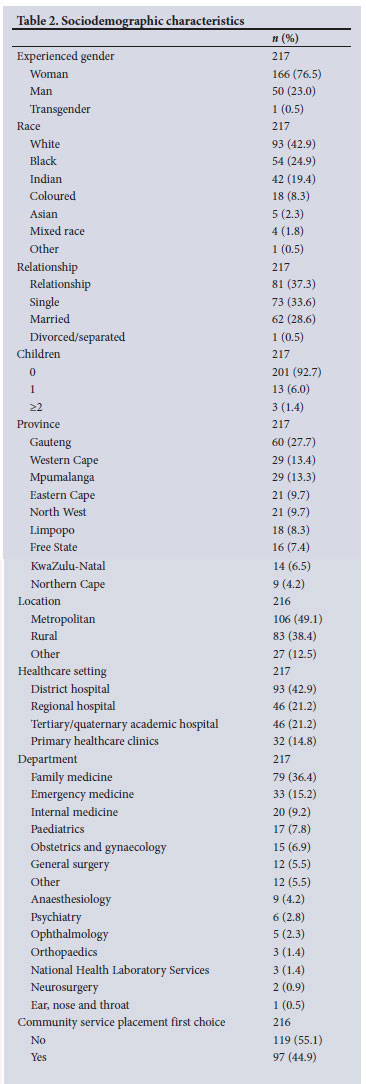
The mean age of participants was 27.6 (1.95) years (Table 2). In terms of racial profile, 42.9% were white and 24.9% were black. Most participants were from Gauteng Province (27.7%) and then Western Cape and Mpumalanga provinces (13.4% each). The majority of participants were located outside of metropolitan areas (49.1%).
The prevalence of possible depression
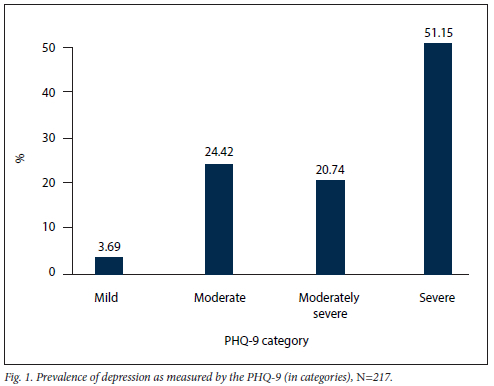
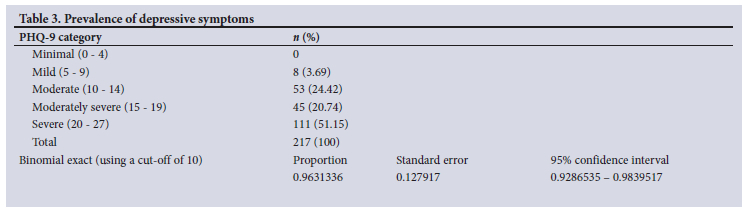
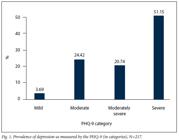
Of the 217 participants, 96.3% (95% confidence interval 92.9 - 98.4%) screened positive for depression (mild, moderate or severe) with 51.15% screening positive for severe depression (Table 3 and Fig. 1).
Predictive factors for depressive symptoms
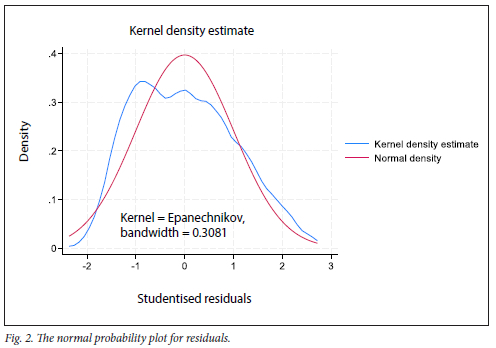
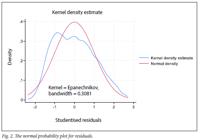
There were various predictors of higher PHQ-9 scores in the study. They included the following, with the increase in PHQ-9 scores noted in brackets: women (2.0), illicit drug use (6.4), feeling neutral (3.2) or disagreeing that one worked outside of normal working hours (2.2), working in KZN (3.7) or North West (4.2) provinces, emotional exhaustion on the MBI (0.2), working in orthopaedics (6.6), obstetrics and gynaecology (2.8) and the National Health Laboratory Service (10.8), getting one's first choice of placement (2.1), current financial difficulties (2.5), and accessing mental health services (psychiatrist (4.3), psychologist (6.6) and counsellor (11.7)) (Table 4). The normal probability plot for residuals showed that the difference between the observed and predicted values of the model were normally distributed, validating the regression model's assumptions (Fig. 2).
Discussion
The prevalence rate of depressive symptoms (96.3%) among respondents is high and extremely concerning. It is more than triple the prevalence rate of depressive symptoms among the general population in SA (25.7%) observed by Craig et al.[16] It is also significantly higher than the global pooled prevalence of 20.5% of depressive symptoms among medical doctors,[17] and the global pooled prevalence of 43.1 - 51.0% for depressive symptoms among trainee doctors.[3] Nazeema et al.[18] also found the prevalence rate of depressive symptoms to be high (53.73%) among medical doctors of varying rank at an academic hospital in Johannesburg using a cut-off score of ≥8. The significantly higher prevalence in our study may be attributable to various factors including that the majority of participants were not in an academic setting, ours was a national study not restricted to an urban city, and the study focused on junior doctors, known to have higher rates of depressive symptoms.
The PHQ-9 has a relatively high sensitivity (0.91 (0.87 - 0.94)) compared with specificity (0.80 (0.77 - 0.83)), which may give rise to false positives, according to a large meta-analysis including various populations by Levis et al.[14] This sample differed from ours, which purely comprised junior medical doctors. However, even taking into account a false-positive rate of 0.20, the prevalence of depressive symptoms (75.97%) among respondents is concerning.
Another consideration is the validity of the PHQ-9 among medical doctors. While various studies have validated the PHQ-9 among the general population,[19] including in low-middle income settings, few have focused on the validation of the tool in medical doctors specifically. The PHQ-9 items pertaining to sleep, appetite and energy may overlap with the lifestyle of the medical profession (for example, shift work, high patient loads, long working hours and a lack of set lunchbreaks). However, without a screening tool for depression specifically developed for medical doctors, the PHQ-9 remains an important indicator that is widely used and generally accepted.[20]
From an individual perspective, this and various other studies have highlighted that women in healthcare are at risk of depression compared with their male counterparts, according to a scoping review by Sriharan et al.,[21] which included other low-middle income countries similar to SA, such as India. Furthermore, less work experience and a self-perception of incompetency have also been identified as potential predictive individual factors.[21] CSDs may experience these phenomena to a greater extent as they are junior doctors practising as independent practitioners for the first time.
Respondents from KZN and North West provinces had higher PHQ-9 scores compared with other provinces. In a multisite study in KZN by Naidu et al.[22] in 2019, a prevalence rate of 21.3% for depressive symptoms using a PHQ-9 cutoff score of ≥10 was observed. It was postulated by Naidu et al.[22] that provincial financial and human resource challenges may play role, with high HIV and tuberculosis rates adding considerably to workload. The highest prevalence rates of HIV in SA are in the northwestern parts of KZN.[23] It has been shown that working in those areas contributes to the development of mental health difficulties in doctors.[12]
Respondents who admitted to illicit drug use had higher PHQ-9 scores by 6.4 points. The relationship between substance use and depression is known to be bi-directional, with those suffering from depressive symptoms having higher rates of substance use and vice versa.[23] Physicians are particularly vulnerable. Issues such as easy access to illicit drugs, a tendency to self-medicate and fear of accessing help/disclosing issues due to career concerns[24] make substance use among physicians a pressing issue. Interestingly, alcohol use was predictive of a lower PHQ-9 score (-1.6), possibly indicating that respondents were self-medicating using alcohol.
PHQ-9 scores in those who had accessed mental healthcare were significantly higher. Medical doctors are known to delay help-seeking and often wait until symptoms are severe before accessing professional services.[25] Those who sought help from counsellors had a score 11.68 points higher. This may indicate that medical doctors who require treatment for depressive symptoms may find it easier to access counsellors initially. One would expect PHQ-9 scores to decrease with time once mental healthcare has been accessed. A prospective study would assist in confirming this.
It is well known that work environments have an effect on the mental health of employees in the healthcare sector.[26] Predictors of lower PHQ-9 scores in this study included agreeing that one's workplace had sufficient resources, interacting with colleagues to cope, having a good work-life balance, and working in certain departments, particularly neurosurgery. From an organisation level, poor support and recognition by peers, supervisors and hospital leadership, as well as work location, have been noted to contribute.[21] On a systemic level, lack of recognition by government officials and policy makers of healthcare workers' work conditions have been noted as contributors.[21] The government's treatment of CSDs in SA has long been criticised, with some labelling these doctors as 'slaves of the state' coerced into employment and not being able to practise as independent practitioners without completing their community service year.[6] Our study noted that not getting one's first choice of placement or being placed in certain departments (perhaps involuntarily) were possible predictors of higher PHQ-9 scores.
Depression among healthcare workers has been associated with loss of doctors in the profession, leading to loss of skilled individuals within the sector, negative effect on physical health of doctors and reduction in quality of patient care.[18] The SA context of resource limitations makes the country even more vulnerable to loss of skilled professionals. As a result, it is important to recognise the effect of depression among CSDs so that timely interventions can be implemented to prevent further negative consequences.
Further research into practical and supportive interventions for CSDs to both prevent and screen for depressive symptoms should be considered. Investigating mental health-seeking behaviour of junior doctors is another potential topic for further research.
The study is an important one as it is the largest national study investigating depression in CSDs in SA, highlighting the extent of the problem. However, some limitations include the lack of a sampling frame, which could not be obtained from the HPCSA, possible respondent bias in that those with depressive symptoms would be more likely to complete the survey, and the cross-sectional nature of the study making temporal inferences impossible.
CSDs in SA are a vulnerable population and such a high prevalence of depressive symptoms this early in their careers can have detrimental effects for their futures, as well as the future of our healthcare system. Supporting these junior doctors at an individual, organisation and structural level should be a priority.
Acknowledgements. Thank you to all the CSDs in SA who took the time from their busy schedules to complete the survey.
Author contributions. GMP and TM contributed to the design and implementation of the research, analysis of the results and writing of the manuscript.
Funding. Partial financial support was received from the University of the Witwatersrand School of Clinical Medicine Graduate Studies and Research Committee MMED Fund.
Conflicts of interest. None.
References
-
1. Søvold LE, Naslund JA, Kousoulis AA, et al. Prioritizing the mental health and wellbeing of healthcare workers: An urgent global public health priority. Front Public Health 2021;9:679397. http://doi.org/10.3389/fpubh.2021.679397
» http://doi.org/10.3389/fpubh.2021.679397 -
2. Bartholomew A, Sanatkar S, Counson I, Harvey SB. Junior doctors' mental health and coronavirus disease safety concerns. Aust N Z J Public Health 2022;46(3):307-313. http://doi.org/10.1111/1753-6405.13213
» http://doi.org/10.1111/1753-6405.13213 -
3. Aljuwaiser S, Brazzelli M, Arain I, Poobalan A. Common mental health problems in medical students and junior doctors - an overview of systematic reviews. J Ment Health 2024;33(6):779-815. https://doi.org/10.1080/09638237.2023.2278095
» https://doi.org/10.1080/09638237.2023.2278095 - 4. American Psychiatric Association. Diagnostic and statistical manual of mental disorders (DSM-5). 5th ed. Washington DC: American Psychiatric Association Publishing; 2013:991.
-
5. Sturman N, Tan Z, Turner J. 'A steep learning curve': Junior doctor perspectives on the transition from medical student to the healthcare workplace. BMC Med Educ 2017;17(1):92. https://doi.org/10.1186/s12909-017-0931-2
» https://doi.org/10.1186/s12909-017-0931-2 -
6. Erasmus N. Slaves of the state - medical internship and community service in South Africa. S Afr Med J 2012;102(8):655. https://doi.org/10.7196/samj.5987
» https://doi.org/10.7196/samj.5987 -
7. World Health Organization. 2022. World mental health report: Transforming mental health for all. https://www.who.int/publications/i/item/9789240049338 (accessed 4 October 2023).
» https://www.who.int/publications/i/item/9789240049338 -
8. Hain S, Tomita A, Milligan P, Chiliza B. Retain rural doctors: Burnout, depression and anxiety in medical doctors working in rural KwaZulu-Natal Province, South Africa. S Afr Med J 2021;111(12):1197. https://doi.org/10.7196/samj.2021.v111i12.15841
» https://doi.org/10.7196/samj.2021.v111i12.15841 - 9. Herman AA, Stein DJ, Seedat S, Heeringa SG, Moomal H, Williams DR. The South Africa Stress and Health (SASH) study: 12-month and lifetime prevalence of common mental disorders. S Afr Med J 2009;99:339-344.
-
10. South African Medical Association (undated). South African Medical Association. Uniting doctors for the health of the nation. https://samedical.org/ (accessed 13 March 2025).
» https://samedical.org/ -
11. Reid SJ, Peacocke J, Kornik S, Wolvaardt G. Compulsory community service for doctors in South Africa: A 15-year review. S Afr Med J 2018;108(9):741. https://doi.org/10.7196/samj.2018.v108i9.13070
» https://doi.org/10.7196/samj.2018.v108i9.13070 -
12. Hain S, Tomita A, Milligan P, Chiliza B. Retain rural doctors: Burnout, depression and anxiety in medical doctors working in rural KwaZulu-Natal Province, South Africa. S Afr Med J 2021;111(12):1197. https://doi.org/10.7196/samj.2021.v111i12.15841
» https://doi.org/10.7196/samj.2021.v111i12.15841 -
13. Van Wijk CH, Martin JH, Maree DJF. Clinical validation of brief mental health scales for use in South African occupational healthcare. SA J Ind Psychol 2021;47:a1895. https://doi.org/10.4102/sajip.v47i0.1895
» https://doi.org/10.4102/sajip.v47i0.1895 -
14. Levis B, Benedetti A, Thombs BD, DEPRESsion Screening Data (DEPRESSD) Collaboration. Accuracy of Patient Health Questionnaire-9 (PHQ-9) for screening to detect major depression: Individual participant data meta-analysis. BMJ 2019;l1476. https://doi.org/10.1136/bmj.l1476
» https://doi.org/10.1136/bmj.l1476 -
15. Kroenke K, Spitzer RL, Williams JBW. The PHQ-9: Validity of a brief depression severity measure. J Gen Intern Med 2001;16(9):606-613. https://doi.org/10.1046/j.1525-1497.2001.016009606.x
» https://doi.org/10.1046/j.1525-1497.2001.016009606.x -
16. Craig A, Rochat T, Naicker SN, et al. The prevalence of probable depression and probable anxiety, and associations with adverse childhood experiences and socio-demographics: A national survey in South Africa. Front Public Health 2022;10:986531. https://doi.org/10.3389/fpubh.2022.986531
» https://doi.org/10.3389/fpubh.2022.986531 -
17. Johns G, Samuel V, Freemantle L, Lewis J, Waddington L. The global prevalence of depression and anxiety among doctors during the covid-19 pandemic: Systematic review and meta-analysis. J Affect Disord 2022;298:431-441. https://doi.org/10.1016/j.jad.2021.11.026
» https://doi.org/10.1016/j.jad.2021.11.026 -
18. Nazeema A, Lowton K, Tenea Z, Anic A, Jayrajh P. Study of burnout and depressive symptoms in doctors at a central level, state hospital. South Afr J Psychiatry 2023;29. https://doi.org/10.4102/sajpsychiatry.v29i0.1866
» https://doi.org/10.4102/sajpsychiatry.v29i0.1866 -
19. Carroll HA, Hook K, Perez OFR, et al. Establishing reliability and validity for mental health screening instruments in resource-constrained settings: Systematic review of the PHQ-9 and key recommendations. Psychiatry Res 2020;291:113236. https://doi.org/10.1016/j.psychres.2020.113236
» https://doi.org/10.1016/j.psychres.2020.113236 -
20. Mata DA, Ramos MA, Bansal N, et al. Prevalence of depression and depressive symptoms among resident physicians: A systematic review and meta-analysis. JAMA 2015;314(22):2373-2383. http://doi.org/10.1001/jama.2015.15845
» http://doi.org/10.1001/jama.2015.15845 -
21. Sriharan A, Ratnapalan S, Tricco AC, et al. Occupational stress, burnout, and depression in women in healthcare during COVID-19 pandemic: Rapid scoping review. Front Glob Womens Health 2020;1:596690. https://doi.org/10.3389/fgwh.2020.596690
» https://doi.org/10.3389/fgwh.2020.596690 -
22. Naidu K, Torline JR, Henry M, Thornton HB. Depressive symptoms and associated factors in medical interns at a tertiary hospital. South Afr J Psychiatry 2019;25. https://doi.org/10.4102/sajpsychiatry.v25i0.1322
» https://doi.org/10.4102/sajpsychiatry.v25i0.1322 - 23. Kleinschmidt I, Pettifor A, Morris N, MacPhail C, Rees H. Geographic distribution of human immunodeficiency virus in South Africa. Am J Trop Med Hyg 2007;77(6):1163-1169.
-
24. Calarco CA, Lobo MK. Chapter Six - Depression and substance use disorders: Clinical comorbidity and shared neurobiology. In: Calipari ES, Gilpin NW, eds. Int Rev Neurobiol Academic Press 2021;157:245-309. https://doi.org/10.1016/bs.irn.2020.09.004
» https://doi.org/10.1016/bs.irn.2020.09.004 -
25. Shadakshari D, Muliyala KP, Jayarajan D, Kandasamy A. Occupational challenges in physicians with substance use disorder: A qualitative study. Indian J Psychol Med 2022;44(3):253-258. https://doi.org/10.1177/02537176211020520
» https://doi.org/10.1177/02537176211020520 -
26. Wijeratne C, Johnco C, Draper B, Earl J. Doctors' reporting of mental health stigma and barriers to help-seeking. Occup Med Lond 2021;71(8):366-374. https://doi.org/10.1093/occmed/kqab119
» https://doi.org/10.1093/occmed/kqab119 -
27. Aust B, Leduc C, Cresswell-Smith J, et al. The effects of different types of organisational workplace mental health interventions on mental health and wellbeing in healthcare workers: a systematic review. Int Arch Occup Environ Health 2024;97(5):485-522. https://doi.org/10.1007/s00420-024-02065-z
» https://doi.org/10.1007/s00420-024-02065-z

Accepted 2 October 2025