Cardiac tamponade secondary to tension pneumopericardium from penetrating chest trauma
SAMJ FORUM
CLINICAL IMAGES
Cardiac tamponade secondary to tension pneumopericardium from penetrating chest trauma
Gavin Robert Sun; Jacques Goosen; Mark Florizoone
Cardiac tamponade secondary to air is rare. Pneumopericardium is most commonly encountered in neonates, often secondary to positive pressure ventilation.1-3 In adults blunt trauma is the main cause of pneumopericardium. Cardiac tamponade occurs in roughly one-third of such patients.1
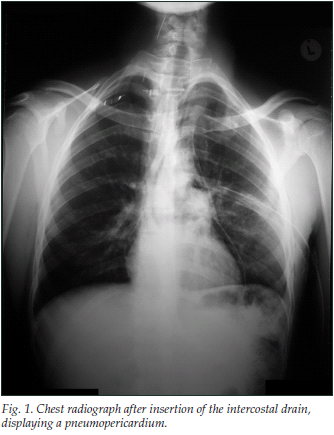
A 24-year-old man presented to the Tshepong casualty department with a stabbed chest. His vital signs were initially stable. A sucking chest wound of 1 cm diameter on the left parasternal border in the 4th intercostal space and a hyperresonant left chest with decreased breath sounds were noted. A pneumothorax was clinically diagnosed and an intercostal chest drain inserted. An hour later a chest radiograph revealed a pneumopericardium (Fig. 1). He was haemodynamically stable, the neck veins were not distended, heart sounds were audible, and good peripheral pulses were palpable.1
During preparation for insertion of a subclavian central venous catheter to assess for pulsus paradoxus, the blood pressure suddenly decreased to 80/50 mmHg, the neck veins became distended and heart sounds diminished. Cardiac tamponade was diagnosed.
An emergency sternotomy for a suspected cardiac injury was performed under general anaesthesia. There was a pneumopericardium and grade 2 through-and-through injury to the left lung, but the heart was intact. Upon incising the pericardium, air was released and the blood pressure improved to 90/60 mmHg. The lung was repaired, the pericardium closed and a pericardial drain inserted. On discharge from the intensive care unit 24 hours later, there were no signs of tamponade. Recovery was uneventful and follow-up chest radiographs were normal.
Discussion
Pneumopericardium may occur whenever a communication is established between the pericardium and a source of air. Haemodynamic compromise is related to the quantity of air present, the rate of accumulation and the presence of underlying cardiac pathology or injury.2,4
The commonest sign of tension pneumopericardium is distant, muffled heart sounds.2 bruit de moulin (mill-wheel murmur). Precordial shifting tympany is another sign.1 1 1
The primary management of tension pneumopericardium is relief of the cardiac tamponade to restore haemodynamic stability.2
We thank Dr Jeffrey King assisting in the literature review, and Dr Tshenkeng and the management of the Klerksdorp/Tshepong Hospital complex for permission to publish.
References
- 1. Cummings RG, Wesly RL, Adams DH, Lowe JE. Pneumopericardium resulting in cardiac tamponade. Ann Thorac Surg 1984; 37(6): 511-518.
- 2. Shorr RM, Mirvis SE. Tension pneumopericardium in blunt chest trauma. J Trauma 1987; 27(9): 1078-1082.
- 3. Haan JM, Scalea TM. Tension pneumopericardium: a case report and a review of the literature. Am Surg 2006; 72(4): 330-331.
- 4. Robinson MD, Markovchick VJ. Traumatic tension pneumopericardium: a case report and literature review. J Emerg Med 1985; 2(6): 409-413.
Dr Goosen is Head of Trauma Surgery at the Charlotte Maxeke Johannesburg Academic Hospital.
Dr Florizoone is head of the Department of Surgery at the Klerksdorp/Tshepong Hospital complex.