HIV-positive kidney transplants for HIV-positive individuals: attitudes and concerns of South African patients and health care workers
Background
South Africa has one of the largest HIV epidemics and largest antiretroviral (ARV) access programmes in the world.1 2 3
Comparative studies of treatment options for ESKD have shown that transplantation rather than dialysis is the most cost-effective form of treatment, greatly improving patients' quality of life and survival.4,5 HIV-positive patients were previously excluded from renal replacement therapy owing to poor outcomes, but evidence indicates that transplantation in selected HIV-infected patients can be beneficial, as 1-and 2-year survival rates were higher than of those maintained on dialysis.6 7
South African health policy guidelines have therefore been revised to allow HIV-infected patients access to dialysis and kidney transplantation, provided that they meet the eligibility criteria: a CD4 count >200 cells/µl; an undetectable HIV viral load; and adherence to a stable ARV regimen.8 9
Methods
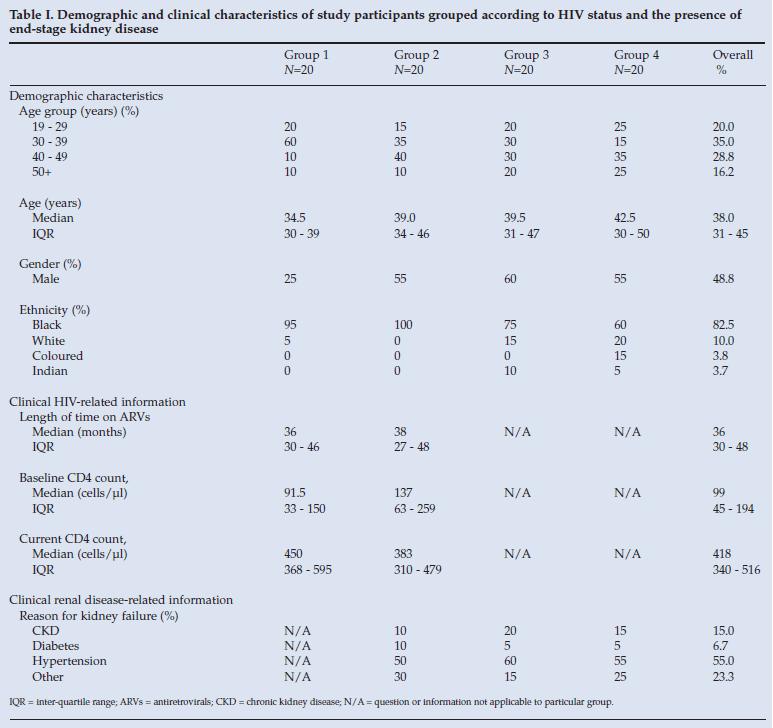
Study participants fulfilling the transplant programme inclusion criteria, as well as those without kidney disease, were recruited from the appropriate clinics by convenience sampling (N=20 for each group) at Charlotte Maxeke Johannesburg, Helen Joseph and Chris Hani Baragwanath hospitals in Johannesburg. They were placed into 4 groups: group 1 - HIV-infected individuals on ARVs without identified kidney disease; group 2 - HIV-infected individuals on ARVs with established stages (1 -5) of CKD, including those on dialysis; group 3 - HIV-uninfected individuals on dialysis; and group 4 - HIV-uninfected individuals with a functioning graft following transplant. Half of the total number of interviewees were HIV-positive, and 75% suffered from CKD. An additional group comprising health care workers in the field of kidney disease and HIV was interviewed using a scenario-based questionnaire. After invitation to participate and providing signed, informed consent, questionnaire-based interviews were conducted in the participants' chosen indigenous language with the aid of a translator. Univariate comparisons were tested using the χ2 p-values are reported as two-sided with a significance value at p<0.05 (STATA 10).
Results
Attitudes of patients
Table I shows the demographic and clinical characteristics of the study groups. All participants were asked whether they thought that people with HIV infection should receive kidney transplants, and whether they would accept an HIV-positive kidney. If the answer to the latter question was 'No', they were asked whether other individuals on ARVs should have access to kidney transplants. Most respondents in all groups thought access should be granted to HIV-positive people, with the highest proportion of affirmative responses (90% and 95%) coming from the two HIV-positive groups. The responses from these groups were not statistically different (p=0.077). HIV-positive patients were more likely to say that they would accept an HIV-positive kidney graft (p<0.001); while a minority of HIV-negative patients would accept one. All groups thought that HIV-positive individuals on stable ARVs should be offered HIV-positive kidneys; the highest positive responses came from the HIV-uninfected groups 3 and 4 (75% and 83.3% respectively). HIV-infected participants were specifically asked whether they would accept kidneys from family members, whether HIV-infected or uninfected. The majority stated that they would accept kidneys from infected and uninfected family members.
Forty-five per cent of HIV-infected participants without kidney disease stated that they would choose transplantation as the preferred method of renal replacement therapy; 25% would consider haemodialysis, peritoneal dialysis or transplantation. When asked if they would be willing to consider dialysis, 55% replied that they would, with an additional 20% noting that they would consider dialysis if they could afford it. Twenty-five per cent of participants said they would refuse dialysis as a treatment option, the most common (30%) reason for refusal among them being the time and high travel cost involved.
Attitudes of health care workers
Health care workers (N=20), who were predominantly nurses (55%), in renal units and ARV clinics were given clinical scenario-based questionnaires. Ninety per cent agreed that HIV-positive individuals should be provided with kidney transplants if patients met the proposed eligibility criteria. However, the need for education of the public to encourage organ donations (15%) and full information about transplantation (10%) was respectively noted by health care workers.
Discussion and conclusion
Our results suggest that both patients and health care workers find it acceptable to include HIV-positive cadaveric donors for transplantation into eligible HIV-positive recipients, despite the unknown risks. The key reasons given for providing transplants to HIV-positive individuals using HIV-positive kidneys were to afford them the opportunity for longer survival, to avoid discrimination because of their HIV status, and to allow them equal rights of health care access compared with HIV-negative patients. Our findings suggest that, unless clear biological risks in using HIV-positive grafts are identified, providing patients with full information about uncertainties and risks will allow them to make a decision on transplantation with HIV-positive kidneys. Such an approach would dramatically increase the donor pool of available kidneys. At the time of writing, 4 HIV-infected donor kidneys were successfully transplanted into HIV-positive recipients in South Africa.10
The authors thank Ms Lucie Ndlovu for her assistance with translation and subject recruitment; Drs T Gerntholtz and M Radev for facilitating access to participants at Chris Hani Baragwanath and Helen Joseph hospitals, respectively; and the participants in this study. The study was funded in part by the Trust Fund of the London School of Hygiene and Tropical Medicine. Approval for the study was obtained from the Human Research Ethics Committee of the University of the Witwatersrand and the London School of Hygiene and Tropical Medicine (reference numbers M080502 and 07/342 respectively).
References
-
1. UNAIDS. Report on the Global AIDS Epidemic. Chapter 2: Status of the global HIV epidemic. Geneva: UNAIDS, 2008. http://www.unaids.org/en/KnowledgeCentre/HIVData (accessed 24 November 2008).
» http://www.unaids.org/en/KnowledgeCentre/HIVData - 2. Bhaskaran K, Hamouda O, Sannes M, et al. Changes in the risk of death after HIV seroconversion compared with mortality in the general population. JAMA 2008; 300: 51.
- 3. Fabian J, Katz I, Gerntholtz T, Goetsch S, Naicker S. Chronic kidney disease in human immunodeficiency virus infection. Panminerva Med 2007; 49: 51.
- 4. Oniscu GC, Brown H, Forsythe JLR. Impact of cadaveric renal transplantation on survival in patients listed for transplantation. J Am Soc Nephrol 2005; 16: 1859.
- 5. Kontodimopoulos N, Niakas D. An estimate of lifelong costs and QALYs in renal replacement therapy based on patients' life expectancy. Health Policy 2008; 86: 85.
- 6. Kumar MSA, Sierka DR, Damask AM, et al. Safety and success of kidney transplantation and concomitant immunosuppression in HIV-positive patients. Kidney Int 2005; 67: 1622.
- 7. Qiu J, Terasaki PI, Waki K, Cai J, Gjertson DW. HIV-positive renal recipients can achieve survival rates similar to those of HIV-negative patients. Transplantation 2006; 81: 1658.
- 8. South African Renal Society, South African Transplant Society, Southern African HIV Clinicians Society. Guidelines for renal replacement therapy in HIV-infected individuals in South Africa. Southern African Journal of HIV Medicine 2008; Autumn: 34.
- 9. Venter WDF, Naicker S, Dhai A, et al. Uniquely South African: Time to consider offering HIVpositive donor kidneys to HIV-infected renal failure patients? S Afr Med J 2008; 98: 182.
-
10. South Africa pioneers HIV-positive transplants. The Guardian 25 October 2008. http://www.guardian.co.uk/world/2008/oct/25/aids-south-africa-hiv-barnard (accessed 18 January 2010).
» http://www.guardian.co.uk/world/2008/oct/25/aids-south-africa-hiv-barnard