Pan computed tomography for blunt polytrauma: Are we doing too many?
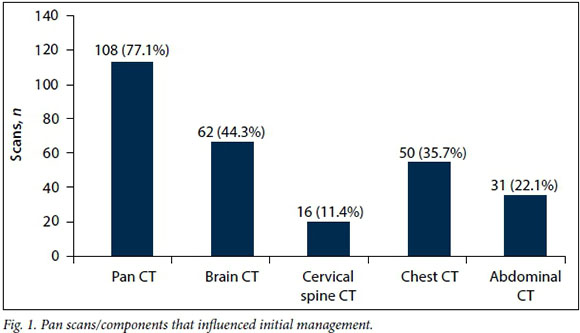
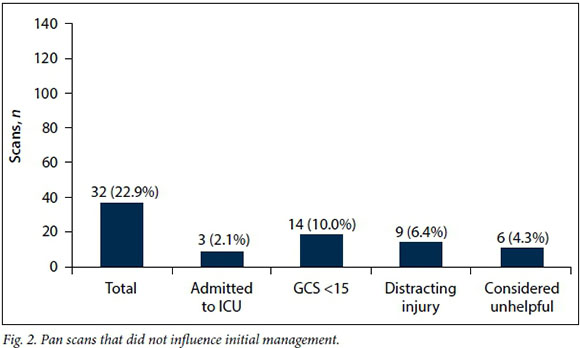
BACKGROUND: Pan computed tomography (CT) is widely used in the evaluation of patients with blunt polytrauma, but there is growing concern about the radiation risks imposed. OBJECTIVES: To ascertain whether we were possibly overutilising pan CT in our trauma service, and whether we could safely cut down on scans without missing significant injuries. METHODS. We audited all pan scans performed in the Metropolitan Trauma Service, Pietermaritzburg, South Africa, during the 12-month period 1 January - 31 December 2012. An analysis was done to determine what injuries were identified and how these findings influenced our management. RESULTS: Of the 140 pan scans, 108 (77.1%) influenced management. These included the following components: 62 brain scans (44.3%), 16 cervical spine scans (11.4%), 50 chest scans (35.7%) and 31 abdominal scans (22.1%). The remaining 32 pan scans (22.9%) did not influence management. However, it turned out that many of these 'clinically negative' scans were in fact clinically important, ruling out injury in patients in whom clinical assessment was regarded as unreliable: 3 patients (2.1%) were hypoxic and had to be sedated, intubated and ventilated; 14 (10.0%) had a Glasgow Coma Score (GCS) of <15; and 9 (6.4%) had major distracting injuries. This left only 6 pan scans (4.3%) that were not regarded as clinically helpful. CONCLUSION: In our setting, the majority of pan scans influence management. By ruling out significant injuries, clinically negative scans are valuable in patients who are obtunded, intubated and ventilated, or have major distracting injuries. In patients with a GCS of 15, not sedated and ventilated and with no major distracting injuries, clinical assessment and alternative imaging modalities may suffice.
SAMJ: South African Medical Journal
 Thumbnail
 Thumbnail