Autologous haematopoietic stem cell transplantation in patients with multiple sclerosis: Experience from South Africa
BACKGROUND. Multiple sclerosis (MS) is a chronic immune-mediated demyelinating disease that remains a major cause of neurological disability in young adults. While disease-modifying therapies (DMTs) can delay progression, many patients with highly active relapsing-remitting MS (RRMS) continue to experience breakthrough disease. Autologous haematopoietic stem cell transplantation (ASCT) offers durable immune reconstitution and remission but remains underutilised in upper-middle-income settings such as South Africa (SA). OBJECTIVE. To evaluate the safety, feasibility and clinical outcomes of ASCT for MS in a real-world SA cohort. METHODS. We conducted a retrospective record review of all MS patients who underwent ASCT between 1 January 2009 and 31 December 2024 at two JACIE-accredited tertiary centres (Wits Donald Gordon Medical Centre and Netcare Pretoria East Hospital). Data were extracted from institutional transplant records and analysed using descriptive statistics and Kaplan-Meier survival estimates. The primary outcome was the safety of ASCT for MS, and the secondary outcomes were the clinical outcomes of patients who underwent ASCT for MS. RESULTS. Thirty-two patients were included (median age 42 years; 53% female; 94% RRMS). Median disease duration prior to ASCT was 7.4 years, and 97% had received prior DMTs. Conditioning included cyclophosphamide (97%), anti-thymocyte globulin (69%) and fludarabine (34%). The median neutrophil and platelet engraftment occurred at 10 and 14 days, respectively. Relapse-free survival was 100% at 1 year and 91% (95% confidence interval 68 - 98) at 5 years. Approximately 90% of evaluable patients demonstrated neurological improvement or stabilisation at 1 year. Treatment-related adverse events occurred in 63% of cases, and 95% of these side-effects were grade 3 or less: most commonly neutropenic fever (50%) and mucositis (16%). Only 5% of adverse reactions were grade 4, with no transplant-related mortality. CONCLUSION. ASCT is safe, feasible and highly effective in aggressive, treatment-refractory RRMS in SA. Its earlier use in selected patients may offer durable remission and substantial cost savings compared with long-term DMTs. The expansion of accredited national ASCT programmes and registry-based outcome monitoring is warranted.
multiple sclerosis; autologous stem cell transplantation; relapsing-remitting MS; South Africa; disease-modifying therapy; cost-effectiveness; hematopoietic stem cell transplantation
Autologous haematopoietic stem cell transplantation in patients with multiple sclerosis: Experience from South Africa
A SetzerI; S DindayalII; J DamelinIII; D MoodleyIV; D BrittainV; A McDonaldVI; A MahomedVII, VIII; A PincusIX; J ThomsonX, XI; J R du ToitX, XI
IMB BCh; Department of Internal Medicine, School of Clinical Medicine, Faculty of Health Sciences, University of the Witwatersrand, Johannesburg, South Africa
IIMB BCh, FCN (SA); Department of Neurosciences, School of Clinical Medicine, Faculty of Health Sciences, University of the Witwatersrand, Johannesburg, South Africa
IIIMB BCh; Wits Donald Gordon Cellular and Immunotherapy Centre, School of Clinical Medicine, Faculty of Health Sciences, University of the Witwatersrand, Johannesburg, South Africa
IVMB BCh, FCP (SA); Wits Donald Gordon Cellular and Immunotherapy Centre, School of Clinical Medicine, Faculty of Health Sciences, University of the Witwatersrand, Johannesburg, South Africa
VMB BCh, FCPath (SA); Wits Donald Gordon Medical Research Institute, Faculty of Health Sciences, University of the Witwatersrand, Johannesburg, South Africa
VIMB ChB, FCP (SA); ACTLIFE, Netcare Pretoria East Hospital, Pretoria, South Africa
VIIMB BCh, Cert Gastro (SA); Department of Internal Medicine, School of Clinical Medicine, Faculty of Health Sciences, University of the Witwatersrand, Johannesburg, South Africa
VIIIMB BCh, Cert Gastro (SA); Wits Donald Gordon Medical Research Institute, Faculty of Health Sciences, University of the Witwatersrand, Johannesburg, South Africa
IX6th-year medical student; Department of Internal Medicine, School of Clinical Medicine, Faculty of Health Sciences, University of the Witwatersrand, Johannesburg, South Africa
XMB ChB, Cert Clin Haematol (SA) Phys; Wits Donald Gordon Cellular and Immunotherapy Centre, School of Clinical Medicine, Faculty of Health Sciences, University of the Witwatersrand, Johannesburg, South Africa
XIMB ChB, Cert Clin Haematol (SA) Phys; Wits Donald Gordon Medical Research Institute, Faculty of Health Sciences, University of the Witwatersrand, Johannesburg, South Africa
BACKGROUND. Multiple sclerosis (MS) is a chronic immune-mediated demyelinating disease that remains a major cause of neurological disability in young adults. While disease-modifying therapies (DMTs) can delay progression, many patients with highly active relapsing-remitting MS (RRMS) continue to experience breakthrough disease. Autologous haematopoietic stem cell transplantation (ASCT) offers durable immune reconstitution and remission but remains underutilised in upper-middle-income settings such as South Africa (SA).
OBJECTIVE. To evaluate the safety, feasibility and clinical outcomes of ASCT for MS in a real-world SA cohort.
METHODS. We conducted a retrospective record review of all MS patients who underwent ASCT between 1 January 2009 and 31 December 2024 at two JACIE-accredited tertiary centres (Wits Donald Gordon Medical Centre and Netcare Pretoria East Hospital). Data were extracted from institutional transplant records and analysed using descriptive statistics and Kaplan-Meier survival estimates. The primary outcome was the safety of ASCT for MS, and the secondary outcomes were the clinical outcomes of patients who underwent ASCT for MS.
RESULTS. Thirty-two patients were included (median age 42 years; 53% female; 94% RRMS). Median disease duration prior to ASCT was 7.4 years, and 97% had received prior DMTs. Conditioning included cyclophosphamide (97%), anti-thymocyte globulin (69%) and fludarabine (34%). The median neutrophil and platelet engraftment occurred at 10 and 14 days, respectively. Relapse-free survival was 100% at 1 year and 91% (95% confidence interval 68 - 98) at 5 years. Approximately 90% of evaluable patients demonstrated neurological improvement or stabilisation at 1 year. Treatment-related adverse events occurred in 63% of cases, and 95% of these side-effects were grade 3 or less: most commonly neutropenic fever (50%) and mucositis (16%). Only 5% of adverse reactions were grade 4, with no transplant-related mortality.
CONCLUSION. ASCT is safe, feasible and highly effective in aggressive, treatment-refractory RRMS in SA. Its earlier use in selected patients may offer durable remission and substantial cost savings compared with long-term DMTs. The expansion of accredited national ASCT programmes and registry-based outcome monitoring is warranted.
Keywords: multiple sclerosis, autologous stem cell transplantation, relapsing-remitting MS, South Africa, disease-modifying therapy, cost-effectiveness, hematopoietic stem cell transplantation
Multiple sclerosis (MS) is a chronic immune-mediated disorder of the central nervous system characterised by inflammation, demyelination, gliosis and neuro-axonal degeneration.[1,2] Although the precise cause remains unclear, it is widely considered autoimmune in nature, initiated by autoreactive T lymphocytes crossing the blood-brain barrier and triggering local inflammatory cascades that lead to progressive neurological dysfunction.[2,3]
In South Africa (SA), epidemiological data on MS remain limited, but the prevalence is estimated to be between 5 and 29 per 100 000 persons, placing the country in a medium-frequency category.[4] MS predominantly affects adults between 20 and 40 years of age, with a female predominance of ~2 - 3 to 1.[5] It represents one of the leading causes of non-traumatic neurological disability in young adults.[6]
Diagnosis is based on the McDonald criteria, which integrate clinical, radiological and laboratory findings.[1] MS manifests as four main phenotypes: clinically isolated syndrome, relapsing-remitting MS (RRMS), primary progressive MS and secondary progressive MS.[7] Approximately 70 - 80% of patients initially present with RRMS, while 15 - 20% exhibit a progressive form from the onset.[8] It is important to note that the aforementioned subtypes are largely artificial and do not account for individual patient disease course.[7]
Treatment is multidisciplinary, encompassing symptomatic care such as analgesia, physiotherapy and occupational therapy together with emotional and social support. Lifestyle modifications include exercise, diet and smoking cessation. Disease-modifying therapies (DMTs) target the immune system to reduce the frequency and severity of attacks. Finally, there are immune-reconstitution strategies such as autologous haematopoietic stem cell transplantation (ASCT).[9-11]
DMTs are effective in reducing relapse rates and delaying progression, particularly when initiated early in the disease course.[12,13] However, patients with highly active or treatment-refractory MS may continue to experience inflammatory disease activity despite optimal therapy.[14] This has prompted the exploration of ASCT as a means to achieve durable remission by 'resetting' immune tolerance.[15]
ASCT involves the mobilisation of autologous haematopoietic stem cells, lympho-ablative conditioning and reinfusion to reconstitute a naive immune repertoire.[16]
Randomised and observational studies, including the MIST trial,'171 have demonstrated that ASCT significantly reduces disability progression compared with continued DMTs in RRMS, with prolonged relapse-free survival and improved magnetic resonance imaging (MRI) outcomes.[17,18] Updated guidelines from the European Society for Blood and Marrow Transplantation (EBMT) endorse ASCT for patients with aggressive RRMS refractory to standard DMTs.[19]
Recent systematic reviews confirm its efficacy and safety, reporting extremely low transplant-related mortality at ~0.3% in patients who received ASCT for MS after 2005.[18,20,21] It is critical to consider and categorise the adverse events associated with ASCT for MS. The CTCAE (common terminology criteria for adverse events) is a widely accepted tool used to grade adverse events.[22] The criteria comprise 5 grades of adverse events: grade 1 - mild; grade 2 - moderate; grade 3 - severe; grade 4 - life-threatening; and grade 5 - death. A Swedish study on ASCT for RRMS showed that 70% of patients had a grade 3 adverse event, of which febrile neutropenia was the most common at 58%, and only 3% of patients experienced a grade 4 adverse event.[23]
Although ASCT remains underutilised in low- and middle-income settings, economic analyses suggest that it may offer long-term cost-effectiveness compared with ongoing high-efficacy DMTs.[24] This study presents the SA experience of ASCT in MS, evaluating its feasibility, early safety and outcomes in our setting.
Methods
Study design and setting
This was a retrospective record review of patients with MS who underwent ASCT between 1 January 2009 and 31 December 2024. The study was conducted at two private tertiary centres in SA with Joint Accreditation Committee of the International Society for Cellular Therapy and the European Group for Blood and Marrow Transplantation (JACIE)-accredited transplant programmes: Wits Donald Gordon Cellular and Immunotherapy Centre in Johannesburg, and Netcare Pretoria East Hospital in Pretoria.
Study population
All transplant files at the designated centres were reviewed and all eligible patients who received ASCT for MS during the study period were included. In each case, the diagnosis of MS was made by a neurologist using the applicable version of the McDonald diagnostic criteria at the time of diagnosis. The cohort size was 32 patients.
Data collection
Data were extracted from institutional transplant records and medical files and entered into a REDCap-based data collection tool developed for the study. Each patient was assigned a unique identifier to ensure de-identification. Collected variables included age at ASCT, sex, duration of MS, comorbidities, indications for ASCT, previous disease-modifying treatment (with details), method of stem cell mobilisation (and associated details), stem cell conditioning regimen (and associated details), number of days to neutrophil and platelet recovery, adverse reactions, date of death (all-cause mortality)/date last seen, date of relapse/date last seen and expanded disability status scale (EDSS) at 30 days, 100 days, 1 year and 5 years, with a breakdown of how many patients were seen at each of the defined time intervals post transplant.
Statistical analysis
Descriptive statistics were used to summarise the patient demographics and clinical characteristics. Overall survival (OS) was defined as the time to death from all causes, and relapse-free survival (RFS) as the time to death or relapse/progression, whichever came first. A relapse was defined by a clear neurological decline lasting at least 24 hours and not attributable to an external cause.[23] OS and RFS were estimated using Kaplan-Meier survival curves.
Platelet engraftment was defined as day 1 of a sustained platelet count of >20 × 109/L for 3 consecutive days without platelet transfusions in the 7 days prior, and neutrophil engraftment was defined as day 1 of 3 consecutive days of a sustained peripheral blood neutrophil count of >0.5 × 10⁹/L.[25] Delayed engraftment was defined as engraftment of platelets and/or neutrophils after day 28, with day 0 defined as the day of transfusion.[25] Cumulative incidence functions were used to estimate engraftment. Data analysis was performed using SAS version 9.4 for Windows (SAS Institute, USA). P<0.05 significance level was used.
Ethical considerations
Ethical approval for the study was obtained from the Human Research Ethics Committee (Medical) of the University of the Witwatersrand, Johannesburg (HREC ref. no. M2502116). All data were anonymised and handled in compliance with the institutional and national confidentiality standards.
Results
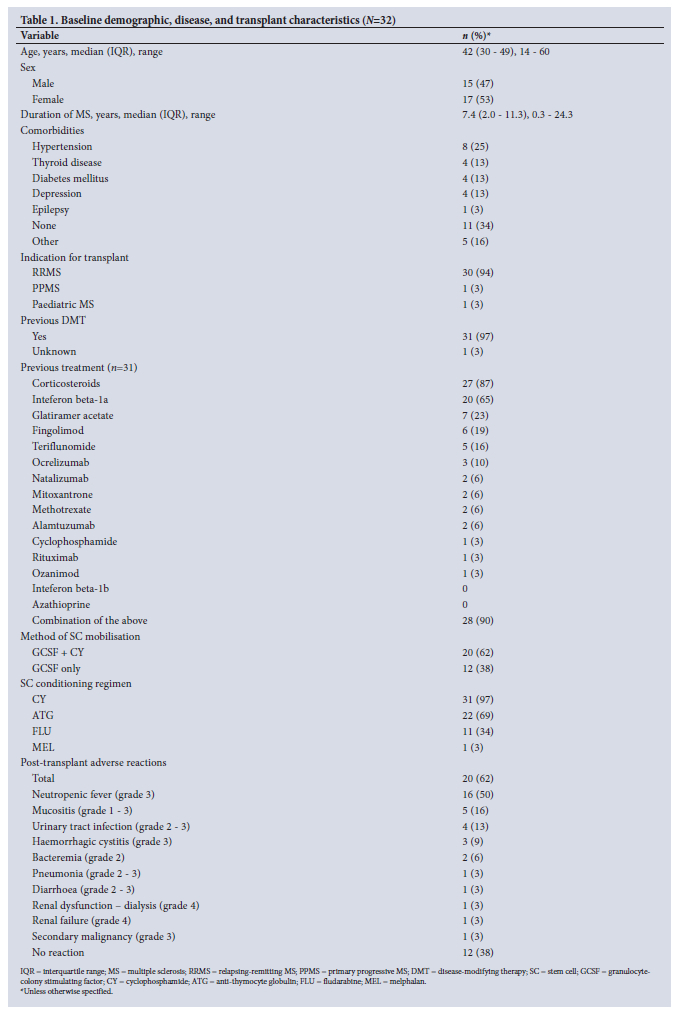
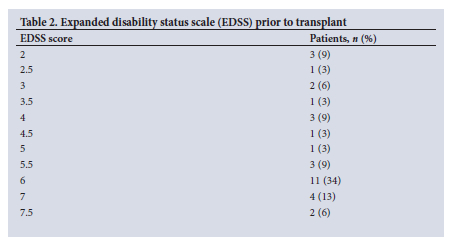
Thirty-two patients underwent ASCT between 2009 and 2024. The baseline demographics, disease and transplant characteristics are depicted in Table 1. Their median age was 42 years (range 14 - 60), and 53% were female. The median disease duration was 7.4 years. Most patients had RRMS (94%). Corticosteroids were used in 87% of patients and 97% received prior DMTs, namely interferon-ß1a (65%), glatiramer acetate (23%), fingolimod (19%) and teriflunomide (16%). Ninety percent had received combinations of DMTs; however, the combinations used were variable and no standard combination therapy was implemented. In all instances, DMTs were stopped post ASCT. Baseline disability before transplantation was substantial (Table 2): the median EDSS was ~6, with 53% (17/32) at EDSS >6 and 31% (10/32) at EDSS <4, indicating a cohort enriched for advanced functional impairment at the time of AHSCT, as a patient with an EDSS of 6 requires a walking aid to walk 100 m with or without breaks.[26]
Mobilisation, the process whereby stem cells are moved from the bone marrow into peripheral blood using medication,[20] was achieved using granulocyte-colony stimulating factor (G-CSF) + cyclophosphamide in 62% of cases, and G-CSF alone in 38% of cases. Conditioning, the preparative lymphodepleting regimen given prior to receiving stem cells[20] included cyclophosphamide (97%), rabbit anti-thymocyte globulin (ATG) (69%) and fludarabine (34%).
Adverse events occurred in 62% of patients, mainly neutropenic fever (50%), mucositis (16%) and urinary tract infections (13%), while 38% of patients did not experience any adverse reactions.
The median follow-up time was 2.9 years. No transplant-related deaths occurred during the follow-up period.
Patient demographics
Overall survival of cohort
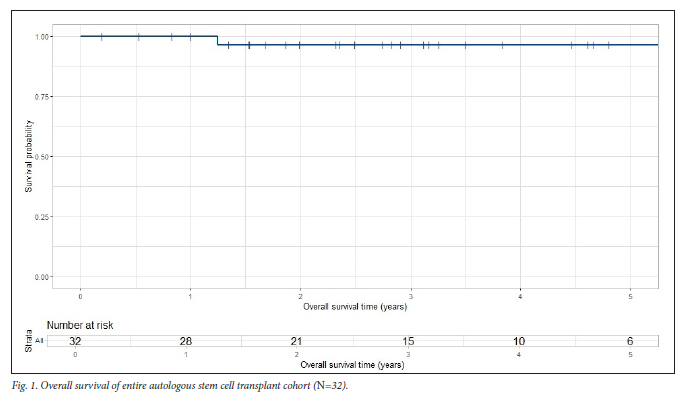
The Kaplan-Meier analysis demonstrates excellent overall survival following ASCT (Fig. 1). Only one of 32 patients died during the follow-up period, from a non-transplant, non-MS-related cause (motor vehicle accident). Estimated overall survival was 100% at 1 year and 96% (95% confidence interval (CI) 77 - 99%) at both 3 and 5 years.
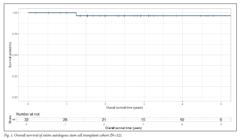
When excluding the non-disease-related death, overall survival remained 100% throughout the study period.
Relapse-free survival
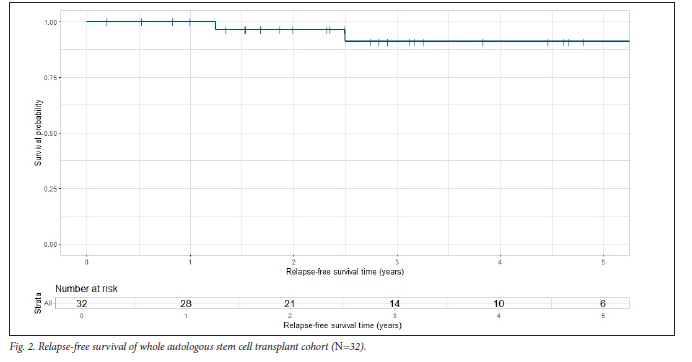
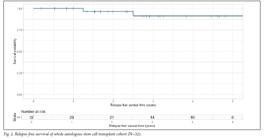
The Kaplan-Meier curve demonstrates excellent relapse-free survival following ASCT (Fig. 2) Only 1 of 32 patients experienced relapse during the follow-up period. Estimated relapse-free survival was 100% at 1 year and 91% (95% CI 68 - 98) at both 3 and 5 years. When excluding the single non-transplant, non-MS-related death, disease-free survival increased to 96% (95% CI 77 - 99) at both 3 and 5 years. Fig. 2. Relapse-free survival of whole autologous stem cell transplant cohort (N=32).
Engraftment of neutrophils and platelets
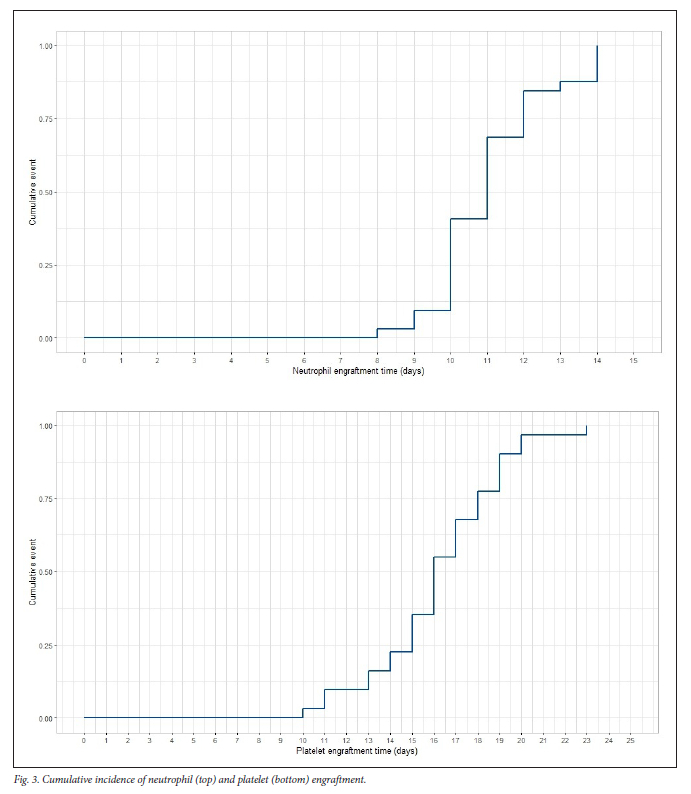
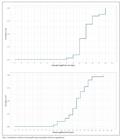
The left panel in Fig. 3 depicts neutrophil engraftment, and the right panel shows platelet engraftment in the study cohort. Median time to neutrophil recovery (absolute neutrophil count >0.5 × 10⁹/L) was 10 days (range 7 - 13 days), while median time to platelet recovery (>20 × 109/L) was 14 days (range 10 - 23 days). These findings indicate prompt and consistent haematopoietic reconstitution post-ASCT, with no cases of delayed engraftment or primary graft failure observed.
Disease status post autologous stem cell transplant
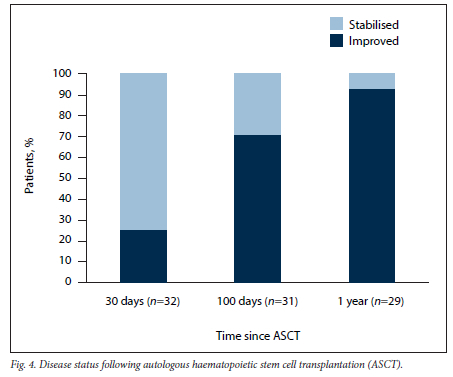
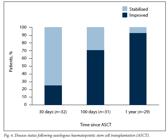
Fig. 4 illustrates the clinical outcomes based on disease status, which was measured through the use of the EDSS scores at 30 days (n=32), 100 days (n=31) and 1 year (n=29) post transplant. An increase in the EDSS score implied a worsening of symptoms, while a reduction in EDSS was deemed an improvement in symptoms and a static EDSS indicated disease stabilisation. By 100 days, the majority of patients demonstrated neurological improvement or stabilisation, with sustained benefit at 1 year. Specifically, ~90% of evaluable patients showed improvement or no further progression at 12 months. Too few patients had complete 5-year follow-up for long-term EDSS data to be analysed. Of note, at all the above end points, no cases of deterioration in EDSS were noted. These findings indicate durable neurological stabilisation and early functional recovery after ASCT in this cohort.
Discussion
This study presents the first and only published SA experience with ASCT for MS. Our findings show that ASCT is safe, feasible and provisionally highly effective in our real-world, resource-limited setting. Only one relapse occurred during follow-up, and no transplant-related mortality was observed. These results align with international evidence confirming ASCT as one of the most potent disease-modifying therapies for RRMS refractory to conventional DMTs.[21,27,28]
Large international studies and meta-analyses have reinforced the superior efficacy of ASCTs for RRMS. Kalincik et al.[27] reported a 2.7-fold higher probability of confirmed disability improvement with ASCT compared with high-efficacy DMTs such as ocrelizumab and natalizumab, with a durable benefit over 5 years. A 2024 meta-analysis including 422 patients found significant reductions in relapse rate and MRI activity, with no transplant-related deaths.[21] Our outcomes are in keeping with these results.
Neurological stabilisation or improvement was seen in nearly all evaluable patients (≈90% at 1 year), consistent with the MIST randomised trial, which demonstrated a 79% reduction in disability progression with ASCT compared with continued DMTs. [17] These findings support the immune reconstitution hypothesis, in which ASCT restores immune tolerance and halts ongoing neuroinflammation. In our study cohort the median duration of MS was 7.4 years, and the mean EDSS was 5 at the time of transplant. This means that owing to the natural progression of MS, one would have expected a deterioration without ASCT at 1 year.[29]
Treatment-related toxicity was manageable, predominantly comprising grade 3 (or lower) adverse reactions, which were mostly transient cytopenias such as neutropenic fever (50%) and mucositis (16%), with no graft failure or transplant-related mortality. This is consistent with modern EBMT registry data reporting <0.3% mortality.[19] Only one patient experienced a grade 4 reaction in the form of renal failure requiring dialysis. All patients engrafted neutrophils and platelets timeously. Platelet and neutrophils engraftment kinetics in our cohort were comparable to those described internationally.[30]
While ASCT is generally reserved for highly active RRMS refractory to high-efficacy DMTs, emerging data suggest superior outcomes when performed earlier in the disease course.[19,28] The 2024 - 2025 EBMT/International Society for Cellular Therapy guidelines acknowledge that first-line ASCT may be appropriate for rapidly evolving, poor-prognosis RRMS, particularly where access to costly DMTs is limited.[28] Evidence increasingly supports earlier intervention to prevent irreversible neurological decline.[21,27,28]
In SA's upper-middle-income but resource-limited setting, these findings have important implications. Access to high-efficacy DMTs is sometimes restricted, and chronic therapy costs remain prohibitive. Introducing ASCT earlier for aggressive RRMS could prevent disability progression and reduce long-term healthcare expenditure.[19,20] Economic analyses demonstrate that ASCT is cost-effective within 5 years, being approximately fivefold less costly than ongoing DMTs and associated with better quality-adjusted outcomes.[24,28] These data highlight ASCT's potential as a durable, cost-effective option when implemented in accredited centres adhering to international standards. With constrained budgets and relatively limited DMT access, earlier ASCT for carefully selected, highly active RRMS could be both clinically superior and cost-saving. A national framework could specify: (i) high-efficacy DMTs as first-line for most; (ii) early ASCT for rapidly evolving RRMS; (iii) close collaboration between neurology and haematology services for early referral for ASCT in select MS cases; and (iv) registry participation for outcomes and cost tracking. Such structured implementation would optimise outcomes, support equitable access and align SA with global standards while addressing local constraints.
Limitations of this study include its retrospective design, modest sample size and incomplete long-term follow-up, because many patients opted only to follow up with their neurologist post ASCT, and many patients were not yet 5 years post ASCT, so that meaningful analysis was not yet possible. The lack of uniform MRI and biomarker data limits direct international comparisons. Nonetheless, this study provides important real-world evidence that ASCT is feasible, safe and potentially cost-effective in the SA population.
In conclusion, ASCT is a safe, powerful and durable therapeutic option for aggressive, treatment-refractory MS. Earlier use in appropriately selected patients could achieve lasting remission, improved quality of life and substantial cost savings. Expanding national ASCT programmes and registry-based evaluations will be essential for ensuring equitable access to this transformative therapy in SA.
Data availability. The data used for this study are available on request from the first author.
Declaration. This study was conducted for the purposes of AS's MMed (Internal Medicine) degree at the University of the Witwatersrand. Acknowledgements. Dr Petra Gaylard for her expert assistance with the statistics.
Author contributions. AS conceptualised the study in discussion with JRdT and SD. AS obtained ethics approval, conducted data collection, wrote up the manuscript and co-ordinated the research under the supervision of JRdT, SD and AM. AP, JD, DM, DB and JT critically reviewed the manuscript. All authors reviewed and approved the final version of the manuscript and accept responsibility for its content.
Funding. The Wits Donald Gordon Medical Research Institute funded the biostatistical analysis.
Conflicts of interest. None.
References
-
1. Tafti D, Ehsan M, Xixis KL. Multiple Sclerosis. Treasure Island (FL), 2025. https://www.ncbi.nlm.nih.gov/pubmed/29763024 (accessed 17 November 2025).
» https://www.ncbi.nlm.nih.gov/pubmed/29763024 -
2. Ludwin SK. The pathogenesis of multiple sclerosis: Relating human pathology to experimental studies. J Neuropathol Exp Neurol 2006;65(4):305-318. https://doi.org/10.1097/01.jnen.0000225024.12074.80
» https://doi.org/10.1097/01.jnen.0000225024.12074.80 -
3. Buzzard KA, Broadley SA, Butzkueven H. What do effective treatments for multiple sclerosis tell us about the molecular mechanisms involved in pathogenesis? Int J Mol Sci 2012;13(10):12665-12709. https://doi.org/10.3390/ijms131012665
» https://doi.org/10.3390/ijms131012665 -
4. Giampaolo D, Bhigjee A, Retief C, et al Guideline for the diagnosis and management ofmultiple sclerosis: A southern African perspective. S Afr Med J 2013;103(9 Suppl 3):670-691. https://doi.org/10.7196/samj.7124
» https://doi.org/10.7196/samj.7124 -
5. Harbo HF, Gold R, Tintore M. Sex and gender issues in multiple sclerosis. Ther Adv Neurol Disord 2013;6(4):237-248. https://doi.org/10.1177/1756285613488434
» https://doi.org/10.1177/1756285613488434 -
6. Wilson M. Modern approaches to multiple sclerosis. Clin Med 2011;11(4):361-363. https://doi.org/10.7861/clinmedicine.11-4-361
» https://doi.org/10.7861/clinmedicine.11-4-361 -
7. Klineova S, Lublin FD. Clinical course of multiple sclerosis. Cold Spring Harb Perspect Med 2018;8(9):a028928 https://doi.org/10.1101/cshperspect.a028928
» https://doi.org/10.1101/cshperspect.a028928 -
8. Iacobaeus E, Arrambide G, Amato MP, et al Aggressive multiple sclerosis (1): Towards a definition of the phenotype. Mult Scler 2020;26(9):1352458520925369. https://doi.org/10.1177/1352458520925369
» https://doi.org/10.1177/1352458520925369 - 9. Giampaolo D. Seeing through the MiSt: A pragmatic guide to managing MS. Neuron SA 2024;17(55):7-23.
-
10. Jacob A, Shatila AO, Inshasi J, et al. Disease modifying treatment guidelines for multiple sclerosis in the United Arab Emirates. Mult Scler Relat Disord 2024;88:105703. https://doi.org/10.1016/j.msard.2024.105703
» https://doi.org/10.1016/j.msard.2024.105703 -
11. Neate SL, Donald A, Jelinek GA, Nag N. Experiences of and attitudes to lifestyle modification for the management of multiple sclerosis: A qualitative analysis of free-text survey data. Health Expect 2022;25(1):214-222. https://doi.org/10.1111/hex.13364
» https://doi.org/10.1111/hex.13364 -
12. Robertson D, Moreo N. Disease-modifying therapies in multiple sclerosis: Overview and treatment considerations. Fed Pract 2016;33(6):28-34. https://pmc.ncbi.nlm.nih.gov/articles/PMC6366576/ (accessed 17 September 2026).
» https://pmc.ncbi.nlm.nih.gov/articles/PMC6366576/ -
13. Freedman MS, Selchen D, Arnold DL, et al. Treatment optimisation in MS: Canadian MS Working Group updated recommendations. Can J Neurol Sci 2013;40(3):307-323. https://doi.org/10.1017/s0317167100014244
» https://doi.org/10.1017/s0317167100014244 -
14. Brown JWL, Coles A, Horakova D, et al. Association of initial disease-modifying therapy with later conversion to secondary progressive multiple sclerosis. JAMA 2019;321(2):175-187. https://doi.org/10.1001/jama.2018.20588
» https://doi.org/10.1001/jama.2018.20588 -
15. Passweg JR, Baldomero H, Bader P, et al. Is the use of unrelated donor transplantation leveling off in Europe? The 2016 European Society for Blood and Marrow Transplant activity survey report. Bone Marrow Transplant 2018;53(9):1139-1148. https://doi.org/10.1038/s41409-018-0153-1
» https://doi.org/10.1038/s41409-018-0153-1 - 16. Cortes AP, Gutierrez CE. Autoimmunity: From bench to bedside. In: Anaya JM, Shoenfeld Y, Rojas-Villarraga A, Levy RA, Cervera R, eds. Autoimmunity: From Bench to Bedside. Bogota: El Rosario University Press, 2013.
-
17. Burt RK, Balabanov R, Burman J, et al Effect of nonmyeloablative hematopoietic stem cell transplantation vs continued disease-modifying therapy on disease progression in patients with relapsing-remitting multiple sclerosis: A randomised clinical trial. JAMA 2019;321(2):165-174. https://doi.org/10.1001/jama.2018.18743
» https://doi.org/10.1001/jama.2018.18743 -
18. Nawar AA, Farid AM, Wally R, et al. Efficacy and safety of stem cell transplantation for multiple sclerosis: A systematic review and meta-analysis of randomised controlled trials. Sci Rep 2024;14(1):12545. https://doi.org/10.1038/s41598-024-62726-4
» https://doi.org/10.1038/s41598-024-62726-4 -
19. Sharrack B, Saccardi R, Alexander T, et al. Autologous haematopoietic stem cell transplantation and other cellular therapy in multiple sclerosis and immune-mediated neurological diseases: Updated guidelines and recommendations from the EBMT Autoimmune Diseases Working Party (ADWP) and the Joint Accreditation Committee of EBMT and ISCT (JACIE). Bone Marrow Transplant 2020;55(2):283-306. https://doi.org/10.1038/s41409-019-0684-0
» https://doi.org/10.1038/s41409-019-0684-0 -
20. Mariottini A, Nozzoli C, Carli I, et al. Cost and effectiveness of autologous haematopoietic stem cell transplantation and high-efficacy disease-modifying therapies in relapsing-remitting multiple sclerosis. Neurol Sci 2024;45(7):3379-3387. https://doi.org/10.1007/s10072-024-07308-y
» https://doi.org/10.1007/s10072-024-07308-y -
21. Muraro PA, Mariottini A, Greco R, et al. Autologous haematopoietic stem cell transplantation for treatment of multiple sclerosis and neuromyelitis optica spectrum disorder - recommendations from ECTRIMS and the EBMT. Nat Rev Neurol 2025;21(3):140-158. https://doi.org/10.1038/s41582-024-01050-x
» https://doi.org/10.1038/s41582-024-01050-x -
22. Shahid Z, Etra AM, Levine JE, et al. Defining and grading infections in clinical trials involving hematopoietic cell transplantation: A report from the BMT CTN Infectious Disease Technical Committee. Transplant Cell Ther 2024;30(5):540. https://doi.org/10.1016/j.jtct.2024.03.001
» https://doi.org/10.1016/j.jtct.2024.03.001 -
23. Zhukovsky C, Sandgren S, Silfverberg T, et al. Autologous haematopoietic stem cell transplantation compared with alemtuzumab for relapsing-remitting multiple sclerosis: An observational study. J Neurol Neurosurg Psychiatry 2021;92(2):189-194. https://doi.org/10.1136/jnnp-2020-323992
» https://doi.org/10.1136/jnnp-2020-323992 -
24. Hartung DM. Health economics of disease-modifying therapy for multiple sclerosis in the United States. Ther Adv Neurol Disord 2021;14:1756286420987031. https://doi.org/10.1177/1756286420987031
» https://doi.org/10.1177/1756286420987031 -
25. Doescher A, Casper J, Kraemer D, Kapels HH, Petershofen EK, Muller TH. Platelet engraftment after allogenic stem cell transplantation is monitored by digital polymerase chain reaction without interference by platelet support. Exp Hematol 2018;68:21-29. https://doi.org/10.1016/j.exphem.2018.08.007
» https://doi.org/10.1016/j.exphem.2018.08.007 -
26. Wallin MT, Fitzgerald KC, Culpepper WJ. Optimal Use of the Expanded Disability Status Scale for Multiple Sclerosis Morbidity. London: SAGE Publications Ltd, 2020. https://doi.org/10.4135/9781529735840
» https://doi.org/10.4135/9781529735840 -
27. Kalincik T, Sharmin S, Roos I, et al. Comparative effectiveness of autologous hematopoietic stem cell transplant vs fingolimod, natalizumab, and ocrelizumab in highly active relapsing-remitting multiple sclerosis. JAMA Neurol 2023;80(7):702-713. https://doi.org/10.1001/jamaneurol.2023.1184
» https://doi.org/10.1001/jamaneurol.2023.1184 -
28. Cohen JA, Cross AH. Is autologous hematopoietic stem cell transplant better than high-efficacy disease-modifying therapies for relapsing multiple sclerosis? JAMA Neurol 2023;80(7):669-672. https://doi.org/10.1001/jamaneurol.2023.0467
» https://doi.org/10.1001/jamaneurol.2023.0467 -
29. Burt RK, Loh Y, Cohen B, et al. Autologous non-myeloablative haemopoietic stem cell transplantation in relapsing-remitting multiple sclerosis: A phase I/II study. Lancet Neurol 2009;8(3):244-253. https://doi.org/10.1016/S1474-4422(09)70017-1
» https://doi.org/10.1016/S1474-4422(09)70017-1 -
30. Patti F, Chisari CG, Toscano S, et al. Autologous hematopoietic stem cell transplantation in multiple sclerosis patients: Monocentric case series and systematic review of the literature. J Clin Med 2022;11(4). https://doi.org/10.3390/jcm11040942
» https://doi.org/10.3390/jcm11040942

Accepted 17 March 2026