Achieving the HIV and AIDS National Strategic Plan: a practical calculator for local target setting in district health facilities
FORUM
ISSUES IN MEDICINE
Achieving the HIV and AIDS National Strategic Plan: a practical calculator for local target setting in district health facilities
Nicholas G Leydon; Francois Venter; Patricia D Webster; Winnie Moleko; Regina Osih; Pierre M Barker
The South African HIV National Strategic Plan (NSP) aims to provide access to appropriate treatment, care and support to 80% of the HIV-infected population by 2011.12all of South Africa's health facilities. While the NSP has broad political and programmatic support from the Department of Health and civil society, and managers are able to recite the national targets, it has been difficult for these managers to relate the targets to their own geographical areas of responsibility. National, regional and district targets for HIV care have been set from South Africa's relatively good census, modelling and epidemiological data.34
Previous tools have provided districts with the ability to calculate their estimated monthly need for HAART initiations533
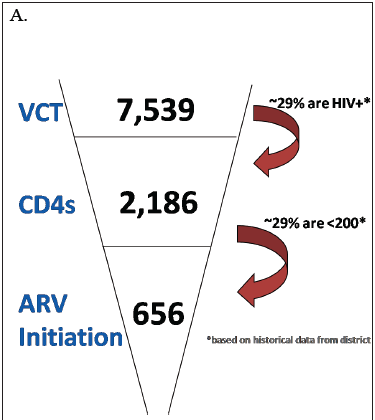
An estimate of the number of clients in a district who would require HIV and CD4-count testing to identify all those who need HAART (100% coverage, calculated from Barker and Venter5Fig. 1A). These calculations provide broad targets that are useful for district planners; however, since each health facility in a district represents only a fraction of that district's total HAART need, further breakdown is required to calculate facility-level targets.
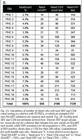
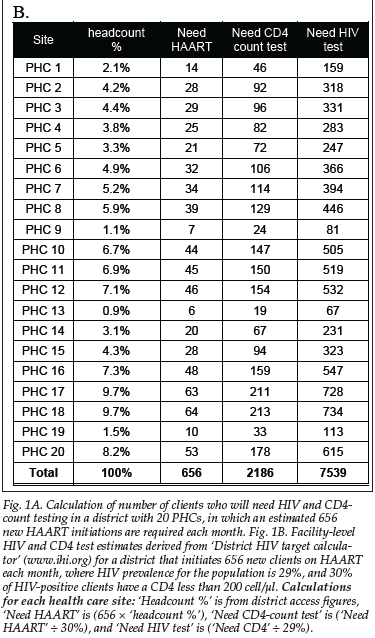
Using the DHIS reports of monthly head count, managers can calculate each PHC's contribution to the total district headcount. Fig. 1B shows how this breakdown can provide the number of patients who must complete each step of HIV care every month in all clinics to achieve a district goal of 656 HAART initiations. For example, PHC 8 represents 6% of the district head count and, assuming equal distribution of HIV prevalence across the district, should refer approximately 39 clients per month for initiation (6% of the district goal of 656 clients requiring initiation). The clinic must first counsel, test and prepare sufficient clients at each step to yield this number of HAART referrals. Using the same historical data for antenatal HIV prevalence and CD4 count in the district, PHC 8 can calculate back through these steps to derive the number of clients it needs to counsel for HIV testing (446 patients per month). A simple tool for calculating district-wide and facility-specific targets for HIV testing and HAART initiations is available at www.ihi.org/topics/developingcountries.
These calculations assume a well-integrated health system for HIV testing, CD4 testing, HAART referral and initiation that functions at 100% efficiency. In reality, many clients are lost at each step of the testing, referral and initiation care pathway owing to system inefficiencies. South Africa's HAART initiation targets will not be reached unless these inefficiencies are addressed. Using methods to improve the reliability of the HAART preparation and initiation processes,6
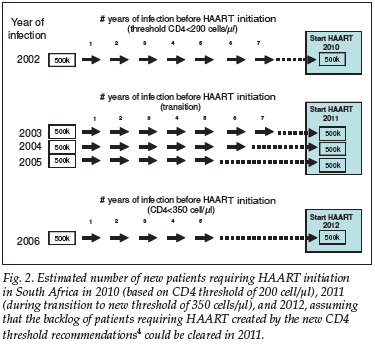
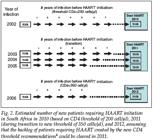
The South African health system may adopt new guidelines related to ARV initiation based on recommendations from the World Health Organization (WHO) to start eligible patients at CD4 <350/µl.437Fig. 2). The change in CD4-count threshold for HAART will, however, create a temporary backlog of approximately 1 million patients (in South Africa's case, the national HAART initiation requirement in 2010 will increase from 500 000 to 1.5 million). After elimination of the backlog, the initiation requirement in subsequent years will revert to a steady state of about 500 000/year. Given that the current performance for HAART initiation is well below the annual need, it is likely that the system will take some years to respond to the surge in demand created by the new guidelines. The calculator can be used to estimate the initiations and HIV/CD4 testing requirements associated with the steady state. The change in CD4 threshold will create a one-time increase in demand for initiation and associated HIV/CD4 testing that is equivalent to double the annual steady-state requirements.
Development Goals or other campaigns. While facilitylevel staff are often urged to 'improve' performance, they have difficulty assessing quantitatively how their facility should contribute to the intended outcome of each strategic initiative. The tool uses data that are readily available to district managers for the purpose of setting targets, measuring progress and optimising resources at each facility.
References
-
1. HIV & AIDS and STI Strategic Plan for South Africa. 2007-2011. http://www.info.gov.za/otherdocs/2007/aidsplan2007/index.html (accessed 2 December 2009).
» http://www.info.gov.za/otherdocs/2007/aidsplan2007/index.html - 2. Geffen N. HAART coverage and unmet need in South Africa. HIV Treat Bull 2009; 10(5/6): 26.
-
3. Actuarial Society of South Africa. ASSA2003. http://aids.actuarialsociety.org.za/ASSA2003-Model-3165.html (accessed 2 December 2009).
» http://aids.actuarialsociety.org.za/ASSA2003-Model-3165.html -
4. World Health Organization. Rapid Advice: Antiretroviral Therapy for HIV Infection in Adults and Adolescents. 30 Nov 2009. http://www.who.int/hiv/pub/arv/advice/en/index.html (accessed 12 January 2010).
» http://www.who.int/hiv/pub/arv/advice/en/index.html - 5. Barker P, Venter F. Setting district-based annual targets for HAART and PMTCT - a first step in planning effective intervention for the HIV/AIDS epidemic. S Afr Med J 2007; 97(10): 916-917.
- 6. Barker PM, McCannon CJ, Mehta N, et al. Strategies for scale-up of antiretroviral treatment in South Africa through health system optimization. J Infect Dis 2007; 196 Suppl 3: S457-463.
- 7. Pantaleo G, Graziosi C, Fauci AS. New concepts in the immunopathogenesis of human immunodeficiency virus infection. N Engl J Med 1993; 328: 327-335.