Mental health service delivery in South Africa from 2000 to 2010: one step forward, one step back
Abstract
OBJECTIVE: To identify progress and challenges in mental healthcare in South Africa, as well as future mental health services research priorities. METHOD: A systematic review of mental health services research. Literature searches were conducted in Medline, PsychInfo and Sabinet databases from January 2000 to October 2010 using key phrases. Hand searches of key local journals were also conducted. Of 215 articles retrieved, 92 were included. Data were extracted onto a spreadsheet and analysed thematically. RESULTS: While progress in epidemiological studies has been good, there is a paucity of intervention and economic evaluation studies. The majority of studies reviewed were on the status of mental healthcare services. They indicate some progress in decentralised care for severe mental disorders, but also insufficient resources to adequately support community-based services, resulting in the classic revolving-door phenomenon. Common mental disorders remain largely undetected and untreated in primary healthcare. Cross-cutting issues included the need for promoting culturally congruent services as well as mental health literacy to assist in improving help-seeking behaviour, stigma reduction, and reducing defaulting and human rights abuses. CONCLUSIONS: While there has been some progress in the decentralisation of mental health service provision, substantial gaps in service delivery remain. Intervention research is needed to provide evidence of the organisational and human resource mix requirements, as well as cost-effectiveness of a culturally appropriate, task shifting and stepped care approach for severe and common mental disorders at primary healthcare level.
Overview of studies
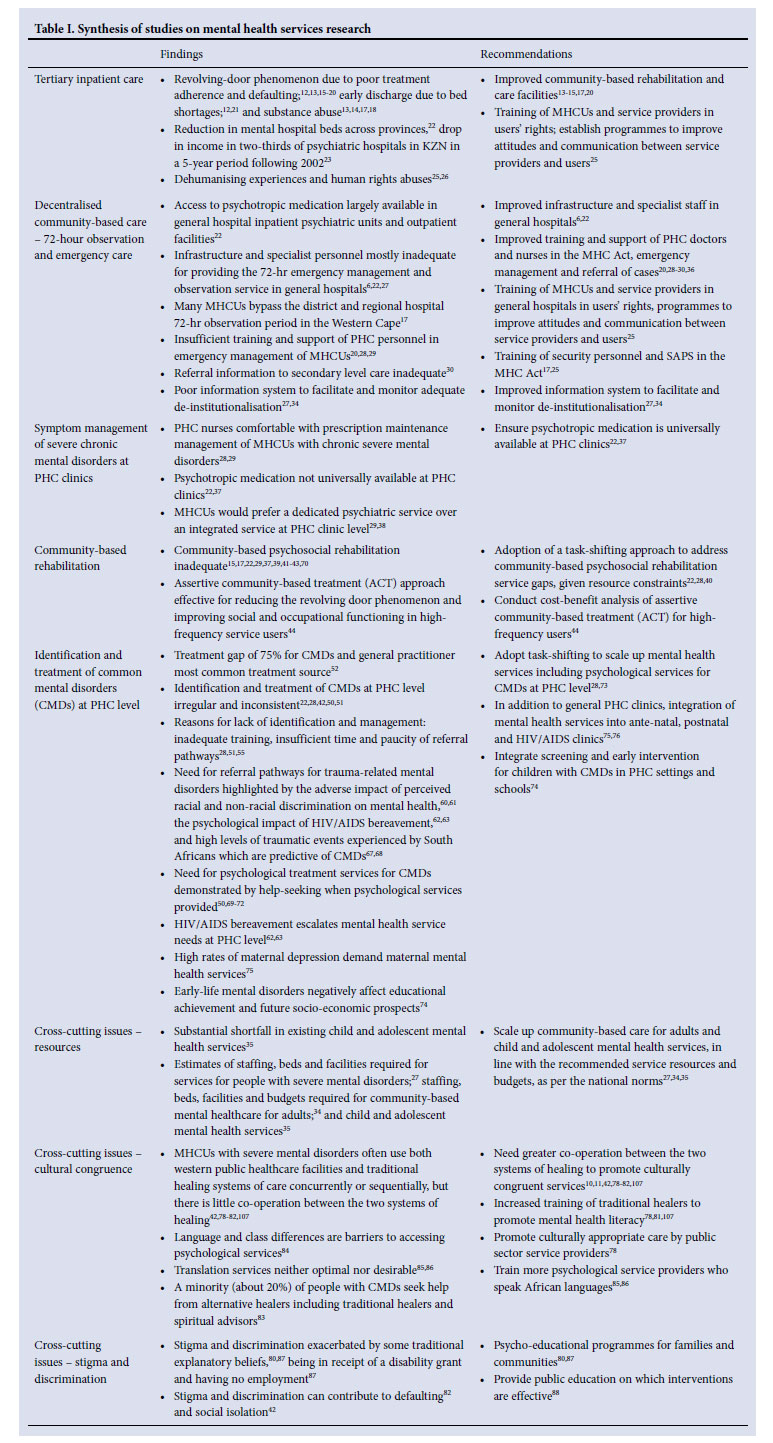
The majority of articles (45 (49%)) were concerned with providing evidence of the status of mental healthcare services and experiences and perceptions of service users. Five of these were published from situation analyses data collected by the Mental Health and Poverty Project, a multi-country study about mental health policy development and implementation in 4 African countries.8Table I. The review studies focused on specific issues of HIV threat and treatment of persons with mental illness and substance use disorders;91011
Tertiary inpatient care
The majority of articles included on tertiary inpatient care focused on the problem of the revolving-door phenomenon that has accompanied policy shifts towards de-institutionalised care. These articles suggest that high rates of re-admission are mostly due to poor treatment adherence and defaulting,12-20 substance abuse13,14,17,18 and early discharge owing to bed shortages.12,21 Concerning the latter, Lund et al. reported a 7.7% reduction in mental hospital bed numbers across all provinces in the 5 years ending in 2005.22 232213-15,17,19,20,24
Other articles concerned the quality of inpatient care. Joska et al.,15et al.25265
Decentralised community-based care
Observation and emergency care of MHCUs with severe and acute mental disorders at general hospitalsAs mentioned in the introduction, the new Mental Health Care Act5 22 et al.22,27 found that infrastructure and specialist staff for the 72-hour emergency management and observation service are mostly inadequate across the country. A detailed study by Ramlall6 6et al.22
Concerning outpatient services, 3 articles report that PHC nurses and doctors, who are often the first contact with the healthcare system, reported insufficient training and support in emergency management of MHCUs with severe and acute mental illness.20,28,29 Struwig30
Savings incurred as a result of budget cuts in tertiary psychiatric care facilities have not been transferred to support community oriented care.24,31-33 There is a shortfall in resources to adequately facilitate de-institutionalisation policy imperatives, so leading to insufficient dedicated beds in general hospitals, insufficient community-based residential care, and poor information systems to monitor the transitions to community-based care.27,34 In particular, there is a substantial shortfall in existing child and adolescent mental health services.35
It follows that recommendations for improving decentralised emergency care and observation of MHCUs with severe and acute mental disorders include: (i) demand for additional resources at the district/regional hospital level, particularly improved infrastructure and specialist staff; and (ii) improved training and support of PHC doctors and nurses for management and referral of cases as set out in the Mental Health Care Act.20,28-30,36 Mayers et al.2517,25
Symptom management of severe mental disorders at PHC clinics
While 2 studies suggest that PHC clinic nurses are generally comfortable with symptom management of chronic severe mental disorders through the provision of maintenance medication,28,29 psychotropic medication is not universally available at PHC clinics across the country.22,37 This poses a threat to adequate treatment adherence and increases the likelihood of defaulting, which was identified as contributing to the revolving-door phenomenon.12,13,15-17,19,20 Two studies investigated MHCUs' experiences of symptom management at PHC level;29,38 both revealed that MHCUs would prefer a dedicated psychiatric service over an integrated service at PHC clinic level. In the main, this was to obviate having to wait in long queues, which was reported in one study to contribute to defaulting.38
Community-based psychosocial rehabilitation
A large number of articles (10) reveal gaps in community-based psychosocial rehabilitation programmes,15,17,22,29,39-43 particularly in rural areas. These articles corroborate those which suggest that the revolving door phenomenon is partly due to inadequate communitybased care, including psychosocial rehabilitation. There has been only one intervention study investigating the efficacy of a modified assertive community-based treatment (ACT) approach that was shown to have good outcomes for reducing the revolving-door phenomenon and improving social and occupational functioning in high-frequency users.44et al.4417,28,37 However, there are no intervention studies that provide evidence of the effectiveness of this approach in South Africa.
Identification and treatment of CMDs at PHC level
The SASH study revealed a 16.5% 12-month prevalence of CMDs45,46 and a lifetime prevalence of 30.3%.46,47 CMDs included anxiety, mood, impulse control and substance use disorders. The SASH study found CMDs to be associated with chronic physical illness, including hypertension,484922,28,42,50,51 corroborated by the SASH finding of a 75% treatment gap for CMDs nationally,52,53 with this gap being greater (>80%) when co-morbid with a personality disorder.54
Several factors have been identified as contributing to this gap, including inadequate training of PHC personnel, limited time of PHC personnel, and under-developed referral pathways.28,51,55 The need to address these issues through training and support of PHC staff to close the treatment gap for CMDs in adults is underlined by the SASH finding that the most common access to treatment is via general practitioners.52
Integrated primary mental healthcare for CMDs needs to adopt a stepped care approach which ensures identification and referral of CMDs for either medical or psychological treatment as indicated.
In addition to mood and anxiety disorders, this approach needs to include substance abuse as well as suicide risk. Substance abuse was identified by the SASH study as being particularly problematic in men,56,57 while South Africans at higher risk of non-fatal suicide attempts were found to be younger, female, less educated, from the Coloured ethnic group, and have one or more DSM IV disorders.58,59
The need for referral pathways for trauma-related CMDs is highlighted by the adverse impact of perceived racial and non-racial discrimination on mental health,60,61 the psychological impact of HIV/AIDS bereavement,62,63 and findings from the SASH study that South Africans have experienced and continue to experience a high number of traumatic events, including politically motivated human rights violations committed under the apartheid regime.64-66 Stressful life events, including traumatic events and relationship problems, were found to be predictive of CMDs.67,68
Psychological treatment can assist with many of these traumarelated CMDs. While psychological services have been integrated into PHC to a limited extent through the development of community psychology service placements,69 50,69-72 In the context of scarce psychological resources, two articles recommend the adoption of a task-shifting approach for scaling up psychological services whereby non-specialist workers provide evidence-based psychological treatment packages, with support and supervision from specialists.28,73
In addition to ensuring identification and treatment of CMDs in general primary healthcare services for adults, the need for screening and early intervention in children within both PHC settings and schools is also highlighted by SASH findings that early-life mental disorders have a negative effect on educational achievement and future socio-economic prospects of individuals.74 757677
Cross-cutting issues
Modelling of resources required
Lund et al.27,31-35 have done extensive work in South Africa calculating the resources required (beds, staff and facilities) to meet the service needs of people with severe mental disorders; as well as the beds, staff, facilities and budgets required to develop community-based mental health services34 35
Cultural congruence
There have been several studies in the past decade that explored the cultural congruence of mental health services in South Africa given the diversity of cultures and languages.42,78-83 These studies indicated that a large proportion of the population hold traditional explanatory models of illness; that MHCUs with severe mental disorders often utilise both western public healthcare facilities and traditional healing systems concurrently or sequentially; that a minority of people with CMDs (about a fifth) seek help from alternative healers including traditional healers and spiritual advisors;8310,11 include the need for greater co-operation between the two systems of healing to promote cultural congruence, increased training of traditional healers to promote mental health literacy, and research to assess the efficacy of traditional treatments.818485,86
Stigma and discrimination
Two studies suggested that some traditional explanatory beliefs promote stigma and discrimination.80,87 One of these found that being a beneficiary of a disability grant and having no employment can contribute to these problems.87824280,87 A recent study suggests that while there are numerous anti-stigma activities across the country, there is a need for more evaluation of these activities and better understanding of what is effective.88
HIV/AIDS
As mentioned under the sub-heading of identification and treatment of CMDs at PHC level, the need for HIV/AIDS treatment programmes to include mental healthcare services is highlighted by a number of studies reporting on the co-morbidity of HIV/AIDS and mental disorders.76,89,90 These studies reveal high levels of CMDs associated with HIV (47.3%),7676,89,90 and elevated suicide risk.7791,92 as well as the introduction of provider-initiated HIV testing for this population.93,94 One study indicates that individuals with anxiety or depressive disorders are more likely to engage in inappropriate behaviour change strategies9596
Concluding discussion
Building on research gaps identified in Thom's review of mental health services prior to 2000, this review indicates that there has been significant progress with epidemiological studies, with the SASH study providing the first nationally representative epidemiological data base on CMDs. There has, however, been little progress made with intervention and economic evaluation studies. These remain research gaps, with close to 50% of the mental health services articles reviewed reporting on descriptive studies of the status of mental health services since 2000. A large number of these studies focused on the effects of the new Mental Health Care Act.5
Collectively, studies on tertiary inpatient admissions and care, symptom management at PHC level, and community-based psychosocial rehabilitation provide corroborative evidence that there has been some progress with decentralised care, but that a number of setbacks and challenges remain. On the positive side, there is relatively wide availability of psychotropic medication, and PHC clinic nurses are generally comfortable with providing follow-up maintenance medication for MHCUs with severe and chronic mental disorders. On the negative side, while there has been a reduction in psychiatric hospital bed numbers, there has not been sufficient investment in the development of community-based psychosocial rehabilitative services to support de-institutionalisation. The result has been 'dehospitalisation' and the development of the classic revolving-door phenomenon. This has also been the case in other countries where there were insufficient community-based rehabilitation programmes to support de-institutionalisation.97
De-institutionalised care is not a cheaper option, and Lund et al. have done extensive work on calculating the resources required care.27,31-35 for tertiary and community-based In keeping with international recommendations (e.g. by Thornicroft et al.),97i) The need for more dedicated resources to support decentralised care within hospitals designated to provide the 72-hour emergency management and observation service, (ii) the development of community-based psychosocial rehabilitation programmes harnessing task shifting and self-help strategies that have been shown to have good outcomes in other developing countries,98 iii) public education to improve mental health literacy and access to care as well as reduce stigma and discrimination, and (iv) the establishment of collaborative arrangements with traditional healers to promote culturally congruent care, understood to involve negotiation of care across language and cultural differences, including specific organisational, system or service attributes that enable this.99
Regarding CMDs, descriptive service studies indicated poor identification and treatment of these disorders at PHC level, corroborated by epidemiological data from the SASH study that showed a large treatment gap of 75% for CMDs.52100 101102103,104
In the face of limited specialist resources, a recommendation for closing the treatment gap for CMDs is the adoption of task shifting within a stepped care approach. PHC staff servicing general as well as vertical antenatal, postnatal and HIV/ARV clinics would need to be trained and supported to identify CMDs, and manage and refer where appropriate. Because PHC staff are overstretched, harnessing trained community care workers to deliver manualised psychosocial interventions for specific conditions, where appropriate, is suggested. There is emerging international evidence of the effectiveness of such approaches from other low- and middle-income countries.98,105,106 This approach also provides the potential for promoting culturally congruent care by overcoming racial, class and language barriers that act as impediments to help-seeking behaviour.
In line with the above service recommendations, future mental health services research needs to focus on intervention and economic evaluation studies of evidence-based culturally appropriate packages of care using a task-shifting approach at the health facility and community levels of care. These should include community-based psychosocial rehabilitation and the identification and management of severe and common mental disorders. Organisationally, intervention and economic evaluation research is also needed to understand the human resource mix and costing for the delivery of integrated packages of care at district level, including training and supervisory needs, organisational arrangements that promote cultural congruence, and capacity development needs for staff, e.g. training and sensitisation workshops and evidence-based programmes to improve communication and attitudes of staff towards users with mental disorders.
Acknowledgement. We thank Kim Baillie for the research assistance she provided on this project, and for funding from the Mental Health and Poverty Research Programme Consortium (RPC) funded by the United Kingdom (UK) Department for International Development (DFID) (RPC HD6 2005-2010) for the benefit of developing countries. The views expressed are not necessarily those of the DFID.
References
- 1. Thom R. Mental health services: A review of southern African literature, 1967-1999. Johannesburg: Centre for Health Policy, University of the Witwatersrand, 2000.
- 2. Thom R. Mental health service policy, implementation and research in South Africa -are we making progress? South African Journal of Psychiatry 2004;10(2):32-37.
- 3. Department of Health. National Health Policy Guidelines for Improved Mental Health in South Africa, Directorate for Mental health and Substance Abuse. Pretoria: Department of Health, 1997.
- 4. Department of Health. White Paper for the Transformation of the Health System in South Africa. Pretoria: Department of Health, 1997.
- 5. Department of Health. Mental Health Care Act (17 of 2002). Pretoria: Department of Health, 2004.
- 6. Ramlall S, Chipps J, Mars M. Impact of the South African Mental Health Care Act No. 17 of 2002 on regional and district hospitals designated for mental health care in KwaZulu-Natal. S Afr Med J 2010;100(10):667-670.
- 7. Hanlon C, Wondimagegn D, Alem A. Lessons learned in developing community mental health care in Africa. World Psychiatry 2010;9(3):185-189.
- 8. Flisher AJ, Lund C, Funk M, et al. Mental health policy development and implementation in four African countries. J Health Psychol 2007;12(3):505-516.
- 9. Parry CD, Blank MB, Pithey AL. Responding to the threat of HIV among persons with mental illness and substance abuse. Curr Opin Psychiatry 2007;20(3):235-241.
- 10. Jansa van Rensburg ABR. A changed climate for mental health care delivery in South Africa. Afr J Psychiatry (Johannesbg) 2009;12:157-165.
- 11. Jones LV. Black South African psychiatric recipients: have they been overlooked under the recent democratization? Soc Work Public Health 2009 ;24(1-2):76-88.
- 12. Botha UA, Koen L, Joska JA, et al. The revolving door phenomenon in psychiatry: comparing lowfrequency and high-frequency users of psychiatric inpatient services in a developing country. Soc Psychiatry Psychiatr Epidemiol 2010;45(4):461-468.
- 13. Janse van Rensburg ABR. Clinical profile of acutely ill psychiatric patients admitted to a general hospital psychiatric unit. African Jounal of Psychiatry 2007;10:159-163.
- 14. Janse van Rensburg ABR. Diagnosis and treatment of schizophrenia in a general hospital based acute psychiatric ward. African Journal of Psychiatry 2010;13:204-210.
- 15. Joska JA, Flisher AJ. Needs and services at an in-patient psychotherapy unit. Afr J Psychiatry (Johannesbg) 2007;10(3):149-156.
- 16. Kotze AME, van Delft WF, Roos JL. Continuity of care of outpatients with schizophrenia in Pretoria. South African Journal of Psychiatry 2010;16(3):80-83.
- 17. Lund C, Oosthuizen P, Flisher AJ, et al. Pathways to inpatient mental health care among people with schizophrenia spectrum disorders in South Africa. Psychiatr Serv 2010;61(3):235-240.
- 18. Moosa MYH, Yeenah FY. Analysis of acute admission to a geneneral hospital psychiatric unit. South African Psychiatric Review 2002;November:16-18.
- 19. Paruk S, Ramlall S, Burns JK. Adolescent-onset psychosis: A 2-year retrospective study of adolescents addmitted to a general psychiatric unit. South African Journal of Psychiatry 2009; 15(4):86-92.
- 20. Temmingh HS, Oosthuizen PP. Pathways to care and treatment delays in first and multi episode psychosis. Findings from a developing country. Soc Psychiatry Psychiatr Epidemiol 2008;43(9):727-735.
- 21. Niehaus DJ, Koen L, Galal U, et al. Crisis discharges and readmission risk in acute psychiatric male inpatients. BMC Psychiatry 2008;8:44.
- 22. Lund C, Kleintjes S, Kakuma R, Flisher AJ. Public sector mental health systems in South Africa: interprovincial comparisons and policy implications. Soc Psychiatry Psychiatr Epidemiol 2010;45(3):393-404.
- 23. Burns JK. Mental health services and funding in KwaZulu-Natal: A tale of inequity and neglect. S Afr Med J 2010;100(10):662-666.
- 24. Lund C, Flisher AJ. South African Mental Health Process Indicators. J Ment Health Policy Econ 2001;4(1):9-16.
- 25. Mayers P, Keet N, Winkler G, Flisher AJ. Mental health service users' perceptions and experiences of sedation, seclusion and restraint. Int J Soc Psychiatry 2010;56(1):60-73.
- 26. Mkize DL. Human rights abuses at a psychiatric hospital in KwaZulu-Natal. South African Journal of Psychiatry 2007;13(4):137-142.
- 27. Lund C, Flisher AJ. Norms for mental health services in South Africa. Soc Psychiatry Psychiatr Epidemiol 2006;41(7):587-594.
- 28. Petersen I, Bhana A, Campbell-Hall V, et al. Planning for district mental health services in South Africa: a situational analysis of a rural district site. Health Policy Plan 2009;24(2):140-150.
- 29. van Deventer C, Couper I. Evaluation of primary mental healthcare in North West Province - a qualitative view. South African Journal of Psychiatry 2008;14(4):136-140.
- 30. Struwig W, Pretorius PJ. Quality of psychiatric referrals to secondary-level care. South African Journal of Psychiatry 2009;15(2):33-36.
- 31. Lund C, Flisher AJ. Staff/population ratios in South African public sector mental health services. S Afr Med J 2002;92(2):161-164.
- 32. Lund C, Flisher AJ. Staff/bed and staff/patient ratios in South African public sector mental health services. S Afr Med J 2002;92(2):157-161.
- 33. Lund C, Flisher AJ. Community/hospital indicators in South African public sector mental health services. J Ment Health Policy Econ 2003;6(4):181-187.
- 34. Lund C, Flisher AJ. A model for community mental health services in South Africa. Trop Med Int Health 2009;14(9):1040-1047.
- 35. Lund C, Boyce G, Flisher AJ, Kafaar Z, Dawes A. Scaling up child and adolescent mental health services in South Africa: human resource requirements and costs. J Child Psychol Psychiatry 2009;50(9):11211130.
- 36. Jonnson G, Moosa MYH, Jeenah FH. The Mental Health Care Act: Stakeholder compliance withs Section 40 of the Act. South African Journal of Psychiatry 2009;15(2):37-42.
- 37. Moosa MYH, Jeenah FH. Community psychiatry: An audit of the services in southern Gauteng. South African Journal of Psychiatry 2008;14(2):36-43.
- 38. Breen A, Swartz L, Flisher AJ, et al. Experience of mental disorder in the context of basic service reforms: the impact on caregiving environments in South Africa. Int J Environ Health Res 2007;17(5):327-334.
- 39. du Plessis E, Greeff M, Koen MP. The psychiatric outpatient's family as a support system. Health SA Gesondheid 2004;9(2):3-19.
- 40. Moosa MYH, Yeenah FY. Community psychiatry: An audit of the services in southern Gauteng. South African Journal of Psychiatry 2008;14(2):36-43.
- 41. Janse van Rensburg ABR. Community placement and reintegration of service users from long term mental health care facilities. South African Psychiatric Review 2005;8:100-103.
- 42. Modiba P, Schneider H, Porteus K, Gunnarson V. Profile of community mental health service needs in the Moretele District (North-West Province) in South Africa. J Ment Health Policy Econ 2001;4(4):189-196.
- 43. Manamela KE, Ehlers VJ, van der Merwe MM, Hattingh SP. A needs assessment of persons suffering from schizophrenia. Curationis 2003;26(3):88-97.
- 44. Botha UA, Koen L, Joska JA, Hering LM, Oosthuizen PP. Assessing the efficacy of a modified assertive community-based treatment programme in a developing country. BMC Psychiatry 2010;10:73.
- 45. Williams DR, Herman A, Stein DJ, et al. Twelve-month mental disorders in South Africa: prevalence, service use and demographic correlates in the population-based South African Stress and Health Study. Psychol Med 2008;38(2):211-220.
- 46. Herman AA, Stein DJ, Seedat S, Heeringa SG, Moomal H, Williams DR. The South African Stress and Health (SASH) study: 12-month and lifetime prevalence of common mental disorders. S Afr Med J 2009;99(5 Pt 2):339-344.
- 47. Stein DJ, Seedat S, Herman A, et al. Lifetime prevalence of psychiatric disorders in South Africa. Br J Psychiatry 2008;192(2):112-117.
- 48. Grimsrud A, Stein DJ, Seedat S, Williams D, Myer L. The association between hypertension and depression and anxiety disorders: results from a nationally-representative sample of South African adults.PLoSOne 2009;4(5):e5552.
- 49. Suliman S, Stein DJ, Myer L, Williams DR, Seedat S. Disability and treatment of psychiatric and physical disorders in South Africa. J Nerv Ment Dis 2010;198(1):8-15.
- 50. Seedat M, Kruger P, Bode B. Analysis of records of an urban african psychologicall service: Suggestions for mental health systems research. South African Journal of Psychology 2003;33(1):44-51.
- 51. Sorsdahl K, Flisher AJ, Ward C, et al. The time is now: missed opportunities to address patient needs in community clinics in Cape Town, South Africa. Trop Med Int Health 2010;15(10):1218-1226.
- 52. Seedat S, Stein DJ, Herman A, et al. Twelve-month treatment of psychiatric disorders in the South African Stress and Health Study (World Mental Health Survey Initiative). Soc Psychiatry Psychiatr Epidemiol 2008;43(11):889-897.
- 53. Seedat S, Williams DR, Herman AA, et al. Mental health service use among South Africans for mood, anxiety and substance use disorders. S Afr Med J 2009;99 (Pt 2):346-352.
- 54. Suliman S, Stein DJ, Williams DR, Seedat S. DSM-IV personality disorders and their axis I correlates in the South African population. Psychopathology 2008;41(6):356-364.
- 55. Petersen I. Comprehensive integrated primary mental health care for South Africa. Pipedream or possibility? Soc Sci Med 2000;51(3):321-334.
- 56. Suliman S, Seedat S, Williams DR, Stein DJ. Predictors of transitions across stages of alcohol use and alcohol-use disorders in South Africa. J Stud Alcohol Drugs 2010;71(5):695-703.
- 57. van Heerden MS, Grimsrud AT, Seedat S, Myer L, Williams DR, Stein DJ. Patterns of substance use in South Africa: results from the South African Stress and Health study. S Afr Med J 2009;99(Pt 2):358-366.
- 58. Joe S, Stein DJ, Seedat S, Herman A, Williams DR. Non-fatal suicidal behavior among South Africans : results from the South Africa Stress and Health Study. Soc Psychiatry Psychiatr Epidemiol 2008;43(6):454-461.
- 59. Joe S, Stein DJ, Seedat S, Herman A, Williams DR. Prevalence and correlates of non-fatal suicidal behaviour among South Africans. Br J Psychiatry 2008;192(4):310-311.
- 60. Williams DR, Gonzalez HM, Williams S, Mohammed SA, Moomal H, Stein DJ. Perceived discrimination, race and health in South Africa. Soc Sci Med 2008;67(3):441-452.
- 61. Moomal H, Jackson PB, Stein DJ, et al. Perceived discrimination and mental health disorders: the South African Stress and Health study. S Afr Med J 2009;99(Pt 2):383-389.
- 62. Demmer C. Coping with AIDS-related bereavement in KwaZulu-Natal, South Africa. AIDS Care 2007;19(7):866-870.
- 63. Myer L, Seedat S, Stein DJ, Moomal H, Williams DR. The mental health impact of AIDS-related mortality in South Africa: a national study. J Epidemiol Community Health 2009;63(4):293-298.
- 64. Williams SL, Williams DR, Stein DJ, Seedat S, Jackson PB, Moomal H. Multiple traumatic events and psychological distress: the South Africa stress and health study. J Trauma Stress 2007;20(5):845-855.
- 65. Stein DJ, Seedat S, Kaminer D, et al. The impact of the Truth and Reconciliation Commission on psychological distress and forgiveness in South Africa. Soc Psychiatry Psychiatr Epidemiol 2008;43(6):462-468.
- 66. Stein DJ, Williams SL, Jackson PB, et al. Perpetration of gross human rights violations in South Africa: association with psychiatric disorders. S Afr Med J 2009;99(Pt 2):390-395.
- 67. Seedat S, Stein DJ, Jackson PB, Heeringa SG, Williams DR, Myer L. Life stress and mental disorders in the South African stress and health study. S Afr Med J 2009;99(Pt 2):375-382.
- 68. Kaminer D, Grimsrud A, Myer L, Stein DJ, Williams DR. Risk for post-traumatic stress disorder associated with different forms of interpersonal violence in South Africa. Soc Sci Med 2008;67(10):15891595.
- 69. Pillay AL, Harvey BM. The experiences of the first community service clinical psychologists in South Africa. South African Journal of Psychology 2006;36(2):259-280.
- 70. Pillay AL, Kometsi MJ, Siyothula EB. A profile of patients seen by fly-in clinical psychologists at a nonurban facility and implications for training and future services. South African Journal of Psychology 2009;39(3):289-299.
- 71. Petersen I. Primary level psychological services in South Africa: can a new psychological professional fill the gap? Health Policy Plan 2004;19(1):33-40.
- 72. Evans DJ, Pillay AL. Mental health problems of men attending district-level clinical psychology services in South Africa. Psychol Rep 2009;104(3):773-783.
- 73. Tomlinson M, Grimsrud AT, Stein DJ, Williams DR, Myer L. The epidemiology of major depression in South Africa: results from the South African stress and health study. S Afr Med J 2009;99(Pt 2):367-373.
- 74. Myer L, Stein DJ, Jackson PB, Herman AA, Seedat S, Williams DR. Impact of common mental disorders during childhood and adolescence on secondary school completion. S Afr Med J 2009;99(Pt 2):354-356.
- 75. Rochat TJ, Richter LM, Doll HA, Buthelezi NP, Tomkins A, Stein A. Depression among pregnant rural South African women undergoing HIV testing. JAMA 2006;295(12):1376-1378.
- 76. Freeman M, Nkomo N, Kafaar Z, Kelly K. Mental disorders in people living with HIV/Aids in South Africa. South African Journal of Psychology. 2008;38(3):489-500.
- 77. Schlebusch L, Vawda N. HIV-infection as a self-reported risk factor for attempted suicide in South Africa. Afr J Psychiatry (Johannesbg) 2010;13(4):280-283.
- 78. Campbell-Hall V, Petersen I, Bhana A, Mjadu S, Hosegood V, Flisher AJ. Collaboration between traditional practitioners and primary health care staff in South Africa: developing a workable partnership for community mental health services. Transcult Psychiatry 2010;47(4):610-628.
- 79. Havenaar JM, Geerlings MI, Vivian L, Collinson M, Robertson B. Common mental health problems in historically disadvantaged urban and rural communities in South Africa: prevalence and risk factors. Soc Psychiatry Psychiatr Epidemiol 2008;43(3):209-215.
- 80. Mavundla TR, Toth F, Mphelane ML. Caregiver experience in mental illness: a perspective from a rural community in South Africa. Int J Ment Health Nurs 2009;18(5):357-367.
- 81. Sorsdahl KR, Flisher AJ, Wilson Z, Stein DJ. Explanatory models of mental disorders and treatment practices among traditional healers in Mpumulanga, South Africa. Afr J Psychiatry (Johannesbg) 2010;13(4):284-290.
- 82. Mkize LP, Uys LR. Pathways to mental health care in KwaZulu-Natal. Curationis 2004;27(3):62-71.
- 83. Sorsdahl K, Stein DJ, Grimsrud A, et al. Traditional healers in the treatment of common mental disorders in South Africa. J Nerv Ment Dis 2009;197(6):434-441.
- 84. Ruane I. Obstacles to the utilization of psychological services in a South African township community. South African Journal of Psychology 2010;40(2):214-225.
- 85. Kilian S, Swartz L, Joska J. Competence of interpreters in a South African psychiatric hospital in translating key psychiatric terms. Psychiatr Serv 2010;61(3):309-312.
- 86. Swartz L, Drennan G. The cultural construction of healing in the Truth and Reconciliation Commission: implications for mental health practice. Ethn Health 2000;5:205-213.
- 87. Botha UA, Koen L, Niehaus DJ. Perceptions of a South African schizophrenia population with regards to community attitudes towards their illness. Soc Psychiatry Psychiatr Epidemiol 2006;41(8):619-623.
- 88. Kakuma R, Kleintjes S, Lund C, Drew N, Green A, Flisher AJ. Mental Health Stigma: What is being done to raise awareness and reduce stigma in South Africa? Afr J Psychiatry (Johannesbg) 2010;13(2):116-124.
- 89. Martin L, Kagee A. Lifetime and HIV-related PTSD among persons recently diagnosed with HIV. AIDS Behav 2011;15(1):125-131.
- 90. Myer L, Smit J, Roux LL, Parker S, Stein DJ, Seedat S. Common mental disorders among HIV-infected individuals in South Africa: prevalence, predictors, and validation of brief psychiatric rating scales. AIDS Patient Care STDS 2008;22(2):147-58.
- 91. Collins PY. Challenges to HIV prevention in psychiatric settings: perceptions of South African mental health care providers. Soc Sci Med 2006;63(4):979-990.
- 92. Collins PY, Mestry K, Wainberg ML, Nzama T, Lindegger G. Training South African mental health care providers to talk about sex in the era of AIDS. Psychiatr Serv 2006;57(11):1644-1647.
- 93. Joska JA, Kaliski SZ, Benatar SR. Patients with severe mental illness: a new approach to testing for HIV. S Afr Med J 2008;98(3):213-217.
- 94. Singh D, Berkman A, Bresnahan M. Seroprevalence and HIV-associated factors among adults with severe mental illness - a vulnerable population. S Afr Med J2009;99(7):523-527.
- 95. Myer L, Stein DJ, Grimsrud AT, et al. DSM-IV-defined common mental disorders: association with HIV testing, HIV-related fears, perceived risk and preventive behaviours among South African adults. S Afr Med J 2009;99(5 Pt 2):396-402.
- 96. Olley BO, Gxamza F, Seedat S, et al. Psychopathology and coping in recently diagnosed HIV/AIDS patients--the role of gender. S Afr Med J 2003;93(12):928-931.
- 97. Thornicroft G, Alem A, Antunes Dos Santos R, et al. WPA guidance on steps, obstacles and mistakes to avoid in the implementation of community mental health care. World Psychiatry 2010;9(2):67-77.
- 98. Chatterjee S, Pillai A, Jain S, Cohen A, Patel V. Outcomes of people with psychotic disorders in a community-based rehabilitation programme in rural India. Br J Psychiatry 2009;195(5):433-439.
- 99. Garrett PW, Dickson HG, Whelan AK, Roberto F. What do non-English-speaking patients value in acute care? Cultural competency from the patient's perspective: a qualitative study. Ethn Health 2008;13(5):479-496.
- 100. Prince M, Patel V, Saxena S, et al. No health without mental health.Lancet 2007;370(9590):859-877.
- 101. Shrier LA, Harris SK, Beardslee WR. Temporal associations between depressive symptoms and selfreported sexually transmitted disease among adolescents. Arch Pediatr Adolesc Med 2002;156(6):599-606.
- 102. Amberbir A, Woldemichael K, Getachew S, Girma B, Deribe K. Predictors of adherence to antiretroviral therapy among HIV-infected persons: a prospective study in Southwest Ethiopia. BMC Public Health 2008;8:265.
- 103. Evans DL, Ten Have TR, Douglas SD, et al. Association of depression with viral load, CD8 T lymphocytes, and natural killer cells in women with HIV infection. Am J Psychiatry 2002;159(10):1752-1759.
- 104. Leserman J, Petitto JM, Gu H, et al. Progression to AIDS, a clinical AIDS condition and mortality: psychosocial and physiological predictors. Psychol Med 2002;32(6):1059-1073.
- 105. Araya R, Rojas G, Fritsch R, et al. Treating depression in primary care in low-income women in Santiago, Chile: a randomised controlled trial. Lancet 2003;361(9362):995-1000.
- 106. Bolton P, Bass J, Neugebauer R, et al. Group interpersonal psychotherapy for depression in rural Uganda: a randomized controlled trial. JAMA 2003;289(23):3117-3124.
- 107. Sorsdahl K, Stein DJ, Flisher AJ. Traditional healer attitudes and beliefs regarding referral of the mentally ill to Western doctors in South Africa. Transcult Psychiatry 2010;47(4):591-609.