Inadequacy of primary health care test request guidelines: lack of an evidence base
SAMJ FORUM
CLINICAL PRACTICE
Inadequacy of primary health care test request guidelines – lack of an evidence base
J C StanflietI; J A KingII; T S PillayIII, *
IRegistrar in the Division of Chemical Pathology (University of Cape Town) and NHLS (Groote Schuur Hospital)
IIMedical scientist
IIIProfessor and Head of the Division and Chief Specialist
Evidence suggests that 3 - 4% of patient encounters in primary health care result in blood tests being requested.1 21 34
Postulates for the differences in testing frequency include the threat or perceived fear of medical malpractice litigation, but there is evidence that more litigation results from failure to act on test results than from not ordering tests a priori.4
Methods to improve test usage have been developed. One of the most effective ways is to redesign laboratory request forms to allow fewer choices, so reducing the number of tests ordered.21
Ravensmead Community Health Centre (CHC) serves the community of Ravensmead in Parow Valley, Cape Town, as a primary health care centre. Health care staff are provided with a Spencer haemoglobinometer and a hand-held glucometer (Accuchek). Urine testing dipsticks (including for semi-quantitative ketones) and urine pregnancy tests (Pregnosticon) are also available. The supporting laboratory service is administered by the National Health Laboratory Service (NHLS), and the request forms and guidelines therein form the basis for this article.
The request form facing page has a very limited test menu, and it clearly states that no further requests should or will be entertained unless authorised by the 'Senior Medical Superintendent'.
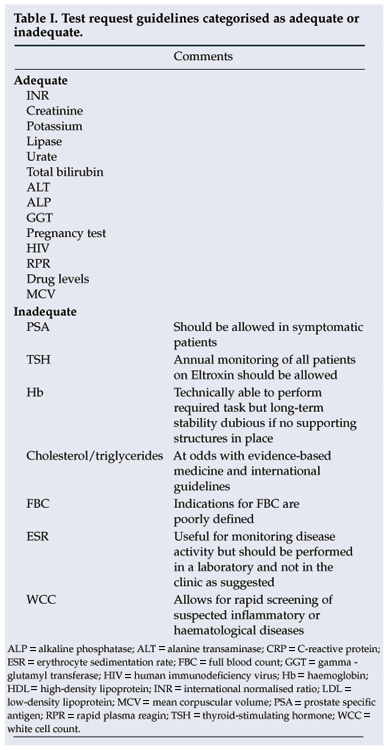
The reverse of the request form has a section that states: 'These recommendations have been developed after wide discussion amongst medical officers, clinical nurse practitioners and the NHLS.' This is encouraging as locally developed guidelines tend to accurately judge the applicability of evidence to local practice.5Table I.
Chemistry
The use of the prostate-specific antigen (PSA) test is controversial; many countries advocate the introduction of national screening programmes, but routine screening in low-risk groups is currently not justified.6
Hypothyroidism is commonly treated with replacement by levothyroxine sodium (Eltroxin). It is claimed that, once established on a stable dose, annual monitoring, although routine, is probably unnecessary except in elderly patients. However, many – sometimes approaching half of all hypothyroid patients receiving replacement thyroid hormone – have abnormal thyroid-stimulating hormone (TSH) results, reflecting inappropriate dosing.7
Cholesterol should be aggressively targeted, and it is established practice to measure high-density lipoprotein (HDL) cholesterol and low-density lipoprotein (LDL) cholesterol in primary care settings and to start statin therapy.8
Rheumatoid arthritis is a common debilitating disease which may be difficult to diagnose. Rheumatoid factor is a nonspecific marker of inflammation, and is generally used to monitor disease activity in rheumatoid arthritis, although with caveats.99
Haematology
The proposed clinical protocol for management of suspected anaemia is to make the diagnosis with a hand-held Spencer haemoglobinometer, give a trial of iron therapy for 2 months, and, if that is unsuccessful, refer the patient. The Spencer haemoglobinometer has long been used in the primary care setting and judged to be an adequate screening method for detecting anaemia.1011et al. concluded that the haemoglobinometer was adequate for South African clinical practice with two caveats: firstly, that they obtained results within 5 - 8% agreement of an automated result by averaging the readings obtained by 3 trained staff, and secondly, that regular calibration was mandatory.10
A single haemoglobin measurement has low sensitivity and specificity for the diagnosis of iron deficiency.124
C-reactive protein (CRP) is probably superior to erythrocyte sedimentation rate (ESR) in the first 24 hours following tissue injury and in children. However, ESR is still valid for clinical practice but is influenced by many factors, and quality control that cannot be achieved in a high-throughput primary health care setting is mandatory.1314
Design of the request form
The request form uses two common and effective methods of reducing test requests: offering a limited test menu, and issuing guidelines to guide clinical practice.
Although we highlight limitations in the current request form, several positives have come from requesting guidelines. Firstly, guidelines are effective in changing requesting habits and limiting costs and inappropriate testing. Secondly, they serve as a useful reference to clinicians as to the utility of tests. Thirdly, they assist clinicians to practise best medicine.5
Recommendations
Guidelines should be developed as part of a structured process to consistently deliver the best practice of care to patients.5
Several characteristics of guidelines have not been addressed in these request forms. Guidelines should be drawn up by an identified and contactable committee that must identify and assess the evidence, translate that evidence into guidelines, and critically and explicitly grade the quality of the evidence.155,15 Guidelines should also have clear tools and methods to monitor their use through regular audits.5
Overall, the request guidelines were reasonable in limiting test requests, but several important shortcomings need to be addressed.
References
- 1. Van Wijk MA, van der Lei J, Mosseveld M, Bohnen AM, van Bemmel JH. Assessment of decision support for blood test ordering in primary care. a randomized trial. Ann Intern Med 2001; 134: 274-281.
- 2. Jackson BR. Managing laboratory test use: principles and tools. Clin Lab Med 2007; 27: 733-748.
- 3. Van Bokhoven MA, Pleunis-van Empel MC, Koch H, Grol RP, Dinant GJ, van der Weijden T. Why do patients want to have their blood tested? A qualitative study of patient expectations in general practice. BMC Fam Pract 2006; 7: 75.
- 4. Hindmarsh JT, Lyon AW. Strategies to promote rational clinical chemistry test utilization. Clin Biochem 1996; 29: 291-299.
- 5. Trenti T, Canali C, Scognamiglio A. Clinical governance and evidence-based laboratory medicine. Clin Chem Lab Med 2006; 44: 724-732.
- 6. Frankel S, Smith GD, Donovan J, Neal D. Screening for prostate cancer. Lancet 2003; 361: 1122-1128.
- 7. Parle JV, Franklyn JA, Cross KW, Jones SR, Sheppard MC. Thyroxine prescription in the community: serum thyroid stimulating hormone level assays as an indicator of undertreatment or overtreatment. Br J Gen Pract 1993; 43: 107-109.
- 8. Olsson AG. NICE lipid modification guideline: both absolute and obsolete! Heart 2008; 94: 1256-1257.
- 9. Brigden ML. Clinical utility of the erythrocyte sedimentation rate. Am Fam Physician 1999; 60: 1443-1450.
- 10. Linegar AG, Knottenbelt JD, Wormald PJ. Accuracy of a portable haemoglobinometer in clinical practice. S Afr Med J 1991; 79: 547-548.
- 11. Briggs C, Guthrie D, Hyde K, et al. Guidelines for point-of-care testing: haematology. Br J Haematol 2008; 142: 904-915.
- 12. Cook JD. Diagnosis and management of iron-deficiency anaemia. Best Pract Res Clin Haematol 2005; 18: 319-332.
- 13. Jacobs L, Jacobs P. Is the ESR dead? S Afr Med J 1991; 80: 122-123.
- 14. Krause JR. Automated differentials in the hematology laboratory. Am J Clin Pathol 1990; 93: S11-S16.
- 15. Christenson RH. Evidence-based laboratory medicine – a guide for critical evaluation of in vitro laboratory testing. Ann Clin Biochem 2007; 44: 111-130.