South African healthcare workers and COVID-19: A shared responsibility to protect a precious and limited resource
South African healthcare workers and COVID-19: A shared responsibility to protect a precious andlimited resource
To the Editor: Healthcare workers (HCWs) in African countries face high risks of occupational exposure to many pathogens, including tuberculosis, measles, HIV and Ebola.[1,2] The novel coronavirus SARS-CoV-2 poses an arguably greater threat to African HCWs than any other infectious agent to date. Data from countries with established epidemics show that HCWs experience high rates of COVID-19 infection, morbidity and mortality. In the USA, 19% of COVID-19 cases whose occupational status was known were HCWs (9 282/49 000),[3 and >90 000 HCW COVID-19 infections were documented in 30 countries, with 260 deaths in nurses, by early May 2020.[4] In South Africa (SA), on 6 May, Minister Zweli Mkhize reported that 511 HCWs had tested positive for SARS-CoV-2 (7% of the national total), with nurses accounting for 53% of total HCW cases.[5]
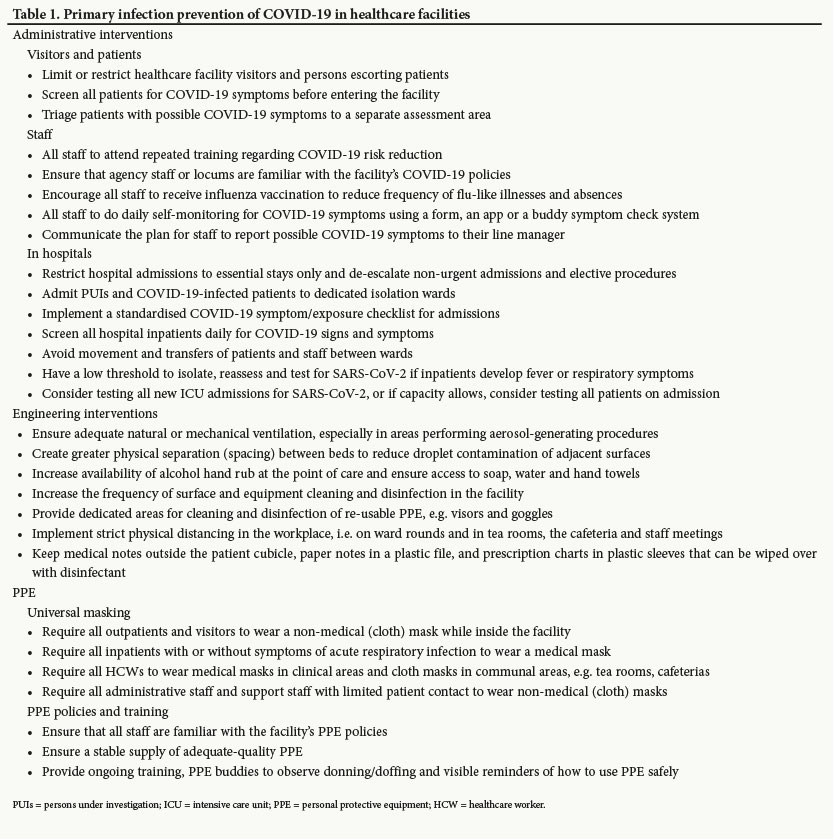
The unprecedented risk posed to HCWs by COVID-19 is clearly acknowledged by all levels of the SA government. Nationally there have been commitments, both financially and administratively, to ensure procurement and local production of personal protective equipment (PPE) and transparent reporting of HCW COVID-19 infections. To varying degrees, administrative and engineering interventions to prevent COVID-19 infections and outbreaks have been implemented in SA healthcare facilities (Table 1). Despite the early phase of the pandemic and general availability of PPE, SA is already facing high rates of HCW COVID-19 infections and exposure events. This is a concerning development reflecting both widespread community transmission (with HCW infections) and the need to strengthen 'universal' prevention measures in healthcare facilities, e.g. physical distancing, mask-wearing, hand hygiene, and increased cleaning/ disinfection of surfaces and equipment. HCWs should note that PPE is the last line of defence against occupationally acquired infections, and that adherence to universal prevention measures in healthcare facilities is critical, particularly in the light of presymptomatic COVID-19 transmission.[6]
From a workforce preservation perspective, all HCWs should practise physical distancing, universal masking and appropriate PPE use. These actions will not only prevent infection but also reduce the occurrence of high-risk COVID-19 exposure events that necessitate self-quarantine for 7 - 14 days. A reliable supply of PPE and HCW adherence to guidance for its safe use is just one aspect of the plan to safeguard HCWs during this pandemic. Implementing a comprehensive set of infection prevention measures in all SA healthcare settings is a shared responsibility, and is critical to protect the health and lives of our precious and limited national healthcare workforce.
Funding. AD and AS are supported by NIH Fogarty Emerging Global Leader Awards K43 TW010682 and TW010683.
Conflicts of interest. None.
Angela Dramowski
Division of Paediatric Infectious Diseases, Department of Paediatrics and Child Health, Faculty of Medicine and Health Sciences, Stellenbosch University, Cape Town, South Africa
Moleen Zunza
Division of Epidemiology and Biostatistics, Department of Global Health, Faculty of Medicine and Health Sciences, Stellenbosch University, Cape Town, South Africa
Kopano Dube
Ukwanda Centre for Rural Health, Department of Global Health, Faculty of Medicine and Health Sciences, Stellenbosch University, Worcester, South Africa
Mohammed Parker
Ukwanda Centre for Rural Health, Department of Global Health, Faculty of Medicine and Health Sciences, Stellenbosch University, Worcester, South Africa
Amy Slogrove
Ukwanda Centre for Rural Health, Department of Global Health, Faculty of Medicine and Health Sciences, Stellenbosch University, Worcester, South Africa; and Department of Paediatrics and Child Health, Faculty of Medicine and Health Sciences, Stellenbosch University, Worcester, South Africa
References
-
1. Alele FO, Franklin RC, Emeto TI, Leggat P. Occupational tuberculosis in healthcare workers in sub-Saharan Africa: A systematic review. Arch Environ Occup Health 2019;74(3):95-108. https://doi.org/10.1080/19338244.2018.1461600
» https://doi.org/10.1080/19338244.2018.1461600 -
2. Ngatu NR, Kayembe NJ, Phillips EK, et al. Epidemiology of ebolavirus disease (EVD) and occupational EVD in health care workers in sub-Saharan Africa: Need for strengthened public health preparedness. J Epidemiol 2017;27(10):455-461. https://doi.org/10.1016/j.je.2016.09.010
» https://doi.org/10.1016/j.je.2016.09.010 -
3. Centers for Disease Control and Prevention. Characteristics of health care personnel with COVID-19 -United States, February 12 - April 9, 2020. MMWR Morb Mortal Wkly Rep 2020;69(15):477-481. https://www.cdc.gov/mmwr/volumes/69/wr/pdfs/mm6915e6-H.pd (accessed 18 April 2020).
» https://www.cdc.gov/mmwr/volumes/69/wr/pdfs/mm6915e6-H.pd -
4. International Council of Nurses. International Council of Nurses calls for data on healthcare worker infection rates and deaths. Press release, 6 May 2020. https://www.icn.ch/news/icn-calls-data-healthcare-worker-infection-rates-and-deaths (accessed 12 May 2020).
» https://www.icn.ch/news/icn-calls-data-healthcare-worker-infection-rates-and-deaths -
5. Grobler R. Coronavirus: 511 healthworkers positive, 26 hospitalised and 2 have died - Zweli Mkhize. News24, 6 May 2020. https://www.news24.com/SouthAfrica/News/coronavirus-511-health-workers-positive-26-hospitalised-and-2-have-died-zweli-mkhize-20200506 (accessed 12 May 2020).
» https://www.news24.com/SouthAfrica/News/coronavirus-511-health-workers-positive-26-hospitalised-and-2-have-died-zweli-mkhize-20200506 -
6. Cheng HY, Jian SW, Liu DP, Ng TC, Huang WT, Lin HH; Taiwan COVID-19 Outbreak Investigation Team. Contact tracing assessment of COVID-19 transmission dynamics in Taiwan and risk at different exposure periods before and after symptom onset. JAMA Intern Med 2020 (epub 1 May 2020). https://doi.org/10.1001/jamainternmed.2020.2020
» https://doi.org/10.1001/jamainternmed.2020.2020