CME: Immunology
EDITOR'S CHOICE
CME: Immunology
Immunology underlies most of the biological and clinical disciplines in medicine. This includes autoimmune diseases, infectious diseases and HIV, primary immunodeficiency, cancer and transplantation medicine. Indeed, the formalised use of immunology knowledge, laboratory techniques and targeted immunotherapies in routine clinical practice is now commonplace in much of the world. It is the most rapidly advancing field, and generalists need to keep up with advances in knowledge that impact on patient management. This is the impetus behind this month's CME, entitled 'Updates in immunology and allergy'. The medical community, both clinical and pathology disciplines, can no longer afford to see immunology as a 'black box' discipline irrelevant to day-to-day patient management or only applicable to the uncommon case of immunodeficiency or autoimmune disease. For South African (SA) doctors this means considering immunology beyond HIV medicine. Is it time for immunology in SA, amid competing public health needs, to be established as a distinct specialty or sub-specialty? This issue of CME provides an overview and an update on clinical immunology that will be indispensable to all practitioners.
'… may we live in a world without lawyers and court cases' (Confucius)
A year ago, I wrote an editorial12SAMJ carries much that confirms this sentiment.
Howarth et al.3
As Howarth et al. emphatically state, the medical profession cannot be expected to resolve the situation, as there is no medical answer. Rather, private patients, private providers, public patients, public providers, politicians and policy pundits all have a vested interest in resolving the problem - the issue has to enter the public debate.
Smith et al.4
Walters5
Looking at the implications of Venter v Roche Products (Pty) Limited and Others for research ethics committees, Strode and Singh6
The article warns that research ethics committees have the obligation both to ensure that compensation clauses in informed-consent documents are carefully reviewed and that these are made clear to potential research participants.
Asking 'Who will guard the guards?', Parrish and Blockman78
The Ebola epidemic rages on …
As the Ebola epidemic rages,9 , 10 clinicians should ask every febrile patient: 'Which African country(ies) have you recently visited?' We are also reminded that the occupational risk of infection by blood-borne viruses (BBVs) in healthcare practitioners (HCPs) and students is significant, especially in the developing world.11et al. 11
Appropriateness of CT and MRI scans
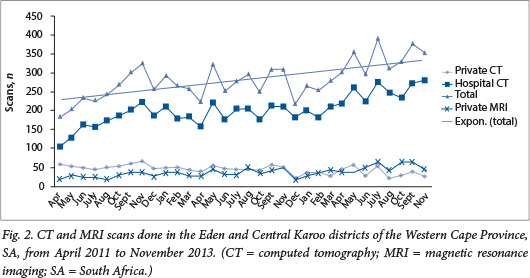
Computed tomography (CT) and magnetic resonance imaging (MRI) are now an essential part of modern healthcare, enabling the practitioner to make non-invasive diagnoses. Imaging is one of the fastest-growing services in medicine, amounting to $100 000 billion annually in the USA. The clinical information obtained, and their increased accessibility, has made these modalities attractive to both patients and referring physicians. However, marked increases in imaging utilisation are now straining healthcare expenditure and threatening health system sustainability. Becker et al.[12] question the appropriateness of CT and MRI scans in the Eden and Central Karoo districts of the Western Cape. The increased utilisation of diagnostic imaging (see Fig. 2 of the article, reproduced below) has brought with it significant economic risks, plus medical risks through increased radiation exposure, with its accompanying carcinogenic potential, and the unforeseen gadoliniumrelated nephrogenic systemic fibrosis, over and above the well-known mild allergies and anaphylactoid responses.
The recommendation is that consultants be required to grant permission for CT or MRI, as at George Hospital, but with awareness of the American College of Radiologists Appropriateness Criteria and and the Royal College of Radiology Guidelines.
REFERENCES
-
1. Seggie J. The 'boom' in medical malpractice claims - patients could be the losers. S Afr Med J 2013;103(7):433. [http://dx.doi.org/10.7196/SAMJ.7127]
» http://dx.doi.org/10.7196/SAMJ.7127 -
2. Malherbe J. Counting the cost: The consequences of increased medical malpractice litigation in South Africa. S Afr Med J 2013;103(2):83-84. [http://dx.doi.org/10.7196/SAMJ.6457]
» http://dx.doi.org/10.7196/SAMJ.6457 -
3. Howarth GR, Goolab B, Dunn RN, Fieggen AG. Public somnambulism: Public lack of awareness of the consequences of increasing medical negligence litigation. S Afr Med J 2014;104(11):752-753. [http://dx.doi.org/10.7196/SAMJ.8568]
» http://dx.doi.org/10.7196/SAMJ.8568 -
4. Roytowski D, Smith T, Fieggen AG, Taylor A. Impressions of defensive medical practice and medical litigation among South African neurosurgeons. S Afr Med J 2014;104(11):736-738. [http://dx.doi.org/10.7196/SAMJ.8336]
» http://dx.doi.org/10.7196/SAMJ.8336 -
5. Walters J. Mediation - an alternative to litigation in medical malpractice. S Afr Med J 2014;104(11):717-718. [http://dx.doi.org/10.7196/SAMJ.8851]
» http://dx.doi.org/10.7196/SAMJ.8851 -
6. Strode A, Singh PP. Compensation for research-related harm: The implications of Venter v Roche Products (Pty) Limited and Others for research ethics committees. S Afr Med J 2014;104(11):759-761. [http://dx.doi.org/10.7196/SAMJ.8596]
» http://dx.doi.org/10.7196/SAMJ.8596 -
7. Parrish A, Blockman M. Who will guard the guards? Medical leadership and conflict of interest in South African healthcare. S Afr Med J 2014;104(11):757-758. [http://dx.doi.org/10.7196/SAMJ.8546]
» http://dx.doi.org/10.7196/SAMJ.8546 -
8. Wang AT, McCoy CP, Murad MH, Montori VM. Association between industry affiliation and position on cardiovascular risk with rosiglitazone: Cross sectional systematic review. BMJ 2010;340:c1344. [http://dx.doi.org/10.1136/bmj.c1344]
» http://dx.doi.org/10.1136/bmj.c1344 -
9. Bateman C. Ebola global response: 'not in my back yard'. S Afr Med J 2014;104(11):722-724. [http://dx.doi.org/10.7196/SAMJ.9021]
» http://dx.doi.org/10.7196/SAMJ.9021 -
10. Weyer J, Blumberg L. Ebola virus disease in West Africa - South African perspectives. S Afr Med J 2014;104(11):754-755. [http://dx.doi.org/10.7196/SAMJ.9045]
» http://dx.doi.org/10.7196/SAMJ.9045 -
11. Rossouw TM, van Rooyen M, Louw JM, Richter KL. Blood-borne infections in healthcare workers in South Africa. S Afr Med J 2014;104(11):732-735. [http://dx.doi.org/10.7196/SAMJ.8518]
» http://dx.doi.org/10.7196/SAMJ.8518 -
12. Becker J, Jenkins LS, de Swardt M, Sayed R, Viljoen M. Appropriateness of computed tomography and magnetic resonance imaging scans in the Eden and Central Karoo districts of the Western Cape Province, South Africa. S Afr Med J 2014;104(11):762-765. [http://dx.doi.org/10.7196/SAMJ.8158]
» http://dx.doi.org/10.7196/SAMJ.8158