Prevalence of Blomia tropicalis allergy in two regions of South Africa
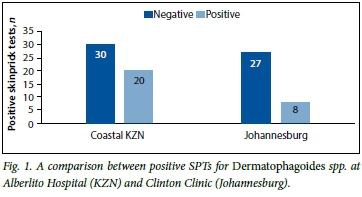
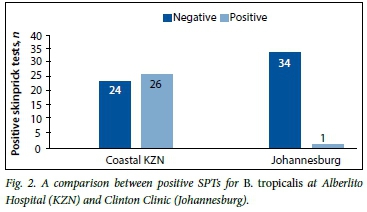
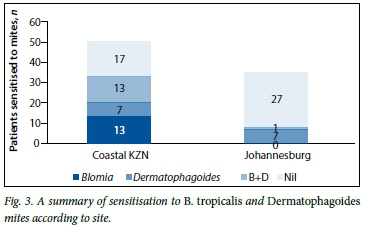
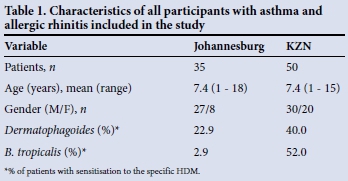
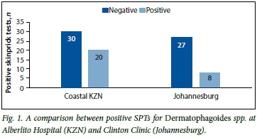
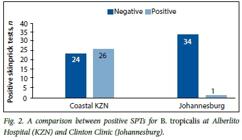
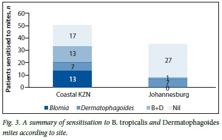
BACKGROUND: Asthma and allergic rhinitis affect 15% and 38% of South African (SA) children, respectively. The housedust mite (HDM) is the most significant indoor aeroallergen. Typical HDM species include Dermatophagoides pteronyssinus, D. farinae and Blomia tropicalis. Conventional skin-prick testing (SPT) panels only test for Dermatophagoides. B. tropicalis has been described in the tropical and subtropical regions, but is not routinely tested for in SA. OBJECTIVE: To ascertain the significance of B. tropicalis as an aeroallergen in northern coastal KwaZulu-Natal Province (KZN), a tropical environment, and in Johannesburg in the highveld, where the climate is milder and less humid. METHODS: Children aged 1 - 18 years with features of allergic rhinitis and/or asthma were recruited over a 6-month period from Alberlito Hospital in northern KZN and the Clinton Clinic in Johannesburg. SPTs included Dermatophagoides and B. tropicalis. Sensitisation was defined as a wheal 3 mm greater than the negative control. RESULTS: Eighty-five subjects were included, 50 in northern KZN and 35 in the Johannesburg arm; 52% of subjects in northern KZN and 3% in Johannesburg were sensitised to B. tropicalis, with a significant difference between these centres (p<0.05). Of the 52% sensitised to B. tropicalis in northern KZN, half were sensitised only to B. tropicalis. CONCLUSION: There is a high prevalence of B. tropicalis allergy in the tropical northern KZN region and a much lower prevalence in the Johannesburg region. Routine testing for B. tropicalis allergy should be employed in northern KZN.
SAMJ: South African Medical Journal
 Thumbnail
 Thumbnail
 Thumbnail