Agreement between various non-invasive blood pressure measurement sites in the obese population using the VitalStream system as control
BACKGROUND: The incidence of obesity and hypertension, with all their associated complications, is on the rise globally. Non-invasive blood pressure (NIBP) is often difficult to measure in obese individuals owing to the increased circumference and conical shape of the upper arm. The forearm and ankle may serve as convenient alternatives to measure NIBP. The aim of this study was to identify the most accurate site for NIBP monitoring in obese patients. OBJECTIVES: To statistically determine an agreement between different NIBP sites (upper arm, forearm and ankle) and our control blood pressure (BP). A secondary objective was to investigate agreements between different NIBP sites, anthropometric variables (body mass index (BMI)/mid-upper arm circumference/conicity index) and the control, with the goal of deriving a correction formula for BP. METHODS: A prospective cross-sectional study was conducted at a provincial tertiary hospital in Gauteng Province, South Africa. Fifty participants aged 20 - 60 years, with BMI 35 - 40 kg/m2, were recruited. Using appropriately sized cuffs, NIBP measurements were obtained from the left upper arm, forearm and ankle. Simultaneous continuous BP measurements were recorded using the VitalStream device on the contralateral hand. Bland-Altman plots and regression analyses were employed to evaluate agreement and derive correction formulas for each measurement site. RESULTS: Bland-Altman analysis revealed significant biases across sites, with ankle systolic BP showing the greatest deviation (mean bias +14.44 mmHg, 95% confidence interval 8.26 - 20.62). Regression analyses identified significant agreements for mean arterial pressure at the upper arm, enabling a correction formula with high reliability (p<0.001). Forearm and ankle measurements demonstrated wider limits of agreement and were prone to overestimation, especially in systolic and diastolic pressures. CONCLUSION: Upper arm NIBP measurements were the most accurate in the obese population. Alternative sites, such as the forearm and ankle, demonstrated inconsistent reliability, and require careful interpretation. Correction formulas can enhance the accuracy of NIBP readings but may be cumbersome for routine clinical use. Future studies should focus on refining measurement protocols and evaluating the efficacy of conically shaped cuffs for improved accuracy.
obesity; blood pressure correlation; non-invasive blood pressure; VitalStream; South Africa
Agreement between various non-invasive blood pressure measurement sites in the obese population using the VitalStream system as control
L M van DykI; N MdzinwaII; M VoigtIII
IMB ChB, DA (SA); Department of Anaesthesia, Faculty of Health Sciences, University of Pretoria, South Africa
IIMB ChB, FCA (SA); Department of Anaesthesia, Faculty of Health Sciences, University of Pretoria, South Africa
IIIMB ChB, FCA (SA); Department of Anaesthesia, Faculty of Health Sciences, University of Pretoria, South Africa
BACKGROUND: The incidence of obesity and hypertension, with all their associated complications, is on the rise globally. Non-invasive blood pressure (NIBP) is often difficult to measure in obese individuals owing to the increased circumference and conical shape of the upper arm. The forearm and ankle may serve as convenient alternatives to measure NIBP. The aim of this study was to identify the most accurate site for NIBP monitoring in obese patients.
OBJECTIVES: To statistically determine an agreement between different NIBP sites (upper arm, forearm and ankle) and our control blood pressure (BP). A secondary objective was to investigate agreements between different NIBP sites, anthropometric variables (body mass index (BMI)/mid-upper arm circumference/conicity index) and the control, with the goal of deriving a correction formula for BP.
METHODS: A prospective cross-sectional study was conducted at a provincial tertiary hospital in Gauteng Province, South Africa. Fifty participants aged 20 - 60 years, with BMI 35 - 40 kg/m2
RESULTS: Bland-Altman analysis revealed significant biases across sites, with ankle systolic BP showing the greatest deviation (mean bias +14.44 mmHg, 95% confidence interval 8.26 - 20.62). Regression analyses identified significant agreements for mean arterial pressure at the upper arm, enabling a correction formula with high reliability (p<0.001). Forearm and ankle measurements demonstrated wider limits of agreement and were prone to overestimation, especially in systolic and diastolic pressures.
CONCLUSION: Upper arm NIBP measurements were the most accurate in the obese population. Alternative sites, such as the forearm and ankle, demonstrated inconsistent reliability, and require careful interpretation. Correction formulas can enhance the accuracy of NIBP readings but may be cumbersome for routine clinical use. Future studies should focus on refining measurement protocols and evaluating the efficacy of conically shaped cuffs for improved accuracy.
Keywords: obesity, blood pressure correlation, non-invasive blood pressure, VitalStream, South Africa
Obesity and hypertension are major global health and economic burdens.[1-3] These conditions frequently coexist, which compounds the sequelae of each condition.[1] Blood pressure (BP) measurement is a fundamental aspect of patient monitoring, as recommended by the South African Society of Anaesthesiologists.[4,5] Ensuring the accuracy of BP measurements is crucial for identifying hypo- and hypertensive episodes perioperatively, as both conditions can have detrimental consequences if not promptly identified and managed.[1,2] Uncontrolled hypertension significantly increases cardiovascular morbidity and mortality, including conditions such as stroke, myocardial infarction, heart failure and dysrhythmias.[4,6,7] Intraoperative BP fluctuations are associated with similar adverse outcomes, with intraoperative hypotension linked to myocardial injury after non-cardiac surgery, renal impairment, stroke and death.[4,7,8] Hypotension is generally defined as a mean arterial pressure (MAP) <20% of baseline, or <60 - 70 mmHg.[7]
While upper arm BP measurement is generally reliable in non-obese patients,[9,10] it is less dependable in obese individuals owing to the arm's conical shape and increased circumference, leading to poor cuff fitment.[11-13] Studies show that a high body mass index (BMI) correlates well with the arm conicity index (CI), further affecting accuracy.[11,12,14] A lack of appropriately sized cuffs in resource-limited settings further exacerbates this issue. Although forearm and ankle sites are considered alternative BP measurement sites, studies show inconsistent reliability in obese populations, making interpretation difficult.[11,13,14] These alternative sites pose various physiological challenges: ankle BP tends to be higher than upper arm BP due to pulse pressure amplification (PPA) in peripheral arteries, a phenomenon influenced by arterial wall stiffening with an increase in distance from the heart.[15,16] Additionally, obesity exacerbates PPA, thus increasing the discrepancy between ankle and upper arm BP measurements.[15,16] The presence of two bony elements in the forearm and leg (ulna/radius and tibia/fibula, respectively), and increased soft-tissue mass in obese patients, may impede accurate BP measurement, leading to falsely elevated/overestimated values.[13,14,17]
The sphygmomanometer, first developed in the 19th century, has evolved through technological advancements into widely used electronic and digital oscillometric devices.[18] Invasive arterial monitoring remains the gold standard for BP measurement.[5,9,19] However, this method may not be readily available in resource-scarce settings. Furthermore, inserting an invasive BP monitoring line is not justifiable in all cases. The 1980s introduced the Finapres finger cuff device, which utilises plethysmography to measure BP,[20,21] paving the way for modern non-invasive finger cuff systems. These devices, including the Caretaker Medical VitalStream, employ pulse decomposition analysis to estimate BP, which correlates well with intra-arterial pressure and reduces the incidence of wide BP swings perioperatively.[22-24] However, accuracy declines at extreme BP values (systolic BP (SBP) <60 or >180 mmHg).[19,25,26] The present study aimed to identify the most accurate non-invasive BP (NIBP) site in obese patients (BMI 35 - 40 kg/m2
Methods
Findings are reported following the STROBE guidelines.[27]
We conducted a prospective, analytical observational cross-sectional study. A non-probability convenience sampling method was used based on phenotypic eligibility.
Inclusion criteria were adults aged 20 - 60 years with a BMI 35 - 40 g/m2
After consent was obtained, participants would lie supine for 5 minutes to minimise movement-induced haemodynamic variation.[28] Screening BP measurements were taken from contralateral upper and lower limbs to confirm <10% SBP difference bilaterally. These measurements were taken with the Carescape Dinamap V100 NIBP machine.
Each participant's mid-upper arm circumference (MUAC), forearm and ankle circumferences were recorded to select correctly sized BP cuffs. Each cuff's circumference range was as per the manufacturer guidelines.
Measurement procedures
Upper arm: with the participant lying flat, the arm was extended 90° above horizontal. MUAC was measured midway between the olecranon and acromioclavicular joint. Proximal and distal circumferences were measured just distal to the axilla and just proximal to the elbow crease, respectively. A suitable cuff was applied with two-thirds overlap and midpoint aligned to the arm's midpoint. NIBP readings were taken with the arm relaxed beside the body.
Forearm: circumference was measured halfway between the olecranon and ulnar styloid. A correctly sized cuff was centred over this midpoint. NIBP readings were recorded with the arm flat and relaxed, with all limbs remaining flat.
Ankle: The cuff's distal edge was placed 3 cm proximal to the medial malleolus. Circumference at cuff midpoint guided cuff selection. NIBP readings were taken with all limbs flat.
The arm CI was calculated using following formula:[12]
(proximal arm diameter - distal arm diameter)/arm length × 100
Where:
proximal diameter = proximal circumference ÷ π
distal diameter = distal circumference ÷ π
arm length = distance from acromion to olecranon.
The Carescape Dinamap V100 (Little Chalfont, UK), a validated NIBP device,[29,30] was used in the study. The same device and cuffs were used on all participants. A distributor representative calibrated the device 2 weeks before the study began, and it was used exclusively for the study thereafter.
Non-invasive continuous BP (NCBP) monitoring was performed using the VitalStream (Caretaker Medical LLC, Charlottesville, USA), with disposable finger cuffs. Calibration was performed before each use as per the manufacturer's protocol. A validation study showed that when the VitalStream device is compared to the gold standard intra-arterial monitoring, the mean (standard deviation (SD)) difference for systolic pressures was 1.14 (13.82) mmHg).[31]
The VitalStream device was placed on the right wrist, contralateral to the NIBP cuffs to prevent interference during inflation. Continuous recording began with the first NIBP measurement (upper arm), and ended after the last NIBP measurement (ankle). Time-weighted averages were calculated from continuous readings, and documented against NIBP values.
NIBP measurement sequence: four NIBP measurements were taken at each site (upper arm, forearm, ankle). After the first two, participants briefly stood and then returned to a supine position to introduce cardiovascular variability and minimise value clustering.[28] The final two measurements were taken once the participant had returned to rest.
This sequence resulted in 12 NIBP measurements per participant, and three time-weighted VitalStream readings (one per site). Measurement time per participant was approximately 30 minutes, yielding 600 total NIBP readings and 50 time-weighted VitalStream recordings.
Results
Data collection took place from 1 May to 31 July 2024. Sixty-four participants were approached. Twelve did not meet the inclusion/exclusion criteria: one had atrial fibrillation, four had BMI <35 kg/m22
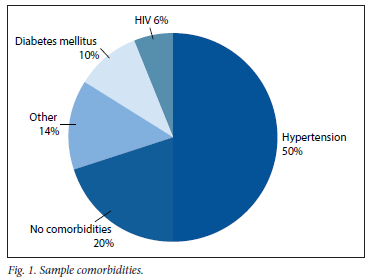
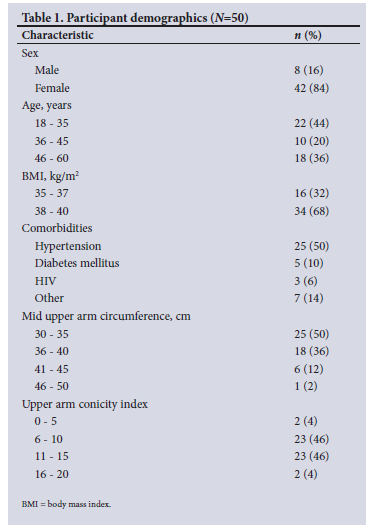
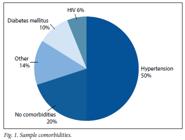
Fifty participants (8 males, 42 females) met the inclusion/exclusion criteria (Appendix Fig. S1). Table 1 summarises their demographic data. Additional comorbidities not listed in Table 1 included epilepsy (n=3; 6%), hypercholesterolaemia (n=2; 4%) and candidates for bariatric surgery (n=2; 4%). Hypertension was the most common comorbidity, followed by diabetes mellitus (Fig. 1). Less frequent conditions (one case each) included uterine fibroids, gout, chronic obstructive pulmonary disease, renal calculi, a malunited distal radius fracture, megaloblastic anaemia and asthma.
Although the sample size calculation specified a priori that 114 observation pairs were required from at least 30 participants, 50 participants were enrolled. Each participant contributed two independent mean BP readings (NIBP and control) per site, which exceeded the required sample size. The 600 NIBP measurements resulted in 200 readings per anatomical site.
All sample parameters were normally distributed, allowing for the calculation of means. The mean (SD) values were: age 40 (11) years, weight 106 (11) kg, height 1.66 (0.07) m, BMI 38 (2.14) kg/m2
The analysis of the results mainly focuses on upper arm BP readings (SBP, DBP, MAP), as the upper arm proved to be the most statistically significant NIBP measurement site.
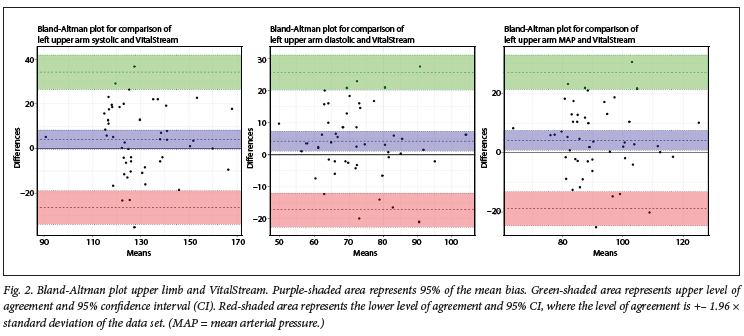
A Bland-Altman analysis was performed to evaluate the agreement between control and measured BP values, as shown in Fig. 2.
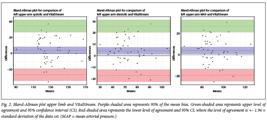
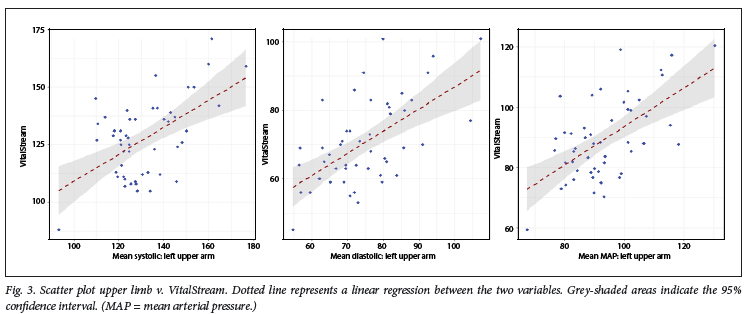
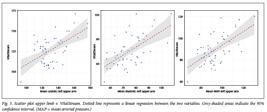
Fig. 3 is a scatter plot that visually represents the differences in the means between the VitalStream and measured BP. Both Figs 2 and 3 show a wide spread/dispersion between the mean values for SBP, DBP and MAP when compared with the VitalStream values. Appendix Figs S2 - S5 represent left ankle and forearm Bland-Altman and scatter plots, respectively.
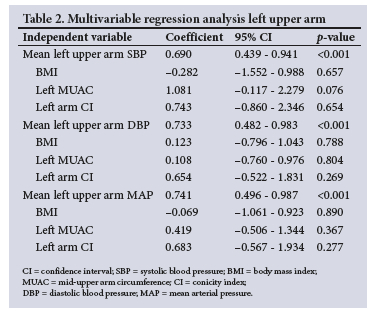
Using univariate and multivariate regression analyses, we further investigate the potential influence that certain variables might have on the agreement between the control and measured BP. Table 2 outlines the variables used and their estimates of the coefficients calculated during the multivariable regression analysis. It is important to note that the added variables (MUAC and CI) are exploratory and not definitive.
Among the multivariable regressions, the most clinically relevant was the one for left upper arm MAP, which had two statistically significant predictors. Given that MAP is a key indicator of organ perfusion,[6,8] this analysis focused on deriving a correction formula for left upper arm MAP in patients who matched our sample demographic. Appendix Tables S1 - S4 illustrate left ankle and forearm multivariate and univariate regressions, respectively.
The formula format is presented as a mathematical formula of a straight line, i.e. y = mx with no intercept (c). This can be translated practically as follows when using the values in Table 2:
Corrected blood pressure (MAP) =
0.741 (left upper arm MAP) + 0.419 (MUAC)
+ 0.683 (left arm CI) - 0.069 (BMI)
The interpretation of the formula is as follows: the sum of the four calculated variables will each affect the corrected blood pressure in the following manner:
For each 1 mmHg increase in left upper arm MAP, corrected BP increases by 0.741, holding other variables constant. Similarly, each 1 cm increase in MUAC raises corrected BP by 0.419, and each unit increase in the arm CI raises corrected BP by 0.683. Conversely, each unit increase in BMI decreases corrected BP by 0.069. This formula indicates that these four variables adjust BP to a fraction of the predictors. Alternatively, it can be interpreted that the NIBP measured in the participant sample was higher than that of the control group (overestimated).
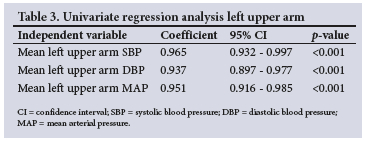
The formula is cumbersome and not easily applied clinically. Furthermore, three of the variables used are not considered significant predictors, as the estimates' 95% confidence intervals included zero, and each had a p-value of >0.05. By employing a univariate regression analysis to upper arm MAP, a correction coefficient for MAP is obtained with a p-value of <0.001, as seen in Table 3.
The formula's interpretation is as follows: Every one mmHg increase in the left upper arm MAP will decrease the corrected BP by a factor of 0.95.
When comparing the two formulas derived by entering the variables of all participants in our sample size into each formula, only a 3% difference was observed in the corrected BP values. However, since the univariate regression includes only one variable coefficient with a p-value of <0.001, it makes it the correction formula of choice.
Appendix Figs 6 - 8 visually represent the correlation between MUAC and CI, BMI and MUAC, and BMI and CI. These figures illustrate the Pearson correlation coefficient (R), which measures the linear dependence between two variables with their respective p-values.
A weak positive[32] correlation exists between MUAC and CI, R=0.29 (p=0.044). A very weak correlation exists between BMI and MUAC, R=0.19 (p=0.19). Lastly, there is a very weak correlation between BMI and CI (R=0.059; p=0.69) (Appendix Fig. S8).
Discussion
Studies report conflicting findings on BP agreement at alternative sites in obese patients compared with invasive BP.[11-13] Our results support this, with bias varying by site: ankle SBP showed the highest absolute bias, averaging 14.44 mmHg above the control, which is consistent with previous studies.[19,33] In contrast, the left upper arm SBP had a lower average bias of 3.92 mmHg, consistent with findings by Graettinger,[9] who reported that upper arm BP closely matched intra-arterial values in non-obese individuals.
Forearm DBP showed a bias of 7.06 mmHg (LOA −17.13 - +31.24) higher than the control, aligning with findings by Leblanc et al.[11] and Schumann et al.[34] However, other studies reported significant variability between forearm BP and their respective controls.[5,13,14] While some found acceptable agreement with upper arm readings, others noted significant differences, underscoring the conflicting evidence. This reinforces the need for clinicians to recognise that BP readings across sites are not interchangeable. Fig. 3 illustrates that as NIBP measurements deviate from the sample mean, their accuracy in predicting true BP declines.
A Bland-Altman analysis of SBP, DBP and MAP at the left upper arm, forearm and ankle revealed varying levels of agreement with VitalStream control measurements. Comparisons (Appendix 1) showed substantial differences in bias across sites. Significant deviations were found in left upper arm DBP (p=0.009), forearm DBP (p<0.001) and ankle SBP (p<0.001), indicating that these values do not reliably reflect control BP. These differences are statistically significant.
In contrast, left upper arm SBP (p=0.079) and ankle DBP (p=0.113) did not demonstrate any statistically significant bias from control values. Fig. 3 illustrates a broad range of measurements around the mean for all BP components, indicating considerable variability between NIBP and control values in this sample.
Multivariate and univariate regression analyses examined how variables influenced BP agreement with the control. Multivariable analysis revealed no clear correlation between BMI, MUAC, CI and BP in this sample. Wide limits of agreement and high p-values (>0.05) suggest that these variables, when combined, do not significantly affect BP measurements.
While the combined effect of these variables on BP remains underexplored, their individual relationships have been studied. Lim et al.[12] found that BMI correlates better with CI than MUAC or weight. A positive correlation between BP and BMI has also been reported.[1,3,35] In our study, BMI showed weak, non-significant correlations with MUAC (R=0.19, p=0.19) and CI (R=0.059, p=0.60). However, MUAC and CI demonstrated a weak but statistically significant positive correlation (R=0.059, p=0.044), suggesting that higher MUAC may be associated with a more conical upper arm.
Statistical analyses revealed substantial variability in biases across measurement sites. CIs confirmed that several findings were not statistically significant. Despite these findings, the results remain clinically significant. Broad limits of agreement indicate that some sites lack reliability for substitution. Most NIBP readings were overestimated, as reflected in all correction formulae adjusting BP downward. Notably, ankle SBP was overestimated by an average of 14.44 mmHg, and forearm DBP by 7.055 mmHg.
Upper arm BP measurements proved more reliable than forearm or ankle readings in this population, with an average abstract bias of 3.92 mmHg above the control SBP, consistent with Graettinger's study.[9] However, conclusions should be drawn cautiously. Factors such as forearm and ankle conicity, as well as cuff design, require further exploration. Conical NIBP cuffs improve accuracy over standard rectangular cuffs in obese patients.[36,37] Lawrence[38] found that conical cuffs also provide accurate forearm readings. Their use on the ankle remains untested. The timing of measurements relative to physiological shifts must also be considered.
A recent study[10] found that a Bland-Altman analysis between two upper arm NIBP devices and invasive BP monitoring demonstrated wide limits of agreement, despite minor mean biases. Their error grid analysis revealed that all their measurements fell into 'no risk' (85%) or 'low risk' (15%) zones, suggesting upper arm NIBP poses minimal risk as a substitute for invasive monitoring.[10] Based on this, a decision was made that SBP readings >15 mmHg above the control should not be considered reliable. In such cases, validated alternatives should be used. In our study, ankle SBP exhibited a significant absolute bias of 14.44 mmHg, which being very close to 15 mmHg indicates that it is not a safe substitute. The forearm and especially the upper arm remain the preferred NIBP sites in this population.
It remains advisable for clinicians to ensure the proper placement and size of cuffs for the obese population. Physiological changes, limb positioning relative to the heart and site-specific factors (such as limb circumference, conicity and possible mean BP bias from the control) should guide clinicians in selecting the appropriate mode and site for BP measurement.
Study limitations
The limitations of the study are as follows:
A limited sample size may not represent the full diversity of the obese population.
Most participants were female, which may skew findings due to physiological and anatomical differences between the sexes.
Measurements were taken under controlled conditions (supine) after a fixed rest period, potentially minimising physiological variations. This might limit ecological validity.
This was a single-centre study, which limits the patient demographic.
Convenience sampling was employed. Future studies could aggregate more than the necessary sample size, and randomly select participants to minimise bias.
Standard rectangular cuffs were used for NIBP measurements, which may not accommodate conically shaped upper arms, forearms and ankles in obese patients.
Conclusion
The wide limits of agreement between various NIBP sites and our control suggest caution when interpreting BP at these sites. This is particularly important for patients requiring strict BP control, such as those with high cardiovascular risk.
The upper arm remains the BP measuring site of choice in this population, followed by the forearm and then the ankle. Ankle blood pressure is considered a potentially unsafe alternative as the absolute measured bias is close to the suggested maximum SBP of 15 mmHg (14.44 mmHg) to be considered a safe measuring method.[10] In cases where standard upper arm NIBP cuffs do not fit, invasive or validated non-invasive BP devices are recommended. It cannot be categorically stated that the forearm is a proven safe alternative NIBP site. The absolute bias for forearm DBP was 7.05 mmHg, but multilinear regression analyses showed an inconclusive agreement with our control BP.
This study emphasises the importance of considering anatomical variation when selecting BP measurement sites for obese patients. Larger studies are needed to validate the developed correction formula and address this study's limitations. Further research should focus on refining measurement protocols, including the use of conically shaped BP cuffs, to improve accuracy. These efforts are especially critical in resource-limited settings where access to specialised equipment may be constrained.
The wide limits of agreement between various NIBP sites and the control highlight the need for caution when interpreting BP measurements, especially in patients requiring strict BP control. In this population, the upper arm remains the preferred site, followed by the forearm and then the ankle. Ankle BP appears to be unsafe, with an absolute SBP bias of 14.44 mmHg, close to the 15 mmHg threshold considered acceptable.[10] The forearm also shows questionable reliability, with a DBP bias of 7.05 mmHg and inconclusive agreement in regression analyses. When standard upper arm cuffs are unsuitable, invasive or validated non-invasive devices should be used. These findings underscore the importance of accounting for anatomical variation in obese patients. Larger studies are needed to validate the correction formula and explore improvements, such as conically shaped cuffs, particularly in resource-limited settings.
Data availability. The data used for this study are available from the authors on request.
Declaration. This study was undertaken to fulfil the minimum requirements for LMvD's MMed (Anaesthesiology) at the University of Pretoria.
Acknowledgements. Prof. D van Zyl (study design and statistics), Dr X Swart (statistician), Caretaker Medical (sponsorship).
Author contributions. LMvD: study design, data collection, dissertation write-up; NM: study design, supervisor; MV: conception of research idea, study design, dissertation write-up and editing, co-supervisor.
Funding. Caretaker Medical, Charlottesville, Virginia, USA, partly sponsored the study.
Conflicts of interest. None.
References
-
1. GBD 2015 Obesity Collaborators. Health effects of overweight and obesity in 195 countries over 25 years. N Engl J Med 2017;377(1):13-27. https://doi.org/10.1056/NEJMoa1614362
» https://doi.org/10.1056/NEJMoa1614362 -
2. Lee EKP, Poon P, Yip BHK, et al. Global burden, regional differences, trends, and health consequences of medication nonadherence for hypertension during 2010 to 2020: A meta-analysis involving 27 million patients. J Am Heart Assoc 2022;11(17):e026582. https://doi.org/10.1161/JAHA.122.026582
» https://doi.org/10.1161/JAHA.122.026582 -
3. Mensah GA, Roth GA, Fuster V. The global burden of cardiovascular diseases and risk factors: 2020 and beyond. J Am Coll Cardiol 2019;74(20):2529-2532. https://doi.org/10.1016/j.jacc.2019.10.009
» https://doi.org/10.1016/j.jacc.2019.10.009 -
4. Saugel B, Sessler DI. Perioperative blood pressure management. Anesthesiology 2021;134(2):250-261. https://doi.org/10.1097/aln.0000000000003610
» https://doi.org/10.1097/aln.0000000000003610 -
5. Verkhovsky A, Smit M, Levin A, Coetzee JF. Blood pressure measurement in obese patients: Non-invasive proximal forearm versus direct intra-arterial measurements. S Afr J Anaesth Analg 2018;24(3):70-74. https://doi.org/10.1080/22201181.2018.1461323
» https://doi.org/10.1080/22201181.2018.1461323 -
6. Devereaux PJP. Myocardial injury after non-cardiac surgery: Diagnosis and management. Eur Heart J 2020;41(32):3083-3091. https://doi.org/10.1093/eurheartj/ehz301
» https://doi.org/10.1093/eurheartj/ehz301 -
7. Ruetzler K, Khanna AK, Sessler DI. Myocardial injury after noncardiac surgery: Preoperative, intraoperative, and postoperative aspects, implications, and directions. Anesth Analg 2020;131(1):173-186. https://doi.org/10.1213/ANE.0000000000004567
» https://doi.org/10.1213/ANE.0000000000004567 -
8. Vlisides Phillip EP. Stroke in surgical patients. Anesthesiology 2021;134(3):480-492. https://doi.org/10.1097/ALN.0000000000003664
» https://doi.org/10.1097/ALN.0000000000003664 -
9. Graettinger WFW. Validation of portable noninvasive blood pressure monitoring devices: Comparisons with intra-arterial and sphygmomanometer measurements. Am Heart J 1988;116(4):1155-1160. https://doi.org/10.1016/0002-8703(88)90181-0
» https://doi.org/10.1016/0002-8703(88)90181-0 -
10. Coetzee B. Comparison between intra-arterial and two non-invasive blood pressure measuring systems: A cross-sectional analytic study employing Bland-Altman and error grid analyses. South Afr J Anaesth Analg 2024;30(5):150-157. https://doi.org/10.36303/SAJAA.3105
» https://doi.org/10.36303/SAJAA.3105 -
11. Leblanc ME, Auclair A, Leclerc J, et al. Blood pressure measurement in severely obese patients: Validation of the forearm approach in different arm positions. Am J Hypertens 2019;32(2):175-185. https://doi.org/10.1093/ajh/hpy152
» https://doi.org/10.1093/ajh/hpy152 -
12. Lim MJ, Tan CW, Tan HS, Sultana R, Eley V, Sng BL. Correlation of patient characteristics with arm and finger measurements in Asian parturients: A preliminary study. BMC Anesthesiol 2020;20(1):218. https://doi.org/10.1181/s12871-020-0113-6
» https://doi.org/10.1181/s12871-020-0113-6 -
13. Pierin AM, Alavarce DC, Gusmao JL, Halpern A, Mion D Jr. Blood pressure measurement in obese patients: Comparison between upper arm and forearm measurements. Blood Press Monit 2004;9(3):101-105. https://doi.org/10.1097/01.mbp.0000132425.25263.ac
» https://doi.org/10.1097/01.mbp.0000132425.25263.ac -
14. Watson S, Aguas M, Colegrove P, Foisy N, Jondahl B, Anastas Z. Level of agreement between forearm and upper arm blood pressure measurements in patients with large arm circumference. J Perianesth Nurs 2017;32(1):15-21. https://doi.org/10.1016/j.jopan.2014.08.145
» https://doi.org/10.1016/j.jopan.2014.08.145 -
15. Nijdam ME, Plantinga Y, Hulsen HT, et al. Pulse pressure amplification and risk of cardiovascular disease. Am J Hypertens 2008;21(4):388-392. https://doi.org/10.1038/ajh.2007.89
» https://doi.org/10.1038/ajh.2007.89 -
16. Wykretowicz A, Rutkowska A, Krauze T, et al. Pulse pressure amplification in relation to body fatness. Br J Clin Pharmacol 2012;73(4):546-552. https://doi.org/10.1111/j.1365-2125.2011.04129.x
» https://doi.org/10.1111/j.1365-2125.2011.04129.x - 17. Schell Kathleen K. Clinical comparison of automatic, noninvasive measurements of blood pressure in the forearm and upper arm. Am J Crit Care 2006;14(3):232-241.
-
18. Rader Florian F. The slow evolution of blood pressure monitoring: But wait, not so fast! JACC 2017;2(6):643-645. https://doi.org/10.1016/j.jacbts.2017.11.001
» https://doi.org/10.1016/j.jacbts.2017.11.001 -
19. Lee S, Chung J, Bae J, Cho YJ, Nam K, Jeon Y. Continuous non-invasive arterial pressure monitoring (ClearSight system) and ankle blood pressure measurements as alternatives to conventional arm blood pressure. J Clin Med 2020;9(11):3615. https://doi.org/10.3390/jcm9113615
» https://doi.org/10.3390/jcm9113615 -
20. Molhoek GPG. Evaluation of the Penàz servo-plethysmo-manometer for the continuous, non-invasive measurement of finger blood pressure. Basic Res Cardiol 1984;79(5):598-609. https://doi.org/10.1007/bf01910489
» https://doi.org/10.1007/bf01910489 -
21. Westerhof BE, Settels JJ, Bos WJ, et al. Bridging cardiovascular physics, physiology, and clinical practice: Karel H Wesseling, pioneer of continuous noninvasive hemodynamic monitoring. Am J Physiol Heart Circ Physiol 2015;308(3):H153-H156. https://doi.org/10.1152/ajpheart.00839.2014
» https://doi.org/10.1152/ajpheart.00839.2014 -
22. Maheshwari K, Khanna S, Bajracharya GR, et al. A randomised trial of continuous noninvasive blood pressure monitoring during noncardiac surgery. Anesth Analg 2018;127(2):424-431. https://doi.org/10.1213/ANE.0000000000003482
» https://doi.org/10.1213/ANE.0000000000003482 -
23. Baruch MC. Validation of the pulse decomposition analysis algorithm using central arterial blood pressure. Biomedical Engineering Online 2014;8:13:96. https://doi.org/10.1186/1475-925X-13-96
» https://doi.org/10.1186/1475-925X-13-96 -
24. Kwon Y, Stafford PL, Enfield K, Mazimba S, Baruch MC. Continuous noninvasive blood pressure monitoring of beat-by-beat blood pressure and heart rate using caretaker compared with invasive arterial catheter in the intensive care unit. J Cardiothorac Vasc Anesth 2022;36(7):2012-2021. https://doi.org/10.1053/j.jvca.2021.09.042
» https://doi.org/10.1053/j.jvca.2021.09.042 -
25. Ameloot K, Palmers PJ, Malbrain ML. The accuracy of noninvasive cardiac output and pressure measurements with finger cuff: A concise review. Curr Opin Crit Care 2015;21(3):232-239. https://doi.org/10.1097/MCC.0000000000000198
» https://doi.org/10.1097/MCC.0000000000000198 -
26. Fassaert LMM, Plate JDJ, Westerink J, Immink RV, de Borst GJ. The clearsight system for postoperative arterial blood pressure monitoring after carotid endarterectomy: A validation study. Am J Hypertens 2021;35(2):164-172. https://doi.org/10.1093/ajh/hpab140
» https://doi.org/10.1093/ajh/hpab140 -
27. Von Elm E. The Strengthening the Reporting of Observational Studies in Epidemiology (STROBE) statement: Guidelines for reporting observational studies. J Clin Epidemiol 2008;61(4):344-349. https://doi.org/10.1016/j.jclinepi.2007.11.008
» https://doi.org/10.1016/j.jclinepi.2007.11.008 -
28. Eser I. The effect of different body positions on blood pressure. J Clin Nurs 16(1):137-140. https://doi.org/10.1111/j.1365-2702.2005.01494.x
» https://doi.org/10.1111/j.1365-2702.2005.01494.x -
29. De Greeff A. Clinical assessment of the DINAMAP ProCare monitor in an adult population according to the British Hypertension Society Protocol. Blood Press Monit 2007;12(1):51-55. https://doi.org/10.1097/MBP.0b013e3280858b73
» https://doi.org/10.1097/MBP.0b013e3280858b73 -
30. Reinders A. validation of the DINAMAP ProCare blood pressure device according to the international protocol in an adult population. Blood Press Monit 2006;11(5):293-296. https://doi.org/10.1097/01.mbp.0000217998.96967.fb
» https://doi.org/10.1097/01.mbp.0000217998.96967.fb -
31. Gratz I, Baruch M, Allen I, et al. Validation of the next-generation caretaker continuous physiological monitor using invasive intra-arterial pressures in abdominal surgery patients. Medical Res Arch 2021;9(7):2482. https://doi.org/10.18103/mra.v9i7.2482
» https://doi.org/10.18103/mra.v9i7.2482 -
32. Akoglu H. User's guide to correlation coefficients. Turkish J Emerg Med 2018;18(3):91-93. https://doi.org/10.1016/j.tjem.2018.08.001
» https://doi.org/10.1016/j.tjem.2018.08.001 -
33. Jaouhari SDE, Meziane M, Kessouati J, Razine R, Jaafari A, Bensghir M. Can we use the ankle non-invasive blood pressure during otolaryngologic surgery: An observational study. Pan African Med J 2020;36:31. https://doi.org/10.11604/pamj.2020.36.31.21019
» https://doi.org/10.11604/pamj.2020.36.31.21019 -
34. Schumann R, Meidert AS, Bonney I, et al. Intraoperative blood pressure monitoring in obese patients. Anesthesiology 2021;134(2):179-188. https://doi.org/10.1097/ALN.0000000000003636
» https://doi.org/10.1097/ALN.0000000000003636 -
35. World Health Organization. A healthy lifestyle. 2010. https://www.who.int/europe/news-room/fact-sheets/item/a-healthy-lifestyle---who-recommendations (accessed 7 May 2025).
» https://www.who.int/europe/news-room/fact-sheets/item/a-healthy-lifestyle---who-recommendations -
36. Palatini P. Rectangular cuffs may overestimate blood pressure in individuals with large conical arms. J Hypertension 2012;30(3):530-536. https://doi.org/10.1097/hjh.0b013e32834f98a0
» https://doi.org/10.1097/hjh.0b013e32834f98a0 -
37. Maxwell GF. Comparison of the conical cuff and the standard rectangular cuffs. Int J Epidemiol 1985;14(3):468-472. https://doi.org/10.1093/ije/14.3.468
» https://doi.org/10.1093/ije/14.3.468 -
38. Hersh LT. Validation of a conical cuff on the forearm for estimating radial artery blood pressure. Blood Press Monit 2014;19(1):38-45. https://doi.org/10.1097/mbp.0000000000000011
» https://doi.org/10.1097/mbp.0000000000000011

Accepted 17 November 2025