Prevalence and predictors of severe Crohn's disease at a tertiary hospital in South Africa
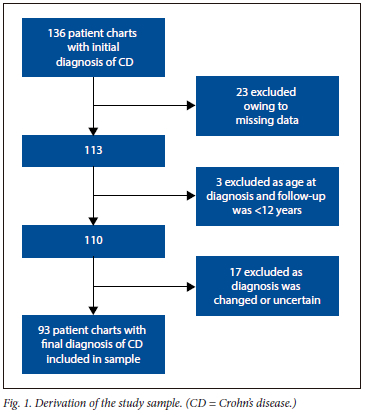
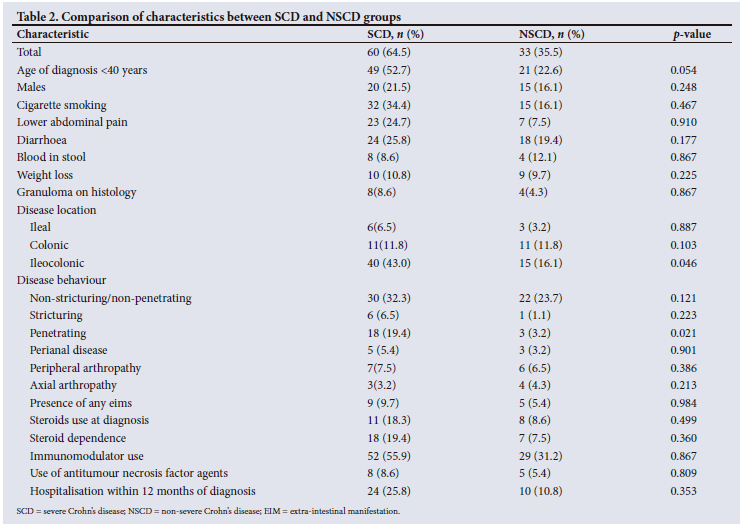
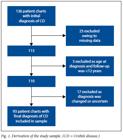
BACKGROUND: Predicting severe Crohn's disease (SCD) can assist in planning risk reduction therapy for SCD, thereby improving disease outcomes OBJECTIVE: To determine the prevalence and predictors of SCD in a sample of South African (SA) patients METHODS: This was a retrospective chart review of patients with Crohn's disease (CD) attending the gastroenterology unit at a tertiary hospital in Durban, SA. Demographic and clinical variables at diagnosis of CD were collected and analysed for statistical associations with SCD (defined as the presence of >1 of the following over the course of CD: complex perianal disease, colonic resection, >2 small-bowel resections, a single small-bowel resection >50cm, or construction of a definitive stoma). The prognostic utility of statistically significant variables was investigated by establishing their sensitivity, specificity and predictive values for SCD RESULTS: The study sample consisted of 93 patients. The rate of SCD was 64.5%, with 63.3% of patients developing SCD within 1 year of CD diagnosis. Ileocolonic location (p=0.046) and penetrating disease at initial diagnosis of CD (p=0.021) were statistically associated with SCD. The sensitivity, specificity, positive predictive value and negative predictive value of ileocolonic location for SCD were 72.7%, 47.4%, 66.7% and 54.6%, respectively. The sensitivity, specificity, positive predictive value and negative predictive value of penetrating disease for SCD were 85.7%, 41.7%, 30.0% and 91.0%, respectively CONCLUSION: Most patients with CD developed SCD within 1 year of their CD diagnosis. CD with a penetrating phenotype at diagnosis is a good predictor for the development of SCD and should be further investigate
SAMJ: South African Medical Journal
 Thumbnail
 Thumbnail